


 English
 Español
 العربية
 한국어
한국어A bottle made entirely from recycled PET resin is a beverage bottle produced from 100% recycled polyethylene terephthalate resin, rather than virgin PET. In practice, this refers to the bottle body being manufactured from post-consumer recycled PET (PCR PET), while closures and labels are typically made from other materials unless specified otherwise.
This guide explains what 100% recycled PET means, how rPET is produced, how bottles perform compared to virgin PET, and what brand owners should consider for sourcing, quality, design-for-recycling, and consumer communication. Results can vary widely depending on feedstock quality, recycling technology, and bottle design choices, so pilot trials and market-specific compliance checks are essential.
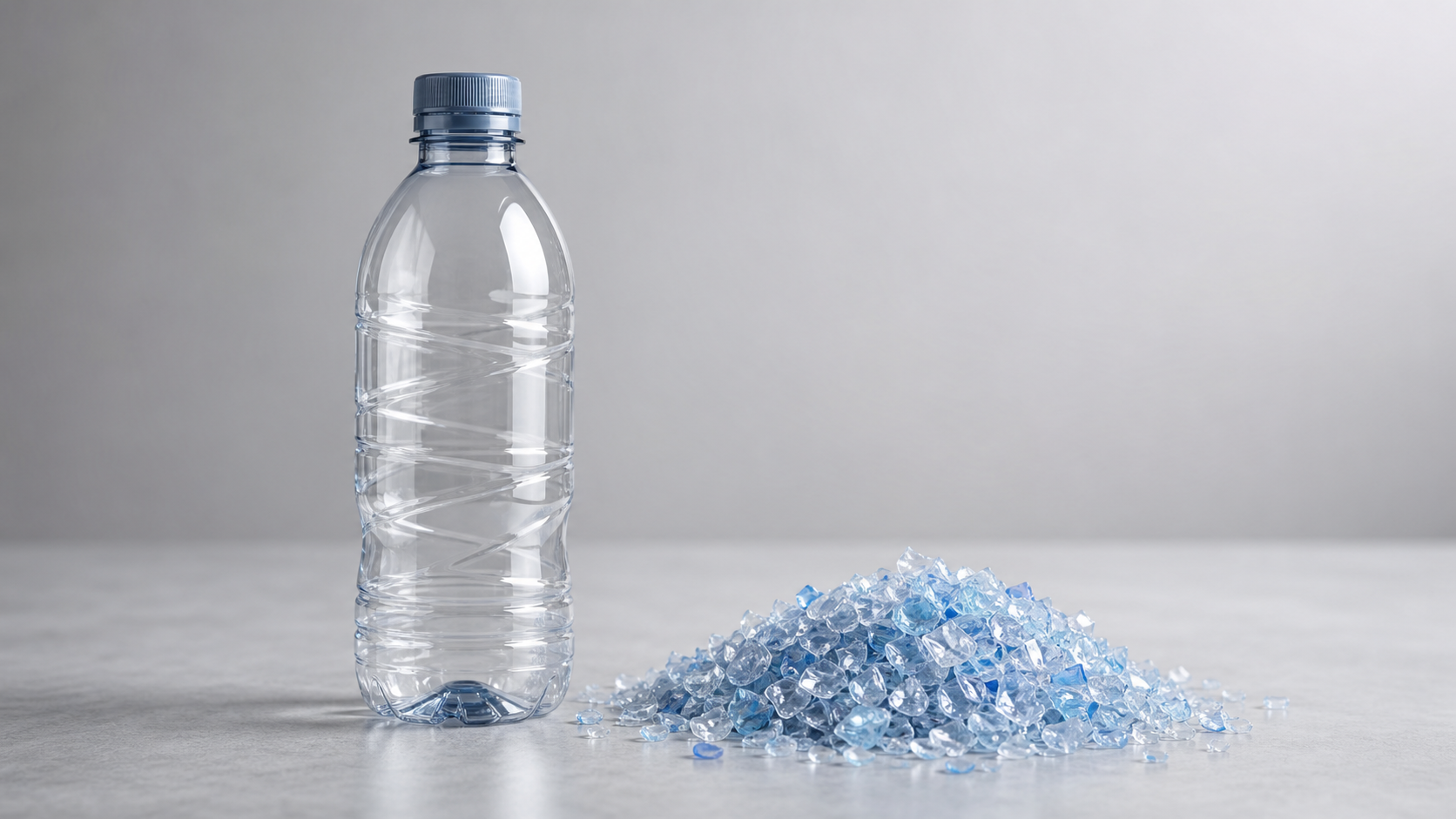
What is a 100% rPET bottle?
A 100% rPET bottle is a container whose PET resin content in the bottle body comes entirely from recycled PET, typically collected from used beverage bottles. It is distinct from partial rPET (e.g., 25% or 50%) and from virgin PET. Caps, labels, and liners are usually not rPET unless clearly specified, and labeling regulations vary by region.
When suppliers and brands say “100% recycled PET bottle,” they generally mean the bottle wall resin is 100% PCR PET. The term PCR refers to post-consumer recycled content collected after consumer use, sorted, cleaned, and reprocessed into food-grade rPET. Some programs also use post-industrial PET (regrind or scrap from manufacturing) or blends, so verify definitions in your market.
In beverage packaging, 100% rPET is increasingly used for still water, ready-to-drink teas, juices, and other cold-fill categories. Adoption depends on the availability of food-grade rPET, required bottle performance, color and clarity expectations, brand positioning, and local recycling infrastructure.
How is rPET made from used bottles?
Most food-grade rPET for bottles is produced through mechanical recycling combined with advanced decontamination. Exact processes vary by supplier, but the general steps are:
- Collection: Used PET bottles are gathered via curbside systems, deposit-return schemes, or commercial channels.
- Sorting: Bottles are sorted by material type and color. Non-PET items, liquids, and contaminants are removed.
- Preparation: Labels, caps, and rings are detached; bottles are ground into flakes and thoroughly washed.
- Purification: Flakes are further cleaned and filtered to remove residual contaminants.
- Decontamination: Food-contact decontamination technologies help ensure flakes or pellets meet strict purity criteria suitable for bottle-to-bottle use, subject to market regulations.
- Pelletizing: Clean rPET flakes may be melted, filtered, and repelletized into uniform pellets; some processors supply high-spec flakes directly to preform manufacturers.
- Preform & bottle: rPET pellets or flakes are used to mold preforms, which are then reheated and blown into final bottles.
Chemical recycling routes exist (e.g., depolymerization to monomers), but availability, scale, and certification approaches differ by region. If you source rPET derived from chemical recycling, confirm how content is accounted for (e.g., mass-balance programs) and whether your market accepts such claims for on-pack communication.
Does a 100% rPET bottle perform like virgin PET?
For many cold-fill beverages, properly specified 100% rPET bottles can deliver comparable performance to virgin PET. However, clarity, color tone, intrinsic viscosity targets, top-load strength, and barrier behavior can vary by feedstock, processing, and bottle design, so application-specific testing is important.
Key considerations brands typically evaluate include:
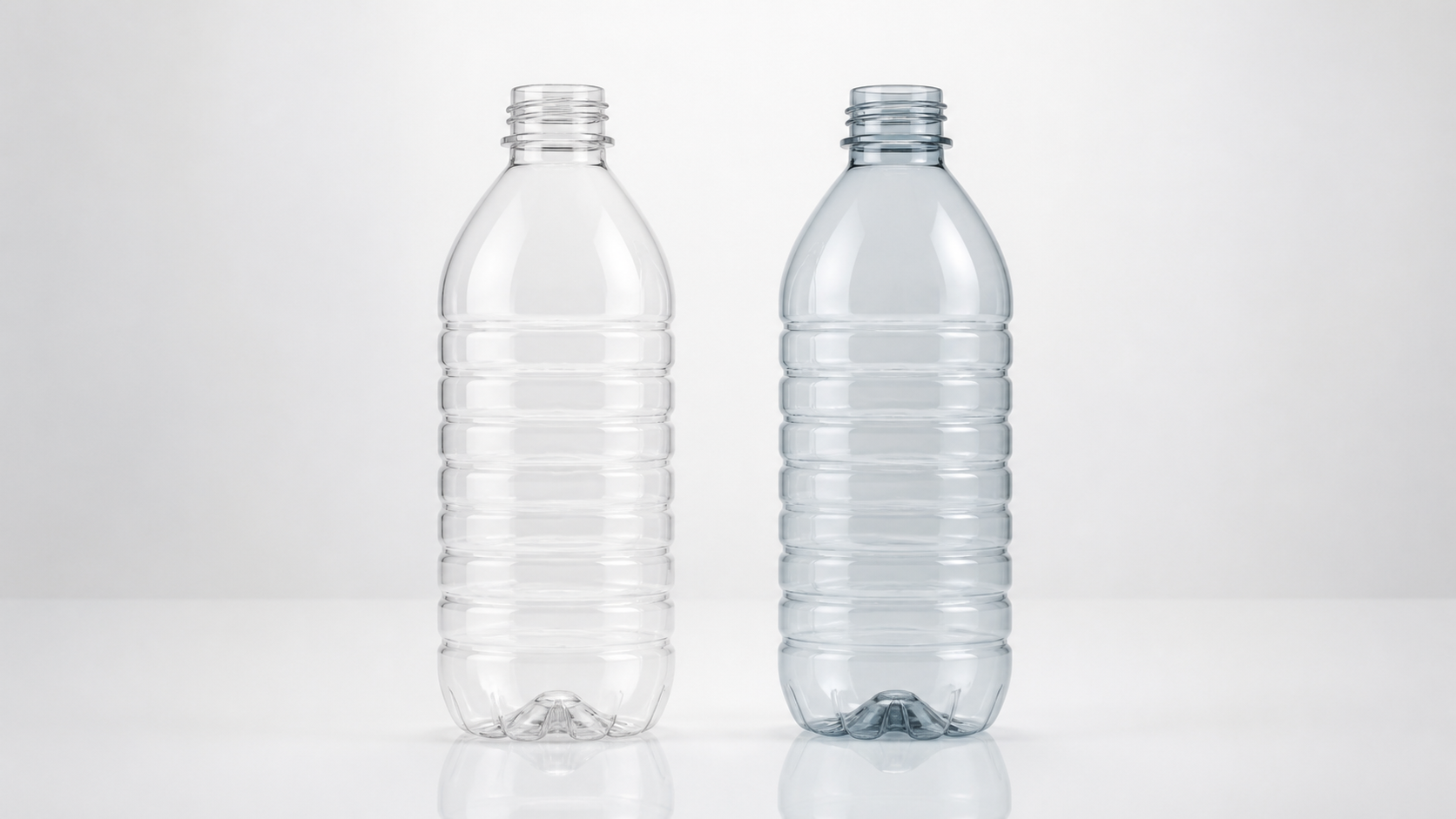
- Clarity & haze: rPET may show a faint tint or slight haze depending on feedstock and decontamination quality.
- Color management: Some preform suppliers use approved colorants to offset gray/blue-green casts. Verify recyclability impacts before specifying color.
- Mechanical performance: Top-load and creep resistance depend on preform design, stretch ratios, and resin properties. Trial with your actual product, fill line, and logistics conditions.
- Barrier & shelf-life: For oxygen-sensitive products, confirm shelf-life targets with rPET through accelerated and real-time tests. Additives or multilayer designs may affect recyclability in certain markets.
- Organoleptics: Sensory neutrality is essential for water and delicate flavors. Specify decontamination performance and conduct migration/organoleptic testing per your market’s requirements.
What influences bottle appearance and color?
Appearance in 100% recycled PET bottles is driven primarily by feedstock quality, the proportion of clear versus colored bottles collected, residual contaminants, and the recycling technology used. A slight bluish or gray-green hue is common in high-PCR content formats; mastering bale selection, flake cleaning, filtration, and color correction helps control this.
What brands often do:
- Lean into recycled aesthetics: Accept a subtle tint as a visual cue of circularity.
- Set clear expectations: Align marketing, photography, and retail lighting plans with the actual bottle tone.
- Use considered color strategies: If colorants are introduced to neutralize tint, verify their compatibility with design-for-recycling guidance in your market.
For guidance on aligning bottle aesthetics with cost and performance, see our PET Bottle Innovation resource.
How do 100% recycled PET bottles relate to sustainability?
Using 100% rPET helps keep PET in circulation and can reduce demand for virgin PET. The overall impact depends on local collection rates, material yields, energy sources, and transport distances. Well-designed bottle-to-bottle systems can support circularity when coupled with strong consumer participation and clear end-of-life pathways.
- Material circularity: Bottles made from bottles signal a closed-loop approach that many consumers recognize.
- Resource efficiency: rPET uses existing material streams, which can be advantageous when supported by robust infrastructure.
- System dependencies: Impact outcomes vary by geography, sorting tech, and policy. Deposit-return programs, for example, can increase the supply of high-quality bales.
- Recyclability first: Design choices for labels, adhesives, pigments, and barriers strongly influence actual recyclability and yield downstream.
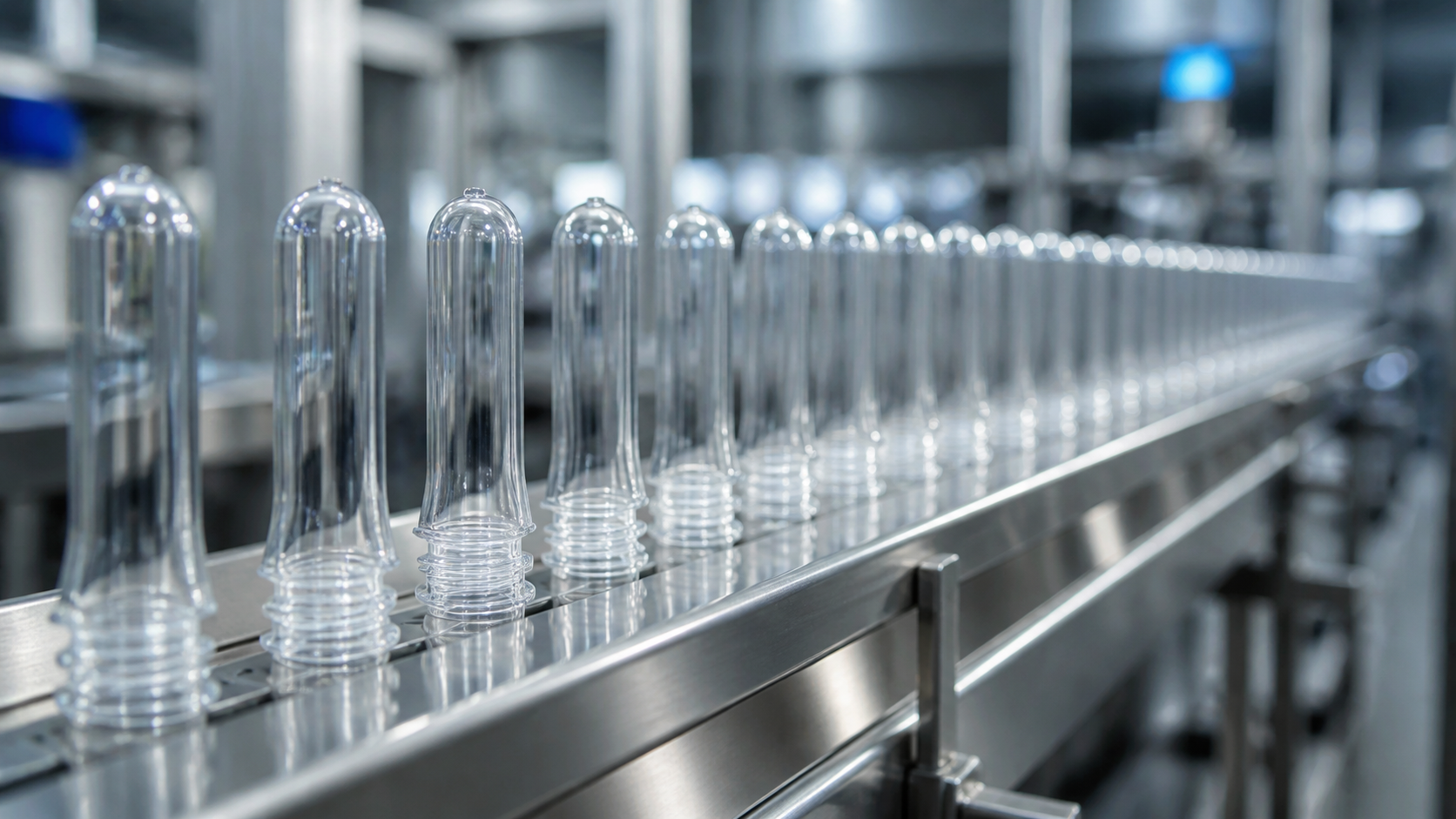
Design for recycling in 100% rPET bottles
Design-for-recycling (DfR) choices determine whether a 100% rPET bottle remains readily recyclable and attractive to reclaimers. While guidance differs by market, brands typically consider the following:
- Labels: Prefer floatable labels on PET, sized to aid wash-off and optical sorting. Avoid full-wrap sleeves that mask the container unless they include detectable features and are compatible with local sorting practices.
- Inks & adhesives: Specify washable inks and adhesives that do not leave residues on PET flakes after hot caustic washing.
- Colors & effects: Clear PET is most broadly recyclable. Opaque and heavy-tint designs can reduce value; confirm market-specific acceptability.
- Closures & rings: Commonly HDPE or PP. Light colors and materials that separate cleanly in recycling are favored.
- Additives & barriers: Evaluate any multilayer, oxygen scavenger, UV blocker, or PCR color correction for DfR compatibility in your target markets.
- Tethered caps: Increasingly required in some regions; verify balance of consumer convenience, line performance, and recyclability outcomes.
100% rPET vs partial rPET vs virgin PET
The right option depends on category, brand positioning, supply security, and line performance. Here is a qualitative comparison often used in early-stage decisions:
| Option | Recycled content | Appearance | Performance | Availability | Cost volatility | Positioning & notes |
|---|---|---|---|---|---|---|
| Virgin PET | 0% | Typically water-clear | Consistent for most uses | Broad | Linked to resin markets | Neutral sustainability message; widely accepted by converters |
| Partial rPET | Commonly 25–50% | Usually close to clear | Comparable when specified | Generally good | Moderate | Step toward circularity; easier color control |
| 100% rPET | 100% in bottle wall | May show slight tint/haze | Application-specific | Region-dependent | May fluctuate | Strong circularity signal; verify DfR & supply |
Sourcing and quality checklist for beverage brands
Before committing to 100% rPET at scale, teams often build a structured brief and qualifying protocol:
- Define usage: Beverage category, fill type (cold-fill/hot-fill), carbonation level, expected shelf-life, and distribution environment.
- Material specs: Intrinsic viscosity targets, contaminant thresholds, organoleptic requirements, and optical properties aligned with brand standards.
- Food-contact compliance: Obtain supplier documentation appropriate for your markets (e.g., declarations that processes are intended to meet applicable food-contact regulations). Confirm with your regulatory team.
- Decontamination & testing: Understand the recycling process, decontamination method, and typical quality metrics. Conduct migration and sensory testing on finished bottles.
- Traceability: Request lot-level traceability and clear definitions of recycled content (PCR vs. post-industrial) and any accounting approaches used.
- Converter readiness: Confirm preform supply, color management strategy, and blow-molding parameters for your bottle geometry.
- Line trials: Test preforms on your lines for blow ratio, top-load, cap application, label application, and downstream case packing.
- Logistics & storage: Check pallet stability, creep, and environmental exposure (heat, UV) effects through transit testing.
- Contingency supply: Qualify secondary sources or flexible content thresholds in case of market tightness.
Cost, supply, and risk management
rPET pricing and availability are influenced by collection rates, bale quality, demand from multiple sectors, and policy changes. Periods of tight supply can occur, especially for clear, food-grade bottle-to-bottle streams. Build resilience by:
- Dual-qualifying suppliers: Maintain approved alternates where possible.
- Considering geographic diversity: Balance proximity with the need for consistent quality.
- Aligning claims with availability: If supply pressures rise, plan how to maintain on-pack statements or adjust content responsibly.
- Forecast collaboration: Share rolling forecasts with suppliers to help secure feedstock and production slots.
What product types fit 100% rPET best?
100% rPET is commonly explored for:
- Still water and flavored water: High clarity expectations; pilot for organoleptics and slight tint acceptance.
- Juices, functional drinks, and teas: Often more forgiving on slight tint; confirm oxygen and light protection needs.
- Carbonated beverages: Validate top-load, creep, and CO2 retention; bottle design and resin specs are critical.
- Hot-fill or pasteurized products: Évaluer la résistance à la chaleur et la stabilité dimensionnelle ; toutes les spécifications de rPET ne conviennent pas au remplissage à chaud.
Les attentes des consommateurs varient également selon le marché. Pour une perspective sur l’adoption de contenu recyclé dans des régions spécifiques, voir les récentes tendances des boissons en Australie.
Processus de développement d’emballage avec 100 % de rPET
Envisagez un processus structuré qui unit les objectifs de durabilité à la fabricabilité et aux normes de marque :
- Brief & objectifs : Définissez les objectifs de contenu recyclé, la géométrie de la bouteille, les KPI de performance et les allégations marketing.
- Sélection de la préforme : Choisissez des préformes et des moules compatibles avec les caractéristiques du rPET et votre équipement de soufflage.
- Qualification du matériau : Évaluez les spécifications du fournisseur de rPET, les étapes de décontamination et la documentation de contact alimentaire.
- Essais de prototypes : Soufflez de petits lots, remplissez avec le produit et évaluez la clarté, la couleur, la résistance à la compression, le couple et l’application de l’étiquette.
- Durée de conservation & sensoriel : Testez l’entrée d’oxygène, la perte de carbonatation (le cas échéant) et l’organoleptique dans des conditions de stockage réalistes.
- Essais de transport : Validez la stabilité des palettes, le fluage et la résistance aux chocs tout au long de votre chaîne logistique.
- Confirmation DfR : Examinez les étiquettes, les encres, les adhésifs, les bouchons et tout additif conformément aux directives de conception pour le recyclage sur vos marchés.
- Allégations & étiquetage : Assurez-vous que les déclarations « bouteille en PET 100 % recyclé » (ou similaires) sont exactes et conformes pour le marché cible, en clarifiant la portée (corps de bouteille vs bouchon/étiquette) si nécessaire.
- Mise à l’échelle & suivi : Phasez la production, surveillez la cohérence et conservez des plans d’urgence pour les fluctuations d’approvisionnement.
Si vous élaborez une feuille de route de marque de distributeur, coordonnez les choix d’emballage avec les stratégies de formulation et de canal. Pour le contexte du développement du marché nord-américain, explorez boissons de marque de distributeur pour les marques américaines.
Communiquer le contenu recyclé aux consommateurs
La clarté renforce la confiance. Gardez les messages précis, simples et alignés avec ce que votre équipe qualité peut justifier.
- Soyez précis : Si seul le corps de la bouteille est en rPET à 100 %, dites-le. Évitez d’impliquer que le bouchon et l’étiquette sont en rPET à moins qu’ils ne le soient réellement.
- Montrez la boucle : Utilisez des visuels qui renforcent la circularité sans exagérer les avantages environnementaux.
- Tenez compte des règles régionales : Les mentions et symboles sur l’emballage sont réglementés ; vérifiez les exigences sur chaque marché cible.
Questions fréquemment posées
Une bouteille en rPET à 100 % est-elle adaptée au contact alimentaire ?
L’aptitude au contact alimentaire dépend du processus de recyclage, des performances de décontamination et de la conformité aux réglementations de votre marché. De nombreux fournisseurs produisent du rPET destiné à un usage bouteille-à-bouteille ; cependant, les marques doivent examiner la documentation des fournisseurs et effectuer leurs propres tests de migration et organoleptiques sur les bouteilles finies.
Pourquoi ma bouteille en rPET à 100 % semble-t-elle légèrement teintée ?
La couleur du rPET est influencée par le mélange de bouteilles collectées, la propreté et le traitement. Même un rPET à 100 % de haute qualité peut présenter une légère teinte bleue ou gris-verte. Certaines marques acceptent cela comme un indice de circularité ; d’autres utilisent des stratégies de couleur compatibles pour la gérer tout en tenant compte de la recyclabilité.
Le rPET à 100 % est-il plus cher que le PET vierge ?
Les prix varient selon la région, la saison, l’approvisionnement en balles et la demande de multiples industries. Parfois, le rPET de qualité alimentaire peut être vendu avec une prime par rapport au PET vierge ; à d’autres moments, les écarts se réduisent. Élaborez des scénarios avec les achats et qualifiez des alternatives lorsque c’est possible.
Les boissons gazeuses peuvent-elles utiliser du rPET à 100 % ?
Oui, avec une spécification et des tests minutieux. Validez la résistance à la compression, le fluage et la rétention de carbonatation avec votre produit, votre système de fermeture et votre profil logistique. La géométrie de la bouteille, la conception de la préforme et les conditions de ligne sont cruciales pour les résultats.
Qu’en est-il du recyclage chimique et des allégations de bilan de masse ?
Certains flux recyclés utilisent des processus chimiques et une comptabilité de bilan de masse. L’acceptation de ces allégations varie selon le marché. Si vous envisagez ces voies, confirmez les définitions, les cadres de certification et le libellé des allégations autorisés sur vos marchés cibles.
Points clés à retenir pour les marques de boissons
Les bouteilles en rPET à 100 % offrent un signal de circularité fort et, lorsqu’elles sont bien spécifiées, peuvent performer efficacement dans de nombreuses catégories de boissons à remplissage à froid. Le succès dépend de la qualité de la matière première, de la capacité du fournisseur, de la conception de la bouteille et de tests rigoureux. Gardez les allégations sur l’emballage précises, alignez les choix DfR avec vos marchés et assurez-vous d’un approvisionnement résilient. Avec un brief discipliné et des essais interfonctionnels, les équipes peuvent libérer le contenu recyclé tout en protégeant la qualité du produit et l’expérience de marque.