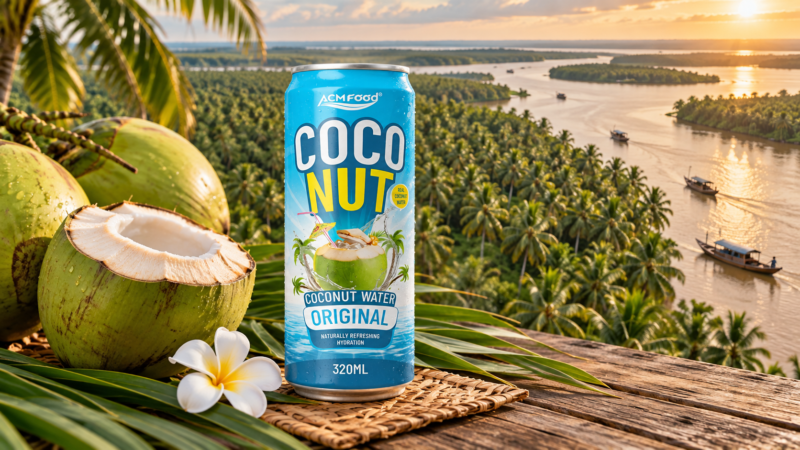
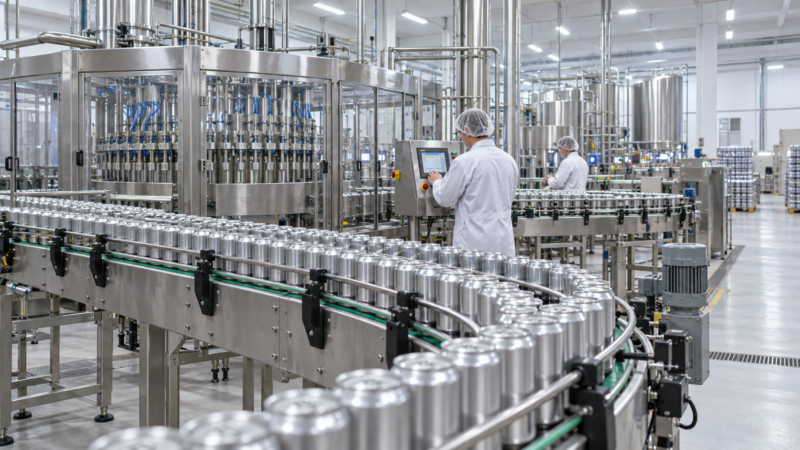
Sourcing a coconut juice bottle that performs on shelf, survives a 30-day ocean freight, and still lands at the right unit cost is not as simple as most product listings make it look. Ask any beverage importer who has handled their first container of tropical drinks from Southeast Asia — there are details that matter enormously and rarely show up in a supplier’s spec sheet.
At ACM FOOD – Coconut Water Manufacturer from Vietnam, we have worked with distributors across Europe, the Middle East, and Southeast Asia on coconut-based beverages. What we see repeatedly is that buyers come in asking about price, but what they actually need is a manufacturing partner who understands the full picture: format, fill weight, shelf life, labeling requirements, and how the product behaves once it hits a market thousands of kilometers from the factory floor.
This article walks through what B2B buyers should know when sourcing OEM coconut juice in PET bottles — from bottle format decisions to export documentation.
Why PET Bottles Dominate Coconut Beverage Export
Glass has its appeal. Tetra Pak has its logistics advantages. But for bulk export of coconut juice, PET continues to be the format of choice for most distributors and retail chains, and the reasons are straightforward.
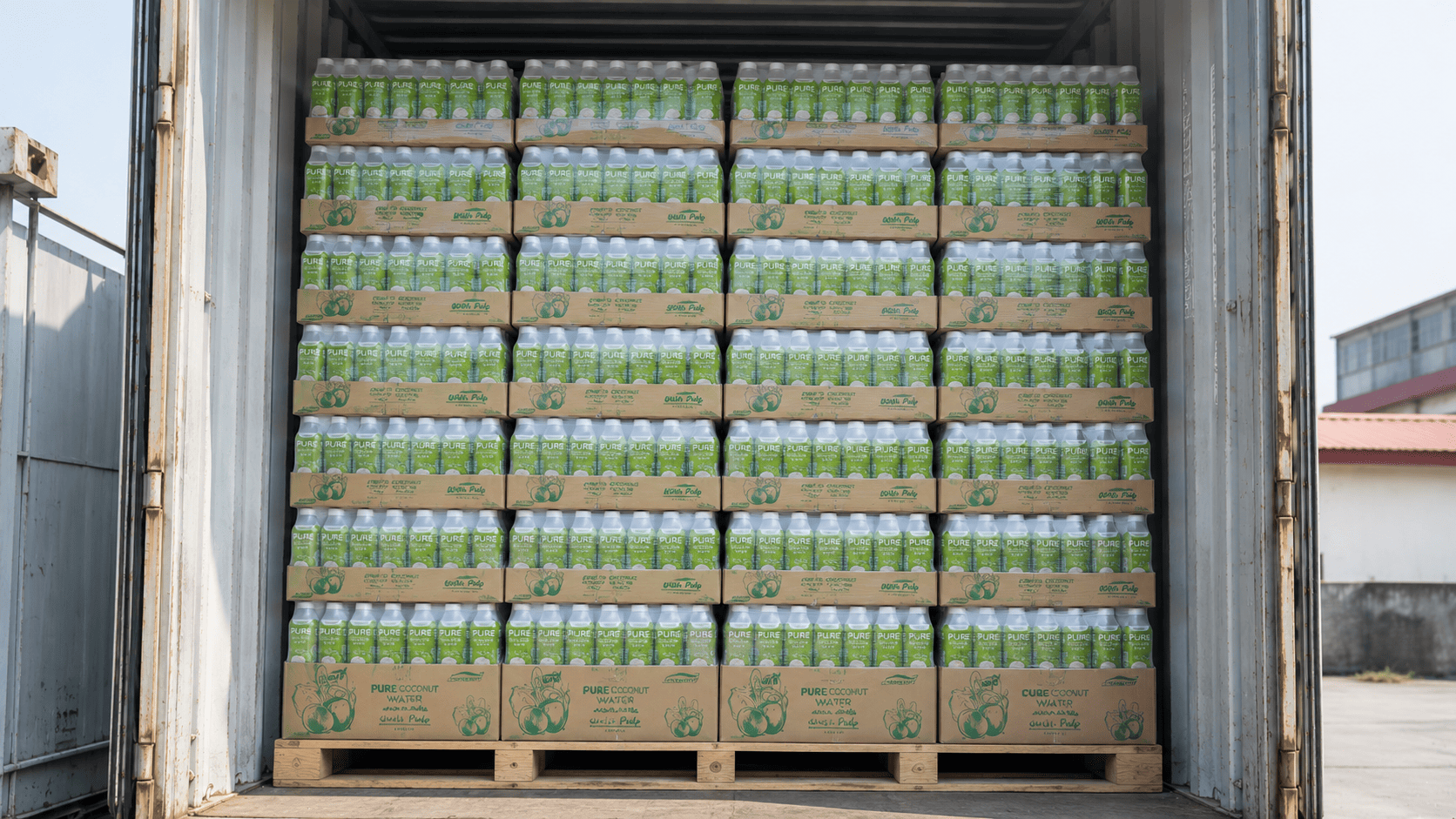
PET bottles are lighter, which directly affects freight cost per container. A 20-foot dry container loaded with 500ml PET coconut juice can typically hold 10–12 pallets, depending on how the bottles are stacked and whether shrink-wrap trays or cardboard outers are used. The same container with glass would carry substantially less volume by weight. For buyers managing thin margin on high-turnover SKUs, that difference matters.
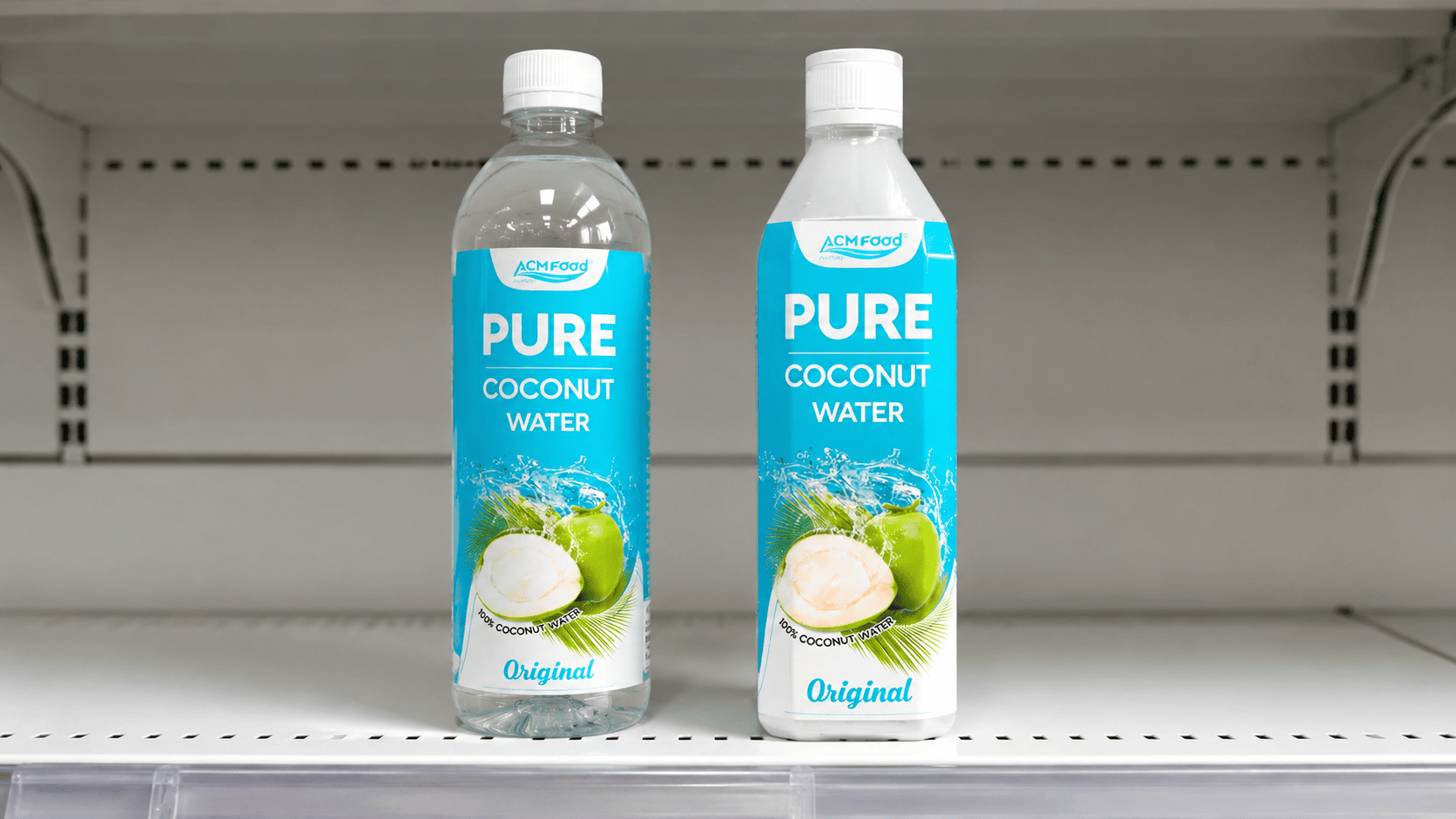
Beyond freight, PET offers flexibility in bottle design that buyers actually use. Custom bottle shapes, embossed logos, textured grip zones — these are all achievable in PET at reasonable tooling costs. From our experience working with beverage importers, the ones who invest early in a distinct bottle shape tend to build stronger shelf presence than those relying solely on label design.
Standard vs. Custom OEM Coconut Juice Bottle Formats
Not every buyer needs a fully custom bottle. Some need speed to market, lower upfront investment, or simply want to test a market before committing to tooling. That is why we offer both paths.
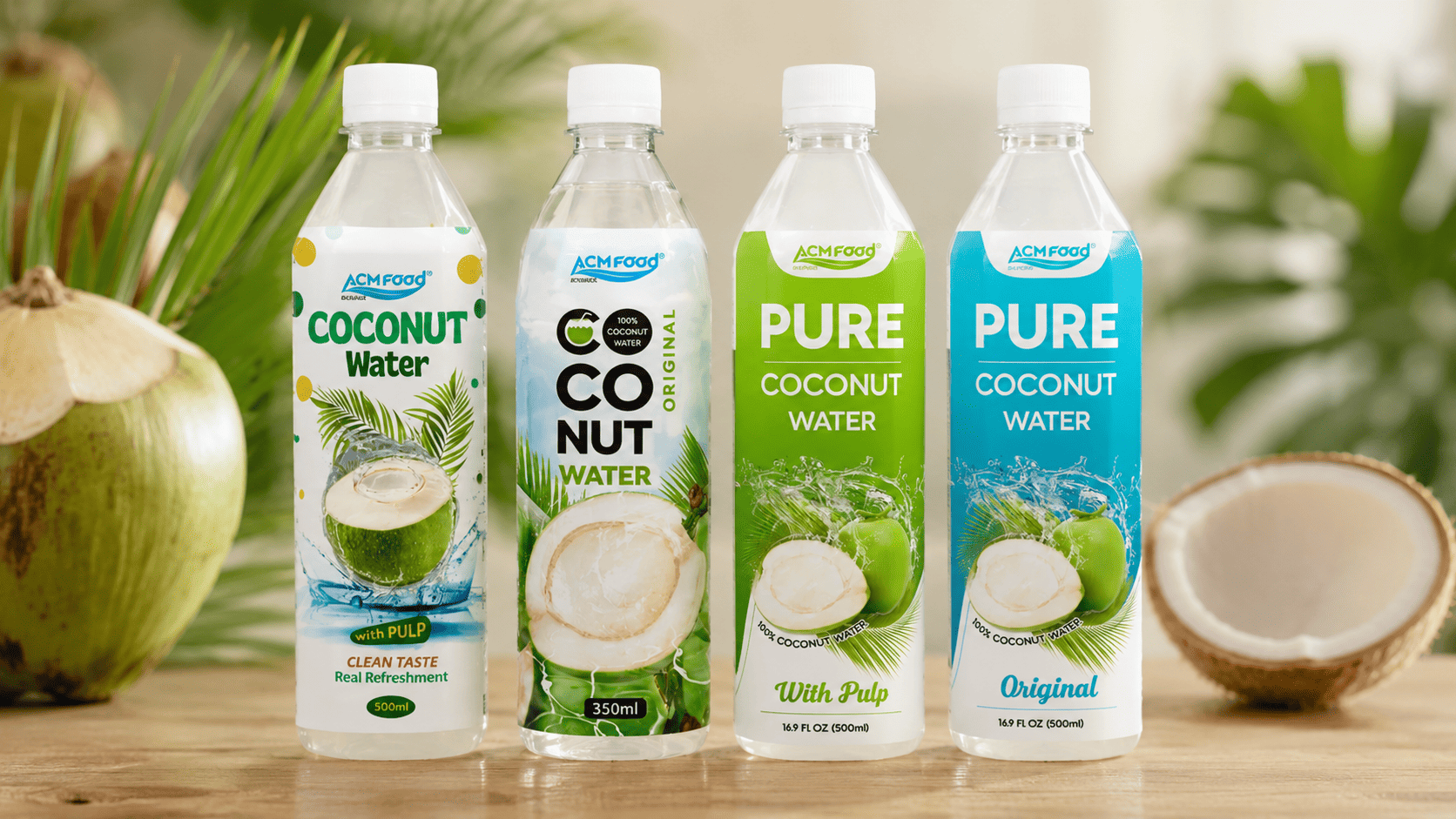
Standard PET formats available for private label coconut juice:
250ml (single-serve, convenience retail)
350ml (mid-size, coffee shop and foodservice)
500ml (mainstream retail, the most requested size)
1,000ml (family size, hypermarkets and club stores)
For buyers placing their first bulk order — typically starting around 1,000 to 3,000 cartons per SKU — standard formats allow faster production lead times, usually 20–25 working days from order confirmation. Custom bottle molds add 30–45 days to the timeline for first production, though repeat orders run on the standard schedule.
Private label coconut drink orders most commonly begin at FCL (Full Container Load) quantities. A 40-foot container holds approximately 2,000–2,500 cartons of 500ml x 24-bottle packs, depending on carton configuration. Buyers ordering LCL (Less than Container Load) for market testing can be accommodated, though unit economics naturally improve at FCL volumes.
Flavor and Formula Options for OEM Coconut Juice
Plain 100% coconut water remains the most requested product. But it accounts for a smaller share of actual orders than it did five years ago. What we see growing, particularly in Middle Eastern and European markets, is demand for blended variants.
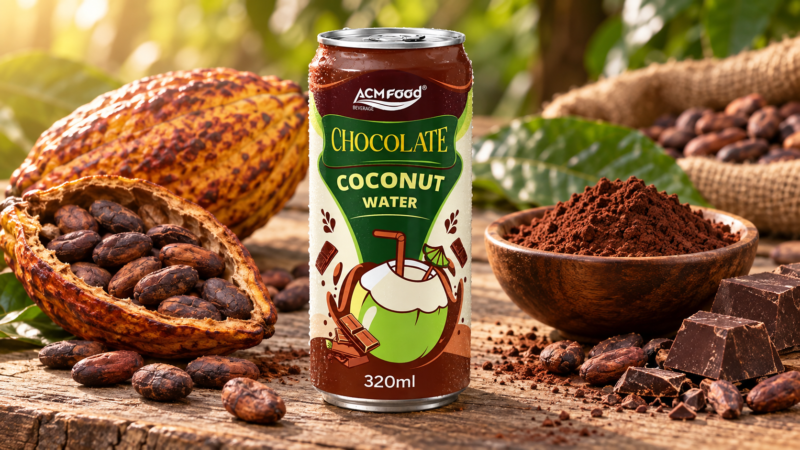
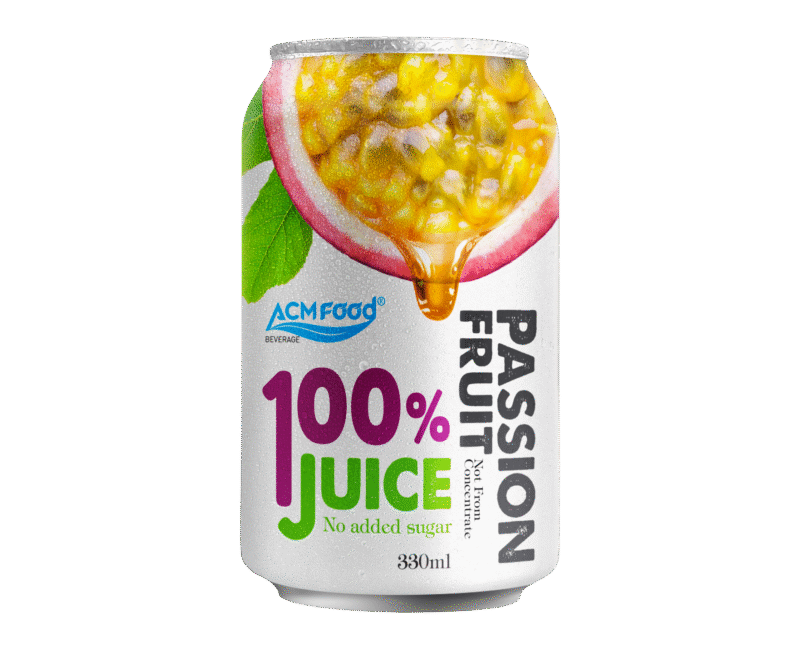
Popular formulations include coconut juice with pulp, coconut plus aloe vera, coconut blended with tropical fruits (mango, pineapple, passion fruit), and low-sugar functional variants positioned around hydration and electrolytes. The last category is especially active with buyers targeting fitness retail and pharmacy channels.
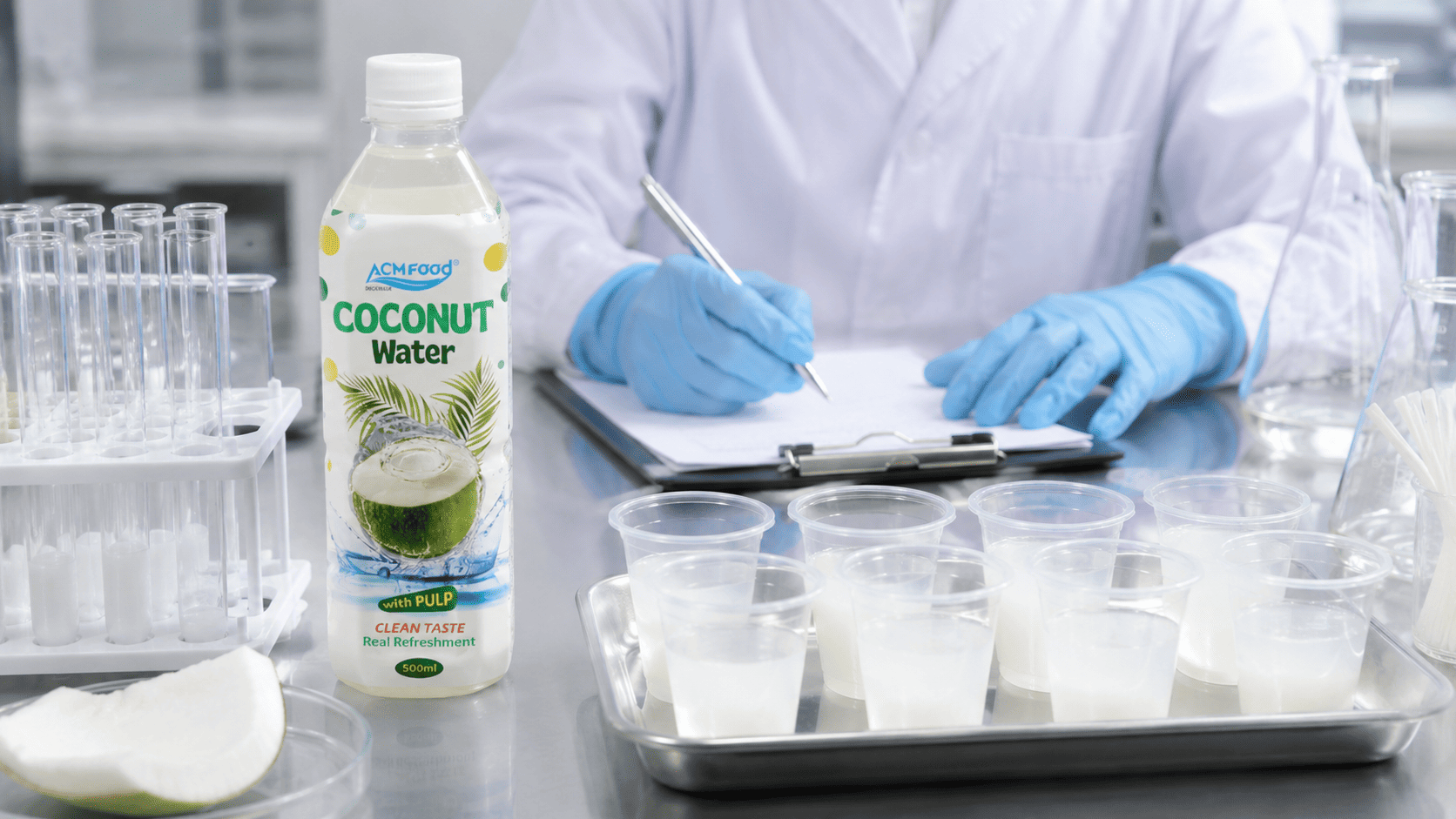
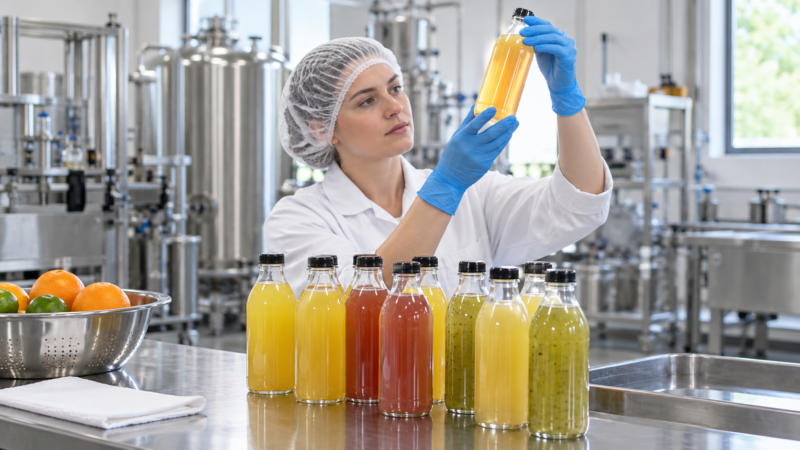
For OEM buyers, flavor customization is handled at the R&D stage before production. We provide samples within 7–10 working days for formula review, and most buyers go through one to two rounds of adjustment before sign-off. Sugar level, acidity, pulp content, and color consistency are the variables that come up most in these conversations — and all are adjustable within regulatory limits.
One detail buyers sometimes overlook: natural coconut water has batch-to-batch variation in flavor profile, especially sweetness. If you are sourcing for a retail chain with strict consistency requirements, make sure your manufacturer has the blending and standardization capacity to manage that. We do.
Label Flexibility and Private Label Coconut Drink Programs
Private label coconut drink programs are the majority of what we produce. Most buyers come with their own brand artwork. Some come with a brand concept and need help developing it. A smaller group comes looking for white-label product to sell under their own existing brand architecture.
For printed labels, we work with both wet-glue and pressure-sensitive labels on standard PET formats. Shrink-sleeve labels are available for custom bottle shapes. Minimum label artwork requirements: vector files at 300 DPI, with CMYK color profiles aligned to your target market’s printing standards.
A common question from importers is whether we can handle multi-language label printing for markets with regulatory requirements (Arabic plus English, French plus English, etc.). Yes — and it is worth discussing early in the project, because label panel allocation affects design layout from the start.
Export documentation bundled with most orders includes a Certificate of Origin, Health Certificate, phytosanitary certificate where required, Halal certification (Malaysia-accredited), and product specification sheets for customs clearance. Some markets require additional documentation — FDA registration for the US, for instance, or SFDA requirements for Saudi Arabia — and we support buyers through those processes as part of our export partnership.
Container Loading, Lead Times, and Logistics Considerations
This is the section most product pages skip. It is also where deals slow down or fall apart.
Lead time for a standard OEM coconut juice order is 20–30 working days from purchase order confirmation and receipt of approved artwork. Peak season (October through February, ahead of Lunar New Year and the summer beverage season in the Northern Hemisphere) can add 5–10 days to production queues. Buyers who plan orders with a 60–90 day horizon generally avoid the crunch.
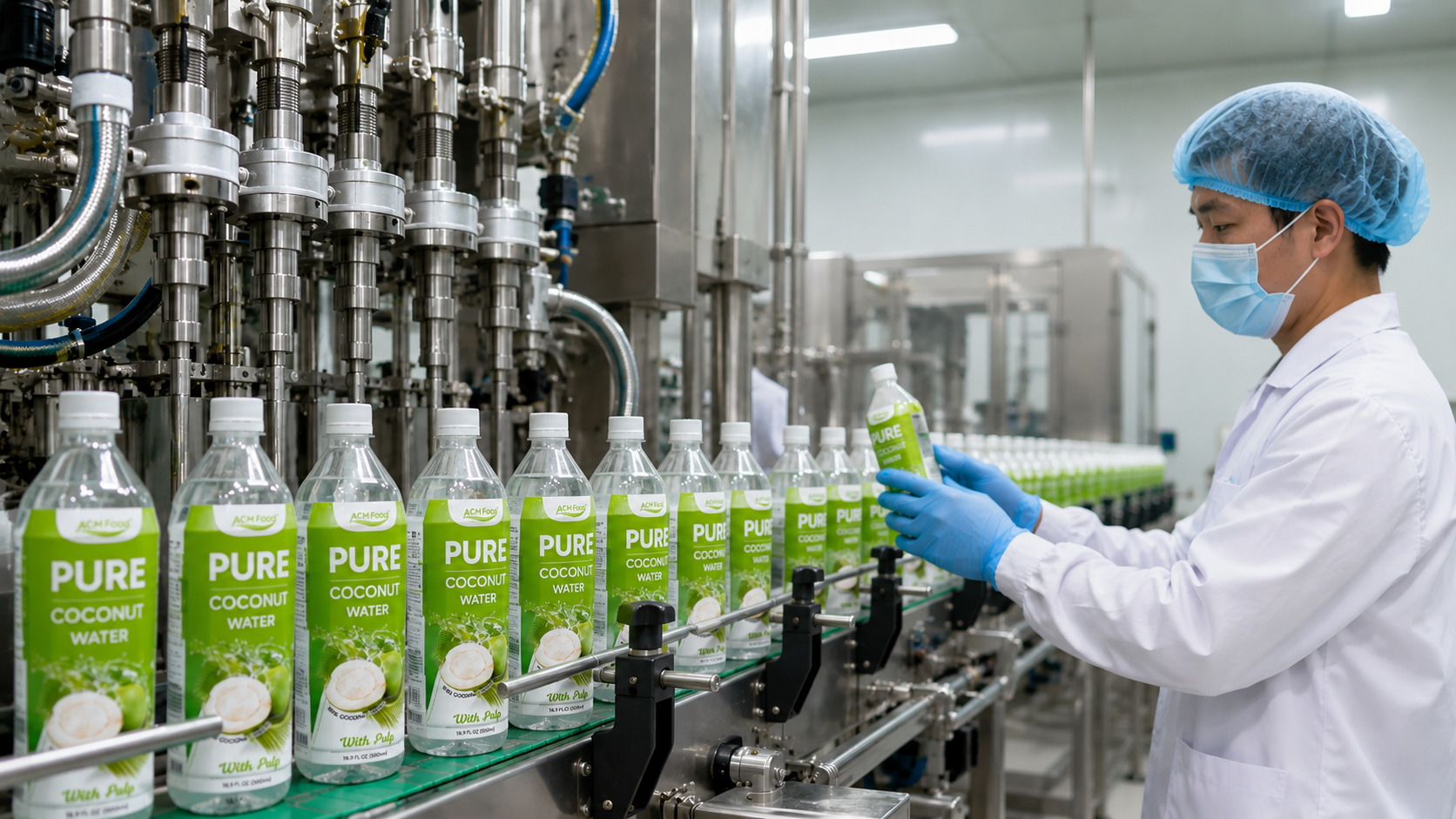
Container loading at our facility is managed by our logistics team, with full photographic documentation of loading and packing condition. We work with several freight forwarders experienced in Vietnam-to-Europe and Vietnam-to-Middle East lanes, though buyers are welcome to nominate their own forwarder.
For ambient-stable coconut juice, shelf life in sealed PET typically ranges from 12 to 18 months depending on formula and pasteurization method. Cold-chain products have shorter windows. If you are buying for a distribution network with slow turnover, clarify the shelf life requirement before finalizing the order — it affects both formula and packaging decisions.
Certifications and Market Readiness
Export-ready production means more than just the product itself. Buyers operating in regulated markets — EU, GCC, Australia, North America — need documentation that holds up to customs inspection and retail compliance checks.
Our certifications include ISO 22000 food safety management, HACCP, Halal (JAKIM-recognized), and FSSC 22000. Products can be formulated to comply with EU food additive regulations, US FDA Generally Recognized As Safe (GRAS) ingredient standards, and GCC food safety requirements. For organic-labeled products, additional third-party certification is required from the buyer’s end — we can produce to organic-compliant input standards, but certification ownership stays with the brand.
Finding the right coconut juice bottle solution for your distribution channel is not just a sourcing decision. It is a branding decision, a logistics decision, and increasingly, a regulatory compliance decision — all bundled into one product specification.
If you are a distributor, importer, or retail buyer exploring private label coconut beverages or looking for a reliable OEM coconut drink manufacturer in Vietnam, we would be glad to discuss your requirements in detail. Send us your target market, format preference, and volume estimate — and we will respond with a production proposal and sample offer within 48 hours.
Standard MOQ starts at 1,000 cartons per SKU for existing bottle formats. For custom bottle tooling, minimum first production is typically 3,000–5,000 cartons to recover tooling investment. We can discuss smaller pilot runs for buyers entering new markets.
Yes. We can formulate with cane sugar, coconut sugar, stevia, monk fruit extract, or produce unsweetened variants. Sweetener choice affects flavor profile and cost — our R&D team will walk you through the tradeoffs during sample development.
For buyers using standard bottle formats with supplied artwork, realistic timeline is 6–8 weeks. Custom bottle projects with new tooling typically run 10–14 weeks for first production. Repeat orders follow the standard 20–30 working day production schedule.
Current export markets include South Korea, the UAE, Saudi Arabia, Germany, Poland, Australia, and several ASEAN markets. Each market has distinct regulatory and labeling requirements — we can share relevant documentation based on your target market.
Partial exclusivity by market or region is negotiable for buyers with consistent container-level volume commitments. Full formula exclusivity requires a higher volume threshold and is covered under a separate OEM agreement.
ACMFOOD Beverage Co., Ltd. is a premier OEM/ODM and Private Label manufacturer of high-quality tropical beverages in Vietnam. Specializing in premium coconut water and natural fruit drinks, our mission is to deliver certified, healthy beverage solutions to global brands and consumers worldwide.



 Français
 Español
 العربية
 한국어
한국어