


 Français
 Español
 العربية
 한국어
한국어Deciding that Vietnam is the right origin is one thing. Actually moving a container of coconut water out of it — under the right trade agreement, with the right proof of origin, through the right port, at a transit time your shelf plan can absorb — is a different exercise, and it is where first-time importers lose weeks.
This is the mechanics article. For why the origin is worth choosing in the first place, see Vietnamese coconut water and what makes it distinctive. For vetting a specific factory, use the supplier due diligence checklist.
Start with the HS code, because everything else follows from it
The tariff classification of your product determines the duty rate, whether a preferential rate is available, and which import controls apply. It is not a formality your freight forwarder handles later — it changes your landed cost, and therefore your price to the retailer.
Classification for coconut water is not always obvious. Pure coconut water, coconut water with added sugar, coconut water blended with fruit juice and carbonated coconut water can fall under different headings, and the presence of pulp or added ingredients can move the classification. Two practical rules follow:
- Confirm the code with a licensed customs broker in the destination country before you order, using the actual finished specification — not a similar product.
- Where the value at stake is significant, consider a binding tariff ruling from the destination customs authority. Many jurisdictions offer this, and it converts an assumption into a decision you can rely on.
Trade agreements and why proof of origin matters more than the agreement itself
Vietnam is party to an unusually broad set of free trade agreements, which is one of the origin’s real commercial advantages. The ones most relevant to beverage importers include the agreement with the European Union, the agreement with the United Kingdom, the CPTPP covering markets such as Canada, Japan, Australia and Mexico, and RCEP across much of Asia-Pacific.
Two things are widely misunderstood about them.
A preferential rate is not automatic. It applies only if the goods qualify under that agreement’s rules of origin and you present a valid proof of origin in the form that agreement requires. Each agreement specifies its own document and its own procedure, and the requirements change over time. Confirm the current form with your broker for your specific route before shipment — a preference claimed without the correct document is simply duty paid at the standard rate.
Rules of origin can be affected by your ingredients. Pure coconut water from Vietnamese coconuts is straightforward. A blend containing imported juice concentrate or imported functional ingredients may need to satisfy a processing or value threshold to qualify. If you are developing a blended product and a preferential rate is part of your cost model, raise origin qualification during formulation rather than after.
The document set for a beverage shipment

Ask your supplier for this set in writing before the first order, and confirm which items they prepare as standard and which need extra lead time.
- Commercial invoice and packing list — must match the bill of lading and the declared value exactly. Mismatches are the most common cause of clearance delay.
- Bill of lading — original or telex release, agreed in advance with your payment terms.
- Certificate of origin in the form required by the trade agreement you intend to claim under.
- Health or free sale certificate, issued by the Vietnamese competent authority, where the destination requires it.
- Phytosanitary certificate, where applicable to your product and destination.
- Certificate of Analysis from a third-party laboratory for the shipped lot.
- Certification copies — HACCP, ISO 22000, HALAL and any others your buyers require.
- Destination-specific filings — several markets require advance notice of arriving food shipments and a registered local agent. Establish these before goods are on the water, not after.
Ports, routing and transit time
Most beverage exports from southern Vietnam move through the Ho Chi Minh City port complex, with deep-water services from the Cai Mep area serving longer-haul routes; northern factories typically ship via Hai Phong. If your manufacturer is in the south, southern ports mean shorter inland trucking and one less handover.
When planning, work with the total timeline rather than the ocean leg alone:
- Production time after order confirmation and artwork approval.
- Inland transport and container loading.
- Export clearance and vessel cut-off — missing a cut-off usually costs a full week.
- Ocean transit, which varies substantially by destination and by whether the service is direct or transhipped.
- Import clearance, plus any inspection hold.
- Delivery to your warehouse and put-away.
Ask for a routing that is direct where one exists. Transhipment adds time and adds a handling point where delay and damage occur. Get current transit estimates from your forwarder for your specific route rather than relying on published averages.
Incoterms: choose deliberately
The Incoterm decides where cost and risk transfer, and inexperienced importers often accept whatever the supplier quotes.
- EXW puts everything from the factory gate onward on you, including Vietnamese export formalities. Rarely a good idea for a first import.
- FOB is the common default: the supplier delivers on board at the origin port and handles export clearance; you control the ocean leg and its cost. Best when you have a forwarder you trust.
- CIF has the supplier arrange freight and insurance to the destination port. Simpler, but you lose visibility of the freight cost and the insurance may be at minimum cover.
- DAP or DDP pushes more or all of the destination burden to the supplier. Convenient, priced accordingly, and not every supplier can genuinely deliver it.
Whichever you choose, confirm who insures the cargo and at what level. Ocean cargo insurance is inexpensive relative to the value of a container of finished goods.
Container planning and product-specific handling
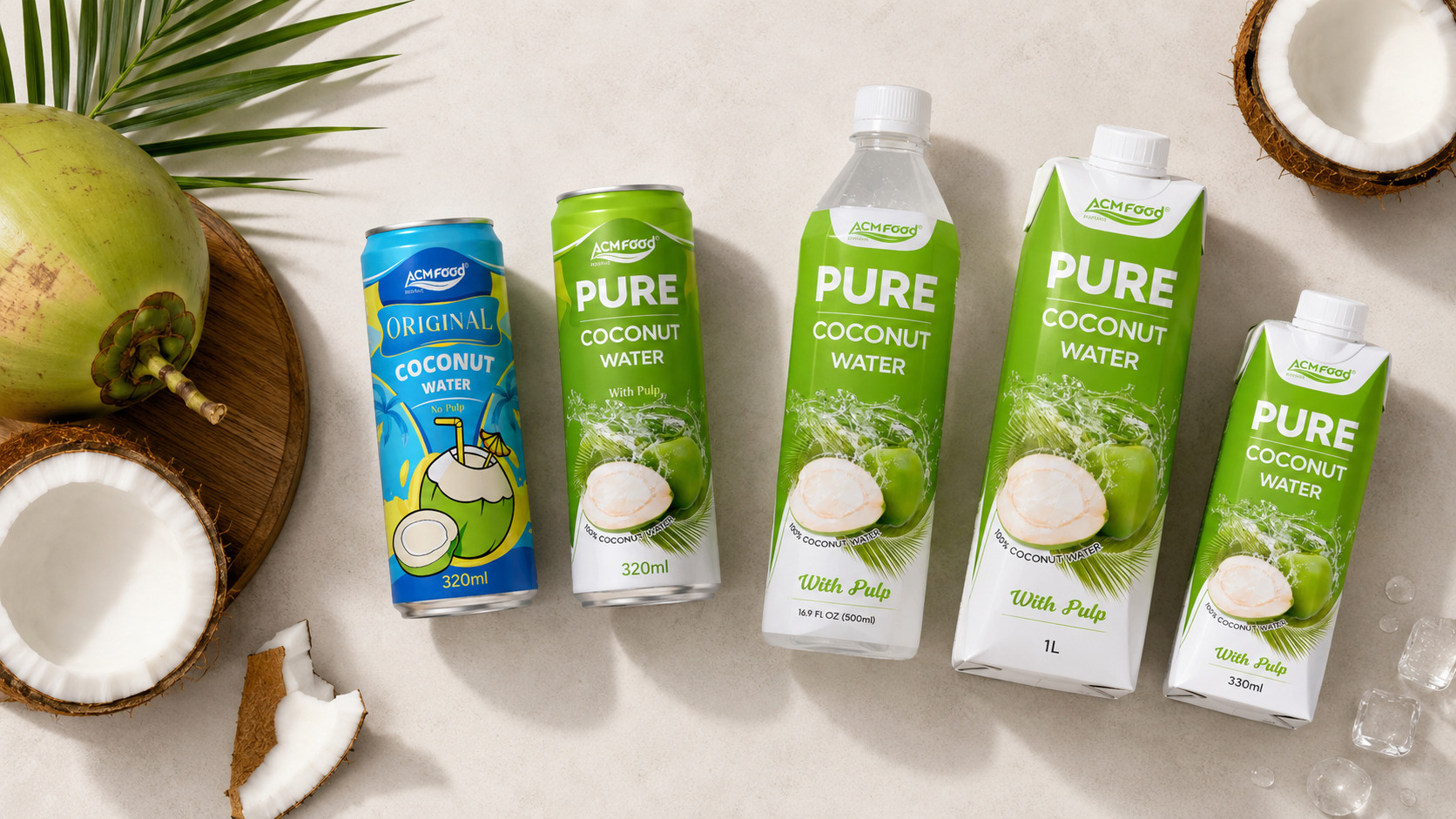
Beverages are dense. A 20-foot container commonly reaches its weight limit before its volume limit, which is why canned drinks usually ship in 20-foot rather than 40-foot equipment. Confirm the units per container for your specific format and palletisation pattern with your supplier, and use that figure — not an estimate — in your landed cost model.
Three product-specific points are worth raising before loading:
- Palletisation and pallet type. Some destinations require heat-treated wood certification; others prefer plastic or slip sheets. Agree this in advance.
- Container temperature. Ambient containers on tropical routes get hot. Shelf-stable product tolerates this, but ask what the supplier does about loading conditions and whether they use container liners on long routes.
- Residual shelf life on arrival. Ask for the production date policy in writing. Retailers reject stock below a residual life threshold, and this is entirely predictable if you agree it up front.
Seasonality
Coconut supply in the Mekong Delta runs year-round, which is a genuine advantage over origins with pronounced seasonal gaps. It is not perfectly flat, however: yields and raw material prices move through the year, and weather events can disrupt harvest. Two practical implications: ask your supplier when their raw material is tightest before committing to a delivery date in that window, and plan around the Lunar New Year period, when Vietnamese factories, transport and customs all slow considerably for a stretch. Orders needing to land in the first quarter should be placed with that shutdown built into the schedule.
Comparing Vietnam with other coconut origins on sourcing mechanics

Thailand, Indonesia, the Philippines, India and Sri Lanka all export coconut water. Rather than ranking them on quality — which depends far more on the individual factory than on the country — compare them on the mechanics that actually affect an import programme.
- Trade agreement coverage for your destination. This can outweigh a difference in ex-works price, and it varies enormously by origin and destination pair. Check it first.
- Shipping frequency and directness from that origin to your port.
- Raw material seasonality and how it aligns with your ordering pattern.
- Minimum order quantity norms, which differ by origin partly because of the pack formats each is set up to produce.
- Certification depth among factories serving your specific destination market.
- Concentration risk. Mature brands eventually qualify a second origin. Weather, policy and freight disruption are all origin-specific risks.
A pre-shipment checklist
- HS code confirmed by a destination-country broker against the final specification.
- Preferential rate and proof-of-origin requirement confirmed for your agreement and route.
- Any destination registration or import notification completed.
- Label reviewed against destination regulations and signed off.
- Incoterm agreed, and cargo insurance confirmed with a named cover level.
- Units per container and pallet configuration confirmed in writing.
- Production date policy and minimum residual shelf life on arrival agreed.
- Third-party pre-shipment inspection booked, at least for the first shipments.
- Full document set listed, with responsibility for each item assigned.
Working with ACMFOOD on the export side
ACMFOOD Beverage Co., Ltd. is a Vietnamese manufacturer and direct exporter of canned coconut water and coconut-based blends, shipping to importers and distributors across Europe, the Middle East, Asia-Pacific and North America.
On the mechanics above, the practical position is this: the standard export document set is prepared in parallel with production rather than after it, shipment is supported on both FCL and LCL terms so a validation order need not be a full container, and units per container and production date policy are confirmed in writing before loading. Pre-shipment inspection by a third party is welcomed.
If you are costing a programme, the three numbers that unlock a real landed cost calculation are the price at your intended volume, the units per container for your chosen format, and the payment terms. Ask for those in writing and the rest of the model follows.
Contact usRelated service pages
For the shipping terms, documentation and freight side of a programme, see export and logistics; for the certificates buyers and customs ask for, see certifications and food safety systems. To price a shipment, request a quote.
Request a quote