


 Français
 Español
 العربية
 한국어
한국어A coconut water supplier is a company that sources coconuts, processes the water and delivers finished or bulk coconut water to brands, importers, distributors and retailers. The best supplier is not the cheapest per litre but the one that delivers consistent batches, holds the certifications your market requires, and gets the export paperwork right first time.
ACMFOOD is a Vietnam-based coconut water supplier offering OEM, ODM, private label and white label manufacturing. This guide gives procurement teams the working detail they need before requesting samples: specifications, formats, certifications, lead times, costs and how to compare suppliers.
Small details decide whether a shipment clears. One US importer we work with had two containers held at port for nine days because the certificate of analysis listed sodium in mg/L while their broker’s template expected mg/100 ml. Same number, different unit, and three missed retail windows.
What does ACMFOOD supply?
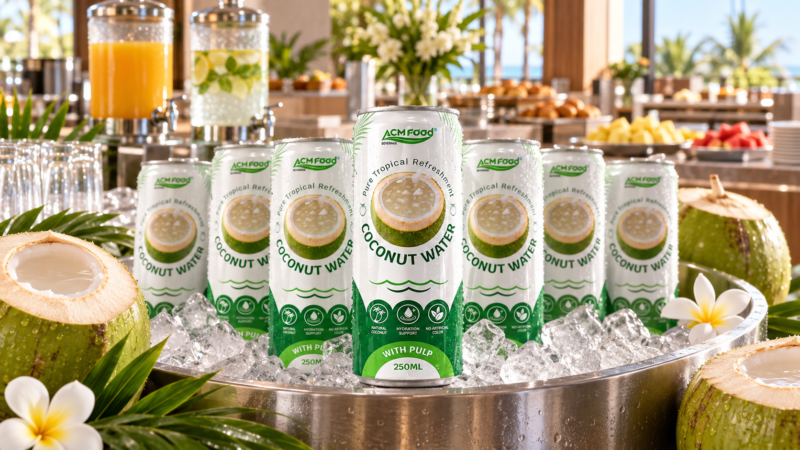
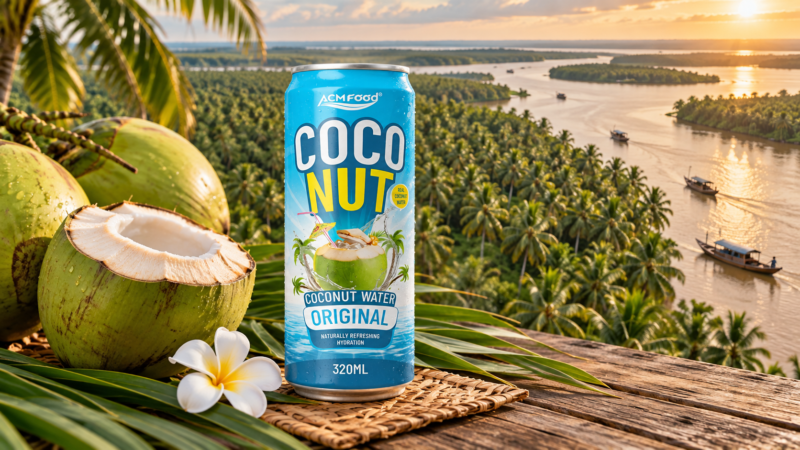
ACMFOOD produces 100% NFC coconut water, coconut water reconstituted from concentrate, and 60 Brix concentrate, in Tetra Pak, aluminium cans, PET and bag-in-box, sourced from farms in Bến Tre, the centre of Vietnam’s coconut growing.
- Certifications: HACCP, ISO 22000 and FSSC 22000 at the partner facilities where ACMFOOD produces.
- Minimum order: from 500 cartons per SKU; several SKUs can share one container.
- Production lead time: 15–30 days from confirmed order.
- Indicative price: FOB Ho Chi Minh City roughly $0.85–1.10 per litre for 1L Tetra NFC in established programmes.
- Freshness: harvest to pasteurisation in under 24 hours.
How do you choose a coconut water manufacturer?
Choose on batch consistency first and price second. Brix, pH and sodium shift with the season, the age of the nut and the time between dehusking and pasteurisation, so a serious manufacturer should share 12 months of batch data without being asked twice.
- Batch consistency: ask for a year of Brix, pH and sodium records.
- Format fit: ask which SKU the line runs most. A line built for 240 ml Tetra Prisma may be slow and costly for 1L gable-top.
- Raw material ownership: a supplier with direct farm contracts can forecast volume eight to ten weeks ahead instead of buying on the spot market. We source directly from Bến Tre cooperatives.
- Audit reports: ask for the latest full audit report with non-conformities and corrective actions, not just the certificate.
A true manufacturer controls the specification from nut to pack. Some “suppliers” are packing operations buying pasteurised juice from third parties, which is why November shipments can taste different from March ones.
What specifications and formats are available?
Vietnamese exporters offer coconut water as 100% NFC, reconstituted from concentrate, or 60 Brix concentrate for buyers who fill their own. Typical values for pure young coconut water:
| Parameter | Typical range | Why it matters |
|---|---|---|
| Brix | 4.8–5.6 | Sweetness; varies with cultivar and harvest age |
| pH | 4.9–5.4 | Sets the acidification and heat treatment route |
| Sodium | About 25–45 mg/100 ml | Nutrition panel and label claims |
| Potassium | About 250 mg/100 ml | Electrolyte positioning |
| Format | Sizes | Shelf life | Best for |
|---|---|---|---|
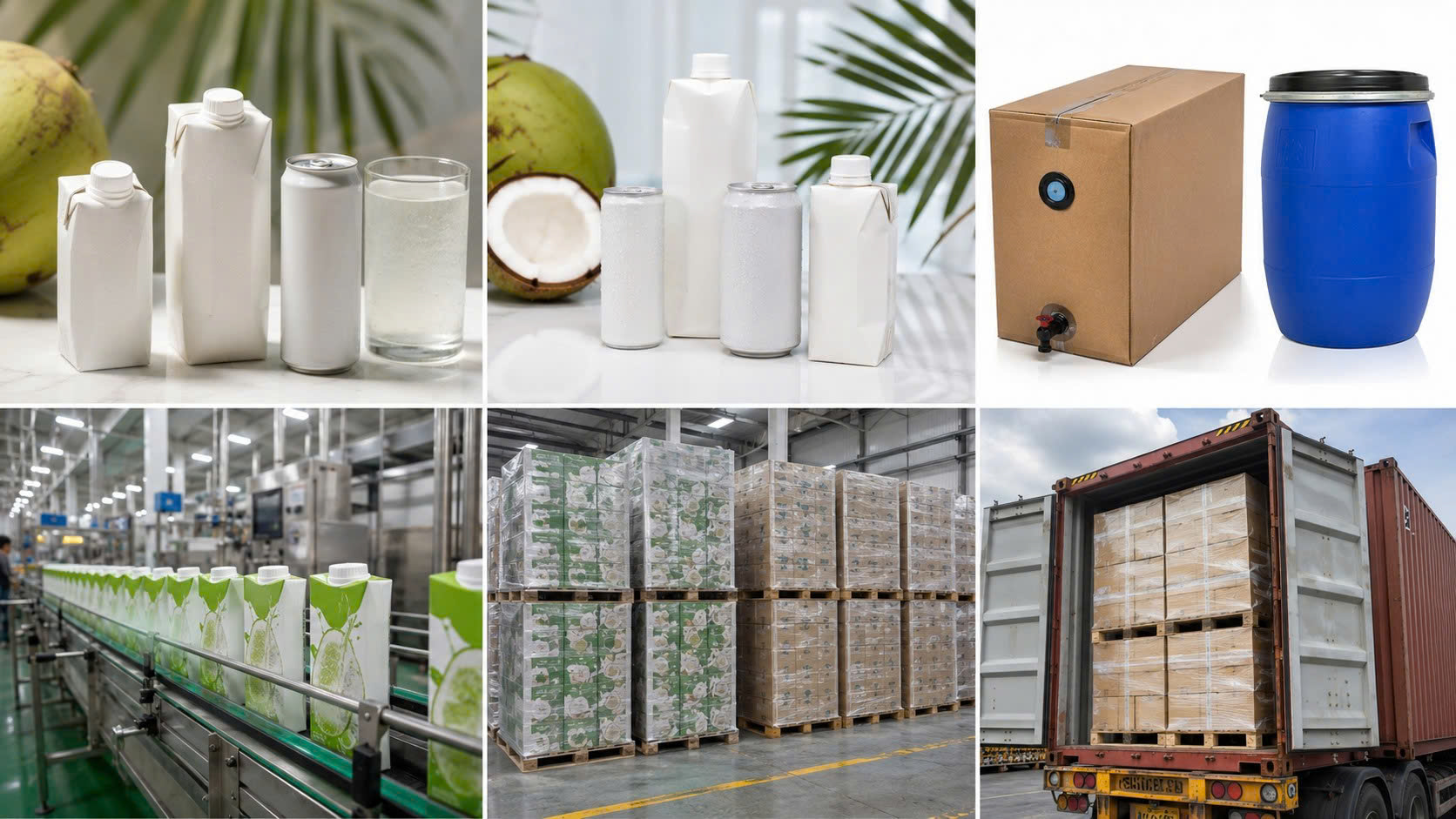
| Tetra Pak aseptic | 200 / 330 / 500 / 1000 ml | 12–18 months ambient | Shelf-stable retail without cold chain |
| Aluminium can | 250 / 330 ml, sleek and standard | 12+ months | Premium retail, foodservice |
| PET bottle (hot-filled) | 350 / 500 ml | About 9 months | Premium shelf presence |
| Bag-in-box | 200 L / 1000 L | Varies | Industrial buyers with their own lines |
Tetra Pak is the workhorse for ambient retail. PET looks more premium but has a shorter shelf life and adds freight weight, which matters once you price a 40-foot container.
What are the minimum order and lead times?
The standard minimum is 500 cartons per SKU, and multiple SKUs can be combined in one container for a first order. For custom artwork, packaging components such as cans or sleeves may carry their own minimums, so confirm the figure for your chosen format.
| Stage or route | Lead time |
|---|---|
| Production from confirmed order | 15–30 days |
| Repeat orders with specification on file | 15–30 days |
| Ocean transit to US West Coast | 22–28 days |
| Ocean transit to US East Coast | 30–38 days |
| Ocean transit to Northern Europe | 32–40 days |
Which certifications does a coconut water supplier need?
The certifications you need depend on the market you sell into. FDA food facility registration is essential for the United States; Halal opens Indonesia, Malaysia and the Gulf; FSSC 22000 or BRCGS is expected by major retailers.
| Certification | Market | ACMFOOD status |
|---|---|---|
| HACCP, ISO 22000 and FSSC 22000 | Global retail and institutional buyers | Held at the partner facilities where ACMFOOD produces |
| FDA food facility registration | United States | Market-specific; confirm the current document set with ACMFOOD |
| Halal | Indonesia, Malaysia, GCC | Arranged per programme where the market requires it |
| EU organic (Regulation 2018/848) | European Union | Arranged per programme; 6–9 months to first certified harvest |
For shelf-stable coconut water entering the US, FCE and SID numbers are needed for the process filing under 21 CFR 108. For the EU, packaging also needs food-contact declarations under Regulation 1935/2004. You rarely need every certificate from day one: stacking certifications your market does not require can add several cents per litre without any shelf benefit.
What regulatory changes matter in 2026?
- US plant-based beverage labelling: FDA draft guidance from January 2025 encourages clearer nutrition disclosure on plant-based drinks; review on-pack copy before printing.
- US tariffs: tariff changes through 2025 raised landed costs for some origins; check current duty for your HS code before comparing FOB and landed prices.
- Vietnam export codes: plantation-area and packing-facility codes for coconut exports have been tightened; work with a supplier whose farms and plant already hold them.
- EU organic: certificates renew annually and depend on continuous farm records.
This is working context, not legal advice; confirm details with your customs broker or regulatory adviser.
Why source coconut water from Vietnam?
Vietnam grows around two million tonnes of coconuts a year on roughly 200,000 hectares, and Bến Tre accounts for about 42% of the planted area. That scale keeps supply and prices steadier, and most factories sit close to the farms, so nuts reach pasteurisation within a day.
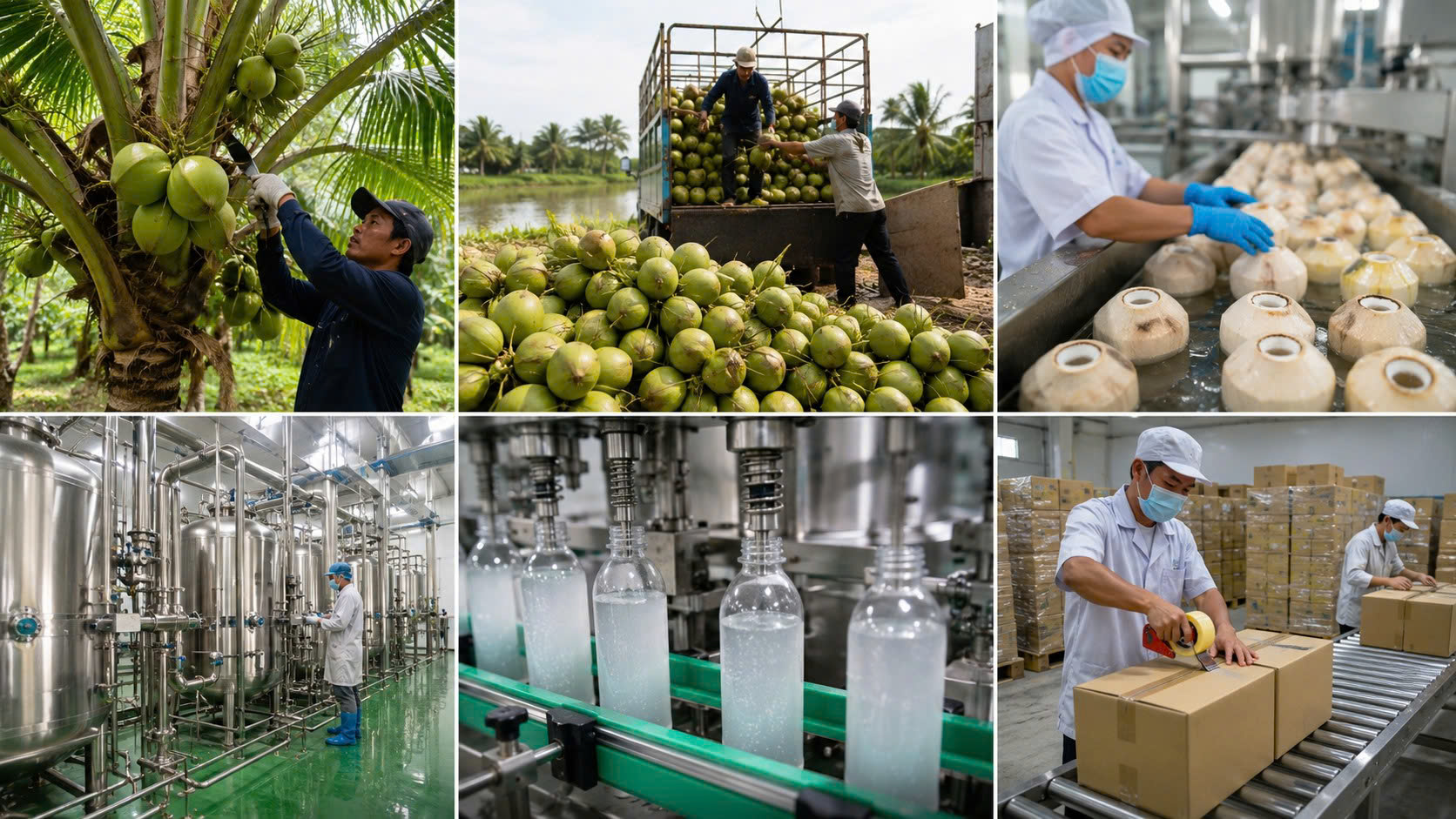
Most Mekong Delta plantations harvest twice a year. Dry-season nuts (December to April) give slightly higher Brix and a cleaner flavour; wet-season nuts give more volume with a softer taste. NFC costs more than reconstituted coconut water because of lower yield and handling, which is justified for premium “never from concentrate” positioning. Market estimates for global coconut water in 2025 range from $4.5 billion to $7.6 billion, depending on the research firm.
| Criteria | Vietnam | Thailand | Indonesia |
|---|---|---|---|
| FOB price, 1L NFC (indicative) | $0.85–1.10/L | Typically 8–14% higher | Variable |
| Harvests per year | Two on most plantations | Seasonal peaks | Year-round |
| Private label availability | Widely available | Available | Limited |
| Packaging flexibility | High (Tetra, can, PET, BIB) | Medium | Medium |
What is the difference between OEM, ODM, private label and white label?
The four models differ in who owns the recipe and how much is customised. OEM builds to your formula, ODM develops one with you, private label puts your brand on a proven recipe, and white label is the fastest route with minimal changes.
| Model | Recipe | Customisation | Best for |
|---|---|---|---|
| OEM | Customer’s specification | Very high | Established brands |
| ODM | Developed with our R&D team | High | New product development |
| Private label | Existing proven recipe | Moderate | Retail chains, distributors |
| White label | Ready recipe, light branding | Low | Fastest market entry |
How is quality controlled?
Every batch follows documented checks from intake to release, and a retained sample from each shipment is kept for 24 months so any complaint can be tested against the original lot.
| Stage | Quality control activity |
|---|---|
| Raw material receiving | Freshness evaluation, supplier verification |
| Ingredient testing | Brix, pH, sensory and specification checks |
| Production | Critical control points through filling |
| Laboratory | Microbiological and quality verification |
| Packaging | Seal integrity, coding, labelling |
| Release | Retained sample and final approval before shipment |
On sustainability, aseptic cartons are mainly paperboard and recyclable where carton collection exists, and aluminium cans recycle without quality loss. Direct sourcing from Bến Tre cooperatives lets us trace finished lots back to grower groups.
How does working with ACMFOOD start?
Most projects start with a free sample kit of six SKUs, shipped within 5–7 business days with freight paid by the buyer. If the specification fits, we send a commercial proposal with pricing tiers, minimums and the certificate list.
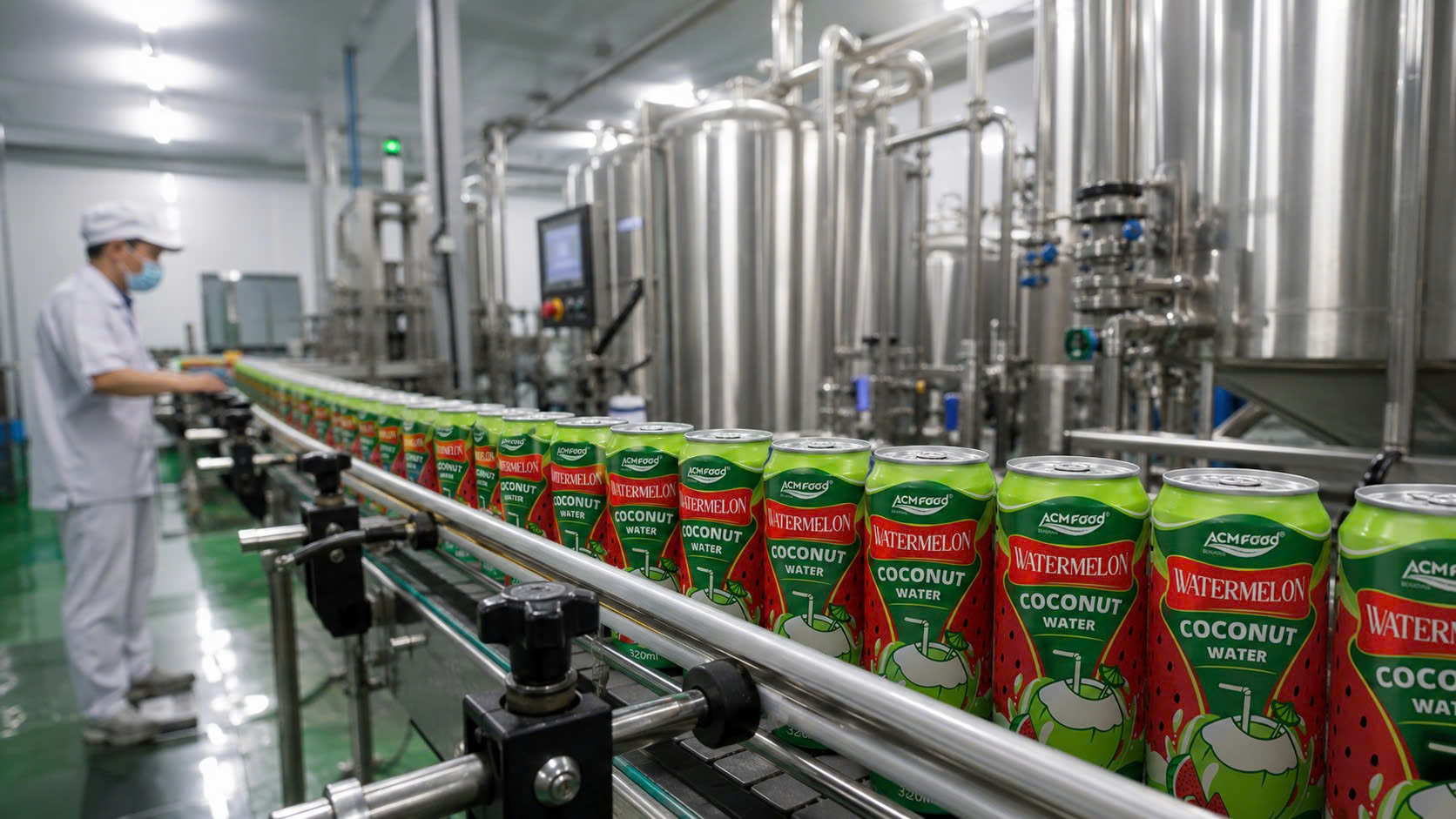
- Technical alignment call: 60–90 minutes between your QA team and our production manager, covering Brix tolerance, sodium variance, heat treatment and migration testing. Our line runs ±0.2 Brix; if you need tighter, we will say so early.
- Pro forma and deposit: 30% deposit, then production is scheduled (15–30 days).
- Pre-shipment samples: taken from the actual lot for your sign-off before the vessel is booked.
- Balance: usually 70% against the scanned bill of lading; repeat buyers can move to LC at sight or open account.
What mistakes should buyers avoid?
- Choosing on price instead of batch consistency.
- Accepting a certificate without the full audit report.
- Skipping samples and the technical alignment call.
- Paying for certifications your market does not require.
- Ignoring the trade-off between packaging shelf life and freight weight.
- Working with a packer that does not control its raw material.
Frequently asked questions
What is the minimum order quantity?
500 cartons per SKU, including private label with custom artwork. Several SKUs can be combined into one container.
Do you supply NFC or concentrate?
Both. We supply 100% NFC coconut water, coconut water from concentrate, and 60 Brix concentrate for buyers with their own filling lines.
What certifications do you hold?
Production runs at partner facilities certified to HACCP, ISO 22000 and FSSC 22000. Other market-specific certificates, such as Halal or organic, can be arranged through dedicated programmes on request.
What happens if there is a quality issue on arrival?
We test the retained sample from that lot. If the issue started in manufacturing, we agree a replacement or commercial compensation.
Can you match a competitor’s product?
Often, yes. Our R&D team can develop a recipe with similar sweetness, acidity and flavour, and will flag anything that cannot be replicated before development starts.
Do you handle private label artwork?
Yes. You can supply print-ready files or use our in-house design team for label development and regulatory review.
What are the payment terms?
Typically 30% deposit and 70% against the scanned bill of lading; LC or open account may be available for long-term customers.
How do I get started?
Send your target market, packaging format, annual volume, required certifications and launch date. We usually reply within 48 hours with indicative pricing, production windows and a sample kit.
Conclusion
A good coconut water supplier is defined by consistency, certification fit and raw material control rather than headline price. Vietnam offers stable supply, fast harvest-to-pasteurisation and competitive FOB pricing, and ACMFOOD adds direct Bến Tre sourcing, production at HACCP, ISO 22000 and FSSC 22000 certified partner facilities, and minimums from 500 cartons per SKU.
Send us your target market, format, annual volume, certifications and timeline, and we will reply within 48 hours with indicative pricing, production windows and a sample kit.
Request a Quote & Free SamplesCoconut water products
Related coconut water guides
- Production process and QC systems: how the water is handled from intake to filling.
- Coconut water private label: the commercial model, minimums and artwork.
- Supplier due diligence checklist: what to demand before your first order.
- Importing from Vietnam: HS codes, proof of origin, ports and Incoterms.
- NFC vs from concentrate: and how to verify an NFC claim.
- Costs and unit economics: landed cost and cash flow.
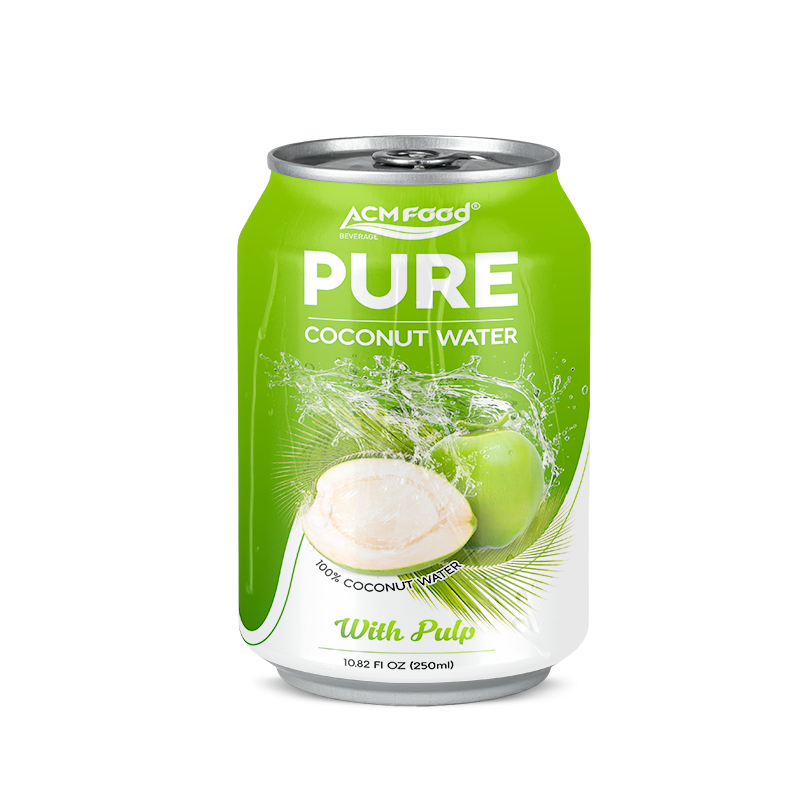
- Sparkling coconut water and coconut water with pulp.
For the wider range beyond coconut water, see our beverage product capabilities, or request a quote.
Request a quoteSources
- VietnamPlus: Coconut exports reach 14-year high
- Produce Report: Vietnam’s coconut exports set to surpass $1 billion
- Fortune Business Insights: Coconut water market
- Research and Markets: Coconut water market global forecast 2025–2032