







 Français
 Español
 العربية
 한국어
한국어Most guides to launching a private label beverage explain the product. Very few explain the money — which is the part that decides whether the business survives its second order. This article is the financial side of a coconut water private label launch: where the capital actually goes, how long it stays out before it comes back, how to build a unit economics model you can defend, and the cash flow mistakes that recur across first-time brands.
It assumes you have already decided the model. If you have not, start with the coconut water private label guide. For choosing a factory, use the supplier due diligence checklist; for developing the liquid itself, see custom coconut water development.
The seven places your launch capital goes
New brands typically budget for the product and are surprised by everything around it. Build the budget in these seven lines from the start, and no single one will ambush you later.
- Product development. Bench trials, processed samples and — if you are making a claim — a stability study. An adapted stock SKU keeps this near zero; a true custom formulation does not.
- Packaging and artwork. Design, regulatory label review for each destination market, and print plates or cylinders. Plate costs are one-off per design but are repeated when you change artwork, which is a common and avoidable second-year expense.
- The goods themselves. Usually a deposit against the purchase order, with the balance due against shipping documents. Both instalments are cash out before you have sold anything.
- Freight and insurance. Ocean freight, origin and destination handling, and cargo insurance. Rates move with the market, so quote them close to the shipment date rather than at planning time.
- Duty, tax and clearance. Import duty on your tariff classification, plus customs brokerage. Confirm the classification before you order — it is not a detail you can adjust afterwards.
- Compliance and registration. Product or facility registration where required, laboratory verification testing in the destination market, and any certification your channel demands.
- Warehousing and working capital. Storage from arrival to sell-through, and the gap between paying your supplier and being paid by your customers. This last line is the one that sinks otherwise healthy launches.
The cash flow timeline nobody plans for

Map your launch as a cash timeline rather than a project plan. The sequence usually looks like this:
- Development and sample costs are spent first, with no inventory to show for them.
- Packaging and plate costs follow, committed before production begins.
- The production deposit goes out, and production time passes with money committed and nothing shipped.
- The balance, freight and duty are paid around shipment and arrival — typically the largest single outflow of the whole project.
- Ocean transit and clearance consume more weeks with capital fully committed.
- Goods land, then move into distribution.
- Payment terms to your retailer or distributor add a further delay after the product has physically left your warehouse.
Add those up honestly. For a first import, the period between the first meaningful outflow and the first customer payment is measured in months, not weeks. The practical implication is that your funding requirement is not the cost of the container — it is the cost of the container plus the operating cost of surviving that entire gap, and ideally plus the deposit on your second order, because reordering before the first is fully paid for is what continuous distribution requires.
Building the unit economics model
Work in cost per unit, and build it in this order. Skipping straight to “factory price versus shelf price” produces a margin that does not exist.
- Ex-works or FOB price per unit from the manufacturer, at your actual order volume rather than at the volume tier you hope to reach.
- Plus freight, insurance, duty and clearance, divided by the units in the container. This gives landed cost per unit — the only number that matters for pricing.
- Plus amortised one-off costs. Development, artwork and plates spread across the units of the first order or two. Ignoring this flatters your first-year margin considerably.
- Plus warehousing, handling and secondary freight to your customer.
- Plus an allowance for damage, short shelf life and unsold stock. Beverage launches always carry some. Budgeting zero is a forecast, not a plan.
- Then work backwards from the shelf. Take the realistic retail price, remove retailer margin, remove distributor margin, remove listing fees and promotional allowances. What remains is your revenue per unit.
The difference between that revenue and your fully loaded cost is the real margin. If it only works at a container volume you cannot yet sell through, the answer is usually a different pack format or a smaller first order — not an optimistic sales forecast.
How pack format changes the economics
Format is a financial decision before it is a marketing one, and it moves several lines at once.
- Units per container. A smaller fill volume puts more sellable units in the same freight cost, which lowers freight per unit but raises the absolute order value at a given container count.
- Minimum order quantity. MOQ is generally set per SKU. Carton lines commonly carry higher minimums than canning lines, which directly changes the capital required for a first order.
- Cold chain. An ambient product removes refrigerated storage and transport from the model entirely. A chilled premium product adds cost at every step and restricts which customers can stock it.
- Shelf life. Longer ambient shelf life reduces write-off risk and gives your sales team more time — which is a financial benefit even though it never appears as a line item.
- Damage rate. Cans and cartons behave differently in transit and in retail handling. Ask your freight forwarder what they actually see.
Sizing the first order
The instinct is to order as much as the price break allows. The better rule is to order the smallest quantity that lets you learn something reliable, because the purpose of order one is validation, not profit.
Ask three questions. How many units do you need to seed enough distribution points to get a genuine rate-of-sale reading? How many units can you afford to be wrong about? And how quickly can you reorder if it works — because a stockout during your first successful months costs shelf space that is hard to win back?
Where a full container is more than the answer to question two, discuss LCL shipment, a shared container, or a lower MOQ tied to a forward commitment. Manufacturers who work regularly with growing brands can usually structure something; the ones who cannot are telling you where you sit in their priorities.
Six financial mistakes that recur
- Pricing off FOB instead of landed cost. The most common and the most damaging, because it is discovered only after the pricing has been agreed with a retailer.
- Forgetting listing fees and promotional allowances. In many retail channels these are substantial and are deducted from your revenue, not added to the shelf price.
- No allowance for artwork rework. A label rejected in regulatory review after plates are made is a real cost with a real timeline attached.
- Under-budgeting the payment gap. Profitable on paper and insolvent in practice is an ordinary outcome for a first import.
- Ordering a second container before the first has a rate of sale. Doubling down on unvalidated demand is how brands end up discounting stock that is approaching its date.
- Treating shelf life as infinite. Retailers reject stock below a residual life threshold. Know that threshold before you plan a slow sell-through.
What to fix before you spend anything
- Confirm the tariff classification and duty rate for your product and destination.
- Get a written MOQ per SKU, and the price at that MOQ rather than at the top tier.
- Get an indicative freight quote for the specific route and container size.
- Establish your customer’s payment terms before you set your price, not after.
- Have the label reviewed against destination regulations before committing to print.
- Model the whole cash timeline, then add a buffer for the parts that always run long.
Where ACMFOOD fits in this model
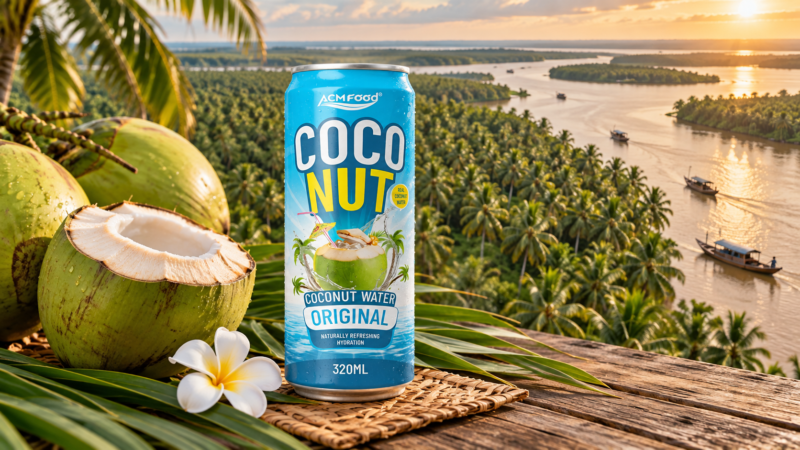
ACMFOOD Beverage Co., Ltd. produces canned coconut water and coconut-based blends in Vietnam for importers, distributors and retail chains on a private label and OEM basis.
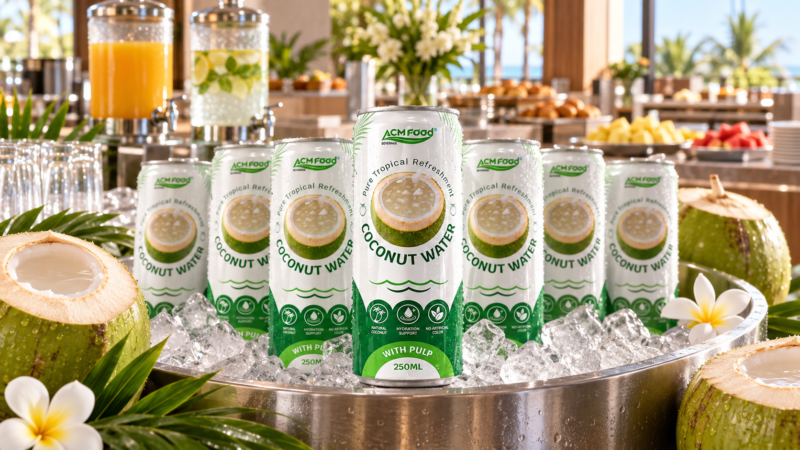
Two aspects matter to the financial model specifically. The product is ambient and canned, which takes cold chain out of your cost structure and gives a long ambient shelf life — both of which reduce the write-off risk that first-time brands consistently under-budget. And shipment is supported on both FCL and LCL terms, so a validation order does not have to be a full container commitment before you have a rate of sale.
If you are building this model now, ask for a written price at your intended MOQ, the units per container for your chosen format, and the standard payment terms. Those three figures are enough to complete a landed cost calculation — and completing it before you commit is the single most useful thing you can do at this stage.
Commercial terms behind these numbers
The figures in this model come from a few fixed terms. For minimums per SKU, see minimum order quantity; for how pack format changes cost per unit, see packaging options; for freight, documents and Incoterms, see export and logistics. To get real figures for your programme, request a quote.
Request a quote