


 Français
 Español
 العربية
 한국어
한국어ACMFOOD is a Vietnamese coconut juice and coconut water manufacturer that supplies canned products and private label programmes to importers worldwide. Importers evaluating a coconut juice brand should check origin, processing, flavour consistency between batches, certifications and first-order flexibility.
Choosing the right coconut juice brand to import is not just a product decision — it is a supply chain commitment. One that affects your shelf life guarantees, your label compliance across markets, your reorder flexibility, and ultimately, your brand’s reputation with end consumers. Most importers learn this the hard way, after a batch of inconsistent flavor profiles or a container held up at customs over a missing food safety certificate.
At ACMFOOD, we have spent years building infrastructure specifically to remove those headaches for international buyers.
Why the canned coconut juice market is worth paying attention to right now
Coconut water has become a multi-billion-dollar global category, and market research firms agree that it is still growing steadily rather than spiking. What makes that number meaningful is where the demand is coming from: North America held over 28% of global market share in 2025, driven by consumers actively moving away from sugary sodas toward natural, functional beverages.
The canned segment specifically is growing faster than the overall category. Market reports consistently show cans as one of the faster-growing coconut water formats. That matters for importers because cans offer longer shelf life, better stacking efficiency in shipping containers, and stronger visual branding real estate on retail shelves compared to pouches or Tetra Pak cartons.
For anyone evaluating which coconut juice brand to partner with, the market trajectory is not the question. The question is whether your supplier can actually scale with you.
What importers actually get wrong when sourcing coconut juice
Most buyers start with the product. They taste the sample, it’s good, they place a trial order. Six months later, they are chasing their supplier for an updated HACCP certificate because their target market’s food authority just updated its import requirements. Or the Brix level on their second container is 0.4° off from the first, and their retail partner is asking questions.
Here is what experienced importers already know: the product is only 40% of the sourcing decision. The rest is documentation readiness, production consistency, lead time reliability, and — critically — private label flexibility.
That is the gap ACMFOOD was designed to fill.
How ACMFOOD approaches production differently
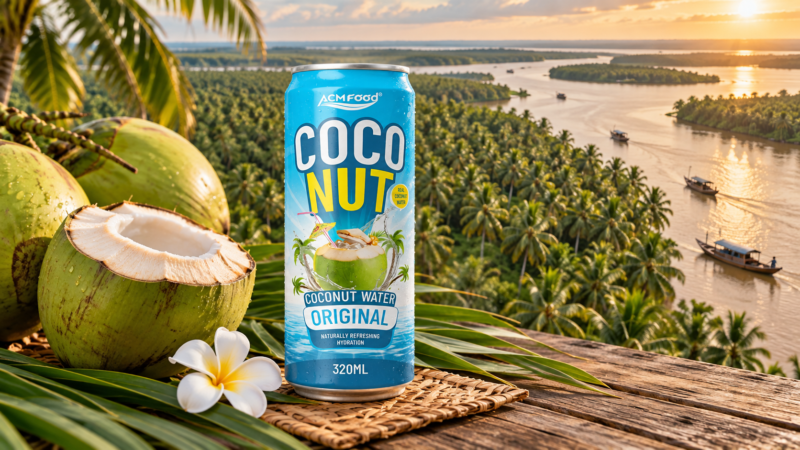
Vietnam sits at the center of Southeast Asia’s coconut belt. Ben Tre province, where our sourcing network is concentrated, produces some of the most consistent young coconuts in the region — with a naturally balanced sweetness and lower sugar variability compared to coconuts sourced from multiple countries, which can shift flavor batch to batch. Some of the largest international coconut juice brands openly acknowledge blending from multiple origins to “standardize” taste. We see standardization differently: it starts with raw material consistency, not post-processing correction.
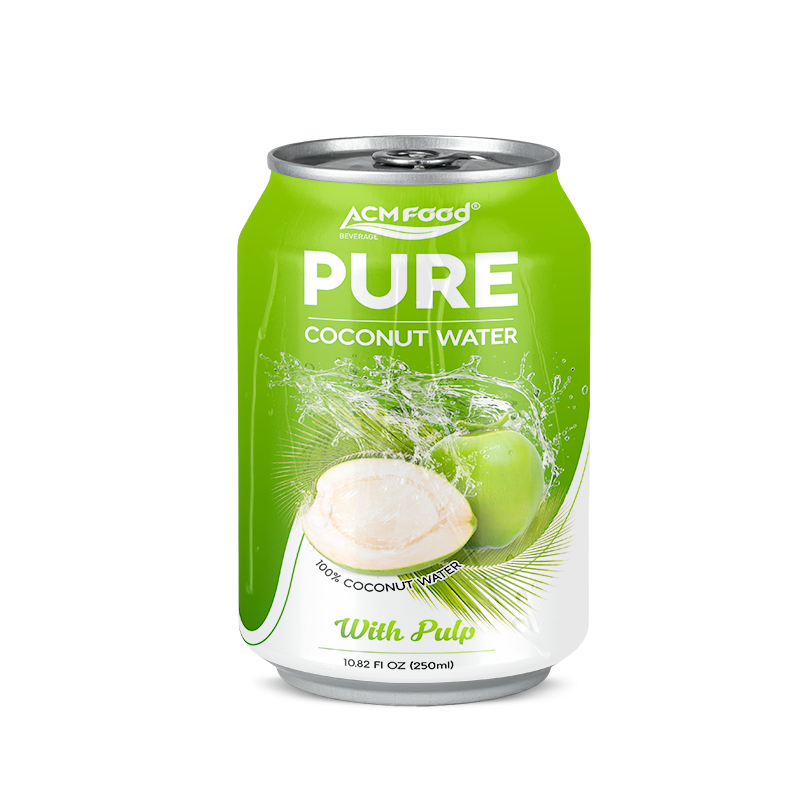
Our production follows a closed cold-chain process from harvest to sealing. The coconut water is extracted within hours of harvest, micro-filtered, pasteurized, and filled into food-grade cans under controlled aseptic conditions. We do not add preservatives. We do not add artificial flavor stabilizers. What goes into the can is coconut water — and if a buyer wants a lightly sweetened variant or a coconut juice with pulp, those are formulations we develop transparently, with every ingredient listed and traceable.
The result is a product where Brix variation between batches stays within ±0.2°. That may sound like a technical footnote. For a retail buyer reviewing your consistency metrics after six months on shelf, it’s the difference between a reorder and a delisting conversation.
Private label: the real reason serious importers are looking at Vietnam
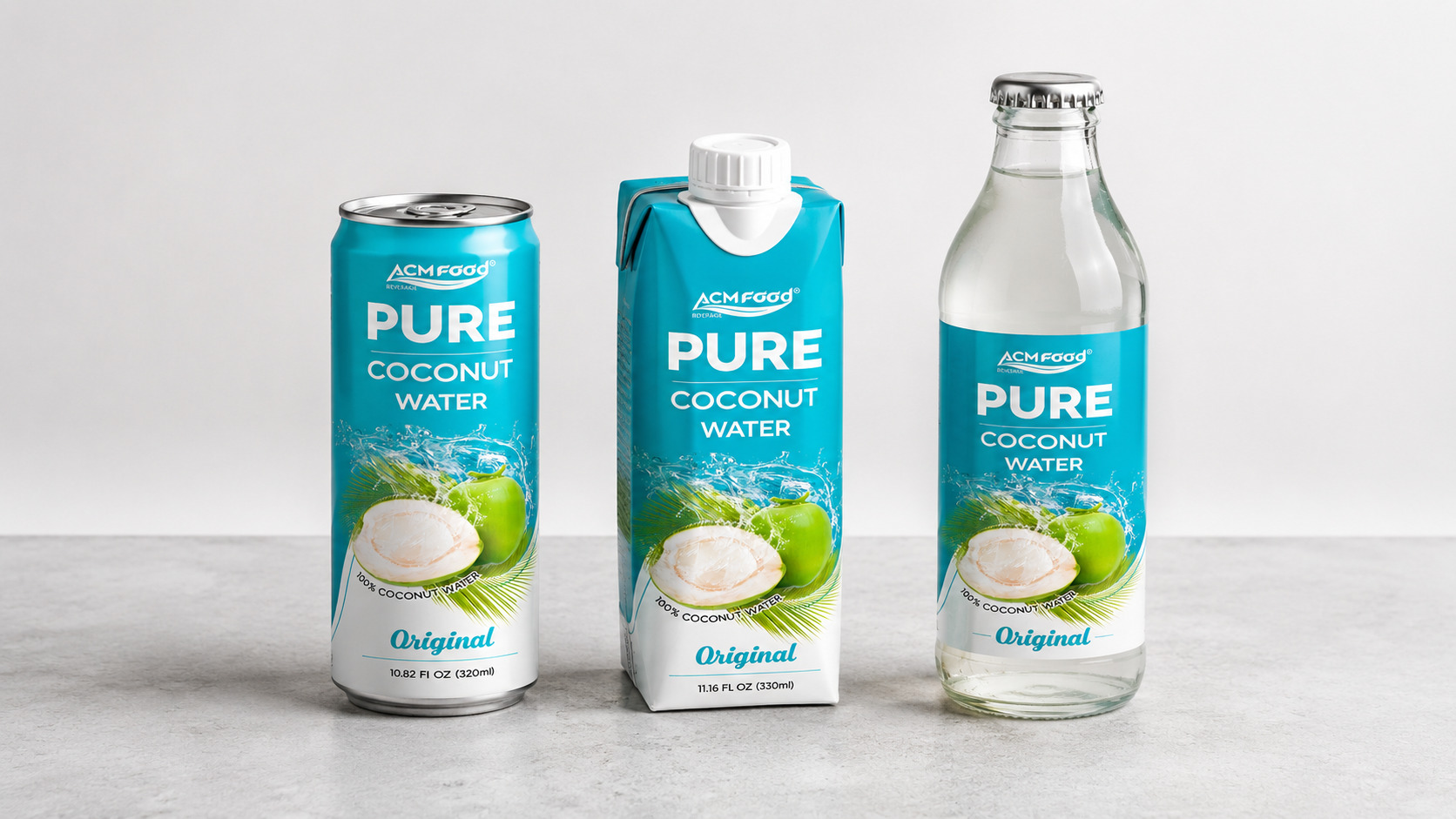
The growth of private label in the packaged beverage space is not a trend — it is a structural shift. Retailers from Europe to the Middle East to North America are allocating more shelf space to house brands because the margin economics are simply better. For importers, this creates a genuine opportunity: find a manufacturing partner capable of producing at scale under your label, and you are no longer just a distributor. You are a brand owner.
ACMFOOD’s private label program is built around four practical principles.
Minimum order quantities that actually work for market entry. We understand that an importer testing a new market cannot commit to 40-foot container volumes on their first order. Our MOQs are structured to allow initial market validation without over-committing capital.
Label and packaging design support. Our in-house team works with importers on label artwork that meets the regulatory requirements of their target market — whether that is FDA compliance for the U.S., EU food labeling directives, or GCC standards for Gulf markets. We have done this across more than a dozen markets. We know where the common mistakes happen.
Formulation flexibility. Beyond standard canned coconut juice, we produce coconut water with pulp, lightly sweetened coconut juice, and blended variants with tropical fruit notes. Buyers can specify their target Brix level, pH range, and flavor profile. We document and lock the specification to their SKU.
Full documentation packages. Every shipment comes with a complete quality documentation file: Certificate of Analysis, Certificate of Origin, Health Certificate, phytosanitary documents where required, and full ingredient traceability records. Importers who have dealt with customs delays know that a missing document is not a minor inconvenience — it is an expensive one.
Certifications: the non-negotiable layer
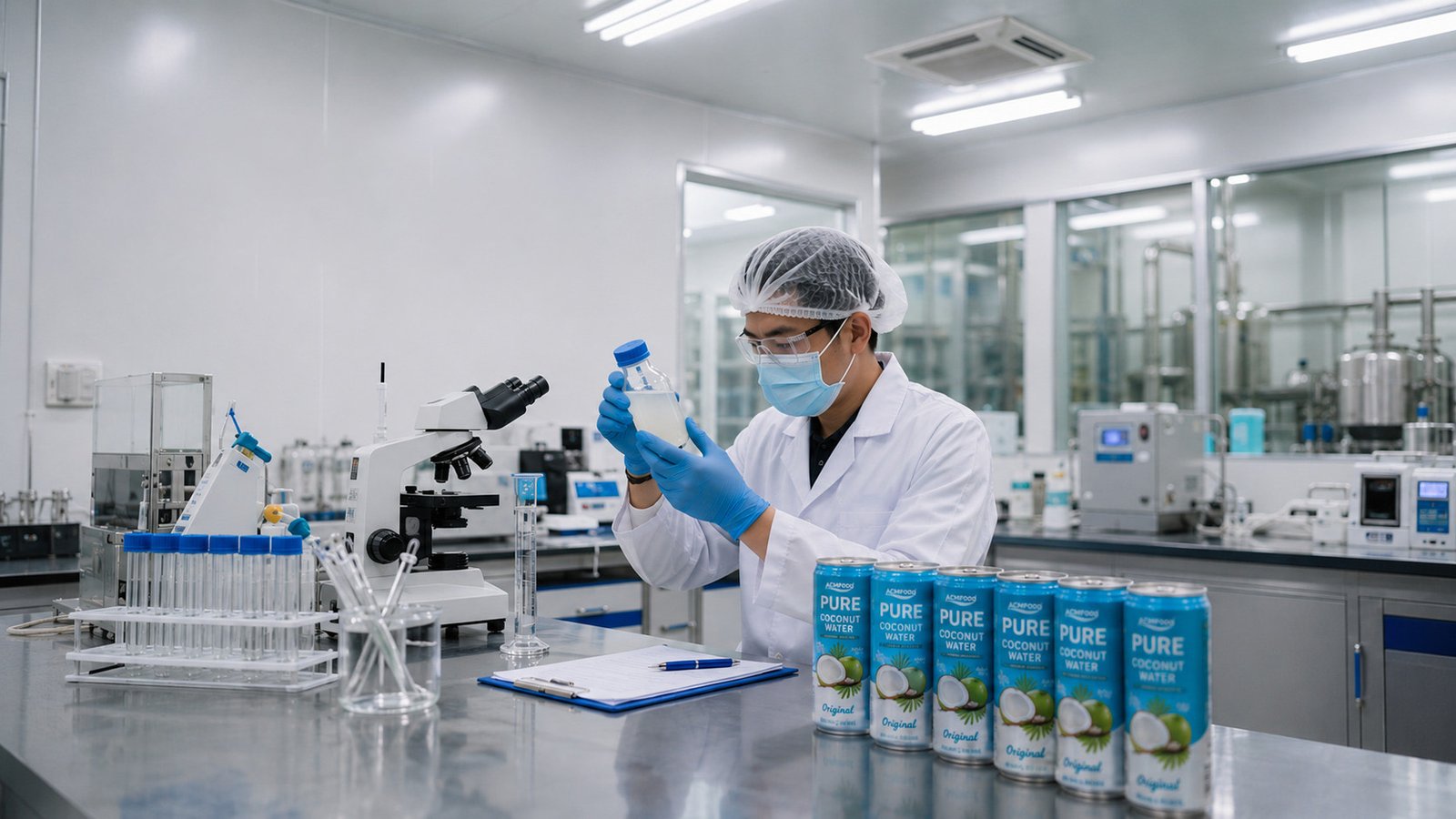
When buyers evaluate a coconut juice brand as a manufacturing partner, certifications are the baseline, not a differentiator. We hold ISO 22000 for food safety management systems, HACCP certification, GMP compliance, and Halal certification — the latter being particularly critical for buyers targeting markets in the Middle East, Malaysia, Indonesia, and parts of Europe with significant Muslim consumer populations. We are also able to support non-GMO documentation requirements for buyers targeting health-food channels in North America.
These are not framed certificates on a wall. They are audit results that buyers can verify, and that their own retail or distribution partners will ask to see.
Understanding the flavor consistency challenge — and how we address it
One of the most commonly cited issues in independent coconut water brand comparisons is flavor inconsistency across batches. This is a known challenge in the category. Coconuts are agricultural products. Their sugar content, mineral profile, and water yield shift with season, soil, and age at harvest.
The solution most producers use is blending — mixing coconut water from many sources and correcting the profile after the fact. This approach works at volume. But it introduces variability that shows up at scale, especially if your supply chain involves multiple harvest seasons.
Our approach combines geographic focus (sourcing from a defined regional cluster in Ben Tre), strict harvest-age specifications (young coconuts at 6–8 months), and in-line Brix monitoring at the filling stage. If a batch deviates, we hold it. That means our lead times are slightly longer than suppliers who ship first and test later. Buyers who have been burned by inconsistent product understand why that is actually a feature, not a limitation.
What the buying process looks like with ACMFOOD
We do not ask importers to commit to large volumes before they have tasted the product, reviewed the documentation, and run their own market validation. Our standard buyer journey works in three stages.
The first is a sample request — we ship a tasting kit of our product variants with full specification sheets and a preliminary certification package. Most buyers can have samples in hand within 10–14 days, depending on location.
The second is a trial order, typically one or two pallets. This lets buyers test the product with a segment of their distribution network or retail channel, confirm that the documentation package satisfies their local import requirements, and validate shelf performance.
The third is a private label agreement, where we lock in the formulation, label design, packaging specifications, and a production schedule aligned with the buyer’s projected demand.
At each stage, the buyer has full visibility into what they are committing to. No opaque pricing tiers. No surprise charges for documentation.
Why this matters for the long-term
The coconut juice brand you import shapes your reputation with distributors and retailers, not just your current margin. A product that consistently delivers on flavor, passes customs documentation without delays, and maintains shelf stability builds the kind of commercial track record that opens new retail partnerships and supports price negotiation from a position of strength.
We are not the right partner for buyers who need the lowest possible unit cost at the expense of consistency or documentation quality. There are suppliers in that segment, and they serve a purpose. ACMFOOD is built for importers who are thinking beyond the first container — who want a manufacturing partner that grows with their business and helps them build something worth holding onto.
If that describes what you are looking for, we would be glad to send samples and start a conversation about what your specific market needs.