


 Français
 Español
 العربية
 한국어
한국어To choose the right peach juice OEM manufacturer, define your product requirements first, then compare manufacturers on experience with fruit juices, food safety certifications, raw material sourcing, R&D support, packaging options, minimum order quantity, lead time and export documentation.
The global fruit juice market continues to expand as consumers look for healthier beverage choices, making peach juice an attractive product for both established companies and new brands. Choosing the right peach juice OEM manufacturer is one of the most important decisions because it directly affects product quality, food safety, production costs, and long-term business growth. A reliable manufacturing partner can help shorten your product launch timeline by several months while ensuring consistent quality across every batch.
If you are planning to build a peach juice private label brand, selecting a factory based only on price can become an expensive mistake. What should you evaluate before signing a manufacturing agreement? This guide explains the most important factors to help you make a confident decision.
Why choosing the right OEM manufacturer matters
An OEM manufacturer becomes an extension of your business. Every bottle, can, or carton carrying your brand name reflects the manufacturer’s production standards, quality control system, and technical capabilities.
Working with an experienced peach juice OEM supplier offers several measurable advantages. Many established factories can produce tens of millions of liters annually, support more than 20 export markets, and provide flexible minimum order quantities depending on packaging type. This allows brands to scale production without changing suppliers as demand increases.
A poor manufacturing choice often results in inconsistent taste, delayed deliveries, packaging defects, regulatory issues, and customer complaints. These problems usually cost far more than the savings gained from selecting the lowest quotation.
Understand your brand requirements first
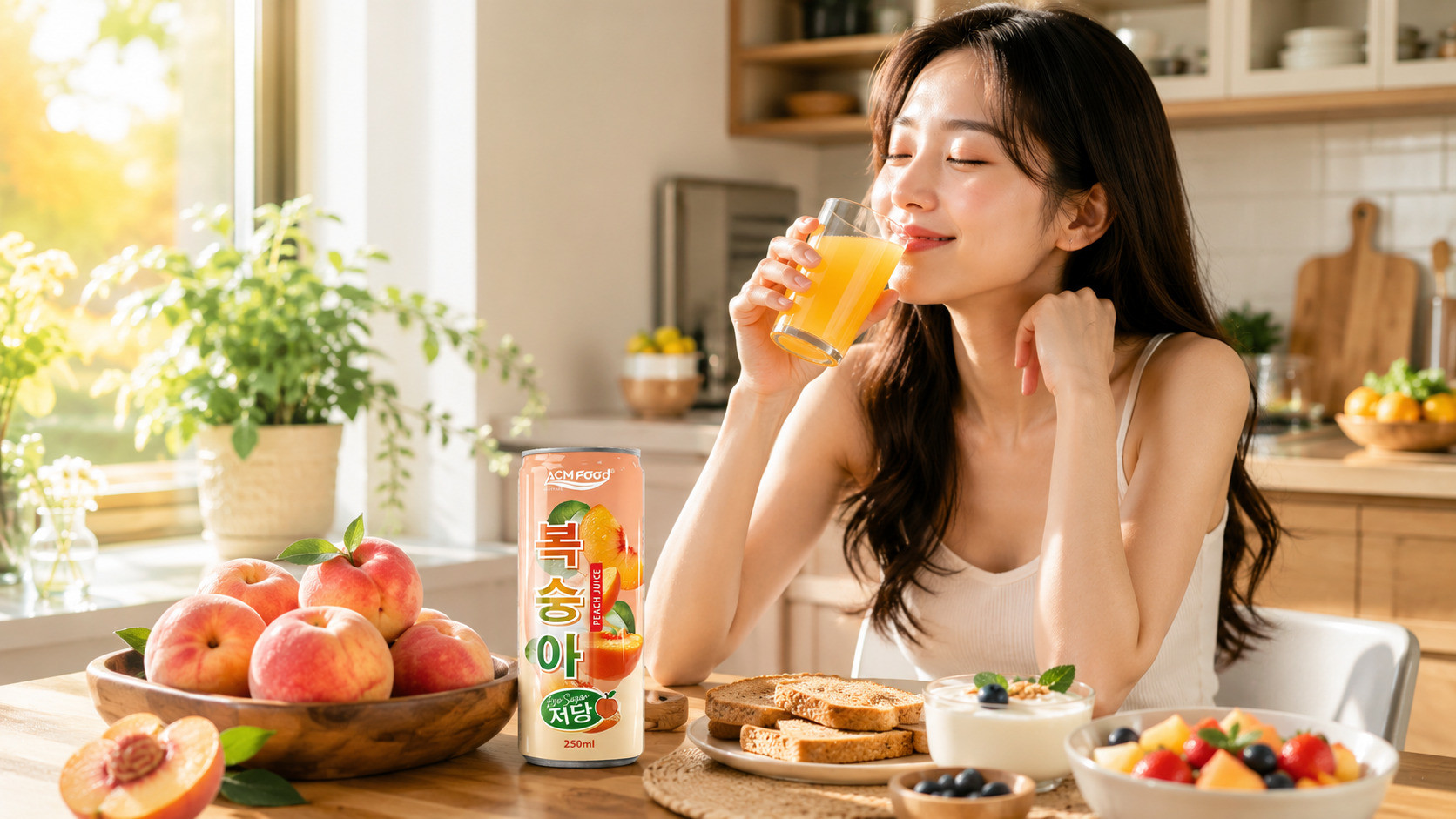
Before comparing manufacturers, define exactly what your brand needs. The clearer your requirements are, the easier it becomes to identify suppliers that match your business model.
Consider several key questions. Will your product contain 100% peach juice or peach nectar? Are you targeting supermarkets, convenience stores, online sales, or hotel distribution? Will you launch in one country or multiple export markets within the next three years?
Many beverage startups begin with one or two SKUs, while larger distributors often launch five to ten products simultaneously. Understanding your production volume helps manufacturers recommend the most suitable production schedule and packaging solution.
Evaluate manufacturing experience
Experience is often the easiest indicator of manufacturing reliability. A factory that has produced fruit beverages for more than 10 years generally has stronger process control than a newly established facility.
Ask manufacturers about their experience with peach juice private label projects. How many international customers do they currently serve? How many private label brands have they developed? Can they provide references or export case studies?
An experienced OEM partner should also understand differences between regional consumer preferences. For example, customers in Europe may prefer lower sugar formulations, while some Asian and Middle Eastern markets often accept sweeter flavor profiles.
Check food safety certifications

Food safety certifications are essential for exporting beverages internationally. They demonstrate that the manufacturer follows internationally recognized quality management systems instead of relying only on internal procedures.
Common certifications include ISO 22000, HACCP, GMP, BRCGS, FSSC 22000, FDA registration for applicable markets, and Halal certification where required. Depending on your target countries, additional certifications may also be necessary.
Instead of simply asking whether certifications exist, request valid certificates and verify their expiration dates. Certification should cover the actual manufacturing facility rather than only the parent company.
Review ingredient sourcing and raw material quality
The quality of peach juice starts long before production begins. Fresh fruit selection, harvesting methods, storage conditions, and transportation all influence the final taste, aroma, and nutritional value.
Ask suppliers where their peaches originate and whether they use concentrate, puree, or freshly pressed juice. Manufacturers with stable agricultural supply chains are generally better prepared to maintain consistent quality throughout the year despite seasonal variations.
Some manufacturers also maintain long-term partnerships with certified farms, allowing better control over pesticide residues, fruit maturity, and traceability.
Assess research and product development capabilities
Strong research and development capabilities allow manufacturers to create products that match your target market instead of offering only standard recipes.
A professional peach juice OEM factory should be able to customize sweetness, fruit concentration, acidity, vitamin enrichment, pulp content, aroma profile, and ingredient combinations. They should also provide laboratory testing and sample development before mass production begins.
In many projects, brands evaluate three to five sample formulations before approving the final recipe. This process significantly reduces the risk of customer dissatisfaction after launch.
Compare packaging options
Packaging influences product appearance, transportation costs, shelf life, and retail positioning. Manufacturers with multiple packaging lines provide greater flexibility as your product portfolio expands.
Common packaging formats include aluminum cans from 250 ml to 500 ml, PET bottles between 300 ml and 1.5 liters, glass bottles for premium positioning, and aseptic cartons for extended shelf life. Some factories also provide customized bottle molds and label design support.
If your brand plans to sell in several countries, ensure the manufacturer can meet local packaging regulations, multilingual labeling requirements, and recycling standards.
Understand production capacity
Production capacity becomes increasingly important as sales grow. A factory capable of producing only small monthly volumes may struggle to fulfill larger orders during peak seasons.
Ask about annual production volume, daily filling capacity, available production lines, and average lead time. Many modern beverage factories operate automated filling systems capable of producing tens of thousands of bottles per hour, improving consistency while reducing contamination risks.
You should also ask how production schedules are managed during busy seasons. Can the factory prioritize repeat customers? Do they maintain sufficient inventory of packaging materials?
Evaluate quality control procedures
Quality control should cover every production stage rather than only the finished product. Professional manufacturers typically inspect incoming ingredients, monitor production parameters continuously, and perform microbiological testing before shipment.
Request information about laboratory equipment, sampling frequency, retention samples, and batch traceability systems. Manufacturers should be able to identify production records for every individual batch quickly if quality concerns arise.
A transparent quality management process reduces product recalls and strengthens consumer confidence in your brand.
Review export experience
International export experience often simplifies the entire purchasing process. Manufacturers familiar with overseas shipments understand documentation requirements, customs procedures, and country-specific regulations.
Ask whether the factory has exported to your target region. Experience with North America, Europe, Australia, the Middle East, or Africa often indicates familiarity with different labeling standards, ingredient restrictions, and food safety requirements.
Experienced exporters can also recommend the most efficient shipping methods and container loading configurations, helping reduce logistics costs.
Compare pricing beyond the quotation
The lowest manufacturing quotation rarely represents the lowest overall cost. Hidden expenses such as packaging upgrades, formulation adjustments, laboratory testing, storage fees, and shipping delays can significantly increase total project costs.
Instead of comparing only unit prices, calculate the complete landed cost. Include product development, certification, packaging materials, transportation, customs duties, warehousing, and expected inventory turnover.
A manufacturer offering slightly higher production pricing but better quality consistency often generates higher long-term profitability through stronger customer retention.
Evaluate communication and customer support
Communication quality often predicts how smoothly future cooperation will progress. Fast responses, detailed technical explanations, and transparent documentation indicate a professional organization.
Observe how quickly the supplier answers technical questions, provides product samples, updates quotations, and shares production schedules. Delays during early discussions frequently become larger operational problems after production begins.
Many successful beverage brands maintain long-term relationships with manufacturers for more than five years because effective communication improves planning, forecasting, and product development.
Questions to ask before signing a contract
Before making your final decision, request detailed answers about production capacity, lead time, minimum order quantity, payment terms, product customization, quality testing, export documentation, and after-sales support. A professional manufacturer should answer these questions clearly and provide supporting documentation whenever possible.
You should also understand ownership of product formulations, packaging designs, trademarks, and intellectual property. Clarifying these details early helps prevent future disputes as your business grows.
Signs of a reliable peach juice OEM partner
A dependable manufacturer demonstrates consistency across every stage of cooperation. They provide transparent pricing, verified certifications, complete technical documentation, stable production schedules, responsive customer service, and clear quality control procedures.
Reliable suppliers also invest continuously in equipment upgrades, research laboratories, sustainability initiatives, and employee training. These investments usually translate into better product consistency and improved manufacturing efficiency over time.

Selecting the right peach juice OEM manufacturer requires careful evaluation of experience, certifications, product development capability, ingredient sourcing, quality management, production capacity, export knowledge, and communication standards. Although comparing suppliers requires additional time during the planning stage, this investment can reduce operational risks and strengthen your brand for many years.
For businesses building a successful peach juice private label brand, the ideal OEM partner is not simply the manufacturer with the lowest price. It is the company that consistently delivers safe, high-quality products, supports product innovation, meets international standards, and grows alongside your business as market demand expands.
Taking this juice to market under your own brand
The OEM route for any fruit juice follows the same commercial path. How production is organised is set out in OEM beverage production. To launch it under your own label, see private label beverages. The formats and categories we run are listed under product capabilities. Minimums are set per SKU — see minimum order quantity. When you have a specification, request a quote.
Request a quote