


 Français
 Español
 العربية
 한국어
한국어Ordering a beverage from an OEM manufacturer follows eight steps, from the first enquiry through to the container leaving port. Each step has an owner, a decision or a document attached to it, and a dependency on the step before, which is why the sequence matters more than the speed of any single stage.
This page sets out the steps in order, what each one produces, and what the buyer supplies or decides. Durations are described by what drives them rather than by a fixed number of days, because the elapsed time on almost every step depends on the product and on how quickly information and approvals come back.

The eight steps at a glance
| Step | What happens | What the buyer supplies or decides |
|---|---|---|
| 1. Enquiry and brief | Product, format, volume and destination are defined | The product brief and target markets |
| 2. Feasibility and quotation | The request is checked against capability and priced | Confirmation of specification and commercial terms |
| 3. Sample development | Bench samples are produced against the brief | Feedback on each round and the approval decision |
| 4. Sample approval | The winning profile is documented and locked | Written approval of the reference sample |
| 5. Artwork and compliance | Label content is prepared and checked for the destination | Brand artwork, claims and responsible party details |
| 6. Purchase order and deposit | The order is confirmed and materials are secured | Signed order and payment per agreed terms |
| 7. Production and quality release | The batch is made, tested and released | Any pre-shipment inspection requirement |
| 8. Documentation and shipment | Export documents are issued and the container ships | Consignee details and the shipping instruction |
Steps 1 to 4: from enquiry to an approved sample
Step 1. Enquiry and product brief
The brief defines the product category, the pack format and size, the target markets, the expected annual volume and any reference product. A brief that names a reference product and the destination markets shortens every step that follows, because both the formulation target and the compliance constraints become known at the start rather than emerging later.
Step 2. Feasibility and quotation
The request is assessed against what the plant can actually run, and priced. Feasibility covers whether the format is available, whether the process suits the product, and whether any ingredient is restricted in the destination markets. The quotation reflects the specification as understood at that point, so a change to format or juice content later changes the price.
Step 3. Sample development
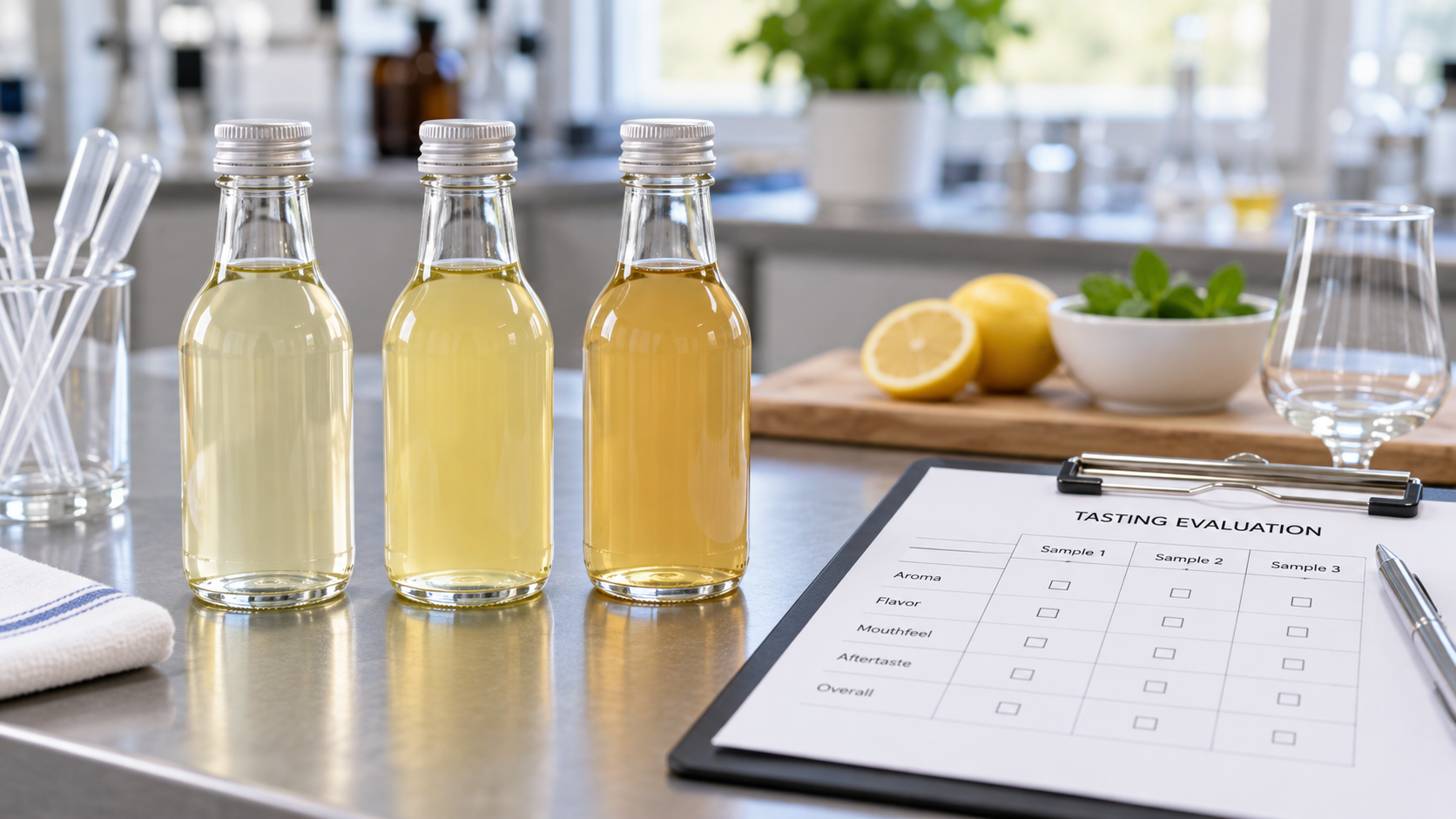
Bench samples are produced against the brief and sent for tasting. Rounds continue until a profile is accepted, with each round narrowing the variables rather than starting again. The number of rounds is the main variable in this stage, and it is driven by how specific the brief was and how quickly feedback returns.
Step 4. Sample approval
The accepted profile is documented as a specification with analytical targets and tolerances, and a reference sample is retained. Approval is given in writing against that documentation rather than verbally against a bottle, because the specification is what later batches are measured against.
Steps 5 to 8: from purchase order to shipment
Step 5. Artwork and compliance
Label content is assembled from the approved specification and checked against the requirements of each destination market. This step depends on step 4, because the nutrition panel and any claim derive from the final formulation and its tested values. Artwork prepared before approval usually has to be revised.
Step 6. Purchase order and deposit
The order is confirmed with quantities, specification reference, delivery terms and payment terms. Packaging materials are ordered at this point, and because printed components are made to order they frequently set the earliest possible production date rather than the filling schedule doing so.
Step 7. Production and quality release
The batch is produced against the approved specification, tested, and released only once results are within the agreed tolerances. Where the buyer requires a pre-shipment inspection or a third-party check, it is arranged in this window, so the requirement needs to be stated in the order rather than raised afterwards.
Step 8. Documentation and shipment
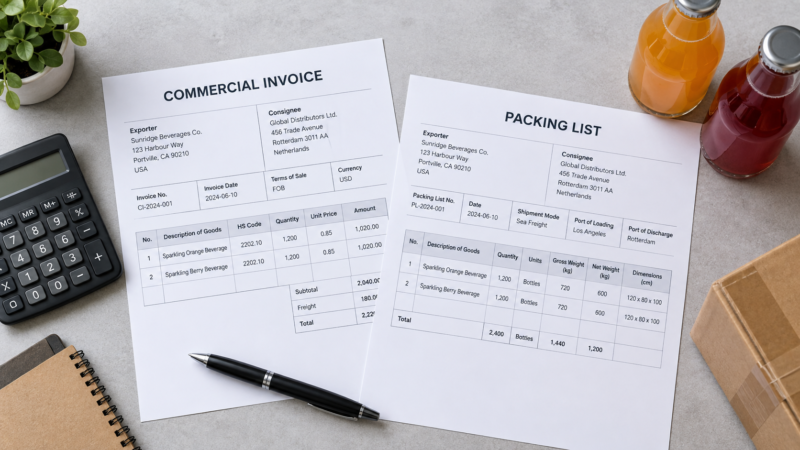
Export documents are prepared, the booking is made and the container ships. The document set typically includes the commercial invoice, packing list, bill of lading and certificate of origin, with certificates specific to the destination added where required. The full sequence on the import side is described in the guide to importing beverages from Vietnam.
Where the sequence usually breaks
Each step has a characteristic failure, and all of them are avoidable with information that costs nothing to supply earlier.
- At the brief. Destination markets are left open, so the formulation is developed without the constraints that will later apply to permitted ingredients and label claims. The fix is to name the markets even provisionally.
- At quotation. The price is agreed against an incomplete specification, and the number moves when the format or juice content is finally settled. The fix is to treat the quotation as conditional until the specification is fixed.
- At sample rounds. Feedback arrives as a general impression rather than as attributes, so the next round guesses. The fix is to comment on sweetness, acidity, body and aftertaste separately.
- At approval. A sample is approved verbally and nothing is documented, leaving nothing to measure later batches against. The fix is written approval against a specification with tolerances.
- At artwork. Design begins before the formulation is locked, so the nutrition panel and claims have to be reworked. The fix is to sequence artwork after approval.
- At the order. Printed packaging is ordered late and becomes the constraint on the production date. The fix is to release the packaging order as soon as artwork is approved.
None of these are technical problems. They are sequencing problems, which is why a project that respects the dependencies generally reaches shipment sooner than one that tries to compress individual steps.
What the buyer owns at each step
Most delays sit with decisions rather than with production. The items below are the buyer’s to provide, and each one blocks the next step until it arrives.
- The brief, including destination markets, without which compliance constraints cannot be applied.
- Sample feedback, ideally structured against attributes rather than expressed as a general preference.
- Written approval of the reference sample and specification.
- Brand artwork and claims, together with the responsible party details required on the label.
- The signed order and payment under the agreed terms, which releases the material purchase.
- Consignee and shipping instructions, including any inspection requirement.
What determines how long it takes
Rather than a fixed calendar, the timeline is set by four things, and a project that manages them well completes materially faster than one that does not.
- Brief specificity. A brief with a reference product and fixed markets typically resolves in fewer sample rounds than one that is still exploratory.
- Feedback turnaround. Sample rounds include international shipping in both directions, so the elapsed time per round is dominated by transit and review rather than by bench work.
- Printed packaging lead time. Components made to order have their own production schedule, and on many projects this is the longest single item.
- Compliance and registration. Where the destination requires product registration, that process runs on the authority’s timetable and is usually the critical path to launch.
Because these overlap, the useful planning question is which items can run in parallel. Artwork preparation, packaging procurement and registration can often proceed alongside one another once the specification is approved, whereas none of them can begin before it.
Where the commercial terms fit
Three commercial questions run alongside the technical steps and are best settled at step 2 rather than at step 6. The first is the minimum order quantity, which is driven by the format and the printed components as much as by the filling run, and which is explained on the minimum order quantity page. The second is the delivery term, which determines where responsibility and cost transfer between the parties. The third is the payment structure, which governs when materials can be purchased and therefore when production can be scheduled.
Buyers preparing for step 2 often find it useful to work through a structured list of questions before the first call, which is covered in questions to ask a beverage manufacturer.

Frequently asked questions
Can steps be run in parallel?
Some can. Artwork preparation, packaging procurement and any destination registration can proceed together once the specification is approved. Sample development and approval cannot be parallelised, because each round depends on feedback from the previous one.
What happens if the sample is not approved?
The round repeats with adjusted variables. This is normal rather than a failure, and structured feedback naming specific attributes shortens the next round considerably compared with a general comment that the sample is not right.
Does the buyer need to supply packaging?
Not usually. Packaging is normally sourced as part of the project, with the buyer supplying the artwork rather than the physical components. Where a buyer prefers to nominate their own packaging supplier, that is arranged at the quotation stage because it affects both the price and the schedule.
Can a trial order be smaller than the normal minimum?
Sometimes, depending on the format and the packaging involved. The constraint is usually the printed components rather than the filling run, because those are made to order in their own economic quantities. Where a smaller first run is possible it generally carries a different unit cost, and the options are best discussed at the quotation stage.
Who arranges the shipping?
That follows from the delivery term agreed in the order. Under some terms the manufacturer books the carriage and under others the buyer nominates their own forwarder. Either arrangement works, but it needs to be fixed at step 6 rather than at step 8, because it determines who provides the booking and when.
When is the specification fixed?
At step 4. Changes after that point are possible but they cascade, because artwork, registration and the packaging order all derive from the approved specification. The cost of a change rises sharply once printed components have been ordered.
Starting an order
The sequence is straightforward once the dependencies are visible: define the brief with the destination markets in it, agree the commercial terms early, lock the specification before artwork begins, and treat printed packaging and registration as the items most likely to set the launch date.
A first project also benefits from agreeing, at the outset, who on each side holds the decision at every step. A brief that names one approver on the buyer side removes the most common source of stalled sample rounds, which is feedback arriving from several people with different priorities and no reconciliation between them.
ACMFOOD works through these steps with brand owners as part of its beverage manufacturing services. To begin at step 1, send a product brief with the category, format, target markets and expected volume through the enquiry and contact form, and the feasibility and quotation stage can start from there.