


 Français
 Español
 العربية
 한국어
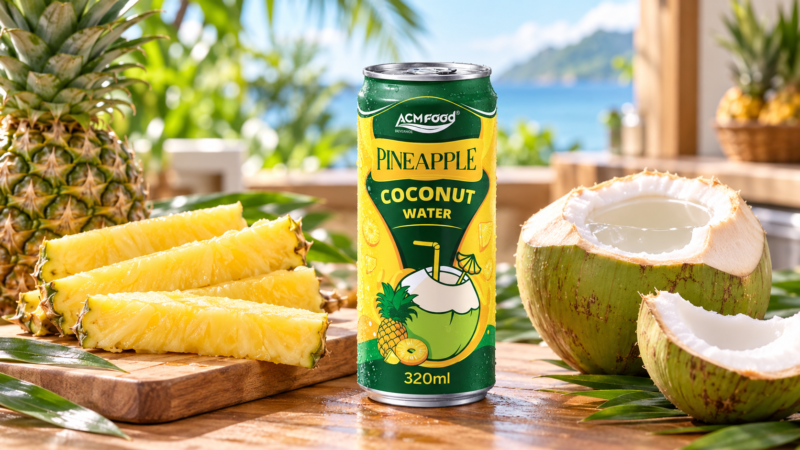
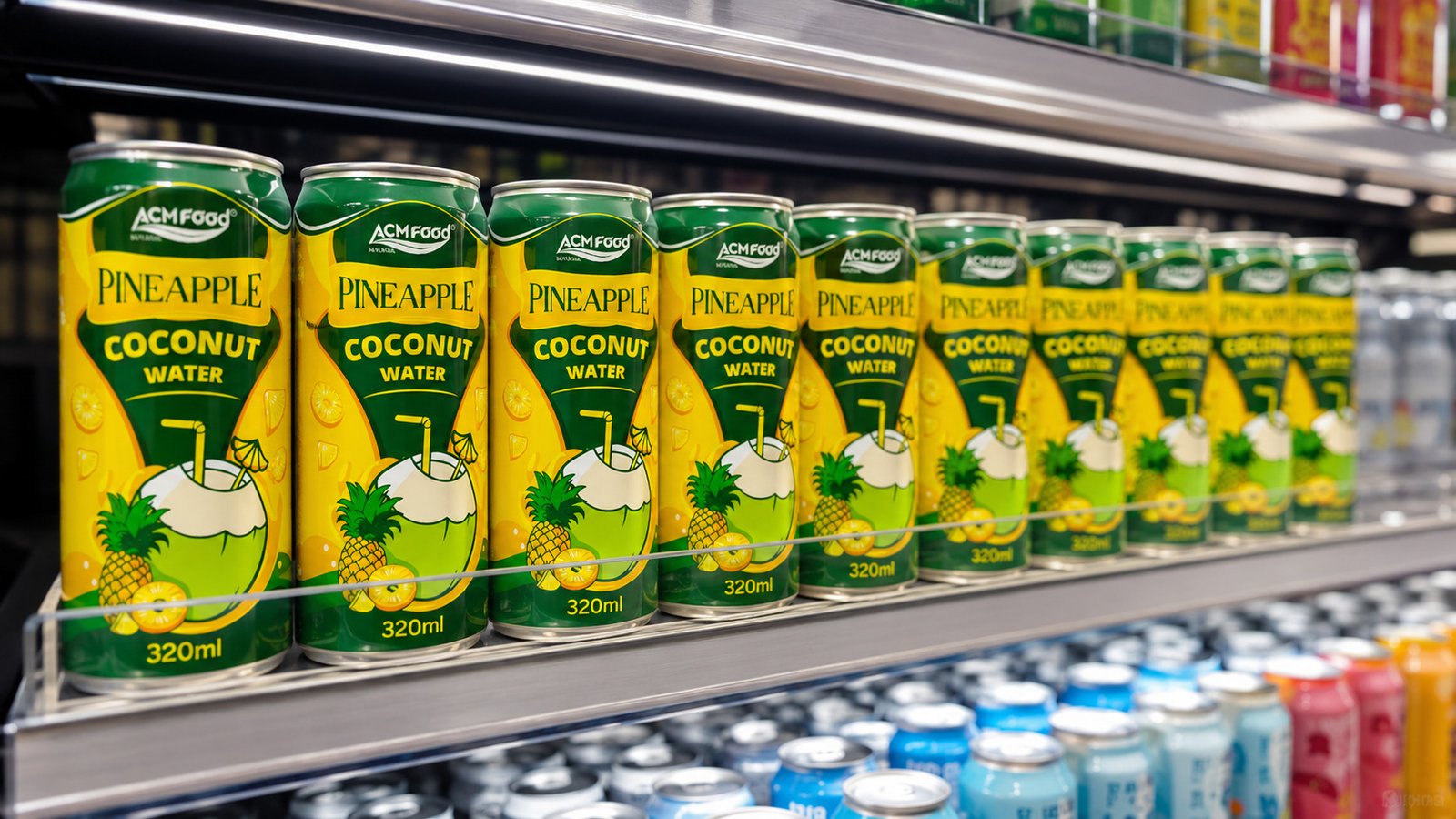
한국어Coconut water pineapple juice is a blend that pairs coconut water’s potassium and mild sweetness with pineapple’s acidity and vitamin C. It is a growing ready-to-drink subcategory; for private label buyers the main decisions are blend ratio, sugar content, pasteurisation method and pack format, typically 250–330 ml cans or PET bottles.
Few beverage combinations have earned their market position as cleanly as coconut water pineapple juice. Not because of clever branding. Because the ingredients actually work together — in terms of flavor, nutrition, and the story they tell on a label. For importers evaluating which tropical RTD formats to bring to their markets next, this pairing deserves a considered look, not as a trend play, but as a category with documented, sustained demand.
Why pineapple and coconut water belong together
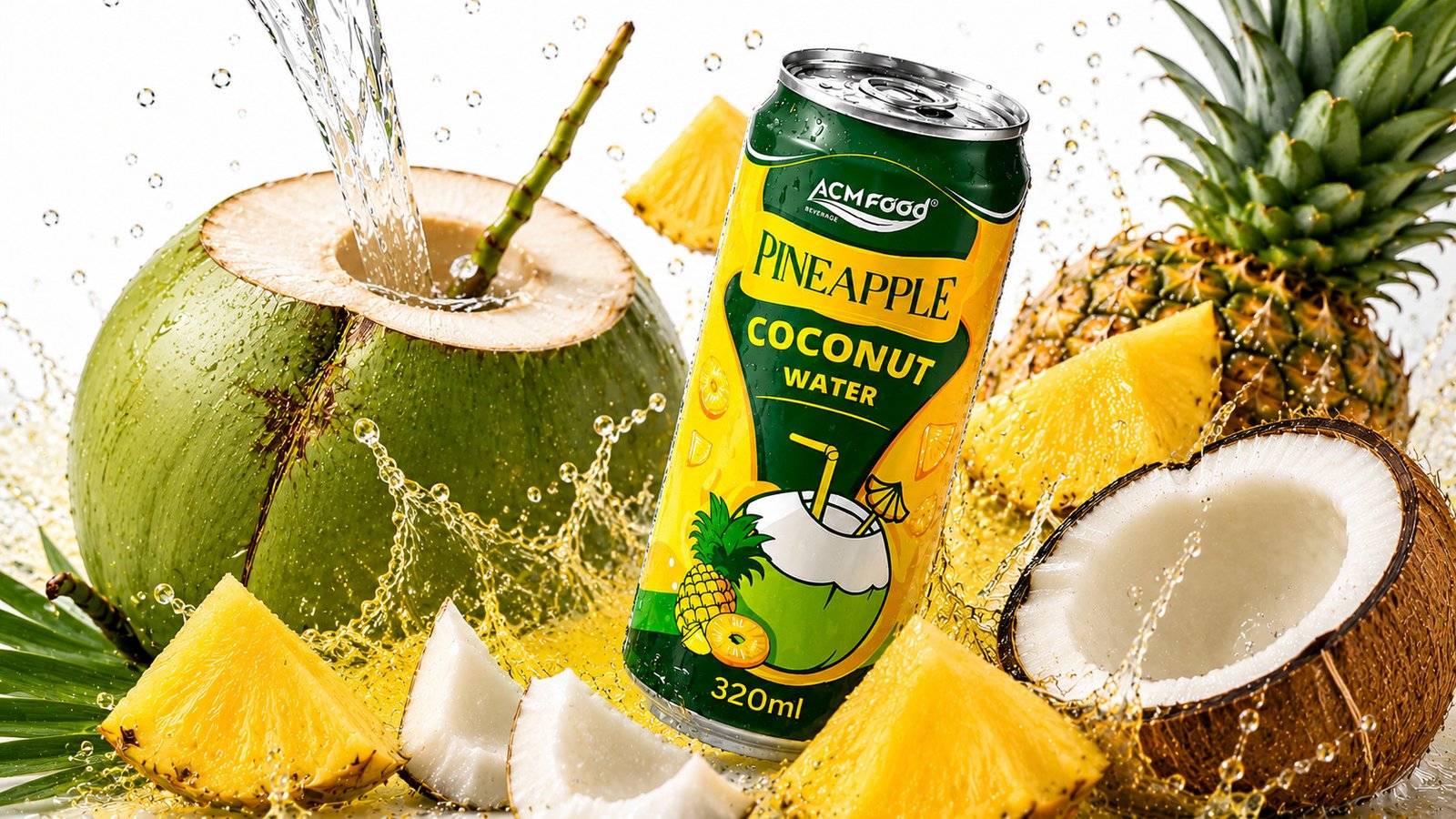
Start with what each ingredient does on its own. Coconut water delivers natural electrolytes — potassium (approximately 600 mg per cup), sodium, magnesium, and calcium — without the artificial additives that define most sports drinks. Pineapple juice brings something different: a bright, acidic sweetness, roughly 88% of the recommended daily intake of vitamin C per cup of pineapple, and bromelain, a group of enzymes with well-documented anti-inflammatory and digestive properties.
Together, pineapple and coconut water cover hydration, immune support, and post-exercise recovery in a single formulation. That’s not a marketing claim. That’s what the ingredients actually deliver. The flavor match is equally practical — the tartness of pineapple balances the mild sweetness of coconut water without either ingredient overwhelming the other. No masking agents, no artificial flavor boosters needed.
What strikes me every time I look at this category is how little work the product has to do to justify itself. The ingredients speak clearly. That’s rare in functional beverages.
The market numbers — and what they actually mean
The global pineapple coconut water market reached a valuation of $230 million in 2025 and is projected to expand to $449.6 million by 2034, at a compound annual growth rate of 7.8%. That figure matters because it represents consistent category growth across a decade-long forecast — not a post-pandemic spike or a social media moment. A 7.8% CAGR in a beverage subcategory with this much retail competition is a signal worth paying attention to.
North America holds the second-largest regional share at 28.7%, driven by health-conscious consumer demographics and premium beverage retail segments. Asia-Pacific leads overall, and for good reason — the region represents the dominant force, reflecting both production infrastructure and deep consumer familiarity with tropical juice formats.
Flavored coconut water has emerged as a leading segment, frequently blended with tropical fruits including pineapple, offering a natural, low-calorie alternative to conventional beverages. The trend isn’t toward more exotic combinations. It’s toward better execution of familiar ones. Pineapple coconut water hits that balance precisely.
What’s driving category growth beyond gym retail
The fitness recovery narrative is well-established for pineapple coconut juice. Coconut water rehydrates; bromelain reduces muscle inflammation; vitamin C from pineapple supports cellular recovery. That story is credible and well-suited to gym retail, sports nutrition specialty channels, and wellness-oriented convenience formats.
But the category is bigger than post-workout. Consumers — particularly millennials and health enthusiasts — are increasingly drawn to packaged coconut water for its ability to aid hydration, reduce fatigue, and provide essential nutrients, with the clean-label trend prompting brands to emphasize organic and non-GMO certifications. A well-formulated pineapple & coconut juice product, with an ingredient list that reads “coconut water, pineapple juice” and nothing else, sits squarely in this demand stream.
There’s also a morning occasion angle that’s underappreciated. In addition to post-exercise consumption, the combination of pineapple and coconut water makes a nutritious start to the day — fast-absorbing nutrients provide an energy kickstart, and pineapple’s vitamin C supports immune function. For retailers looking to move product outside the sports aisle, that morning positioning opens up a different placement conversation entirely.
The Ramadan consumption window in markets with large Muslim consumer populations — the Middle East, Southeast Asia, parts of Africa — is another opportunity that often gets missed in Western-centric category analysis. The hydration profile of coconut water pineapple juice maps directly onto the rapid rehydration need after long fasting periods, and the clean, natural formulation aligns with the ingredient consciousness that Halal-certified beverage buyers bring to sourcing decisions.
Not all pineapple coconut water drink products are equivalent, and the difference usually starts with sourcing decisions invisible on the finished label.
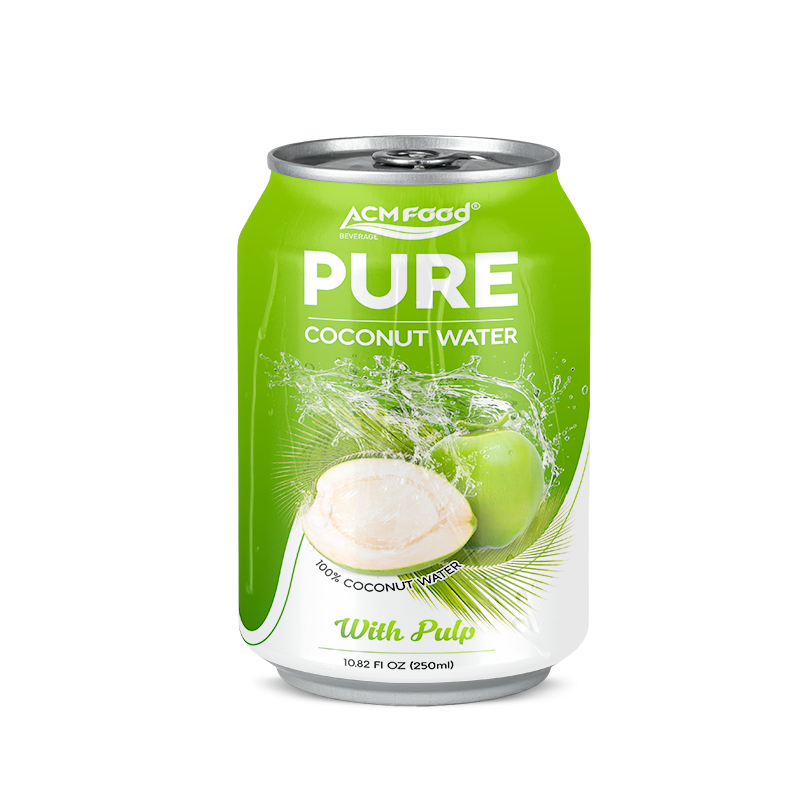
The first is fresh coconut water versus concentrate. Coconut water sourced as 100% natural from a single origin, never from concentrate or purée, delivers a meaningfully different flavor profile — and increasingly, buyers in the US, Europe, and Australia can tell. The label claim “not from concentrate” has moved from premium differentiation to category expectation in several markets. Any importer building a branded product at a mid-to-premium price point needs to verify this at the factory level, not just on the spec sheet.
The second is pineapple juice quality. Fresh-pressed pineapple juice versus pineapple juice from concentrate are not the same product. Fresh juice retains bromelain activity and delivers the bright, slightly floral flavor that makes this combination appealing. Concentrate often introduces a cooked sweetness that flattens the profile. The functional story of a pineapple and coconut juice product is only credible if the pineapple juice component actually contains active bromelain — which heat-treated concentrates frequently do not.
Third: sugar. A pineapple coconut water drink that relies on added sugar to hit its flavor target is a fundamentally different product from one that achieves sweetness entirely through ripe pineapple and the natural sugars present in young coconut water. The clean-label consumer knows this. The RTD buyer in Europe or North America will ask about it during product review.
Packaging format and shelf life for international distribution
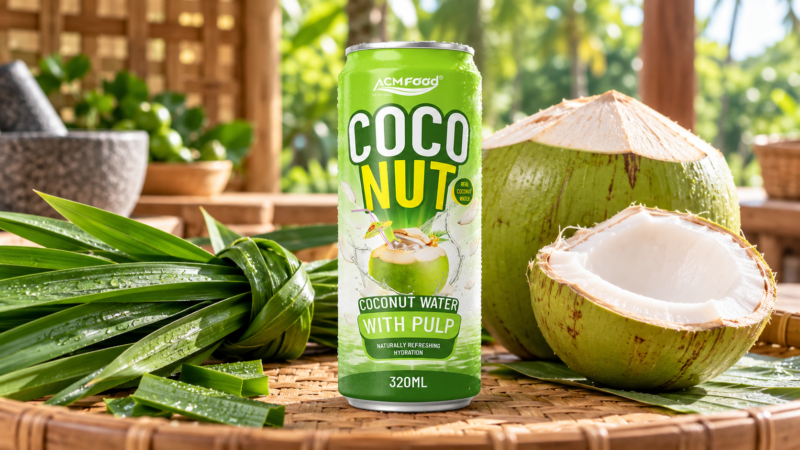
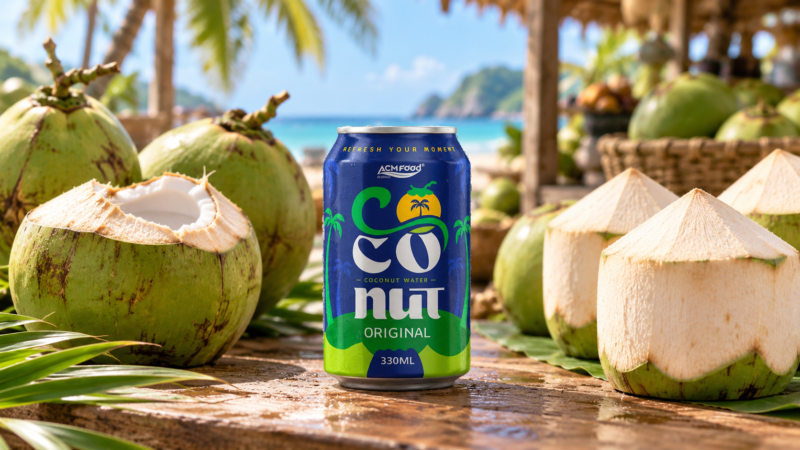
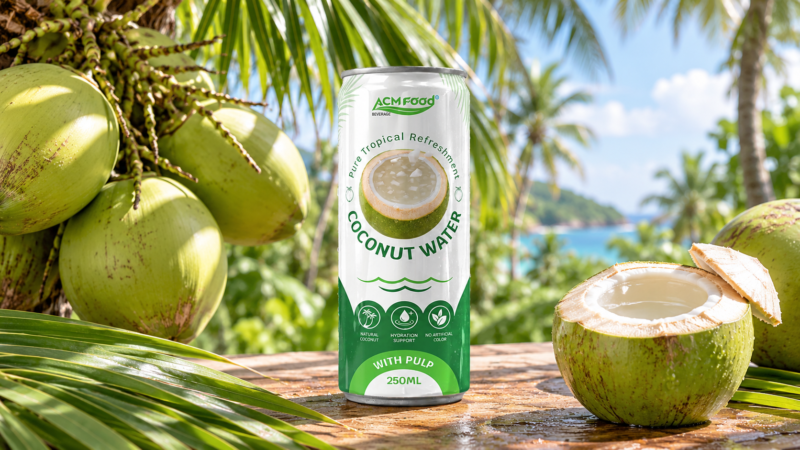
Canned format remains the strongest choice for pineapple coconut juice in international distribution. Cans exclude light entirely — important for preserving the delicate volatile compounds in fresh pineapple juice that degrade under UV exposure. They handle the pressure variations of multi-leg international freight without compromising the product inside. And they deliver a 12- to 18-month shelf life when properly sealed under nitrogen, giving importers the margin they need for distribution and retail sell-through.
Can size matters for positioning. 250 ml and 330 ml formats dominate convenience and impulse channels. 500 ml and larger formats suit gym retail and health food specialty, where consumers are purchasing for planned consumption rather than impulse. A capable OEM manufacturer can run both formats from the same base formulation, which gives importers flexibility across channel strategies without requiring separate supply relationships.
Sourcing coconut water pineapple juice from Vietnam
Vietnam is a natural sourcing origin for aloe and coconut water blends, but its credentials for pineapple and coconut water formulations are equally strong. The Mekong Delta produces high-quality young green coconuts year-round. Vietnam’s central and southern regions grow pineapple at commercial scale, and the country has invested heavily in food processing infrastructure over the past decade.
ACMFOOD Beverage Co., Ltd., based in Ho Chi Minh City, sits at a practical intersection of these supply advantages. As a specialist OEM/ODM manufacturer, ACMFOOD runs both pure coconut water and blended fruit juice product lines — meaning the formulation capability, ingredient sourcing, and production know-how for a coconut with pineapple juice SKU are already operational, not theoretical. Their modern factory in Tan Phu Trung Industrial Park operates under international certifications covering food safety, export compliance, and traceability — the documentation infrastructure that regulated markets in Europe, North America, and the Middle East require before a first purchase order is placed.
With a supply capacity of 20,000 cartons per day and an active export presence across more than 40 countries, ACMFOOD can support a brand from early market-entry volumes through to full distribution scale. That continuity matters: switching suppliers mid-growth introduces reformulation risk, re-certification costs, and the kind of supply inconsistency that damages retailer relationships. Importers who get the supply relationship right from the start avoid that problem entirely. For brands evaluating Vietnam as a sourcing origin for pineapple coconut water products, ACMFOOD is a manufacturer worth a direct conversation.
What to ask before committing to a supplier
A few questions that belong in any supplier qualification process for a pineapple coconut water drink.
Is the coconut water base fresh, not from concentrate — and can you provide third-party lab documentation confirming this? The claim needs to be verifiable, not just stated.
Is the pineapple juice fresh-pressed or from concentrate, and what is the processing temperature? Bromelain denatures above approximately 60°C. If your functional claim depends on enzyme activity, you need to know whether the processing temperature preserves it.
What is the Brix level of the finished product, and is any sweetener — including honey, sugar, or agave — added? For clean-label positioning, this determines whether the product can carry “no added sugar” claims in your target market.
What are the certifications covering the facility and the finished product for your specific target markets? Ask for names, certification bodies, and current validity dates — not a generic list.
Can you receive samples from a standard production run, not a specially prepared batch? The product needs to taste exactly like what will come off the line at full volume. A sample prepared for evaluation purposes tells you very little.
The sourcing case in brief
Pineapple coconut water is not chasing a trend. It’s a formulation built on two ingredients with independent, growing consumer recognition, a health narrative that holds up to scrutiny, and a flavor combination that needs no explanation to the consumer picking it up off the shelf.
For importers building or extending a tropical RTD portfolio, the category has real demand, real margin potential, and a sourcing path from Vietnam that is both accessible and well-supported by existing manufacturing capability. The combination is sound. The market is there. The question is whether the sourcing relationship is in place to move on it.
Data sources:
- Global pineapple coconut water market valuation and CAGR — DataIntelo, Global Pineapple Coconut Water Market Report
- Coconut water flavored segment trends — IMARC Group, Coconut Water Market Size & Forecast
- Consumer behavior and clean-label trends — Grand View Research, Coconut Water Market Report
Turning a trend into a product
For the categories, formats and ingredients the factory can actually run, see beverage product capabilities. The production side is covered under OEM beverage manufacturing services; to launch under your own label, see private label beverages. To brief a concept, request a quote.
Request a quote