


 Français
 Español
 العربية
 한국어
한국어A free sale certificate and a health certificate are two different export documents that buyers frequently confuse, and asking for the wrong one is a common cause of a delayed first shipment. A certificate of free sale confirms that the product is legally sold in the country of origin. A health certificate confirms that it is fit for human consumption and was produced under supervision.
They are issued by different authorities, they answer different questions, and some markets require both. This article separates them, explains which Vietnamese body issues each, and sets out how to plan the timing so that the paperwork is not the reason a container waits.

What is a certificate of free sale?
A certificate of free sale, usually abbreviated to CFS, states that the product is manufactured and freely sold on the domestic market of the exporting country. It is a commercial and regulatory attestation rather than a test result: it tells the importing authority that the goods are not restricted or prohibited where they are made.
Importing authorities use it as a first filter. If a product cannot be sold in its own country of origin, the question of whether it should be admitted elsewhere largely answers itself. Because the certificate speaks to legal status rather than to a specific consignment, it is typically issued for a product or a product range and remains valid for a defined period rather than being tied to one shipment.
What is a health certificate?
A health certificate, sometimes written as HC, attests that the product is fit for human consumption and that it was produced in a facility subject to food safety supervision. It is a food safety document rather than a commercial one, and it usually references the specific consignment or batch, which makes its role at the border quite different from that of a CFS.
Because it speaks to a consignment, a health certificate commonly carries details such as the product name, the quantity, the batch or lot identification, the manufacturing site and the destination. Some markets also expect specified test results to be referenced or attached. That consignment-specific character is why it cannot simply be reused across shipments in the way a CFS often can.
| Aspect | Certificate of free sale | Health certificate |
|---|---|---|
| Question it answers | Is this legally sold at origin? | Is this consignment fit for consumption? |
| Nature | Regulatory and commercial attestation | Food safety attestation |
| Scope | Usually product or product range | Usually consignment or batch |
| Reusable across shipments | Often, within its validity | Generally no |
| Typical supporting evidence | Business registration, product declaration | Test results, production records |
| Where it is used | Product registration and market entry | Customs clearance of a shipment |

Who issues each one in Vietnam?
The two documents come from different parts of government, which is the practical reason they cannot be requested in a single application.
The health certificate for exported food and beverage products is issued by the food safety authority under the Ministry of Health. The application is made per consignment or per product as required, and it is supported by test results from a recognised laboratory together with the production documentation for the goods in question.
The certificate of free sale is issued by the line ministry responsible for the product category. For processed foods and non-alcoholic beverages this sits with the Ministry of Industry and Trade rather than with the health authority. The application relies on the manufacturer’s registration, the product self-declaration and evidence that the goods are on sale domestically.
Because responsibility is allocated by product category and that allocation is periodically revised, it is worth confirming the current issuing body for your specific product before preparing an application rather than relying on a precedent from a different category.
Which markets ask for which?
There is no single rule, and the requirement often depends on the stage rather than the market. Registration and market entry tend to call for a certificate of free sale; routine clearance of a shipment tends to call for a health certificate where one is required at all.
- Gulf states. Both documents are commonly requested, often with legalisation, alongside the other requirements described in GCC beverage import requirements.
- Middle East and North Africa more broadly. A free sale certificate is frequently part of the registration dossier.
- Several Asian markets. A health certificate is commonly expected for food consignments, with the format sometimes prescribed by the importing authority.
- European Union. For most non-animal-origin beverages neither document is routinely required at the border, though a buyer may still request one for their own due diligence.
- United States. Neither is generally a border requirement for these products, although the importer may ask for a CFS to support a commercial or registration process.
The reliable approach is to ask the importer to state, in writing, exactly which documents their customs authority requires and in what form. A request for a document a market does not need is common, and so is the reverse.
How long do they take?
Both are administrative processes with defined procedures, and the elapsed time is driven mainly by how complete the application is when it is submitted. A dossier that arrives with the required test results, registration evidence and product declarations attached moves through the process; one that triggers a request for further information restarts the clock.
Rather than planning against a fixed number of days, plan against the sequence. The health certificate cannot be applied for until the goods exist and have been tested, which places it late in the production schedule and close to the shipping date. The free sale certificate can usually be obtained ahead of any specific order, which makes it the one to arrange early and keep on file.
Two additional steps extend the timeline where they apply. Legalisation, in which the document is authenticated by a consulate or under an apostille arrangement, adds a separate process after issue. Translation into the language of the destination, where required, adds another. Neither can begin until the certificate itself is in hand, so both sit on the critical path. Confirm the current processing time with the issuing authority when planning, since published timeframes are revised from time to time.
What the buyer should send you before you apply
Most wasted applications come from starting before the requirement is pinned down. A short written brief from the importer prevents the common outcome in which a certificate is issued correctly and then turns out to be the wrong instrument, the wrong scope or in the wrong form.
Four items are usually enough. The first is the exact document name as their authority uses it, because local terminology does not always map onto the English names. The second is whether a prescribed format or template must be followed, since some authorities will only accept their own wording. The third is whether legalisation is required and by which consulate, as this determines where the document travels after issue. The fourth is the exact product description and quantity to be stated, so that the certificate reconciles with the invoice from the outset.
Obtaining those four in an email before the application is prepared costs a day and regularly saves a full reissue cycle.
What usually goes wrong
The failures are rarely about the substance of the product. They are about detail that does not match across the document set.
- Names that do not match. The product name on the certificate must correspond to the name on the invoice, the packing list and the label. A marketing name on one and a technical name on another causes a query.
- Expired validity. A free sale certificate has a validity period, and buyers sometimes hold one beyond it because the product has not changed.
- Missing legalisation. The certificate is genuine but has not been authenticated in the form the destination requires.
- Wrong scope. A certificate covering one product is submitted for a consignment that includes variants not listed on it.
- Consignment details that do not reconcile. Quantities or batch codes on a health certificate that differ from the packing list will stop a clearance.
Each of these is avoidable with a single reconciliation step before the documents are couriered: lay the certificate, the invoice, the packing list and the label side by side and check that the product name, quantity and batch identification agree.
How they fit the wider export file
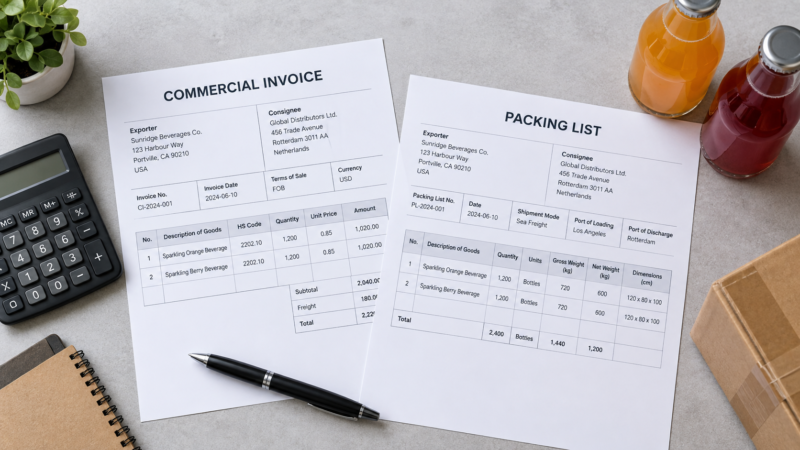
These two certificates sit inside a larger set of documents that travel with a beverage shipment. The commercial invoice and packing list describe the transaction, the bill of lading covers the carriage, the certificate of origin supports any preferential duty claim, and the analytical documentation evidences conformity with the agreed specification.
The origin document in particular is often confused with the free sale certificate, because both are issued by a government-linked body and both speak to the country of manufacture. They serve entirely different purposes: origin determines duty treatment, free sale determines legal status. The origin document is covered separately in the article on the certificate of origin for Vietnamese exports.
Buyers assembling a full supplier file will typically ask for these certificates alongside the food safety certification and specification documents listed in the document pack buyers need, and the overall import sequence is set out in the guide to importing beverages from Vietnam.

Frequently asked questions
Do I need both documents?
It depends on the destination and on the stage. Some markets require a free sale certificate for product registration and a health certificate for each consignment, others require only one, and several require neither for non-alcoholic beverages. Ask the importer to confirm against their own customs requirements.
Can one certificate cover several products?
A free sale certificate can often list several products from the same manufacturer, provided all of them are covered by the application. A health certificate is normally tied to a specific consignment, so it lists what is actually in that shipment rather than a product range.
What is legalisation and when is it needed?
Legalisation is an authentication step that confirms a document and the signature on it are genuine, carried out by a consulate or under an apostille arrangement depending on the countries involved. Several markets require it, and because it happens after issue it must be built into the timeline rather than added at the end.
Who applies for the certificates?
The exporter or manufacturer applies in the country of origin, because the applications rely on domestic registration and production records. The importer specifies what is needed and in what form, so the two sides have to agree the requirement before the application is made.
Planning the documents rather than reacting to them
The distinction is straightforward once separated: free sale speaks to legal status and can usually be arranged in advance, while a health certificate speaks to a consignment and is necessarily prepared close to shipment. Most delays come from discovering the requirement late or from details that do not reconcile across the document set.
The practical approach for a first order is to confirm the exact requirement with the importer in writing, obtain the free sale certificate early and keep it on file, and build the health certificate application into the production schedule alongside the release testing. Further guidance on assembling the full export file is collected in the compliance and export article series.