


 Français
 Español
 العربية
 한국어
한국어GCC beverage import requirements are the rules that govern how drinks enter Gulf markets, focusing on GSO standards, Arabic labelling, Halal expectations and product documentation across five core countries in scope here. Expect bilingual labels in two languages and structured pre-approvals enforced through national portals.
This cornerstone guide explains how the Gulf Standardization Organization (GSO) framework is applied to drinks, what Arabic & English labels must contain, when Halal certification is expected, how shelf life is assessed on arrival, and what to prepare for Saudi, UAE/Dubai, Qatar, Kuwait and Oman. It also offers a practical workflow and checklists for importers and brands.
What are the core GCC beverage import requirements?
At a high level, GCC beverage import requirements include conformity with the Gulf Standardization Organization (GSO) framework, bilingual Arabic–English labelling, Halal suitability or certification where relevant, and successful completion of each country’s importer and product registration. On arrival, shipments are checked against documents and may be sampled for lab tests before release.
While the GCC shares many common requirements via GSO, each state enforces them through its own competent authority and online portals. Importers should plan for advance registration, accurate documentation and labels that meet both shared and country-specific rules.
How does the GSO framework apply to drinks?
The Gulf Standardization Organization publishes Gulf standards and technical regulations used across GCC states. For beverages, these standards typically cover definitions, ingredient permissions, additives, labelling, date coding and certain product categories (for example juices, nectars, flavored drinks or energy drinks). GCC countries adopt GSO texts and then implement them through national legislation, circulars and guidance.
What this means for beverage brands and importers:
- Common baseline: Core label elements, date formats and terminology are harmonized under GSO, supporting cross-border consistency.
- National enforcement: Authorities in Saudi Arabia, UAE, Qatar, Kuwait and Oman issue their own practice guides, circulars and electronic procedures. Compliance is assessed at the national border and in local markets.
- Category-specific expectations: Some drink types (e.g., juices vs. juice drinks, caffeinated beverages) can carry additional requirements on naming, composition or warnings under GSO-derived or national rules.
Successful market entry typically depends on two pillars: (1) meeting the GSO-aligned content rules, and (2) completing each country’s registrations, documentary steps and controls.
What must appear on Arabic & English beverage labels?
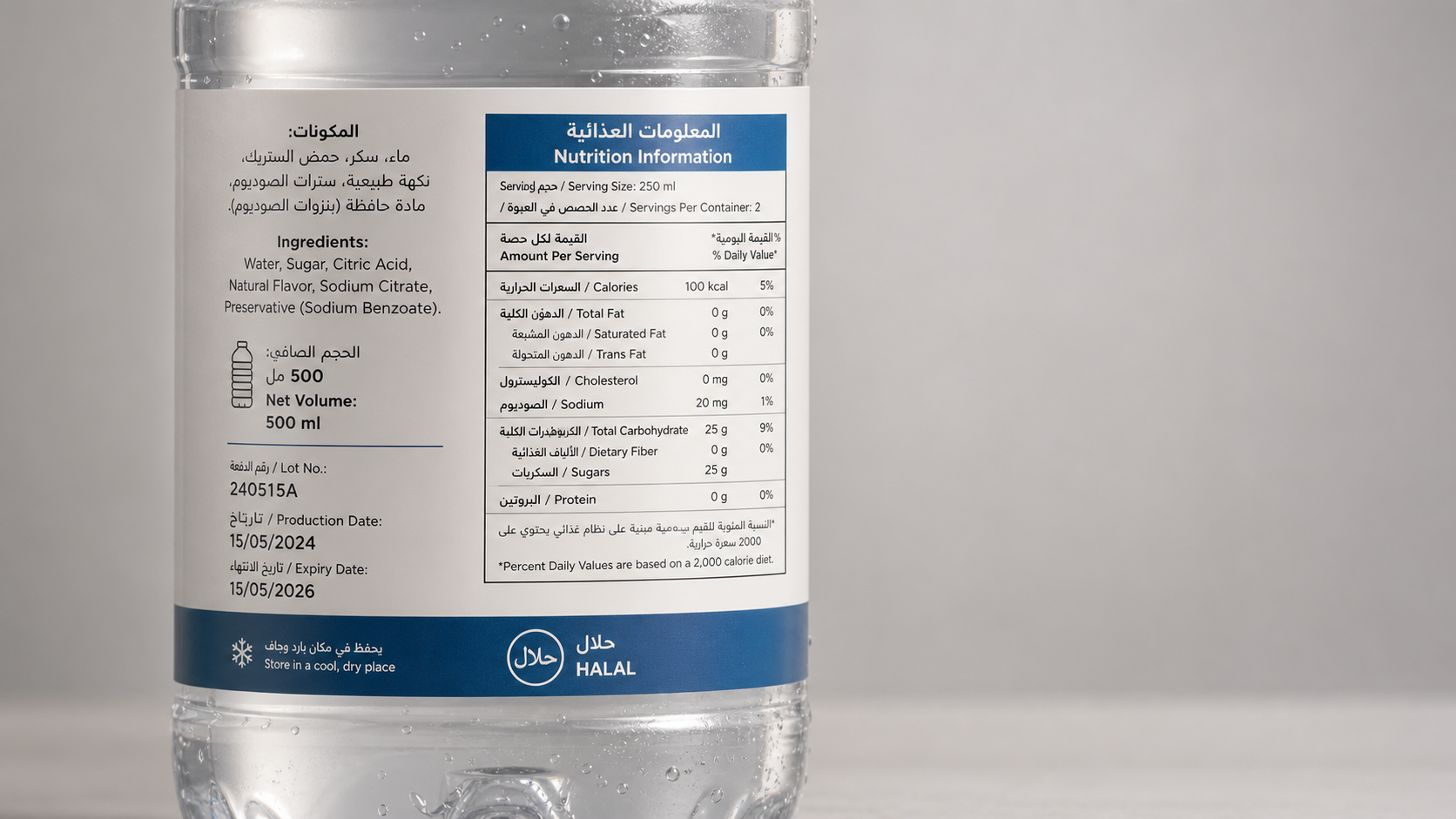
Labels generally need to be in Arabic and English. The Arabic content should be complete, correct and legible; English is typically accepted as a second language for international products. At minimum, a compliant GCC beverage label usually includes:
- Product name that matches the drink type as sold (e.g., 100% juice, nectar, flavored drink).
- Ingredients list in descending order by weight, including sub-ingredients where applicable.
- Allergen declarations where relevant, using clear terminology understood by local consumers.
- Net content in metric units (mL, L, g), expressed consistently across all panels.
- Producer or brand owner details and country of origin. Local importer details are typically required on the label or via an approved sticker.
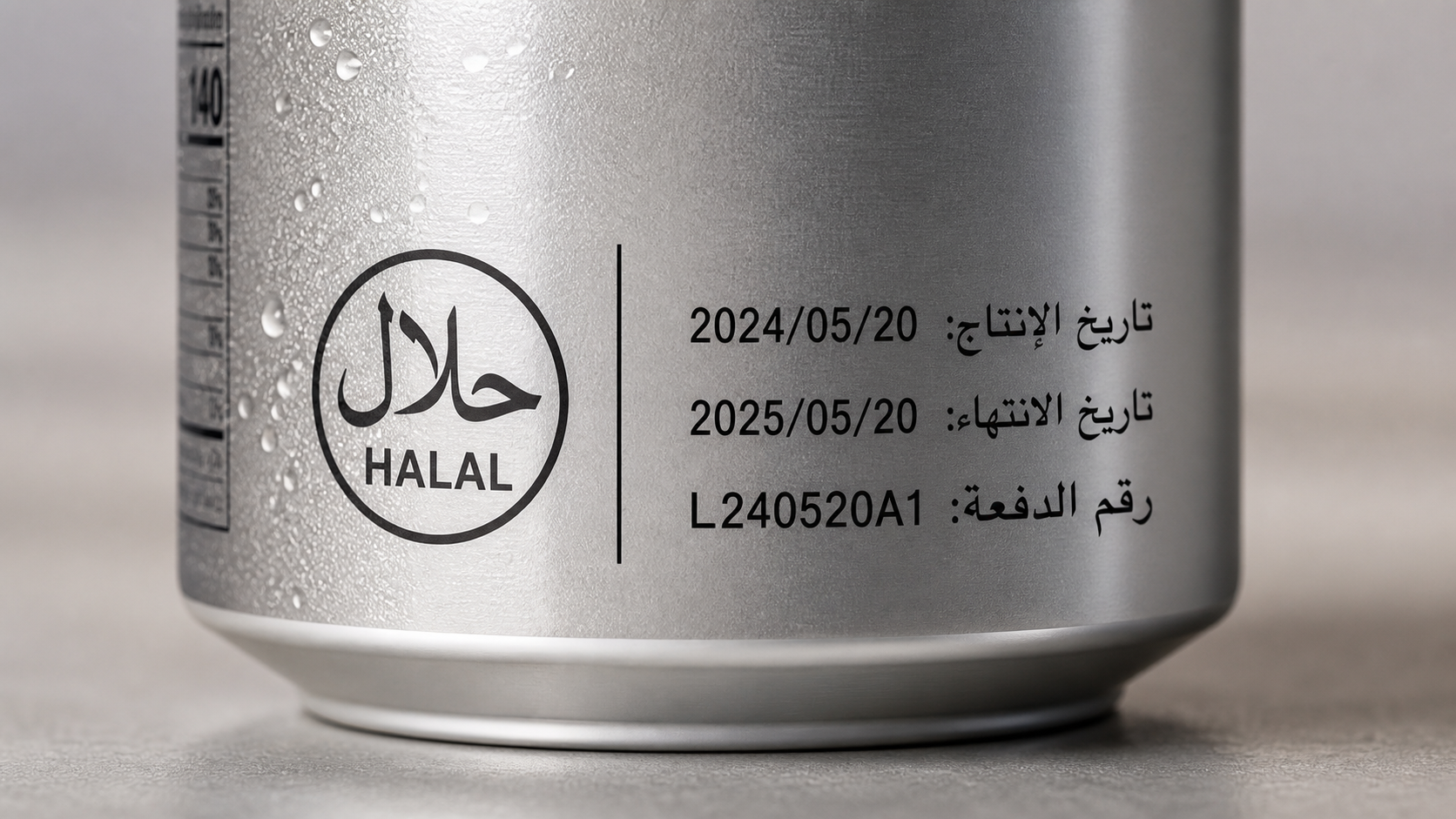
- Production and expiry/best-before dates in a clear, non-ambiguous format, usually together with a lot/batch code.
- Storage conditions and any handling instructions (e.g., refrigerate after opening; shake well).
- Claims and descriptions that are accurate and consistent with GSO/national rules (avoid medicinal or therapeutic claims).
- Nutrition information if required or if you choose to present it, formatted to local expectations.
- Halal statement or mark if the market or channel expects visible Halal suitability; practices vary by country and retailer.
Print quality, contrast and the permanence of labelling (including Arabic) should be adequate for normal distribution. Some ports accept compliant Arabic stickers placed before retail sale; others expect Arabic to be part of the original label. Confirm with your importer for each destination.
How should date coding and shelf-life be presented and managed?
Use clear production and expiry/best-before dates with a non-ambiguous order, and keep the date language aligned to Arabic and English. Avoid formats that can be misread (e.g., month/day vs. day/month without context) and ensure lot codes tie back to your production records.
Customs and food authorities commonly evaluate whether a shipment’s remaining shelf life is adequate upon arrival. The exact expectation can differ by authority and product type. To reduce risk, plan conservative logistics timelines, protect temperature-sensitive drinks, and coordinate sailing dates so goods land with a comfortable remaining life agreed with your importer.
For short-life chilled products, align production runs with sailing schedules and port processing capacity. For ambient drinks, validate shelf-life through stability testing and protect against heat exposure during transit across hot seasons.
Halal for beverages in the Gulf: what actually matters?
For most non-alcoholic, plant-based beverages, Halal suitability is often straightforward when formulations and processes avoid prohibited ingredients and contamination. Many buyers and ports expect documentary proof of Halal conformity; in some markets, recognized Halal certification is routinely requested for imports or retail listings.
Key points for beverage teams:
- Formulation: Avoid alcohol, non-Halal animal derivatives and cross-contamination risks from shared equipment or processing aids.
- Certification: Depending on country and channel, a Halal certificate from a recognized body may be required for import clearance or for retail acceptance. Importers can advise which certification bodies are recognized.
- Labelling: If you place a Halal logo, ensure it matches your certificate details and market expectations. Keep Halal claims conservative and document-supported.
Because Halal acceptance is both regulatory and commercial, map requirements early with your importer and confirm which certificates and marks are expected for your category.
Pre-approvals and import registration by country
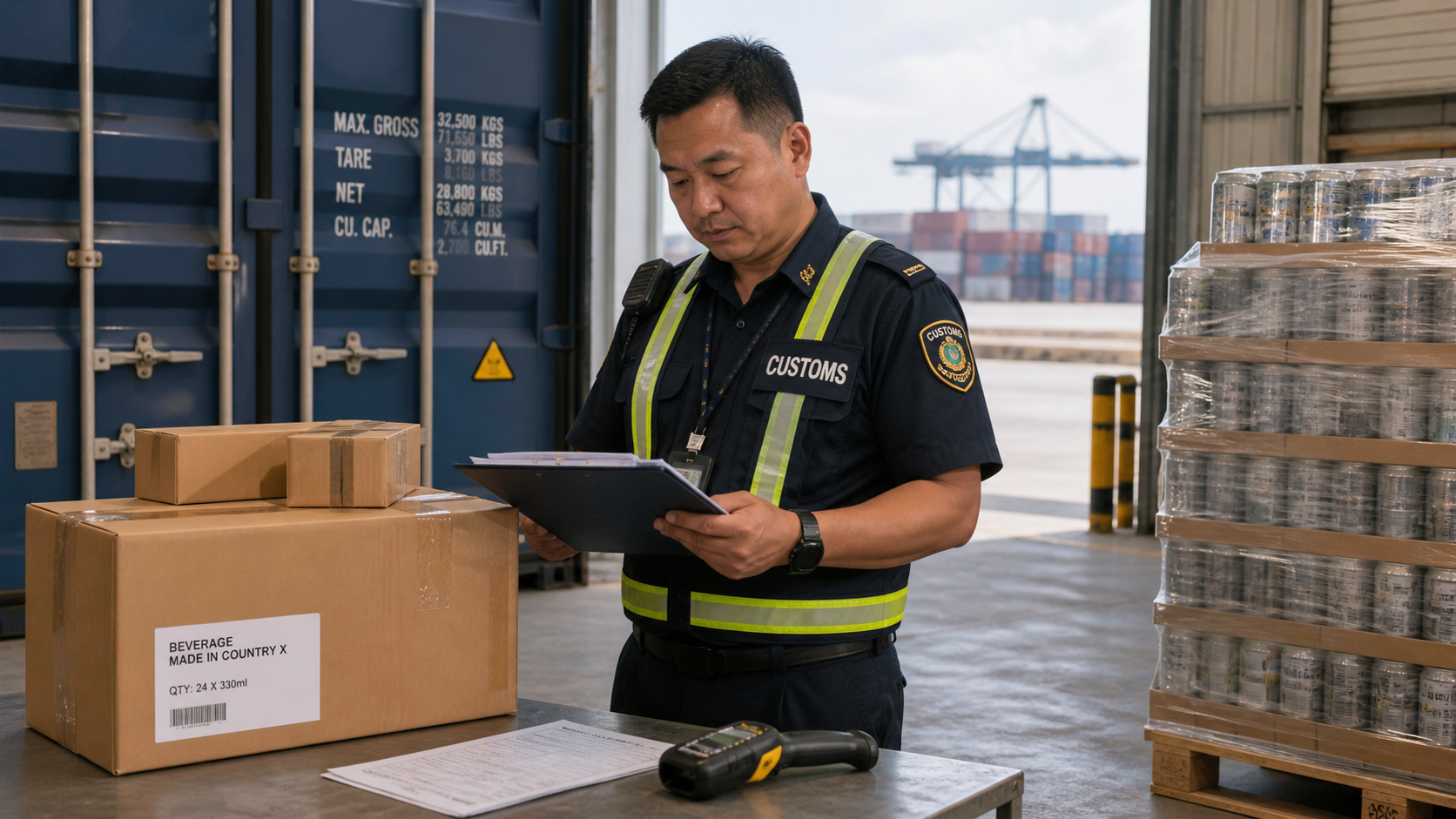
Across the GCC, importers usually register themselves and then register products with the competent authority. Expect online portals for document submission, label files, ingredient disclosures and certificates. Below is a practical view of how this works in the five focus markets.
Saudi Arabia (SFDA & SABER)
Saudi Food & Drug Authority (SFDA) oversees food safety, labelling compliance and market controls. Importers typically register with SFDA and provide documentation for each product. The SABER platform is used nationally for product conformity for regulated items; importers can advise whether a beverage, its contact packaging or associated items require SABER entries. Expect customs to verify documents, and shipments may be sampled for lab tests on arrival.
United Arab Emirates (Dubai FIRS)
In the UAE, food import is managed through national and emirate systems. Dubai uses the Food Import & Re-export System (FIRS) for importer registration, product assessment and consignment clearance. Expect to upload label artwork, ingredient breakdowns, certificates and laboratory reports if requested. Other emirates operate comparable procedures to register products and manage border inspections.
Kuwait applies food import controls through its national food authority and customs. The Kuwait Conformity Assurance Scheme (KUCAS) governs regulated products; your importer will confirm whether any element of your beverage or its associated packaging or equipment falls under KUCAS oversight. Separately, food-specific labelling and safety checks apply to beverages at import and in market.
Qatar
In Qatar, the competent authorities register importers, assess product documentation and inspect consignments at entry. Expect to submit bilingual labels, ingredient details, certificates and testing evidence where needed. Municipal or ministerial systems may be used for approvals and release.
Oman
Oman implements GSO-aligned food laws with importer registration, product assessment and documentary controls at the border. As elsewhere, Arabic labelling, Halal suitability and correct date coding are core elements; authorities may sample shipments for verification.
A note on Iraq
Although not part of the GCC, Iraq often expects Arabic labelling and documentary controls with food safety checks. Do not assume full GSO alignment; instead, confirm the exact Iraqi requirements with your importer and plan labels and documents accordingly.
GCC beverage compliance at a glance
The table summarizes common elements and national touchpoints for quick planning. Always confirm specifics with your importer for the target port and category.
| Market | Main authority / portal | Typical focus | Positioning & notes |
|---|---|---|---|
| Saudi Arabia | SFDA; SABER (where applicable) | Importer & product registration; Arabic labels; Halal suitability | Expect documentary checks and potential sampling on arrival |
| UAE (Dubai) | Food Import & Re-export System (FIRS) | Label review; product records; consignment clearance | Upload label artwork and product data before shipments |
| Kuwait | National food authority; KUCAS for regulated items | Arabic labels; documentary controls; lab testing if needed | Confirm any KUCAS touchpoints with your importer |
| Qatar | National/municipal food systems | Importer & product registration; Arabic labelling | Check consignment-specific lab test expectations |
| Oman | National food safety & customs systems | Arabic labels; Halal suitability; date coding | Coordinate with importer for pre-approvals |
Formulation considerations under GSO and national rules
GSO-aligned regulations and national rules focus on truthful composition, permitted additives and safe manufacturing. For beverages, plan your formulation around these pillars:
- Category alignment: Ensure your declared drink type (e.g., 100% juice, nectar, flavored beverage) matches composition expectations, such as minimum fruit content for certain categories under GSO-derived rules.
- Permitted additives: Colors, preservatives, stabilizers, sweeteners and acidity regulators must be allowed for the target category. Keep a clean dossier listing E-numbers or additive names that match local permissions.
- Caffeine and sensitive ingredients: Caffeine, herbal extracts and novel ingredients attract extra scrutiny. Provide full documentation, safe-use rationale and clear label statements where required.
- Alcohol-free processing: Avoid any alcohol carryover, non-Halal derivatives or cross-contact from shared equipment. Document cleaning and segregation practices.
- Allergens & cross-contact: Declare allergens appropriately and substantiate any “free-from” statements with your quality controls and testing.
During product registration, authorities often ask for detailed ingredient lists, additive justifications, production flowcharts and specifications. Preparing these docs in advance shortens approval timelines.
Packaging, language and readability
Authorities look for permanent, legible and accurate information presented in Arabic and English. Consider the following labelling practices for GCC entry:
- Arabic coverage: Provide complete Arabic translations for the product name, ingredients, allergens, net content, dates, storage and importer details.
- Permanence: Some ports accept Arabic stickers applied prior to retail sale; others want Arabic in the original artwork. Confirm the latest practice per destination.
- Metric units only: Declare volumes and weights in metric; avoid dual-unit clutter that reduces legibility.
- Contrast & font size: Ensure labels are readable in typical store lighting. High-contrast backgrounds improve reviews and border checks.
- Consistent nomenclature: Use consistent naming for ingredients and coloring agents across the label and registration docs.
- Legible date marks: Date codes should be easy to locate and interpret, supported by Arabic and English wording.
For multi-market packs, lock designs that satisfy the strictest shared expectations, and allow a controlled area for importer details to vary by country.
Logistics and documents for GCC customs clearance
Customs and food authorities verify importer and product registration and check that documents match the shipment. Expect a core pack of commercial and product-safety documents, often submitted electronically before arrival:
- Commercial invoice with accurate HS code and product descriptions.
- Packing list detailing units, cases, lot codes and palletization where helpful.
- Certificate of origin issued by your chamber or authorized body.
- Health or sanitary certificate (or manufacturer declaration) as requested by the authority, aligned to the beverage type.
- Halal certificate from a recognized body when required.
- Product registration approvals and any test reports referenced in pre-approval.
- Transport documents (BL/AWB) matching the importer’s license and portal entries.
On arrival, authorities may sample consignments for laboratory testing (microbiological safety, composition, additives or contaminant screening). Keep master documents synchronized with what is printed on the labels to avoid discrepancies.
Quality checks and lab testing on arrival
Border checks commonly include physical inspection, label verification and sampling for laboratory analysis where warranted. Labs may verify absence of undeclared ingredients, compliance of permitted additives, basic microbiological safety parameters and alignment of declared sugar or juice content with the category.
Good preparation minimizes delays:
- Submit complete, consistent dossiers during product registration.
- Ensure shipping marks, lot codes and case labelling match the paperwork.
- Use temperature-controlled logistics where needed, with data logging for sensitive drinks.
- Keep retain samples and certificates readily accessible for importer uploads.
Common mistakes and how to avoid them
Several recurring issues cause avoidable rejections or delays. Build your workflow to prevent them:
- Incomplete Arabic: Translating only the product name but not ingredients or storage instructions. Provide full bilingual content.
- Ambiguous dates: Using formats that can be misread. Present production and expiry with clear wording and logical order.
- Unsubstantiated claims: Printing nutrition or quality claims that are not documented. Keep claim substantiation files ready.
- Disallowed additives: Re-using a global formula with an additive that is not permitted in the target category. Cross-check with GSO/national rules.
- Late pre-approvals: Shipping before product registration is finalized. Align production with confirmed approvals and sailing schedules.
- Sticker quality: Arabic stickers that peel or obscure mandatory information. Use durable materials and place stickers without blocking critical text.
- Importer mismatch: Documents referencing a different importer than the one listed in the portal. Verify all entries before vessel departure.
Practical workflow for importers and beverage brands
Use this sequence to reduce risk and compress timelines:
- Define product scope: Drink type, flavor range, pack sizes and target GCC markets. Decide whether a single multi-market label can serve all, or if you need market-specific variants.
- Formulation review: Check ingredients and additives against GSO-aligned permissions for your category. Validate caffeine or botanicals where relevant.
- Halal mapping: Confirm if your channel needs Halal certification and which bodies are recognized. Align label marks with your certificate.
- Label build: Prepare Arabic & English content, agree final date coding, importer fields and any claims. Run a formal label compliance review.
- Importer & product registration: Your importer completes portal registrations (e.g., SFDA/SABER, FIRS), uploads label files and product dossiers.
- Pilot testing: Ship a controlled first consignment once approvals are live. Monitor lab results and border processing times.
- Scale-up: Align production cadence, sailing windows and shelf-life buffers. Keep a change-control process for any label or formula updates.
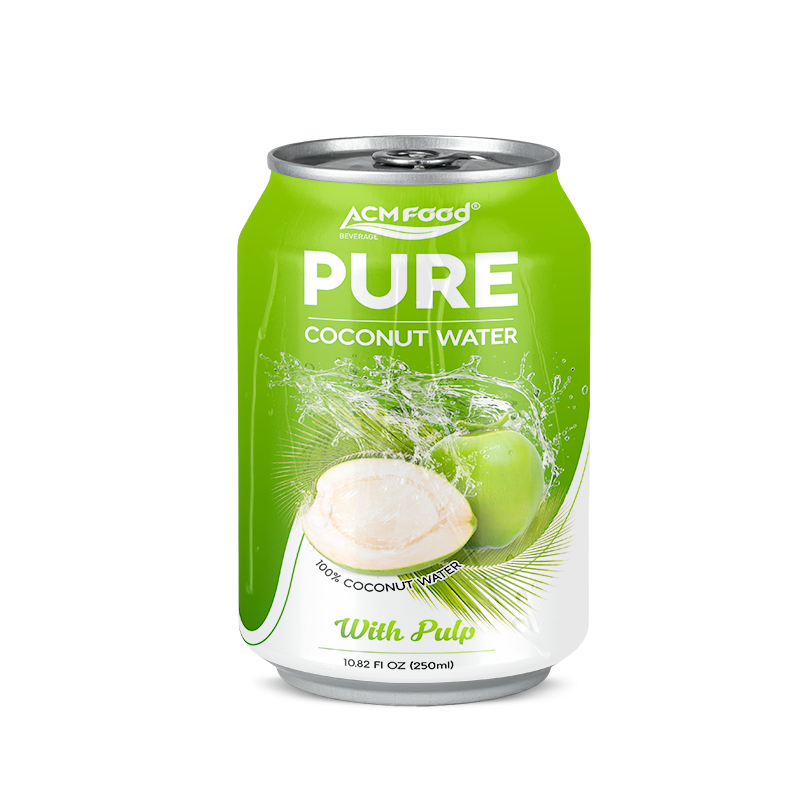
If you are evaluating ready-to-drink coconut water or adjacent categories for the Gulf, see how product-market fit and positioning translate into compliant packs and reliable supply via these resources:
- OEM and private label coconut water supply for end-to-end development and manufacturing options.
- Premium coconut water private label options to position an elevated SKU within Gulf retail.
- Pure coconut water opportunities for international buyers in 2026 for forward planning and assortment strategy.
- The rise of carbonated coconut water in global ready-to-drink markets for carbonation-led innovation ideas relevant to Gulf shoppers.
- Sea moss beverage opportunities for Gulf buyers to assess a functional category’s compliance and positioning steps.
Timelines and cost planning
Lead times depend on the product category, completeness of dossiers and portal processing workloads. Plan adequate buffers for label translations, importer registrations and any lab tests that might be requested before or after landing. Build your commercial plan around conservative first shipments and iterate toward faster cycles as the product’s compliance record builds.
For cost modelling, capture the following line items and validate with your importer and logistics partners:
- Label translations, design revisions and print plate changes.
- Halal certification and renewals where applicable.
- Portal registration and approval fees borne by the importer or brand.
- Laboratory testing pre-shipment or on arrival, as required.
- Port handling, customs brokerage and storage during inspections.
- Temperature-controlled freight or reefer surcharges for sensitive SKUs.
Documentation checklist for GCC beverage imports
Use this as a working list and adapt to each country and category:
- Up-to-date product dossier (formula, additive list, specifications, flowchart).
- Final Arabic & English label artwork with legible date code and lot code conventions.
- Importer licences and active portal registrations for the destination market.
- Halal certificate where required for the category/channel.
- Health/sanitary certificate or manufacturer declaration consistent with local practice.
- Commercial invoice, packing list, certificate of origin, BL/AWB.
- Any pre-approval letters or laboratory reports referenced during product registration.
Risk controls for hot-weather logistics
Given Gulf climates, heat exposure in transit and at port can compromise beverages. Build controls into your operations:
- Use insulated or refrigerated containers for sensitive products.
- Specify loading times to avoid peak heat; monitor temperatures with data loggers.
- Choose liners, pallets and shrink films rated for the route’s conditions.
- Agree with your importer on contingency storage if inspections extend beyond plan.
Label change management and post-market surveillance
Once listed, maintain a documented change-control process. Any change to ingredients, additives, allergens, claims, dates, importer details or artwork may require portal updates or re-approvals. Keep samples, certificates and test records ready for post-market checks. Track and respond to any authority feedback to protect continuity of supply.
Summary for decision-makers
GCC beverage import requirements revolve around GSO-aligned labelling and formulation rules, Arabic and English label delivery, Halal suitability or certification, and country-specific registrations that culminate in documentary checks and possible lab testing on arrival. With disciplined dossier preparation, careful date coding and realistic logistics buffers, brands can scale reliable Gulf distribution while maintaining compliance.
FAQ: GCC beverage import requirements
Do GCC countries accept English-only beverage labels?
No. Arabic labelling is expected across GCC markets, with English commonly accepted as a second language. Provide complete Arabic for product name, ingredients, net content, dates, storage and importer details.
Is a Halal logo mandatory on every beverage?
Not in every case, but many ports, buyers or retailers expect visible Halal suitability for drinks that may raise questions. Your importer can confirm whether a recognized Halal certificate and on-pack mark are required for your category and channel.
Can we use Arabic stickers instead of reprinting labels?
Some ports accept compliant Arabic stickers placed before retail sale; others prefer Arabic to be part of the original artwork. Confirm the latest practice for each destination and ensure stickers are durable and do not obscure mandatory information.
How much remaining shelf life must a shipment have on arrival?
Authorities look for an adequate remaining shelf life, but the exact expectation varies by country, port and product type. Align a clear target with your importer, plan conservative shipping windows and protect temperature-sensitive SKUs.
Which documents are usually required for beverage imports?
Expect a commercial invoice, packing list, certificate of origin, health or sanitary certificate as requested, Halal certificate where needed, transport documents and product registration records through the relevant portal.
What is the role of SABER in Saudi Arabia?
SABER is a national platform used to manage conformity assessment for regulated products. Your importer will confirm whether your beverage, its contact packaging or associated items require SABER entries, in addition to SFDA product records.
What is FIRS in Dubai?
The Food Import & Re-export System (FIRS) is Dubai’s online system for importer registration, product assessment and consignment handling. You will submit labels, product data and certificates through FIRS before shipments are cleared.
Does Kuwait’s KUCAS apply to beverages?
KUCAS governs regulated products; applicability to beverages depends on the specific item and any associated materials or equipment. Your importer will confirm KUCAS touchpoints. Separately, food safety and labelling controls apply to drinks.
Can QR codes replace full ingredient lists?
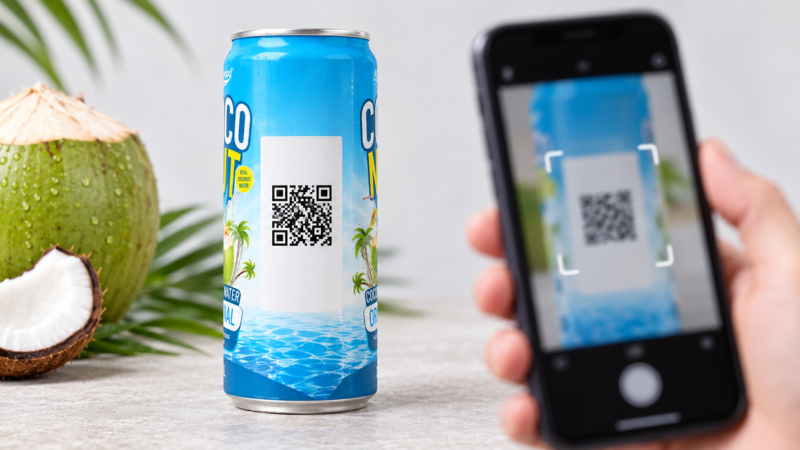
QR codes may supplement information, but mandatory on-pack details must still appear in Arabic and English in a permanent, legible manner. Do not replace legally required text with online-only content.
Are GCC rules the same for all drink types?
Core principles are shared, but category-specific expectations can apply (for example, naming conventions, additive permissions or warnings). Verify the rules for your exact drink type before finalizing labels.
How should we plan first shipments?
Complete importer and product registrations, finalize Arabic–English labels, align Halal documentation, agree on shelf-life targets with your importer, and time sailings to land with a comfortable buffer. Pilot a controlled first consignment before scaling up.
Ready to build a GCC-compliant beverage? Align formulation, labelling and documents early with your importer, then pilot shipments and scale with disciplined change control. For category development ideas, explore the OEM, private label and positioning resources linked above.