



 Français
 Español
 العربية
 한국어
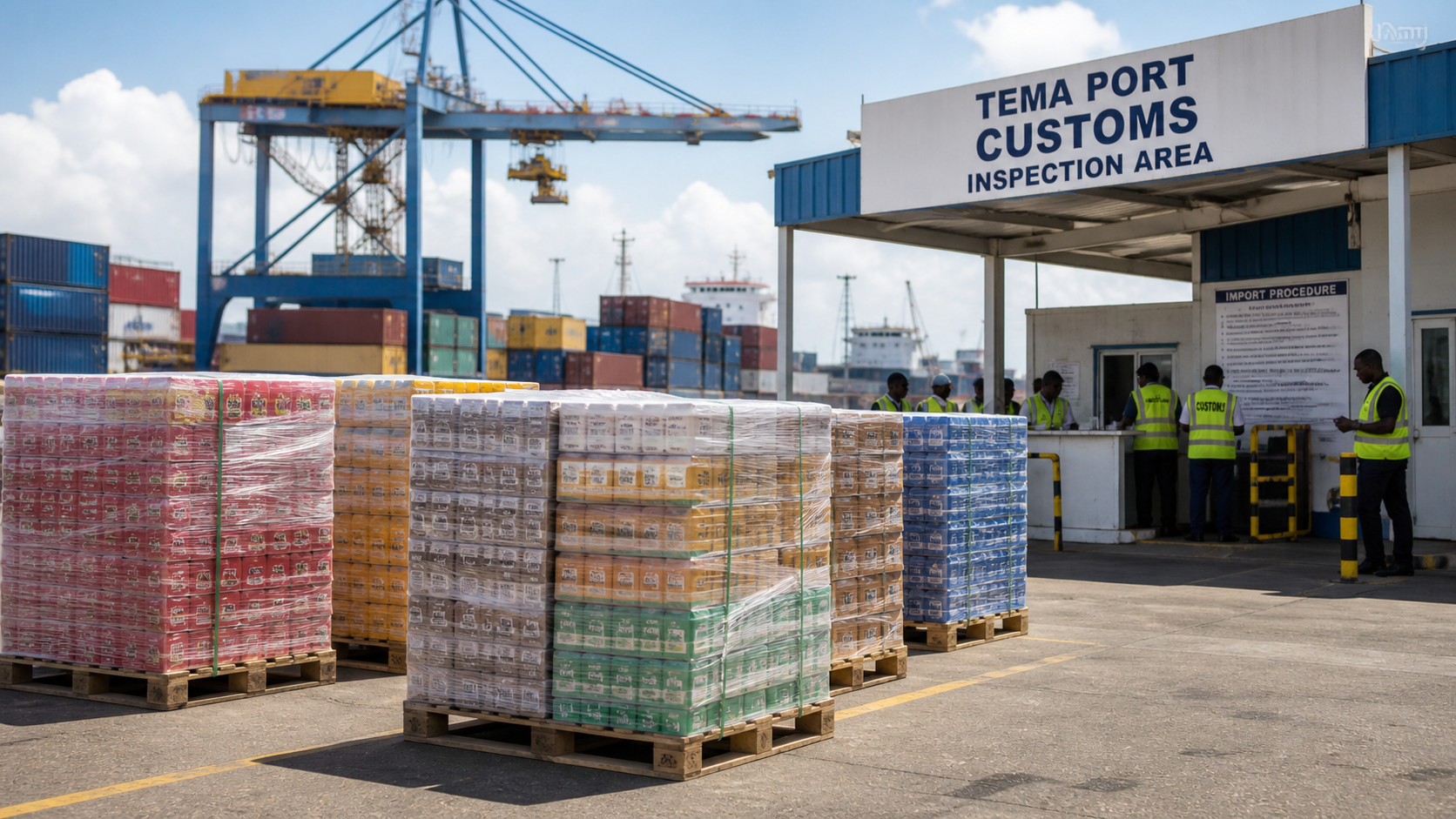
한국어To import beverages into Ghana, you must register each product with the Food and Drugs Authority (FDA Ghana) before shipment, use English labeling, and clear customs at one of three main gateways: Tema, Takoradi, or Kotoka International Airport. Expect multiple authorities to be involved across registration, standards, and customs clearance.
This guide explains the end-to-end process for importers and beverage brand owners, from FDA Ghana product registration to labeling, pre-shipment paperwork, and border clearance via Ghana Revenue Authority (GRA) Customs using ICUMS/PAARS.
What does it take to import beverages into Ghana?
In short: get FDA Ghana product registration approved before shipping, ensure English labels that meet Ghana requirements, prepare conformity and sanitary documents as applicable, file pre-arrival through ICUMS/PAARS with GRA Customs, then clear inspections and pay duties, VAT and levies at Tema, Takoradi or KIA. Your local Importer of Record (IOR) coordinates most on-ground steps.
Step-by-step: how to import beverages into Ghana
Follow this operational sequence. Each step names the Ghana-specific authority or checkpoint so you can plan responsibilities and timelines.
- Define product scope & HS classification
Identify whether your beverage is non-alcoholic (e.g., juice, tea drink, energy drink, water) or alcoholic. Map each SKU to the correct HS code used by GRA Customs. This drives duty, VAT and levy calculations and whether extra controls apply. - Appoint a Ghana-based Importer of Record (IOR)
Your IOR must be registered with the Ghana Revenue Authority (GRA) Customs and operate in the Ghana Integrated Customs Management System (ICUMS). They typically hold a Tax Identification Number (TIN) and can handle Unique Consignment Reference (UCR) generation via the Pre-Arrival Assessment Reporting System (PAARS). - Create an FDA Ghana account & register each beverage SKU
Product registration with FDA Ghana is mandatory before import. For each SKU, your dossier typically includes: product composition, label artwork, Certificate of Analysis (COA), manufacturer details, product specifications, and a Certificate of Free Sale or equivalent from the country of origin. Submit, respond to queries, and wait for approval. Timeframes vary; plan early. - Prepare English labeling to Ghana requirements
Labels must be in English and consistent with the registered information. Align product name, ingredients, net quantity (metric), date marking, storage instructions, country of origin, and local importer details. Avoid unauthorized nutrition or health claims and make sure any batch/lot codes are visible and durable. - Secure pre-shipment compliance documents
Gather the commercial invoice, packing list, bill of lading/air waybill, COA, and origin evidence. Where applicable, obtain a Certificate of Conformity (CoC) under the Ghana Standards Authority’s (GSA) import conformity assessment program for regulated goods. Keep all documents consistent (same product names, codes, and quantities). - Pre-arrival filing in ICUMS/PAARS
Your IOR uses ICUMS to submit pre-arrival data and obtains a Unique Consignment Reference (UCR) through PAARS. Accurate HS codes, values, and documents reduce queries and facilitate risk assessment ahead of vessel or flight arrival. - Ship to Tema, Takoradi, or Kotoka International Airport (KIA)
Coordinate sailing/flight schedules, transit times, and Incoterms. For temperature-sensitive SKUs, align reefer settings and transit insurance. Share all paperwork with the IOR so manifests and entries match your final commercial documents. - Border inspections & customs clearance
On arrival, expect FDA Ghana border checks for food safety and labeling, possible GSA standards verification, and GRA Customs valuation/classification. Pay duties, VAT and applicable levies per the Ghana tariff. Physical examination may occur based on risk or targeting. - Post-clearance release & distribution
After release, arrange local warehousing and transport. Maintain traceability records. Keep copies of FDA registration, CoC (if any), and customs entries for potential audits or market surveillance by FDA Ghana. - Renewals, variations & ongoing compliance
Track FDA Ghana registration renewal dates. If you change formula, label, manufacturer, or pack size, engage FDA Ghana for variation approval before the next shipment. Periodically review HS code accuracy and tariff updates with your customs broker.
Which documents are required at customs in Ghana?
Customs documentation is led by GRA via ICUMS, with technical controls by FDA Ghana and standards checks by GSA. Expect the IOR to present a core set of shipping, commercial, and regulatory papers that match each other exactly.
- Commercial invoice and packing list (consistent product descriptions and quantities)
- Bill of lading or air waybill (consignee/notify matching IOR details)
- FDA Ghana product registration evidence (per SKU), and any import permit if required
- Certificate of Analysis (COA) and product specification sheet
- Certificate of Origin or origin statement
- Certificate of Conformity (CoC) if the SKU falls under GSA’s regulated scope
- ICUMS/PAARS pre-arrival record and UCR
Do beverages need registration with FDA Ghana before import?
Yes. Pre-market product registration with FDA Ghana is generally required for pre-packaged food and beverages before importation. Importing unregistered SKUs risks detention at the border, storage costs, and possible refusal of entry. Align your dossier, English labels, and shipping plan to the approved registration details.
Labeling requirements for beverages in Ghana
FDA Ghana requires English labeling and alignment with the registered product information. While your exact obligations depend on product type, the following items are commonly expected:
- Product name and description appropriate to the beverage type
- Ingredient list in descending order; allergen disclosure where relevant
- Net quantity in metric units (e.g., mL, L)
- Name and address of the manufacturer and the Ghana-based importer
- Country of origin
- Batch/lot number and date marking (e.g., Best Before/Expiry)
- Storage conditions and, if applicable, preparation/serving instructions
- Consistent claims; avoid unauthorized nutrition or health claims
Multiple Ghana agencies oversee beverage imports. Use this table as a planning map for responsibilities and checkpoints.
| Process area | Primary authority | When it applies | Positioning & notes |
|---|---|---|---|
| Product registration | Food and Drugs Authority (FDA Ghana) | Before any shipment | Register each SKU; dossier typically includes label, COA, specs, origin sale evidence. |
| Food labeling control | FDA Ghana | At registration & border | English label required; align content with approved registration. |
| Standards conformity | Ghana Standards Authority (GSA) | Pre-shipment & border | For regulated goods, a Certificate of Conformity (CoC) may be required. |
| Customs clearance | GRA Customs (ICUMS/PAARS) | Pre-arrival & arrival | UCR via PAARS; HS classification drives duties, VAT and levies. |
| Border inspections | FDA Ghana; GSA (as needed) | On arrival | Inspection at Tema, Takoradi, and Kotoka International Airport. |
Ports of entry and logistics tips for Ghana beverage imports
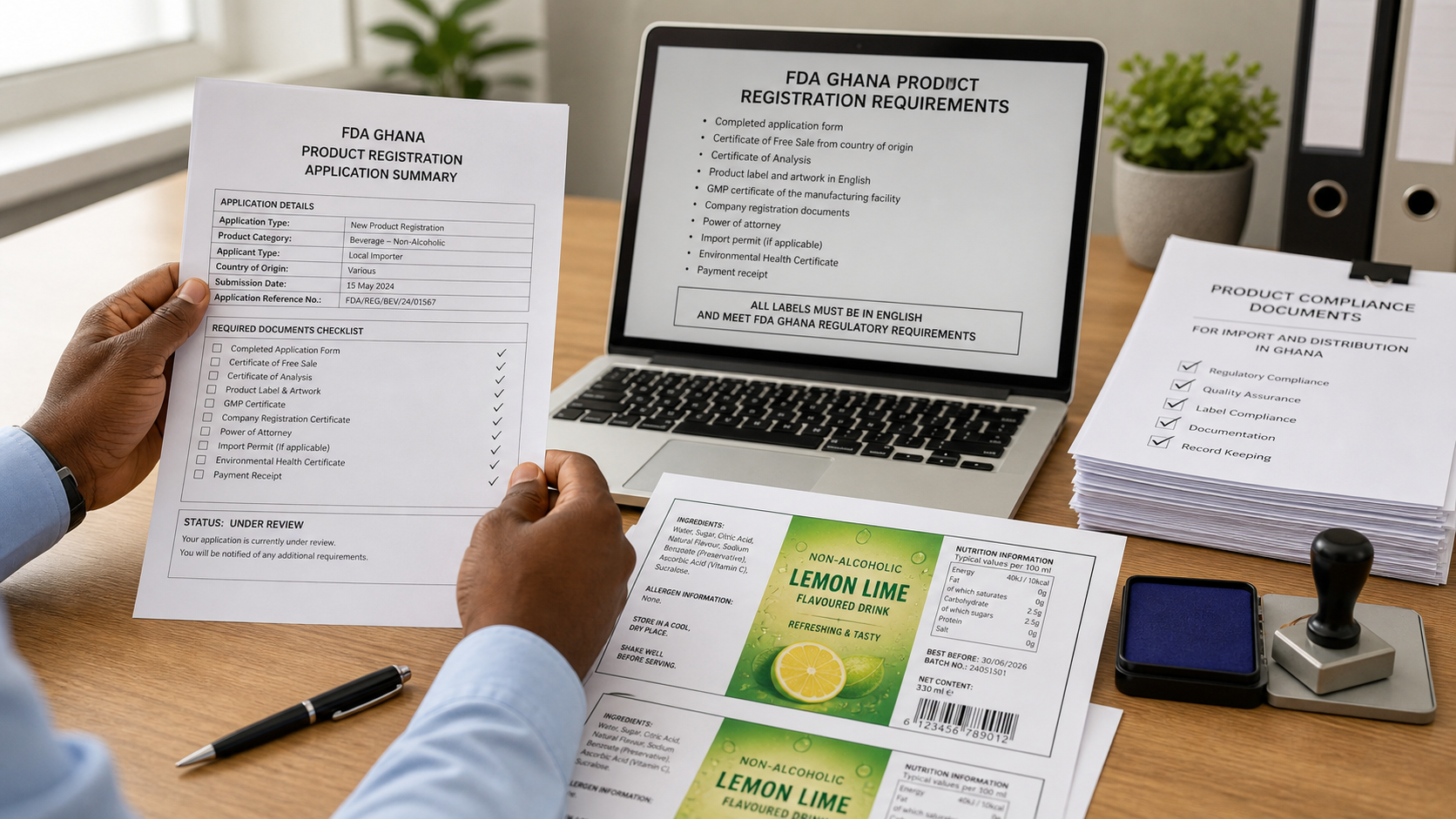
Ghana’s main entry points for beverages are Tema Port (Greater Accra), Takoradi Port (Western Region), and Kotoka International Airport (KIA) for airfreight. Choose the gateway based on volume, cold-chain needs, and time-to-market.
- Tema Port: Ghana’s busiest seaport with extensive container services. Plan for yard storage, potential inspections, and appointment systems through your terminal operator and customs broker.
- Takoradi Port: Useful for regional distribution to Western and Central corridors. Capacity and service options differ from Tema; confirm sailing schedules early.
- KIA: Preferred for high-value, urgent, or sample shipments. Coordinate cold-chain handover on arrival, including swift FDA checks and customs processing.
Cold-chain & shelf life: For chilled juices, dairy-alternative beverages, and probiotics, align reefer set-points, temperature loggers, and ground handling at the chosen port. Keep your COA and stability data accessible in case of quality queries at the border.
Common pitfalls and how to avoid delays
- Unregistered SKUs: Shipping before FDA Ghana approval is a top cause of detention. File early and track queries closely.
- Label-file mismatch: If the shipped label differs from what FDA approved, expect holds. Version-control your artwork.
- Wrong HS code: Misclassification affects duty and compliance flags. Align with your broker and review product specs.
- Missing CoC: For goods under GSA’s regulated scope, lack of a pre-shipment CoC can trigger inspection and delays.
- Inconsistent paperwork: Product name, pack size, and lot codes must match across invoice, packing list, and bill of lading/air waybill.
- Late PAARS/UCR filing: Pre-arrival submissions in ICUMS/PAARS reduce questions at arrival; don’t leave it to the last minute.
- Temperature abuse: For perishable beverages, document cold-chain handoffs and add data loggers to defend quality at the border.
Information for beverage brands and importers
For brand owners planning Ghana entry, design your product brief and supply plan around Ghana’s pre-market registration model. Coordinate closely with your Ghana IOR on dossier preparation, HS classification, and label approval schedules. Validate packaging durability for tropical transit and distribution conditions, and consider a phased launch (core SKUs first) to focus regulatory resources on high-rotation items.
If you are still assessing the opportunity size and channel mix, explore our concise Ghana market overview to frame consumer dynamics, route-to-market, and price ladders relative to tariffs and logistics costs.

FAQ
How long does FDA Ghana product registration take?
Timelines vary by product type, dossier quality, and query cycles. Build in sufficient lead time before your first shipment and avoid scheduling production or sailing dates until you have approval in hand.
Do I need a local Importer of Record to import beverages into Ghana?
Yes. A Ghana-based Importer of Record registered with GRA Customs is required to file in ICUMS/PAARS, manage inspections, and complete duty and tax payments on your behalf.
Are bilingual labels accepted if English is included?
Yes, bilingual or multilingual labels are commonly acceptable as long as the English text is present, accurate, legible, and aligns with the FDA Ghana-approved registration details.
Sources
- Food and Drugs Authority (FDA Ghana): https://fdaghana.gov.gh/
- Ghana Standards Authority (GSA): https://gsa.gov.gh/
- Ghana Revenue Authority (GRA): https://gra.gov.gh/