


 Français
 Español
 العربية
 한국어
한국어To import beverages into Oman, appoint an Omani importer of record, register in the Bayan customs single window, meet GCC GSO standards with Arabic–English labels and Halal compliance, and clear goods through seaports like Sohar or Salalah. Expect a typical 5% customs duty and 5% VAT, plus selective tax on specific drink categories.
This guide focuses on the Oman-specific process, authorities and ports. For GCC-wide standards, Arabic labelling rules and Halal frameworks, use the summary in the GCC guide and confirm your product’s final formula and label against it before shipment.
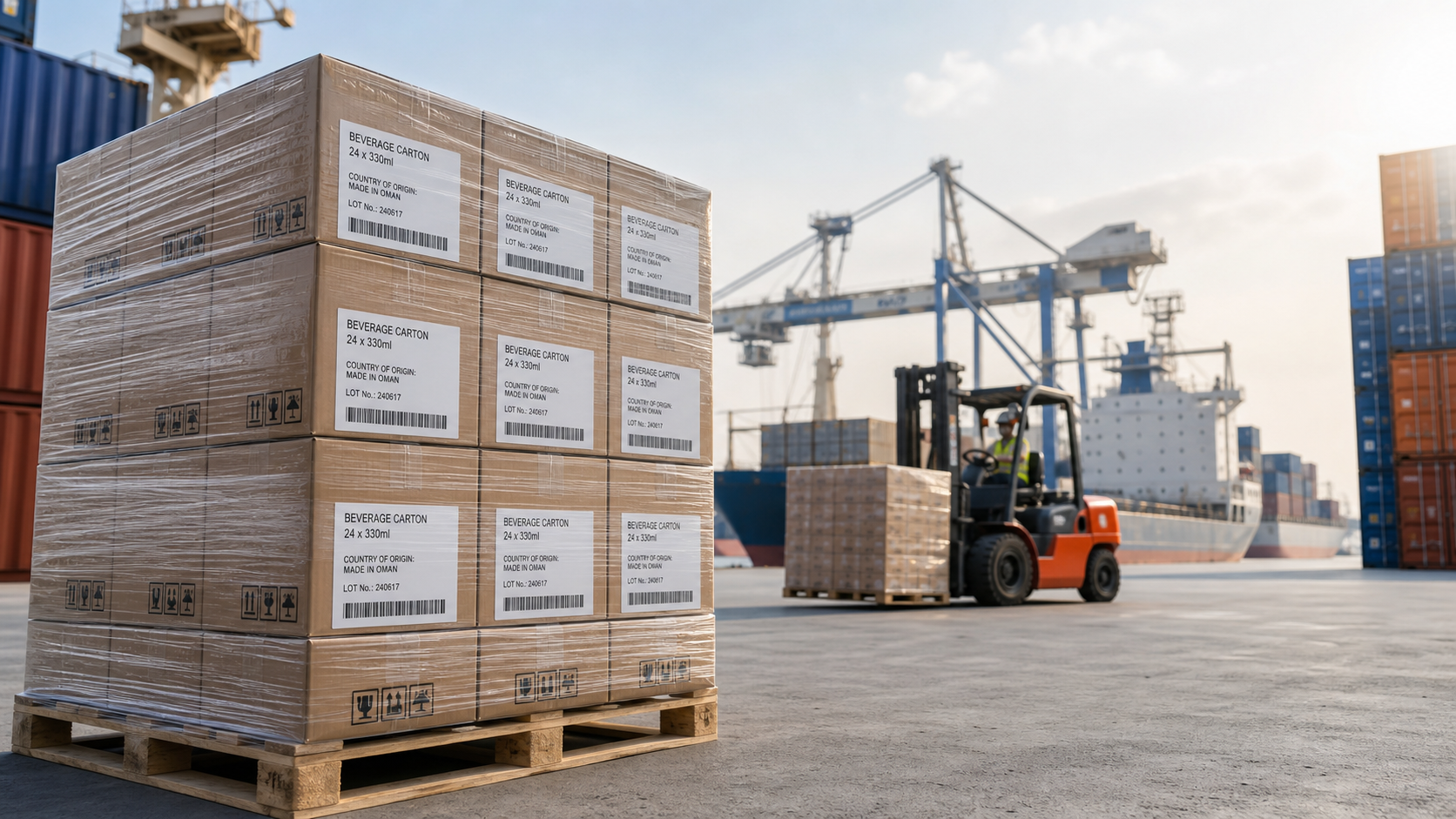
In Oman, the Ministry of Commerce, Industry and Investment Promotion (MOCIIP) oversees trade licensing and standards policy, Oman Customs (Royal Oman Police) operates the Bayan single window for import clearance, and the Oman Tax Authority administers VAT and selective (excise) tax.
- Ministry of Commerce, Industry & Investment Promotion (MOCIIP): Commercial Registration (CR), trade activity licensing and policy for standards and metrology.
- Oman Customs (Royal Oman Police): Border control, inspections, risk management and the Bayan e-customs platform.
- Oman Tax Authority (OTA): VAT registration/accounting and selective tax on specified beverages (e.g., carbonated, energy drinks).
- Main entry ports: Sohar (north), Salalah (south), and Duqm (central). Air cargo commonly enters via Muscat International Airport.
What documents do you need to import beverages into Oman?
You will typically need standard commercial documents plus compliance evidence aligned with GCC requirements. Ensure Arabic–English labelling is ready before clearance and that Halal compliance is covered where applicable.
- Commercial invoice (currency, Incoterms, consignee/importer details)
- Packing list (marks, weights, carton count, dimensions)
- Bill of lading or airway bill
- Certificate of origin (preferably chamber-attested)
- HS code classification consistent with GCC tariff
- Halal documentation if any ingredient or process requires it (see GCC guide)
- Product label artwork and translation (Arabic–English)
- Any test reports or authenticity documents required by risk profile
Step-by-step: How to import beverages into Oman
Follow these steps with your Omani importer of record and customs broker. They align with Oman’s Bayan single window and the Sultanate’s port operations.
- Confirm product scope & HS code. Define the exact SKU(s), packaging format (can, PET, glass, aseptic), and HS codes. Align descriptions on invoice and packing list with the HS code to avoid reclassification.
- Engage an Omani importer of record (IOR). Only Omani-registered companies with a valid Commercial Registration (CR) and relevant trade activities can act as IOR. Agree responsibilities for declarations, duties/taxes, and sampling.
- Register for Bayan (customs single window). The importer (or their broker) must hold a Bayan account and an importer code. Make sure your broker’s license is active in Oman.
- Check GCC-wide standards, Halal & Arabic labelling. Oman applies GSO standards across the GCC. Halal compliance is mandatory, and retail packs must carry Arabic (bilingual with English recommended). See the consolidated GCC beverage import requirements and align your final label and formula accordingly.
- Prepare label files & translations. Ensure the label includes product name, ingredients, net content in metric, manufacturer/brand owner, country of origin, importer’s name & address in Oman, lot/batch and date markings, storage instructions, and nutrition where relevant. Arabic must be clear and accurate.
- Plan shipment routing & port. Choose Sohar, Salalah or Duqm for sea freight. For urgent launches, air freight via Muscat is viable. Consider summer heat when choosing container type and stowage for sensitive drinks.
- Issue commercial documents. Ensure invoice, packing list, BL/AWB and certificate of origin match each other and the HS code(s). Avoid marketing terms on invoices that can trigger reclassification.
- Pre-alert your broker & lodge the import declaration. Your broker creates the Bayan declaration, attaches required documents and assigns the correct HS codes. Respond quickly to any information requests to reduce dwell time.
- Border inspection & sampling. Oman Customs may require physical inspection or sampling based on risk. Keep master labels and ingredient specifications available. Allow time for any quality checks.
- Pay customs duty, VAT & selective tax (if applicable). Most beverages attract 5% customs duty and 5% VAT. Carbonated and energy drinks may be subject to selective tax. The Bayan system calculates payable amounts at clearance.
- Sticker application, if used. If you rely on compliant Arabic stickers, ensure they are applied properly and securely before goods are released to the local market, and that they match the approved artwork.
- Release & inland logistics. After duties/taxes are paid and inspections cleared, arrange delivery to your warehouse or distributor. Maintain temperature control if required by product type.
- Post-clearance compliance. Retain records, monitor shelf life in-market, and maintain traceability for any authority queries or recalls.
Oman-specific taxes and fees on beverages
Oman applies a 5% customs duty to many beverage lines under the GCC Common External Tariff and a 5% VAT on most goods. Selective (excise) tax also applies to specific categories such as carbonated and energy drinks; confirm current rates with your broker or the Oman Tax Authority before pricing.
- Customs duty (typical): 5% ad valorem on many non-alcoholic beverages (check HS line).
- VAT: 5% on most beverages at import.
- Selective tax: Applies to defined categories (e.g., carbonated, energy drinks). Rates and scope can change; verify per SKU.
Note on alcoholic beverages: Imports are tightly restricted in Oman, require special permits, and face additional taxes. This guide focuses on non-alcoholic beverages.
Arabic–English labelling for Oman: what to prepare
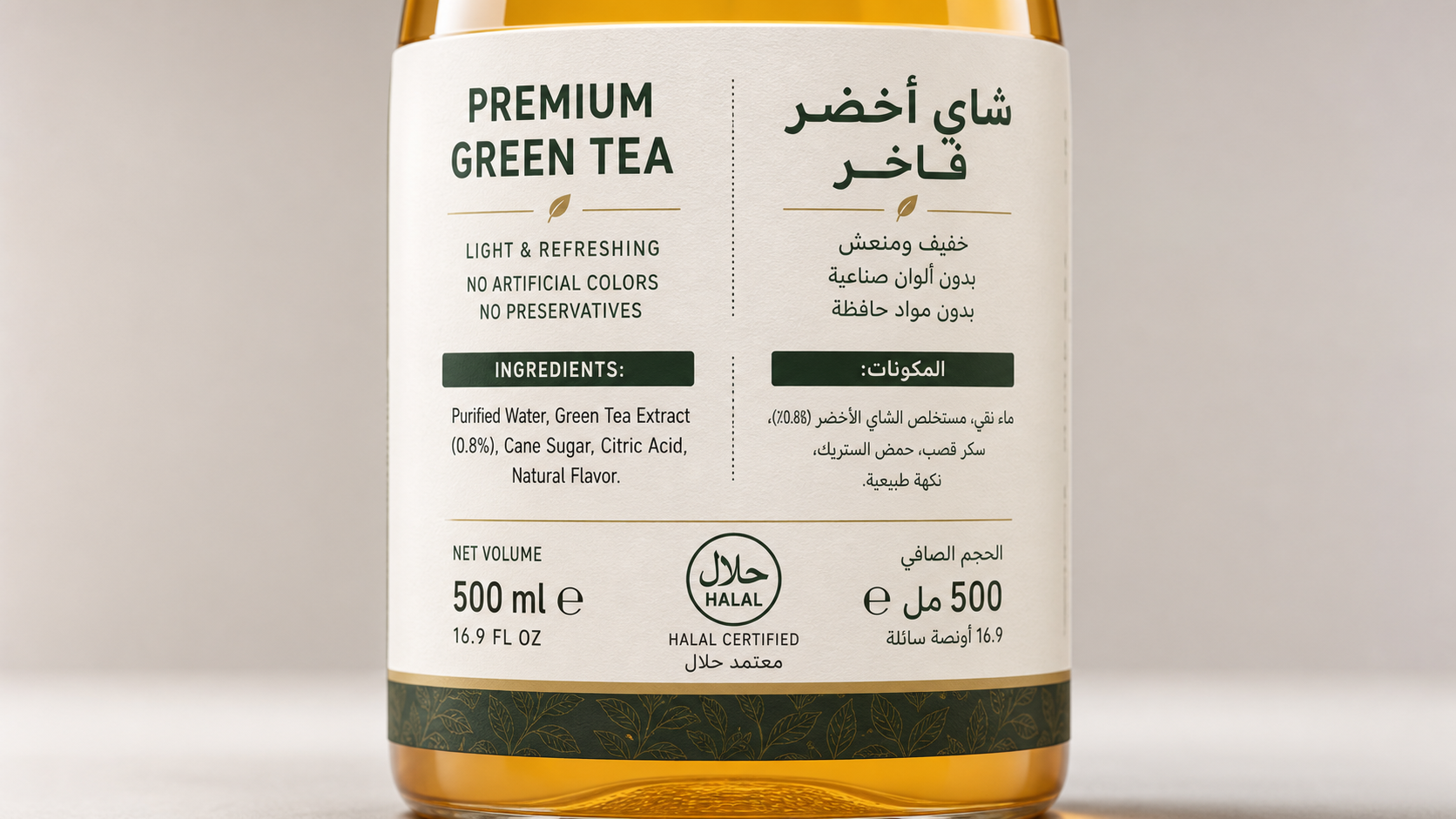
Arabic must be present and legible on retail packs cleared in Oman. Bilingual Arabic–English labelling is the practical norm. You can use a pre-printed bilingual label or an applied sticker, provided it fully complies before the product is offered for sale.
- Mandatory Arabic: Product name and key information in Arabic; English is recommended alongside for trade.
- Content & format: Ingredients list, net content (metric), country of origin, importer’s details in Oman, lot/batch and date markings, storage conditions, and other declarations triggered by the product.
- Consistency: All declarations must match formula and documentation. Keep translations precise; avoid ambiguous claims.
- Halal compliance: Halal is mandatory in Oman. Requirements depend on ingredients and processing. See the consolidated GCC beverage import requirements and verify documentation per product.
Ports, routing and clearance scenarios in Oman
Choose an entry point that fits your supply chain and customer base. Oman’s network lets you serve the Muscat–Batinah corridor via Sohar, southern Dhofar via Salalah, and central/eastern projects via Duqm.
| Entry point | Typical use | Positioning & notes |
|---|---|---|
| Sohar Port | High-volume sea freight to northern Oman (Muscat/Batinah) | Modern container facilities; good road links inland; frequent regional feeder services |
| Salalah Port | Sea freight to southern Oman (Dhofar) | Major transshipment hub; strong reefer capabilities and global connections |
| Duqm Port | Project-based or central/eastern distribution | Growing industrial hub; confirm carrier schedules and equipment availability |
| Muscat International Airport | Air cargo for urgent launches or samples | Faster transit with higher freight cost; ensure quick broker coordination |
Quality, climate and packaging considerations for Oman
Ambient temperatures, especially in summer, can affect sensory quality and shelf life. Plan packaging, logistics and warehousing accordingly.
- Heat exposure: Consider reefers for sensitive SKUs and request shaded or ventilated stowage. Avoid prolonged tarmac dwell time for air cargo.
- Packaging choice: PET and cans are common for carbonates and juices; aseptic cartons for ambient juices. Verify seal integrity under heat stress.
- Sticker durability: If using Arabic stickers, choose adhesives that resist high temperatures and humidity.
- Warehouse rotation: Implement FEFO to protect freshness across Oman’s north–south distribution distances.
Common pitfalls when importing beverages into Oman (and how to avoid them)
Most delays and penalties stem from preventable documentation or labelling gaps. Address these early with your importer and broker.
- Mismatch between HS code and invoice description: Keep commercial descriptions neutral and aligned to classification.
- Arabic label missing at clearance: Pre-approve bilingual artwork and ensure the physical product matches it.
- Unconfirmed selective tax exposure: Validate whether your SKU is treated as a carbonated or energy drink; price accordingly.
- Incomplete importer profile in Bayan: Make sure CR, importer code and broker permissions are active before ETA.
- Summer heat damage: Specify equipment and stowage in the booking; avoid weekend rollovers that extend transit.
Who should be your importer of record in Oman?
Foreign suppliers generally appoint an Omani company with an appropriate Commercial Registration and import permissions as the importer of record. Distributors often serve as IORs; alternatively, a dedicated trading entity can be engaged for initial test shipments.
Assess each candidate on sector experience, Bayan capability, storage conditions, and coverage of Muscat, Batinah and Dhofar. For market context, review our Oman beverage market overview.
Commercial and pricing checklist
Build landed-cost scenarios early to avoid re-pricing after arrival.
- Duty & VAT: Model 5% customs duty (typical) and 5% VAT; add selective tax if your category is in scope.
- Port charges & brokerage: Confirm terminal, handling and broker fees for each entry point.
- Inland freight & warehousing: Reflect Oman’s distances and climate control for sensitive products.
- Label execution: Budget for sticker printing/application if you are not printing bilingual primary packaging.
GCC requirements and Halal: use the consolidated guide
Oman applies GCC GSO standards and requires Halal compliance. Rather than duplicating the framework here, consult the consolidated GCC beverage import requirements and align your product formula, claims, and label with that checklist before shipment to Oman.
At-a-glance: who does what in Oman
| Entity | Role in beverage imports |
|---|---|
| MOCIIP | Trade licensing, Commercial Registration, standards policy |
| Oman Customs (ROP) | Border control, inspections, and Bayan customs declarations |
| Oman Tax Authority | VAT at 5% on most goods; selective tax administration |
| Ports (Sohar, Salalah, Duqm) | Primary seaport gateways for beverages into Oman |
Shipping to other Gulf markets as well? See how to import beverages into Kuwait for KUCAS conformity and PAFN clearance.
FAQ: importing beverages into Oman

Is an Arabic sticker acceptable, or must Arabic be printed on-pack?
Arabic must be present and clear at the time of clearance and sale. Oman commonly accepts compliant Arabic stickers if they fully cover required information and are applied properly. Many brands still prefer pre-printed bilingual packaging for consistency.
Do I need an Omani company to act as importer of record?
Yes. The importer of record must be an Omani-registered company with appropriate trade activities and access to the Bayan system. Overseas sellers typically appoint a distributor or trading partner as IOR.
Are carbonated drinks and energy drinks taxed differently?
Often yes. Beyond the typical 5% customs duty and 5% VAT, selective tax applies to defined categories such as carbonated and energy drinks. Confirm current rates with your broker or the Oman Tax Authority before finalizing pricing.
Can I route via another GCC country and truck into Oman?
Many importers use regional hubs and then supply Oman, but your Omani importer of record and an Oman-side Bayan declaration are still required. Factor in additional transit time, permits and temperature control for cross-border moves.
How long does clearance take in Oman?
Timelines vary by risk channel, documentation accuracy, and whether sampling is required. Pre-alert your broker, ensure labels are compliant, and respond quickly to information requests to minimize dwell time.
Next steps
Align your formula and labelling with GCC rules, secure an Omani importer with Bayan capability, and choose the right entry port for your go-to-market plan. For regional context, explore Oman beverage market overview and compare with UAE beverage market insights before locking your distribution model. Keep the regulatory checklist central: Arabic–English labels, Halal compliance and Oman-specific taxes.
Sources
Ministry of Commerce, Industry and Investment Promotion (MOCIIP); Oman Customs (Royal Oman Police) and the Bayan customs single window; Oman Tax Authority.