




 Français
 Español
 العربية
 한국어
한국어UAE beverage import duty is determined by HS classification, origin, and whether a preferential agreement applies. Start with the 6-digit HS heading and confirm the 8-digit GCC subheading to find the correct line. The UAE follows the GCC Common Customs Tariff, while VAT and any excise are settled separately at import.
There is currently no bilateral FTA in force between the UAE and Vietnam, so a non-preferential Certificate of Origin usually supports origin proof without reducing duty. If your beverage qualifies under a UAE CEPA with another origin, preferential rules of origin and documents will be required.
What determines UAE beverage import duty?
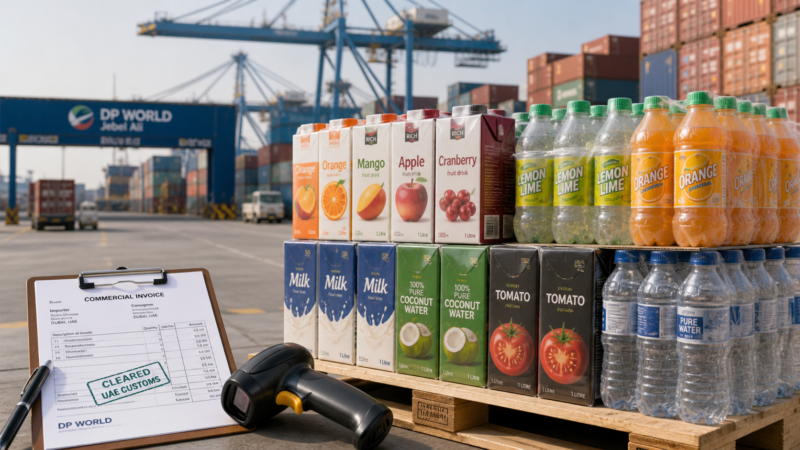
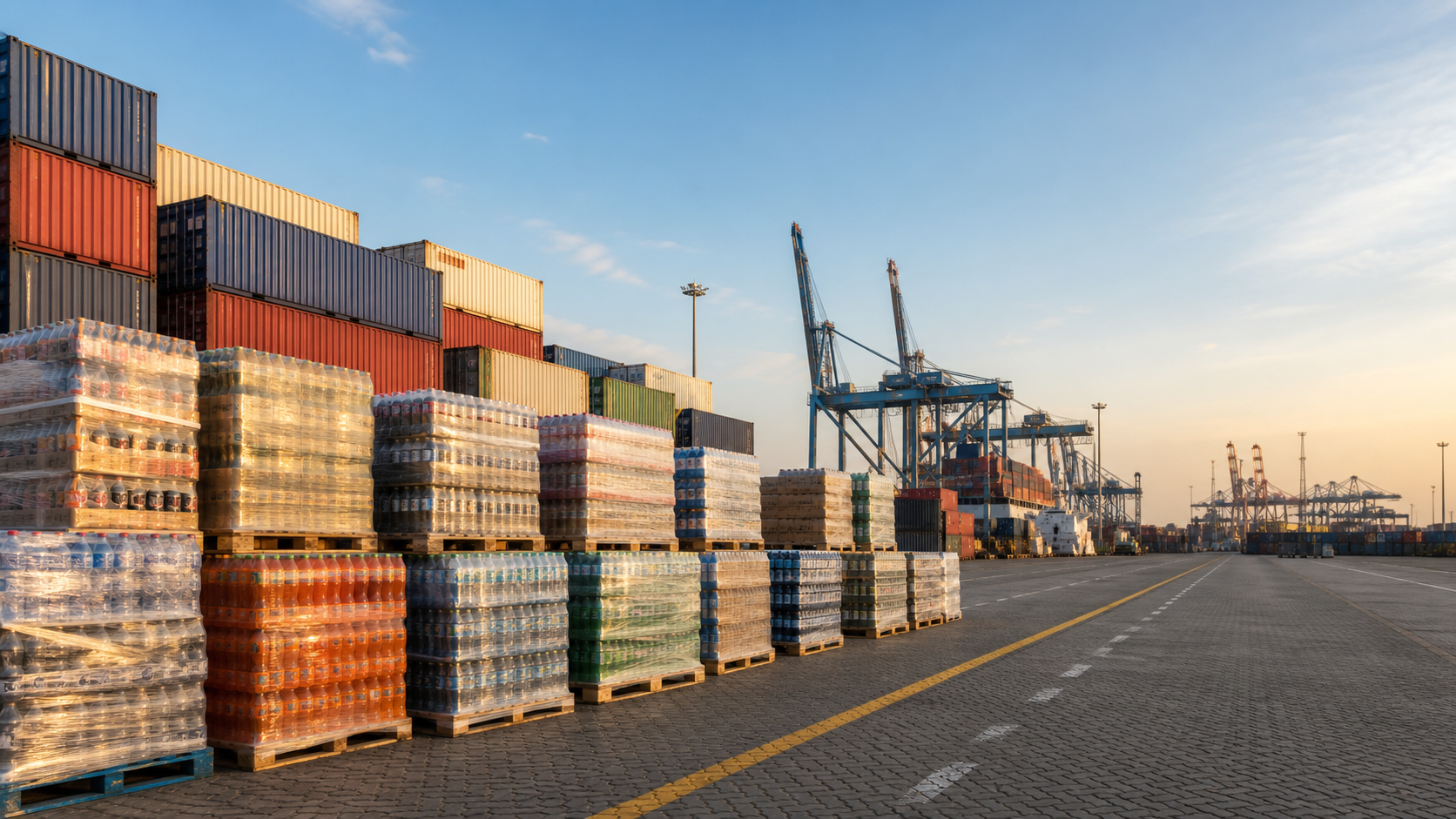
Three factors drive the payable customs duty in the UAE: tariff classification (HS code), origin (and any applicable trade agreement), and customs valuation at the first GCC point of entry. Duty is collected by UAE Customs at gateways such as Jebel Ali Port (Dubai) or Khalifa Port (Abu Dhabi) when goods enter the GCC customs territory.
- HS code: Classification defines the legal tariff line your product falls under, based on composition, processing, and presentation.
- Origin & agreements: Preferential rates apply only if the product is covered by a UAE or GCC agreement and you hold a valid preferential Certificate of Origin that meets rules of origin.
- Customs value: Duty is calculated on the customs value per UAE/GCC valuation rules, typically referencing the transaction value plus certain costs to the UAE border.
How do you classify beverages for UAE tariffs using HS codes?
Begin with the WCO HS at 6 digits, then narrow to the GCC/UAE 8-digit subheading that matches your product. Classification turns on product type, juice content, carbonation, sweeteners, caffeine, dairy content, and packaging format.
- Common chapters: Chapter 20 (e.g., fruit juices and certain preparations) and Chapter 22 (waters and other non-alcoholic beverages) are typical for soft drinks and juices.
- Juice content: 100% juices are often classified differently from juice drinks or nectars with added water, sugar, or flavors.
- Carbonation & caffeine: Sparkling, caffeinated, or energy-type formulations can shift classification.
- Ingredients: Dairy, cereal, tea/coffee extracts, or botanicals may move the product to alternative headings.
- Packaging: Retail-ready small bottles versus bulk containers can influence the final subheading.
For consistency and risk control, align your commercial invoice and packing list descriptions with the selected HS code and maintain a technical sheet or full ingredient list to support classification during customs queries.
Are preferential rates available under UAE trade agreements?
Preferential duty can apply if the beverage’s origin is covered by a live UAE or GCC agreement and the shipment meets rules of origin and documentary requirements. Without those conditions, the GCC Common Customs Tariff applies.
- Vietnam–UAE status: There is no bilateral FTA currently in force; a CEPA has been under discussion. For goods of Vietnamese origin, importers generally rely on non-preferential C/O and the standard GCC tariff.
- Existing UAE CEPAs: The UAE has concluded CEPAs with selected partners. Only products and HS lines listed in those agreements, meeting rules of origin, are eligible for preferences.
- GCC-wide agreements: Where the GCC as a bloc has agreements, eligibility still depends on the precise HS line, origin criteria, and compliance with documentation and direct shipment rules.
Always verify the exact HS line coverage, rule of origin method (e.g., change in tariff classification or regional value content), and document format of the preferential Certificate of Origin before you quote prices or ship.
Certificate of Origin for the UAE: what should you prepare?
For non-preferential treatment, provide a Certificate of Origin issued by a recognized chamber/authority in the exporting country (e.g., Vietnam) to evidence origin. For preferential treatment, the preferential C/O format required by the relevant CEPA/FTA is mandatory and must match the rule of origin for that HS line.
- Direct shipment: Many agreements require direct transport or controlled transshipment with proof of non-manipulation.
- Producer vs. trader: If the exporter is not the manufacturer, maintain producer affidavits or supplier declarations supporting origin.
- Minor operations: Simple packaging or dilution usually does not confer origin; confirm processing thresholds in the agreement.
- Document control: Ensure names, addresses, HS code, and product descriptions are consistent across invoice, packing list, and C/O.
Is import VAT and excise separate from customs duty?
Yes. Customs duty is distinct from import VAT (administered by the UAE Federal Tax Authority) and any excise tax that may apply to specific beverage categories (e.g., certain sweetened, carbonated, or energy drinks). Your importer’s FTA Tax Registration Number (TRN) must be linked to the customs account to correctly account for import VAT.
- Timing: Import VAT is assessed when the goods are released into the UAE mainland. In designated free zones, specific procedures may apply before goods enter the mainland.
- Excise registration: Importers or warehouse keepers handling excisable beverages may require FTA registration and monthly returns.
- Documentation: Keep customs declarations, C/O, freight invoices, and insurance details for VAT/excise reconciliation and audits.
Re-export from the UAE: how does duty treatment work?
The UAE is a major re-export hub for MENA. If goods enter the UAE mainland, duty is paid at the first GCC entry; subsequent movement to another GCC state uses proof of duty-paid movement. If goods are re-exported outside the GCC from a free zone or under a customs suspension procedure, duty may be avoided, provided procedures are followed.
- Free zones: In zones such as Jebel Ali Free Zone (JAFZA), storing under customs control allows deferral of duty until mainland entry.
- Onward to GCC: Coordinate with your partner on evidence of duty-paid movement to Saudi Arabia or Oman. For market-specific steps, see how to import beverages into Saudi Arabia and how to import beverages into Oman.
- Outside GCC: Use re-export declarations and obtain proof of exit to close the import file.
Where are beverages cleared in the UAE and who regulates?
Most beverage consignments enter via Jebel Ali Port (Dubai) or Khalifa Port (Abu Dhabi), with additional gateways through airports such as Dubai International and Al Maktoum International. Key authorities include:
- Dubai Customs and Abu Dhabi Customs for clearance, valuation, and duty collection.
- Federal Tax Authority (FTA) for import VAT and excise administration.
- Ministry of Industry and Advanced Technology (MoIAT) on national standards/regulatory policy (formerly ESMA), alongside local municipality food control units (e.g., Dubai Municipality Food Safety Department).
- Ministry of Climate Change and Environment (MOCCAE) in areas related to agricultural and certain food import systems.
GCC/GSO conformity requirements and Halal rules apply at regional level. Refer to your organization’s dedicated GCC beverage import requirements guidance for those common standards; this article focuses on the UAE specifics for duty and origin.
How to look up the correct UAE tariff line without quoting rates here
To remain precise and up to date, use your HS code and the UAE/GCC tariff schedule rather than relying on generic rate lists. Here is a practical workflow you can adopt internally or with your customs broker:
- Confirm the 6-digit HS heading from the product’s technical specification and label.
- Identify the GCC/UAE 8-digit subheading that matches juice content, carbonation, sweeteners, and packaging.
- Check if any UAE CEPA/GCC agreement covers that exact 8-digit line for your product’s origin.
- Document the applicable rule of origin and verify your ability to meet it (CTC, RVC, or process rule).
- Validate customs valuation (price, freight, insurance, assists) consistent with UAE/GCC valuation rules.
- Screen for excise applicability and plan import VAT accounting with your TRN-linked customs profile.
- Decide on mainland clearance or free zone storage based on your re-export plan.
| Determinant | What to verify | Impact on duty/clearance |
|---|---|---|
| HS code | Ingredients, juice %, carbonation, caffeine, dairy, packaging size | Sets the legal tariff line and eligibility for preferences |
| Origin | Manufacturer location, processing steps, suppliers | Determines if CEPA/FTA preference may apply |
| C/O document | Non-preferential vs preferential format, data consistency | Supports origin claim; required for any preference |
| Customs value | Invoice, freight, insurance, assists, incoterms | Used to calculate ad valorem duty and taxes |
| VAT & excise | TRN linkage, excise product scope, warehouse status | Affects cash flow, registrations, and return filing |
| Clearance location | Jebel Ali, Khalifa Port, airports; free zone vs mainland | Changes timing of duty/VAT and re-export options |
Product formulation choices that can influence classification
Small recipe and packaging decisions can alter HS codes. Collaborate early with R&D and regulatory teams to lock a formulation that meets market positioning while avoiding unintended reclassification.
- Juice vs drink: A 100% juice typically falls under a different heading than a flavored drink with added sugar and water.
- Carbonation: Adding CO2 can shift a product from a juice heading to a different beverages heading.
- Sweeteners: Use of non-nutritive sweeteners or high-intensity sweeteners can change product identity and code.
- Functional ingredients: Caffeine, botanicals, dairy or cereal components may redirect classification.
- Pack size: Retail packs vs bulk containers can lead to different subheadings.
When planning your portfolio, build classification scenarios and test them with your customs broker before finalizing labels and cartons. For an end-to-end view beyond duty, see our overview of the full import process for UAE beverages.
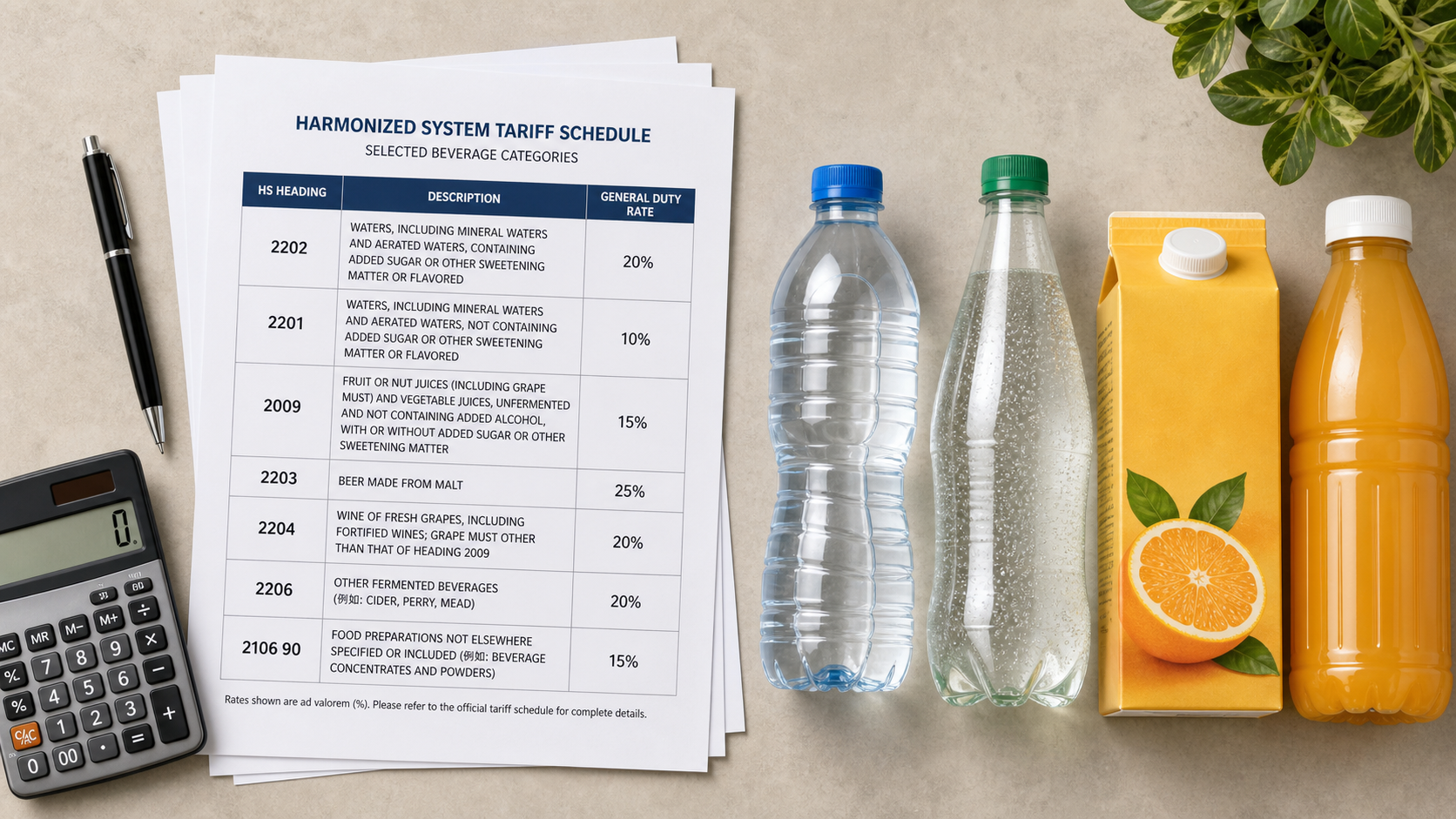
UAE drinks import tax: coordinating duty, VAT and excise in practice
Your landed cost must capture customs duty, import VAT, any excise, and local handling. Because tax treatments differ by category, keep separate cost models for still water, sparkling drinks, juices, energy-style drinks, and dairy-based beverages.
- Systems: Ensure your importer code at UAE Customs is synced with your FTA account for automated import VAT posting.
- Free zones: Duty and import VAT are generally triggered when goods move from a designated free zone to the mainland; maintain clear audit trails.
- Excise flows: If excise applies, factor warehouse registrations and monthly returns into your cash flow plan.
From UAE to the region: planning re-export and distribution
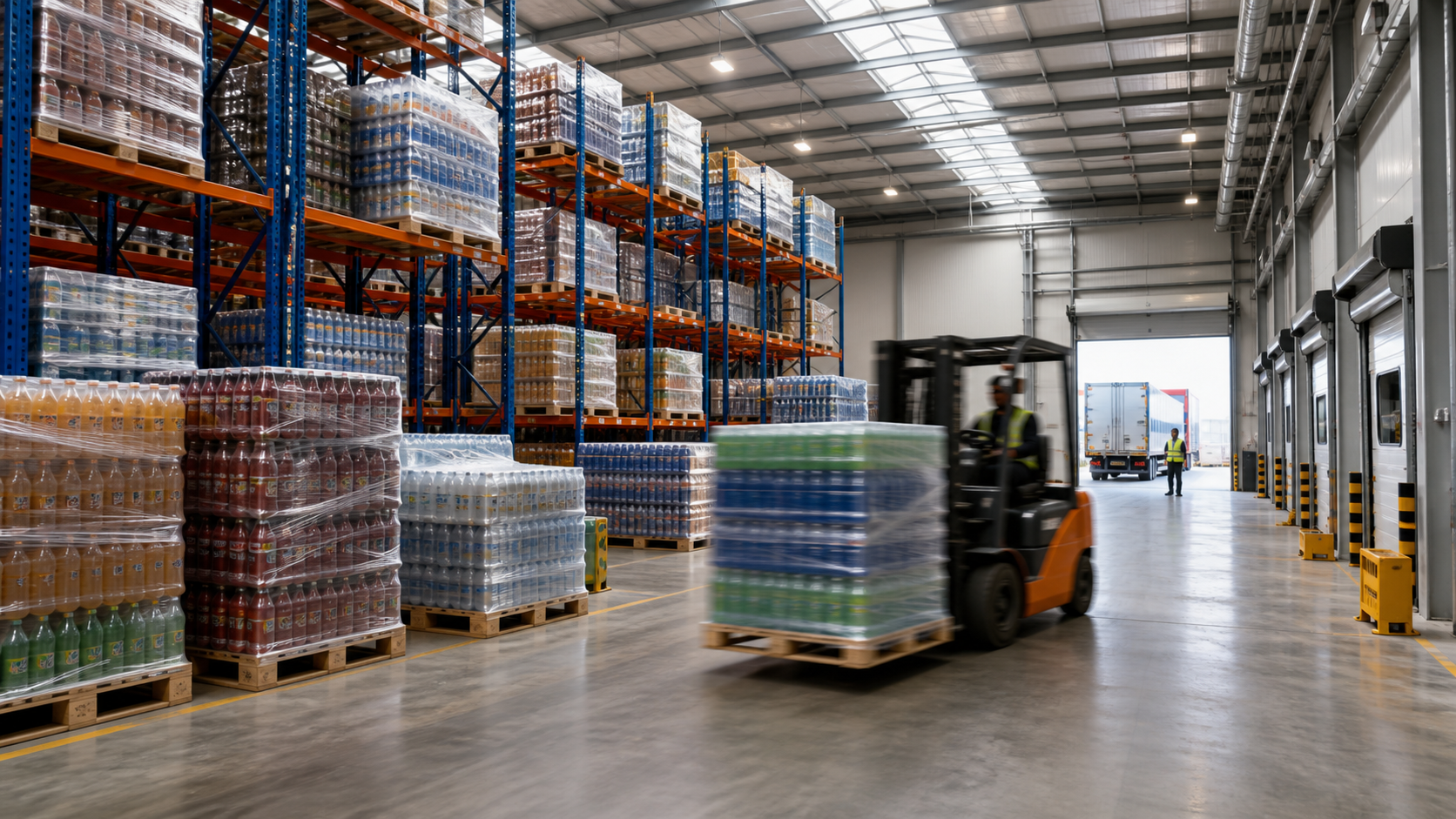
UAE-based distribution can accelerate MENA market entry. Jebel Ali’s connectivity and bonded facilities help you hold stock close to buyers while controlling duty exposure.
- Route design: Decide which SKUs clear into the mainland versus staying under bond for re-export.
- Neighboring markets: Understand differences when you import beverages into Saudi Arabia versus when you import beverages into Oman.
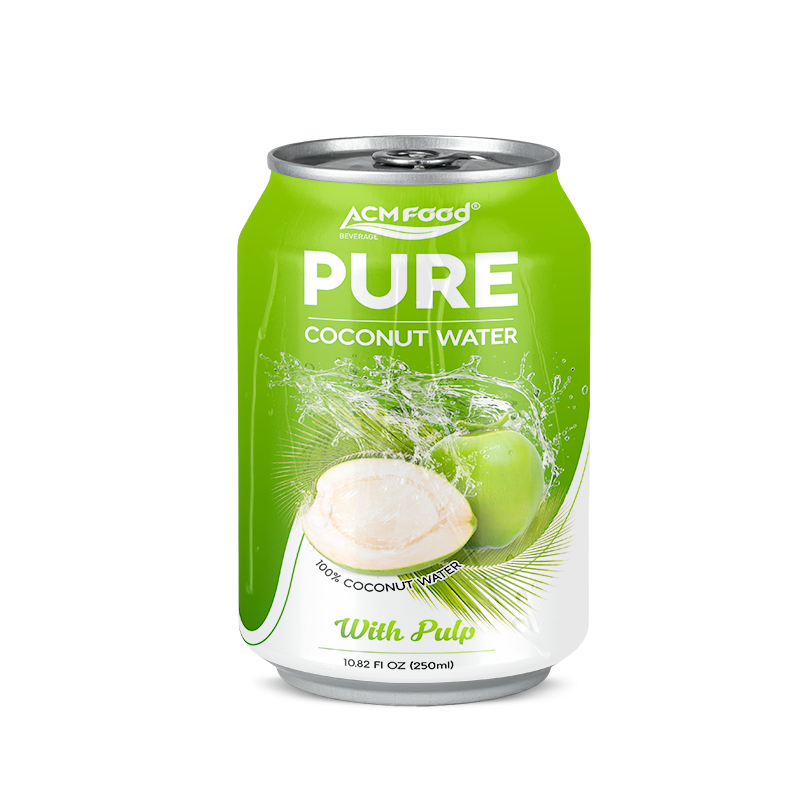
- Category playbooks: Certain categories, like coconut water, follow distinct sourcing and quality drivers; see why best quality coconut water for export markets tends to perform strongly.
Documentation and data pack for smooth UAE clearance
Prepare a complete, consistent document set. Inconsistencies are a common reason for delays at Dubai Customs or Abu Dhabi Customs.
- Commercial invoice with clear product descriptions aligned to HS codes and pack sizes.
- Packing list detailing SKU, cartons, net/gross weights, and pallet configuration.
- Bill of lading/air waybill, freight and insurance documents for valuation.
- Certificate of Origin (non-preferential or preferential as applicable).
- Technical data sheet and full ingredient list; sample labels and artwork.
- Any registrations/approvals required by local municipalities or MOCCAE for specific product types.
Step-by-step checklist to estimate landed cost
Use this internal checklist to quote reliably without stating rates here:
- Fix the HS code at 8 digits for GCC with broker validation.
- Confirm origin eligibility: standard vs preferential; rules of origin and C/O availability.
- Compute customs value under GCC rules; ensure incoterms alignment.
- Map potential excise exposure by category and formulation.
- Model import VAT timing based on mainland or designated free zone flows.
- Add local costs: terminal handling, storage, inspection, and delivery to DC.
- Stress-test re-export options to avoid double taxation.
Information for beverage brands and importers
If your target is the UAE plus GCC, design SKUs with classification in mind and stage inventory strategically across free zones and mainland DCs. For a complete procedural view, read the guide to importing beverages into the UAE, then map adjacent markets using the Saudi and Oman guides linked above.
If you are scoping a category entry plan, consider starting with a hero SKU where your formulation, HS code, and cost-to-serve are straightforward. Apply learnings before expanding into more complex energy-style or dairy-based drinks.
Trade agreements and origin scenarios: Vietnamese exporters
Because there is no current bilateral FTA in force between the UAE and Vietnam, Vietnamese-origin beverages typically clear under the GCC Common Customs Tariff with a non-preferential C/O. If you manufacture in Vietnam but source key inputs from a CEPA partner, evaluate whether processing in Vietnam could qualify under any cumulation provisions of the relevant agreement—only where explicitly allowed. Otherwise, consider contract manufacturing in a partner country where a UAE CEPA is active, subject to industrial, quality, and commercial feasibility.
For category strategy and market fit, study proven export performers (e.g., premium coconut water) for channel, pricing, and shelf execution—see insights on best quality coconut water for export markets.
Common pitfalls to avoid at UAE entry
- Misaligned documents: Different product names or pack sizes across invoice, packing list, and C/O increase query risk.
- Unsupported preferences: Claiming preferential duty without meeting the rule of origin or correct C/O format leads to reassessment.
- Excise oversight: Ignoring excise registration or warehouse procedures can delay release and add penalties.
- Poor re-export planning: Clearing into mainland when the stock is intended for non-GCC export ties up cash unnecessarily.
Quick comparison: Mainland clearance vs Free zone staging
| Option | When to use | Positioning & notes |
|---|---|---|
| Mainland clearance | Immediate UAE sales; stable demand and short lead times | Duty/VAT paid on entry; simpler last-mile; track excise if applicable |
| Free zone staging | Uncertain demand; regional re-export to MENA | Duty deferred until mainland entry; maintain tight inventory and audit trails |
FAQ
Does the UAE have a bilateral FTA with Vietnam for beverages?
No. A bilateral CEPA has been under discussion, but there is no FTA currently in force. Vietnamese-origin beverages usually clear under the GCC Common Customs Tariff with a non-preferential Certificate of Origin.
Which HS chapters often apply to beverages entering the UAE?
Most beverages classify under Chapter 20 (fruit juices and certain preparations) or Chapter 22 (waters and other non-alcoholic beverages). The exact 8-digit GCC subheading depends on juice content, carbonation, sweeteners, caffeine, dairy components, and packaging size.
Is a Certificate of Origin mandatory for UAE imports?
Yes. A non-preferential C/O is generally required to evidence origin. If you claim preferential duty under a UAE CEPA or GCC agreement, you must present the specified preferential C/O and meet the rule of origin for the HS line.
Do UAE free zones eliminate customs duty?
Free zones allow deferral while goods remain under customs control. Duty and import VAT become payable when goods enter the UAE mainland for consumption. For re-export outside the GCC under the correct procedures, duty can be avoided.
How do VAT and excise interact with customs duty?
Customs duty, import VAT, and any excise are separate. Import VAT is administered by the Federal Tax Authority and typically assessed on mainland entry. Certain beverage categories may also be subject to excise; check scope and registration requirements in advance.
Where can I learn the full import process beyond duty?
For a step-by-step view from documentation to clearance, read the dedicated guide to importing beverages into the UAE. It complements this duty- and origin-focused overview.
Conclusion
To navigate UAE beverage import duty effectively, fix the correct HS code, confirm whether any UAE/GCC agreement truly covers your origin and product line, and separate customs duty from import VAT and any excise. Use UAE gateways like Jebel Ali or Khalifa Port strategically—leveraging free zones for regional re-export—to align tax timing with demand. With disciplined documents and classification, you can quote confidently and scale across the UAE and wider GCC.