



 Français
 Español
 العربية
 한국어
한국어The EU Packaging and Packaging Waste Regulation, usually shortened to PPWR, replaces the previous packaging directive with a single regulation that applies across the union rather than through national transposition. For a drink exporter the significance is that packaging requirements which used to vary by member state are converging, and that several of them are design requirements rather than reporting obligations.
This article sets out the elements that affect beverage packs, the sequence in which they take effect, and what an exporter outside the EU is realistically expected to do. Implementing detail continues to develop through secondary legislation, so confirm the current position before committing to tooling.

What is the PPWR?
The PPWR is an EU regulation covering how packaging is designed, what it may contain, how it is labelled for sorting, and how it is collected and recovered. Because it is a regulation rather than a directive, it applies directly in every member state instead of being rewritten into twenty-seven national laws, which reduces the divergence exporters previously had to manage.
It sits alongside, rather than replacing, the earlier single-use plastics rules. Requirements such as tethered caps on plastic beverage containers and recycled content in plastic bottles originate there and continue to apply. An exporter therefore has to read the two frameworks together rather than treating the newer regulation as the whole picture.
What changes for beverage packaging?
Five strands matter to a drink producer, and they land at different times. Treating them as one deadline is the most common planning error, because the design work sits years ahead of the collection targets.
- Design for recycling. Packaging must be recyclable against defined criteria, which constrains material combinations, sleeves, closures, adhesives and pigments.
- Recycled content. Plastic packaging must contain minimum proportions of recycled material, with beverage bottles treated as their own category.
- Packaging minimisation. Empty space and unnecessary layers are restricted, which affects secondary and transport packaging as much as the primary pack.
- Sorting labels. Harmonised marking tells the consumer which stream the pack belongs in, replacing a patchwork of national symbols.
- Deposit return. Member states are required to operate deposit systems for single-use plastic bottles and metal cans unless very high separate collection is already achieved.
| Requirement | What it means for a beverage pack | Planning horizon |
|---|---|---|
| Recyclability criteria | Material and decoration choices must meet design-for-recycling rules | Design decisions needed well before the end of the decade |
| Recycled content in plastic bottles | A minimum share of the bottle must be recycled polymer, rising over time | Staged, with a further step at 2030 |
| Tethered caps | Caps must remain attached to plastic containers up to three litres | Already in force |
| Sorting label | Harmonised symbol added to the artwork | Align with the next artwork revision |
| Deposit return schemes | Packs must carry the national deposit marking where a scheme operates | Scheme coverage broadens towards 2029 |
| Empty space limits | Cartons, trays and outers sized to the product | Review at the next packaging change |
Design for recycling in practice
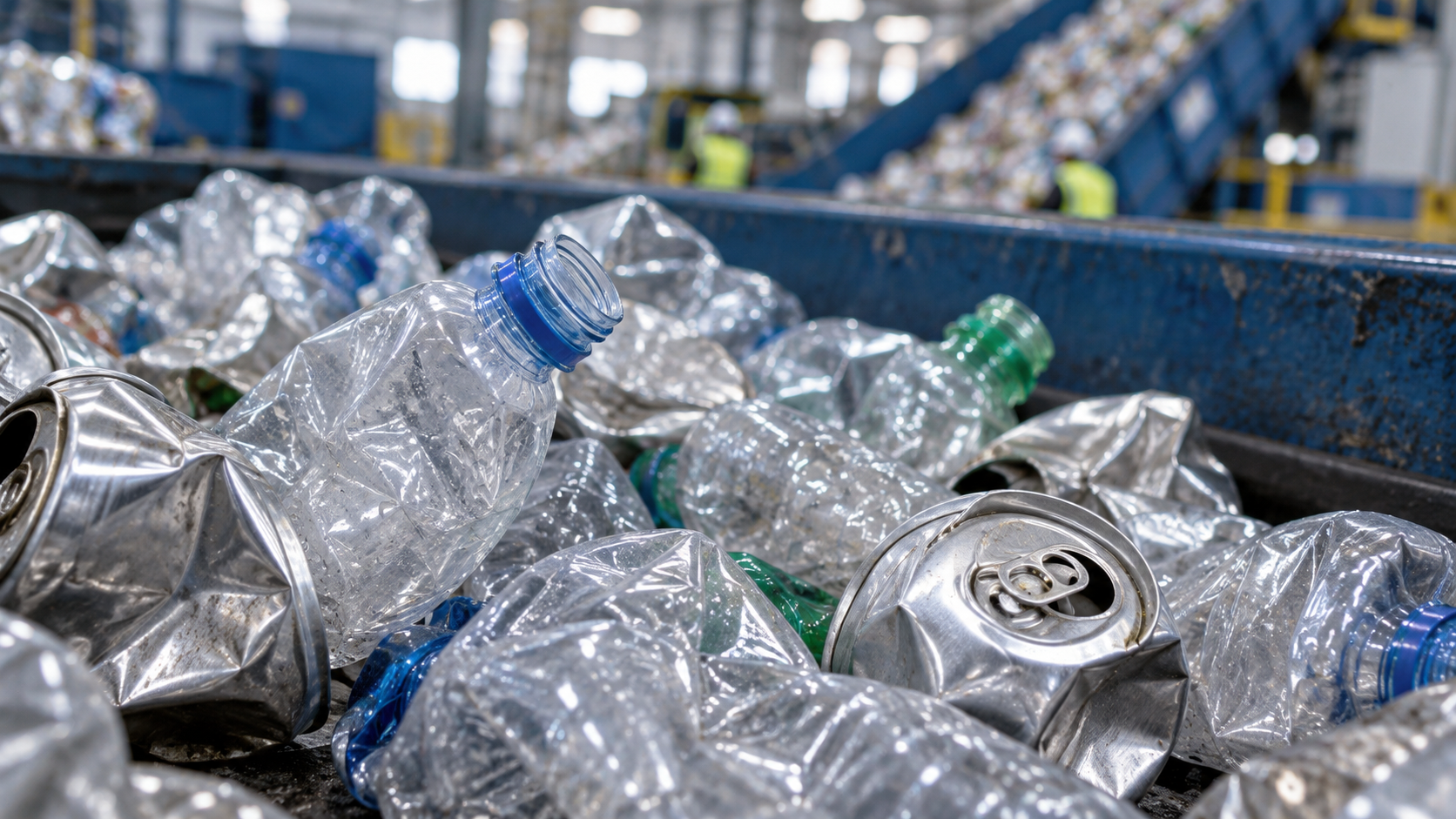
Recyclability is assessed against the reality of the collection and sorting infrastructure, not against whether a material is theoretically recyclable. That distinction is what catches beverage packs, because several common decoration and closure choices interfere with automated sorting even when every component is a recyclable material in isolation.
The decisions most likely to require review are the ones taken for shelf appearance. A full-body sleeve in a different polymer from the bottle can prevent optical sorters from identifying the container. Dark pigments can make a pack invisible to the same equipment. Metallised layers, multi-material laminates and strong adhesives all reduce the recyclate value even where the pack is collected.
None of these rule out an attractive pack, but they move the decision earlier. Packaging design and recyclability are now the same conversation, which is why the topic sits alongside the material comparison in the article on sustainable beverage packaging claims.
Recycled content minimums
Plastic beverage bottles carry their own recycled content obligation, expressed as a minimum share of recycled polymer by weight, with a higher figure applying later in the decade. The obligation attaches to the packaging placed on the EU market, which means it reaches an exporter through the buyer even though the exporter is not the obligated party.
Two practical consequences follow. The first is supply: food-grade recycled polymer is a constrained material, and securing it at a stated percentage requires a supplier relationship rather than a spot purchase. The second is documentation. A buyer claiming recycled content needs evidence of it, which means certificates and mass balance records travelling with the packaging supply, not an assurance in an email.
For an exporter this changes the bottle conversation. Where a buyer previously specified a bottle weight and a neck finish, they now also specify a recycled content percentage and ask how it is evidenced.
Deposit return schemes
Deposit return requires the consumer to pay a refundable amount at purchase and reclaim it when returning the empty container. Member states must operate such systems for single-use plastic beverage bottles and metal beverage cans, with an exemption available where separate collection is already very high.
For an exporter the effect is on the artwork and on the commercial arrangement rather than on the liquid. Packs sold into a deposit market carry the national deposit marking and must be registered with the scheme operator, and the deposit itself flows through the pricing. Because schemes are national, a pack destined for several member states may need market-specific marking, which reduces the value of a single pan-European artwork.
The practical question to ask a buyer early is whether the pack will be registered under their scheme membership and who applies the marking. Both answers affect the artwork timeline, and neither is something an exporter can decide alone. The per-market context for the largest EU destination is set out on the Germany market page.
What does an exporter outside the EU actually have to do?
The legal obligations generally fall on the party placing the packaging on the EU market, which is the importer or the brand owner established in the union. A Vietnamese manufacturer is not usually the obligated entity. That does not make the requirements someone else’s problem, because the obligated party can only comply if the pack they receive already meets the design requirements.
In practice the exporter’s responsibilities are these:
- Supply a compliant pack. Material structure, closure type and decoration must meet the design rules, because these cannot be corrected after filling.
- Provide evidence. Recycled content certificates, material specifications and component breakdowns are requested by the importer for their own compliance file.
- Accommodate national marking. Deposit markings and sorting labels must be designed into the artwork rather than added later as a sticker.
- Flag changes. A change of packaging supplier or component can affect the importer’s compliance position, so it needs to be notified rather than absorbed silently.
The labelling elements interact with the wider mandatory label content, which is covered in the article on EU beverage labelling and import rules.
Extended producer responsibility and fee modulation
Alongside the design rules sits the funding mechanism. Extended producer responsibility requires the party placing packaging on the market to pay towards the cost of collecting and treating it, and those fees are increasingly modulated by how recyclable the packaging is. A pack that sorts cleanly attracts a lower fee than one that disrupts the stream.
This turns recyclability from a compliance question into a recurring cost difference. Two packs that both satisfy the minimum requirement can carry different annual fees for the importer, and that gap is large enough to influence which supplier a buyer chooses when the liquid is comparable.
The exporter is rarely the fee payer, but the exporter supplies the pack that determines the fee. A manufacturer who can demonstrate that a proposed structure sits in a favourable modulation band is offering the buyer a measurable saving, which is a stronger commercial argument than a general sustainability statement. It is worth asking the buyer how their scheme modulates fees before finalising the decoration method, since sleeves and pigments are usually the deciding variables.
Planning the timeline
The requirements arrive in a sequence, and the useful planning approach is to work backwards from the hardest one rather than forwards from the nearest. Design for recycling is the constraint with the longest lead time, because changing a pack structure can mean new tooling, new sleeve artwork, requalification of the filling line and a fresh shelf life confirmation.
A workable sequence for a brand currently exporting to the EU is to audit the existing pack against the recyclability criteria first, since that audit determines whether anything structural has to change. Recycled content is next, because it is a procurement conversation rather than a design one and can run in parallel. Sorting labels and deposit markings are artwork tasks and can be absorbed into the next scheduled revision, provided the revision happens before the relevant date rather than after.
Format choice interacts with all of this, since the recyclability position of a can, a PET bottle and a carton differ. The trade-offs are compared in aluminium can versus PET bottle and across the wider range on the packaging options page.

Frequently asked questions
Does the PPWR apply to packaging filled outside the EU?
Yes, in the sense that packaging placed on the EU market must meet the requirements regardless of where it was filled. The obligation falls on the importer or the EU-established brand owner, but the pack itself has to comply, so the requirements reach the manufacturer through the specification.
Are glass and aluminium affected?
They are within scope for recyclability, minimisation and labelling, though the recycled content obligations for plastic do not apply to them. Metal beverage cans are also within the scope of deposit return where a scheme operates, so the marking requirement applies to cans as well as to plastic bottles.
Can a single artwork serve the whole EU?
Partly. The harmonised sorting label improves the position compared with the previous national symbols, but deposit markings remain national, so a pack shipped to several deposit markets may still need market-specific versions. Language requirements apply on top of that.
Who pays for the deposit?
The consumer pays it at purchase and reclaims it on return, so it is not a cost to the exporter in the way a levy is. It does affect the commercial arrangement, because the deposit flows through the supply chain and the pack must be registered with the scheme operator by whoever holds that obligation locally.
Treating packaging rules as a design input
The change the PPWR brings is less about new paperwork and more about when packaging decisions are taken. Recyclability, recycled content and deposit marking are all easier to satisfy at the design stage than to retrofit once tooling exists and artwork has been approved.
For brands exporting to Europe, the practical first step is a recyclability review of the current pack, followed by a conversation with the buyer about who holds the compliance obligations and what evidence they need. ACMFOOD works with brand owners on format and component decisions during development, so that the packaging specification reflects the destination market rules before production begins.