


 Français
 Español
 العربية
 한국어
한국어EU beverage labelling regulation is the shared rulebook that sets how drinks are named, listed and presented across the single market. Led by Regulation (EU) No 1169/2011, it requires disclosure of 14 allergens and a mandatory nutrition declaration on prepacked beverages, with import and packaging duties layered on top.
This guide explains the common layer that simultaneously covers Germany, France, the Netherlands, Poland and Spain, and also applies in Iceland via the EEA. You will find what must be on-pack, how nutrients are declared, how border control works, and which packaging obligations typically affect beverages.
The shared layer is the set of EU-wide rules that all Member States apply to beverage labels and product information, primarily under Regulation (EU) No 1169/2011 on food information to consumers. It defines mandatory particulars, allergens, nutrition declarations and how information is presented, forming a harmonised baseline across markets.
Because this framework is harmonised law, one compliant label can often serve multiple EU countries when languages and any small local additions are addressed. For Iceland, the same consumer information rules apply through the European Economic Area (EEA) agreement, although customs and import procedures differ (see the Iceland note below).
Which mandatory particulars must appear on a beverage label?
In short, EU law requires a standard set of label elements on prepacked beverages, displayed legibly and in the appropriate language(s) of the destination market. The key particulars include the product’s legal name, ingredients, allergen emphasis, net quantity, durability date, storage/usage conditions when needed, responsible business name & address in the EU/EEA, and the nutrition declaration.
Below is a practical summary you can use as a checklist at artwork stage. Always verify exact phrasing and placement against your final formulation and the market(s) where you will sell.
| Label element | Applies to | Positioning & notes |
|---|---|---|
| Legal name of the food | All beverages | Use the correct product category name (e.g., fruit juice, nectar, soft drink) as defined under EU rules, not a marketing description alone. |
| Ingredients list | All beverages with more than one ingredient | List in descending order by weight at mixing; group components of compound ingredients; declare additives by functional class and specific name. |
| Allergen emphasis | When any Annex II allergen is present | Highlight in the ingredients list with a distinct typeset (e.g., bold). Do not use a separate statement instead of emphasis, unless permitted. |
| Quantitative ingredient declaration (QUID) | When an ingredient is emphasised or essential to characterisation | Show percentage at the point in the name or ingredients where the ingredient appears (e.g., strawberry 20%). |
| Net quantity | All prepacked beverages | Use legal volume units appropriate for the pack (e.g., mL, L), placed on the principal field of vision. |
| Durability date | All beverages | Show “best before” or “best before end” as relevant to product stability; add storage conditions if needed to achieve durability. |
| Special storage/usage conditions | If needed for safety/quality | Include after opening storage time/temperature or preparation/use directions where necessary for safe consumption. |
| Name & address of Food Business Operator (FBO) | All beverages | Indicate the FBO established in the EU/EEA responsible for information; for third-country products, this is typically the importer or EU entity. |
| Country of origin/place of provenance | Where omission could mislead or when specifically required | Provide origin statements as required for certain products or when branding/presentation would otherwise mislead. |
| Alcohol by volume | Alcoholic beverages | Declare ABV when applicable; other alcohol-specific rules may also apply. |
| Nutrition declaration | Prepacked beverages | Mandatory table per 100 mL; per-portion may be added in addition to per-100 mL. |
Ingredients, additives and sweeteners: what should teams verify?
Check that every component is permitted in beverages under EU rules and appears on the label correctly by functional class and specific name. Food additives in the EU are governed by a positive list system; your formulation must use authorised substances in authorised categories and conditions, and they must be declared properly.
Some sweeteners and flavourings come with additional statements or naming conventions under EU law. Energy drinks, flavoured waters, reduced-sugar soft drinks and similar formulations can trigger specific on-pack statements or usage limits. Always align the final pack copy with your confirmed, analytical specification and the applicable EU legislation for additives and flavourings. When using claims such as “no added sugar” or “low calorie,” ensure you meet the separate EU nutrition and health claims regulation and that your wording is precise and substantiated by the product as sold.
How are nutrients declared on drinks in the EU?
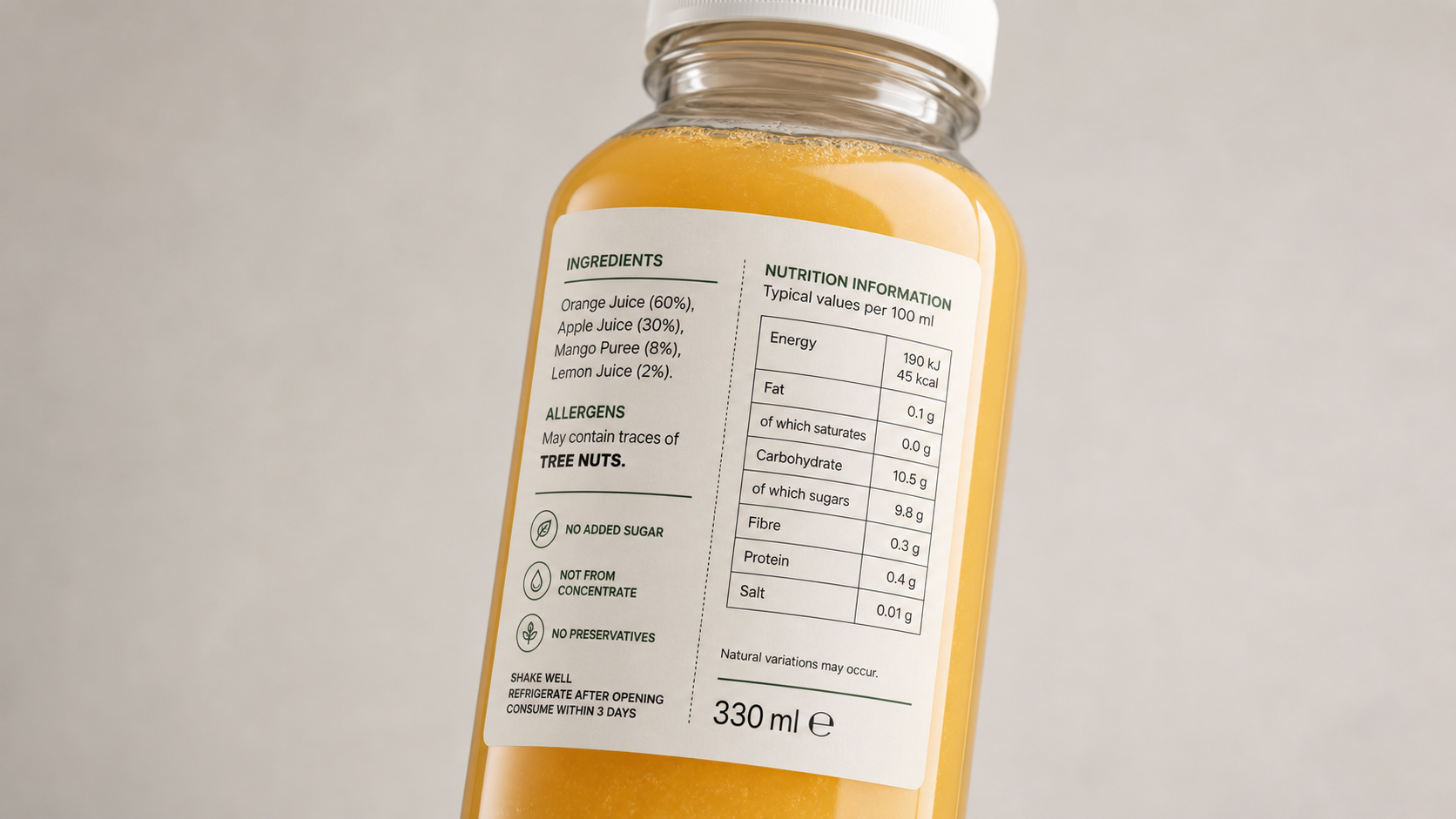
For prepacked drinks, the nutrition declaration is mandatory and must be provided at minimum per 100 mL, in a prescribed order and format. Present energy in kJ and kcal together, followed by specific nutrients. You can add per-portion information voluntarily, but not as a substitute for the per-100 mL figures.
Declare the following as a core set in this order: energy (kJ/kcal), fat, of which saturates, carbohydrate, of which sugars, protein and salt. Additional nutrients (such as fibre, mono-unsaturates, polyunsaturates, polyols, starch, and certain vitamins/minerals) can be added when permitted and when conditions for declaration are met. Keep your nutrient values aligned with your final recipe and verified test reports; the panel should reflect the food “as sold,” unless clearly presented as “as prepared” with instructions.
Formatting, language and proximity rules apply. Many brands choose a tabular layout when space allows, with uniform type sizes and clear contrasts for legibility. If you communicate nutrition or health claims anywhere on the pack, ensure the nutrition declaration placement complies with the claims framework and that the claim wording is authorised for the EU.
Which allergens must be highlighted on EU beverage labels?
The EU requires emphasis for Annex II allergens within the ingredients list. Beverages rarely contain many of them, but cross-over occurs via flavourings, stabilisers, proteins or processing aids. Emphasise each occurrence consistently, using a typeset that clearly distinguishes the allergen from surrounding text.
- Gluten-containing cereals (wheat, rye, barley, oats and their hybrids)
- Crustaceans
- Eggs
- Fish
- Peanuts
- Soybeans
- Milk (including lactose)
- Nuts (e.g., almond, hazelnut, walnut, cashew, pecan, Brazil nut, pistachio, macadamia)
- Celery
- Mustard
- Sesame seeds
- Sulphur dioxide and sulphites at relevant levels
- Lupin
- Molluscs
Where a beverage contains or derives from any of the above, declare them in the ingredients and emphasise them. Precautionary allergen labelling (e.g., “may contain”) is not a substitute for good manufacturing practice and is subject to national guidance; use it only when a genuine, assessed risk of cross-contact remains despite controls.
Do 100% juice, nectar and soft drinks follow different naming rules?
Yes. While the information framework is shared under Regulation 1169/2011, product naming and composition for fruit juices and nectars are governed by dedicated EU fruit juice legislation. Your declared name must match the category and formulation. Soft drinks and flavoured waters also need correct category names consistent with EU conventions.
In practice, that means: do not market a nectar as “juice,” do not imply added sugars are absent when they are present, and ensure any statements about sweeteners, fruit content or reconstitution are accurate. The correct category name should appear prominently near the main field of vision, and any required qualifiers should sit alongside it, not buried elsewhere on the pack.
What happens at the EU border for beverage imports?
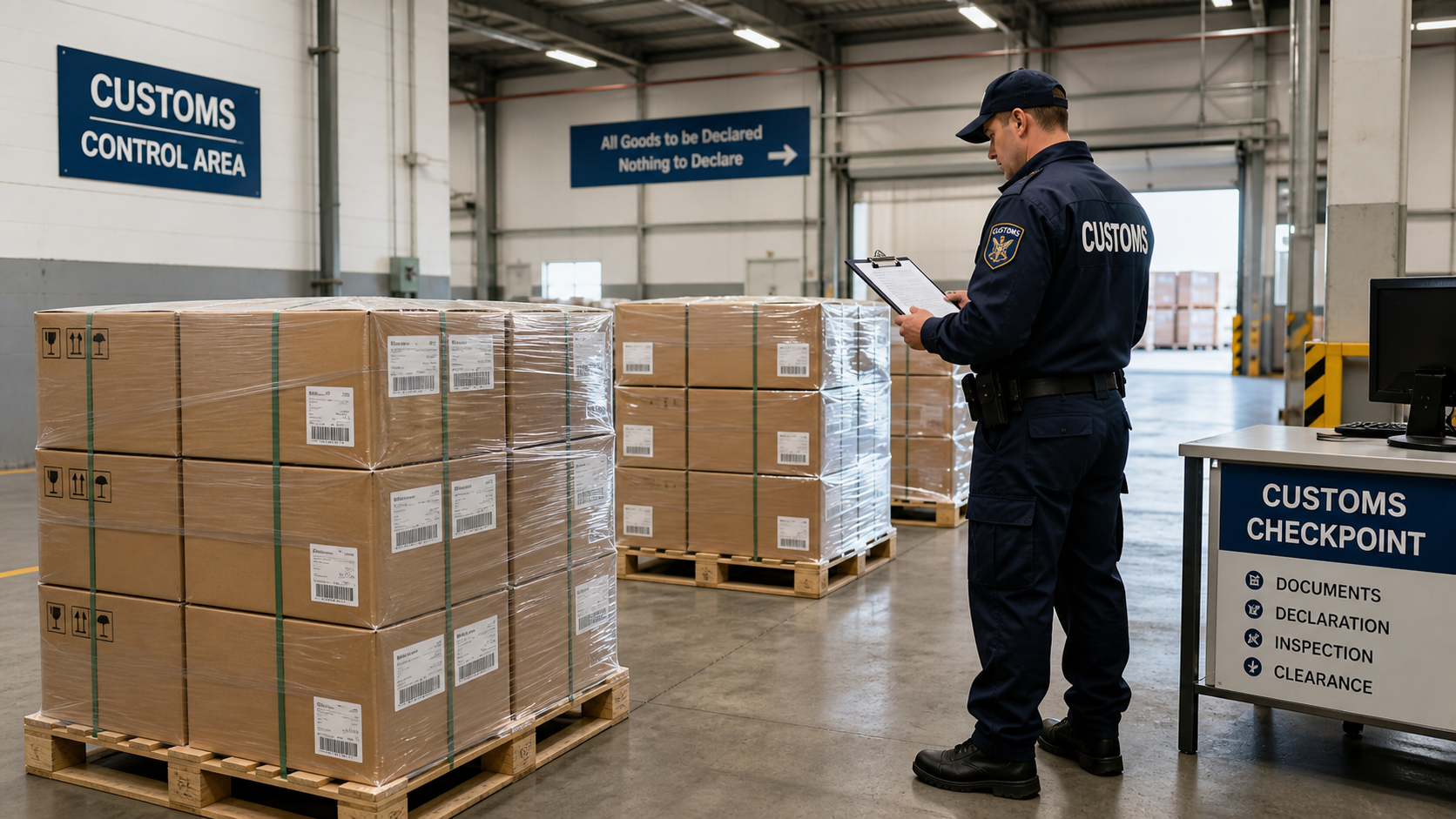
Imports of beverages into the EU undergo customs clearance and, where applicable, official controls on food safety and compliance. Importers need the correct tariff classification, documentation and (for certain consignments) may be subject to documentary, identity or physical checks under the EU’s official controls framework.
For most non-animal beverages, controls focus on compliance of the product and label with EU law: authorised additives, contaminant limits set by EU legislation, and correct consumer information. Your EU-based importer or responsible Food Business Operator (FBO) carries legal duties to ensure that the product placed on the market is compliant. Keep specifications, certificates and test results ready to support the shipment and, if requested, official control authorities.
Iceland note: Iceland applies the shared food information rules via the EEA, so labels designed for the EU information framework typically work in Iceland when language and any local specifics are addressed. However, Iceland is not part of the EU customs union, so imports into Iceland follow separate national customs procedures and are not cleared through the EU customs system.
Language, legibility and layout: what does the law expect?
Information must be easily visible, clearly legible and indelible. Use a type size and contrast that support legibility on curved bottles and small cans. Do not hide or separate mandatory particulars from the principal field of vision without justification.
Language matters. Provide mandatory information in the official language(s) of the Member State where the product is marketed. For multi-market packs, it is common to group languages while maintaining a single nutrition table (per 100 mL) and a single ingredients list with multilingual headings and allergen emphasis that remains obvious in every language. Keep critical declarations (e.g., allergens, storage after opening) close to the ingredients panel so they are not overlooked.
Packaging and environmental obligations that affect beverages
Beyond food information, packaging rules shape what must appear on beverage containers and outer cases. EU-level packaging and packaging waste law sets a framework for extended producer responsibility (EPR) schemes, recycling targets and, in many countries, deposit-return systems for beverage containers. These obligations are implemented nationally, so the artwork may require local waste sorting symbols or producer registration numbers in specific countries.
Some packaging materials or single-use formats face restrictions or special marking rules in certain EU jurisdictions. When planning a multi-country pack, align early with the importer or local compliance partner to confirm which environmental marks, recycling cues or deposit logos are mandatory in each target market. Design your label architecture with a flexible zone that accommodates such country-level additions without redrawing the entire pack.
While the shared layer is harmonised, Member States can impose limited national measures. Common additions include:
- Deposit-return identifiers, waste sorting symbols or EPR registration references on beverage containers.
- Language-specific nuances (e.g., mandatory phrasing or display conventions for certain statements).
- Fiscal measures like sugar taxes that do not directly change label rules but may influence claims and pack messaging.
Plan your artwork with a “country tiles” panel, or validated over-stickers, to append national marks efficiently. Keep version control tight so each SKU is traceable to its exact label and compliance dossier.
For importers and beverage brands: how to operationalise compliance
The smoothest EU launch starts with a structured dossier and pack copy aligned to the final formulation. Use this workflow to manage risks and timelines:
- Lock the specification: finalise recipe, additives, flavours, allergens, acidity regulators, colour and clarity expectations, and shelf life (with and without chill-chain). Ensure additive permissions align with EU product categories.
- Build the pack copy: legal name, ingredients (with QUID where required), allergen emphasis, net content, best before/best before end, storage after opening, importer/EU FBO details, origin/provenance where needed, nutrition declaration per 100 mL, and any mandatory statements specific to your formulation (e.g., sweetener-related).
- Choose the artwork architecture: design for legibility on curved surfaces; reserve space for multi-language headings and for country-level symbols (EPR/deposit) without crowding mandatory particulars.
- Substantiate any claims: if you intend to use nutrition or health claims, check the EU list of authorised claims and the wording conditions. Match serving sizes and nutrient levels to the claim conditions; keep evidence on file.
- Translate and review: translate mandatory texts into the official language(s) of target markets and have a compliance reviewer check for local nuances. Harmonise punctuation, decimal markers and allergen emphasis consistently across languages.
- Pre-ship checks: ensure date coding, lot marking and pack integrity match the label. Keep test reports for key nutrients (when claimed), microbiology (as relevant) and any contaminant monitoring aligned with EU limits for beverages.
- Importer readiness: confirm your EU FBO address on-pack, importer registrations at national EPR schemes when required, and keep your customs classification and product documentation accessible for border checks.
When evaluating manufacturers, a structured due diligence helps ensure label claims match production reality. See a practical checklist in Auditing a Vietnamese beverage manufacturer: what to check. If you are deciding how to launch, compare commercial pathways in Private label, white label and OEM beverages compared. For process thinking on cross-border sourcing, see how to choose an overseas beverage manufacturer and regulatory context in a practical guide to Australian beverage regulations as a reference point for building your internal compliance playbook.
EU vs. Iceland: what stays the same, what changes?
Same information rules: Iceland, through the EEA agreement, applies the core EU food information framework to beverages, including allergens and the mandatory nutrition declaration on prepacked drinks. If you prepare a label that meets the shared EU layer and add Icelandic language where required, the information architecture generally carries across.
Different customs pathway: Iceland is not part of the EU customs union. That means importation into Iceland uses Icelandic customs formalities and is not cleared under EU customs procedures. Treat your Iceland consignments as a separate customs project, even though the consumer information requirements mirror the EU layer.
Data management: keep your label and specification in sync
Regulatory deviations often come from version drift. Keep a single source of truth that synchronises:
- Approved specification: ingredients, authorised additives and their maximum levels, declared allergen presence, analytical support for nutrition values.
- Artwork master files: locked copy in each language, with change history; separate layers for country-specific symbols or deposit marks.
- Shipment documentation: lot list, date code map, certificates, test results and importer registrations as applicable.
Before each production, run a label-vs-spec check. After production, verify that the printed lots match the approved PDF and that the nutrition and allergen statements are unchanged from the signed master.
Common pitfalls to avoid on EU beverage labels
- Using a marketing name in place of the legal name: keep the correct category name visible.
- Forgetting allergen emphasis: bold allergens inside the ingredients list; do not rely solely on separate statements.
- Misaligned nutrition panel: always declare per 100 mL in the prescribed order; per-portion is optional and additional.
- Missing EU/EEA FBO details: third-country brands must indicate an EU/EEA-based responsible operator on-pack.
- Over-claiming: nutrition and health claims require strict conditions and exact wording; verify before printing.
- Ignoring country add-ons: leave space for EPR/deposit marks and local phrases without crowding mandatory items.
How to prepare a master label that works across five EU markets
A practical approach is to build a pan-EU core that is strictly compliant, then append country modules. Consider this structure:
- Front-of-pack (shared): legal name, net quantity, core claims (if any, and only once validated), and clear category identity.
- Back panel (shared): ingredients with allergen emphasis, nutrition declaration per 100 mL, storage/use instructions, durability date, and importer/EU FBO address.
- Country band (modular): compact area for national EPR/deposit icons, optional local guidance phrases and any legally required national marks.
- Language blocks: grouped headings (Ingredients/Nutrition/Storage) repeated in each language; keep typographic hierarchy consistent so allergens remain obvious in all languages.
This architecture minimises rework while keeping room for national obligations that sit on top of the shared layer. It also helps distributors swap a country band without disturbing the core compliance elements.
FAQ
Can one label serve Germany, France, the Netherlands, Poland and Spain?
Yes—if the label meets the shared EU framework (Regulation 1169/2011), uses the official language(s) for each market and includes any country-specific environmental marks or phrases. Many brands run a single pan-EU core with modular country tiles for local additions.
Do I need an EU address on the label if I produce outside the EU?
Yes. The label must indicate a Food Business Operator established in the EU/EEA who is responsible for the information. For third-country brands, this is typically the importer or a designated EU-based entity.
Are nutrition tables required on all non-alcoholic beverages?
For prepacked beverages, the nutrition declaration is generally mandatory and must appear per 100 mL in the prescribed order. Exemptions are limited and specific; plan on including the table unless your product clearly falls within an exemption.
Can we list multiple languages on one pack?
Yes. Group headings and keep a single ingredients list with clear allergen emphasis visible across languages. Ensure translation accuracy and keep the same typographic emphasis for allergens in every language used.
Does Iceland follow the same labelling rules?
Yes, broadly. Iceland applies the EU’s consumer information framework via the EEA, so the shared labelling rules and the 14-allergen approach apply. Customs procedures, however, are separate because Iceland is outside the EU customs union.
Key takeaways for teams planning EU beverage launches
The shared layer under EU beverage labelling regulation lets you design one compliant core label for multiple countries. Centre your artwork on the legal name, complete ingredients with allergen emphasis, and a per-100 mL nutrition table. Build a modular zone for national packaging marks and plan translations early. Align imports with your EU-based FBO and keep a tight spec–artwork–shipment triangle. With that structure, pan-market launches become a controlled, repeatable process.
Sources
- Regulation (EU) No 1169/2011 on the provision of food information to consumers (FIC)
- Regulation (EC) No 1333/2008 on food additives
- Regulation (EU) 2017/625 on official controls
- Directive 94/62/EC on packaging and packaging waste
- Regulation (EC) No 1924/2006 on nutrition and health claims made on foods