


 Français
 Español
 العربية
 한국어
한국어To import beverages into Egypt, you must clear three checkpoints: factory pre-registration, cargo pre-registration, and border inspection. Two authorities lead the process—NFSA for food safety and GOEIC for trade controls. Your shipment cannot clear if the foreign factory is not registered in advance and the cargo lacks an ACID under Egypt’s ACI system.
This guide explains the exact order of work, documents, labeling expectations, and on‑the‑ground realities at ports such as Alexandria, Damietta, Port Said, and Sokhna. If you are evaluating demand, see the broader Egypt market overview and category insights like Egypt’s affinity for karkadé in our article on hibiscus flower tea popularity.

Who regulates beverage imports into Egypt?
NFSA (National Food Safety Authority) oversees food safety compliance at import, while GOEIC (General Organization for Export and Import Control) handles trade control, importer records, and release coordination. Egyptian Customs manages tariff and VAT assessment, and EOS (Egyptian Organization for Standardization) sets technical standards that labels and formulations are typically measured against.
| Authority | Primary role at import | Where it applies |
|---|---|---|
| NFSA | Food safety review, product risk classification, border inspection, sampling & lab testing | NFSA clearance at port and during lab release |
| GOEIC | Importer records, foreign factory/brand registration, conformity & trade documentation checks | Pre-shipment registration and release coordination |
| Customs | Tariff code validation, duties/VAT assessment, final release after NFSA/GOEIC | Port clearance window |
| EOS | Egyptian standards for composition, additives, and labeling | Label/content review and market surveillance |
What must be registered before shipping?
Your foreign beverage factory must be registered with GOEIC/NFSA before any shipment can be imported. Without this, your cargo cannot legally enter Egypt. In parallel, the Egyptian importer needs to be properly recorded with GOEIC and onboarded to the national single window (NAFEZA) to use Advanced Cargo Information (ACI) and obtain an ACID for each shipment.
- Foreign factory registration: Submit facility identity documents and product scope for GOEIC/NFSA pre-approval. Only registered factories/brands are admissible.
- Importer onboarding: The local importer must have active records with GOEIC and access to ACI via NAFEZA to request an ACID per shipment.
- ACID (advance cargo ID): This unique cargo identifier must appear on the bill of lading and commercial documents prior to loading.
Step-by-step: How to import beverages into Egypt
Follow these steps in order. Missing any early registration—especially factory registration or ACID—typically causes holds or refusal.
- Define the product and HS code precisely. Identify whether it’s 100% juice, nectar, juice drink, flavored water, tea drink, energy drink, or other. Correct HS classification drives duties, testing focus, and labeling specifics.
- Confirm foreign factory registration with GOEIC/NFSA. Ensure the producing facility and brand are pre-registered and approved for the intended product scope. If not, complete registration before any commercial booking.
- Validate the importer’s GOEIC/NAFEZA readiness. The Egyptian importer must have active credentials to file ACI and manage customs entries.
- Compile the product technical dossier. Include full ingredient list (descending order), additive functions, allergens if present, nutrition panel (if applicable), shelf life, storage conditions, and manufacturing flow. Prepare a certificate of analysis and a country-of-origin certificate for the shipment stage.
- Pre-check Arabic labeling against EOS/NFSA expectations. Egypt commonly requires Arabic on labels, production and expiry dates, net content, country of origin, and importer name/address. Ensure label artwork is final before printing.
- Plan primary & outer packaging. Confirm pack sizes and case configurations that withstand long-haul shipping and port handling at Alexandria, Damietta, Port Said, or Sokhna. Consider moisture, stacking, and container temperature ranges.
- Book shipment and obtain the ACID. Through ACI on NAFEZA, the importer requests an ACID. Share it with your forwarder. Ensure the ACID is printed on the commercial invoice and bill of lading before loading.
- Prepare shipment documents. Typical sets include commercial invoice, packing list, bill of lading (with ACID), certificate of origin, health certificate or free-sale certificate when applicable, and lab test results or CoA aligned to NFSA expectations.
- Produce, test, and seal. Keep production records traceable to the shipped lot. Retain samples. Verify that date coding (production and expiry) matches Egyptian expectations and is durable.
- Dispatch and track. Confirm container number, seal, and sailing. Share pre-alerts with the importer so they can lodge entries and NFSA requests in time.
- Port arrival and NFSA clearance. NFSA may inspect, sample, and send to accredited labs. Provide any requested dossiers or clarifications quickly to avoid storage charges.
- Customs assessment and release. After NFSA/GOEIC clear the shipment, Customs finalizes duties/VAT and issues release. Arrange inland transport and temperature-appropriate warehousing immediately.
Documentation checklist for beverages (Egypt)
These documents are commonly requested for beverage imports. Align formats, product names, and lot details across all files; inconsistencies are a frequent cause of holds.
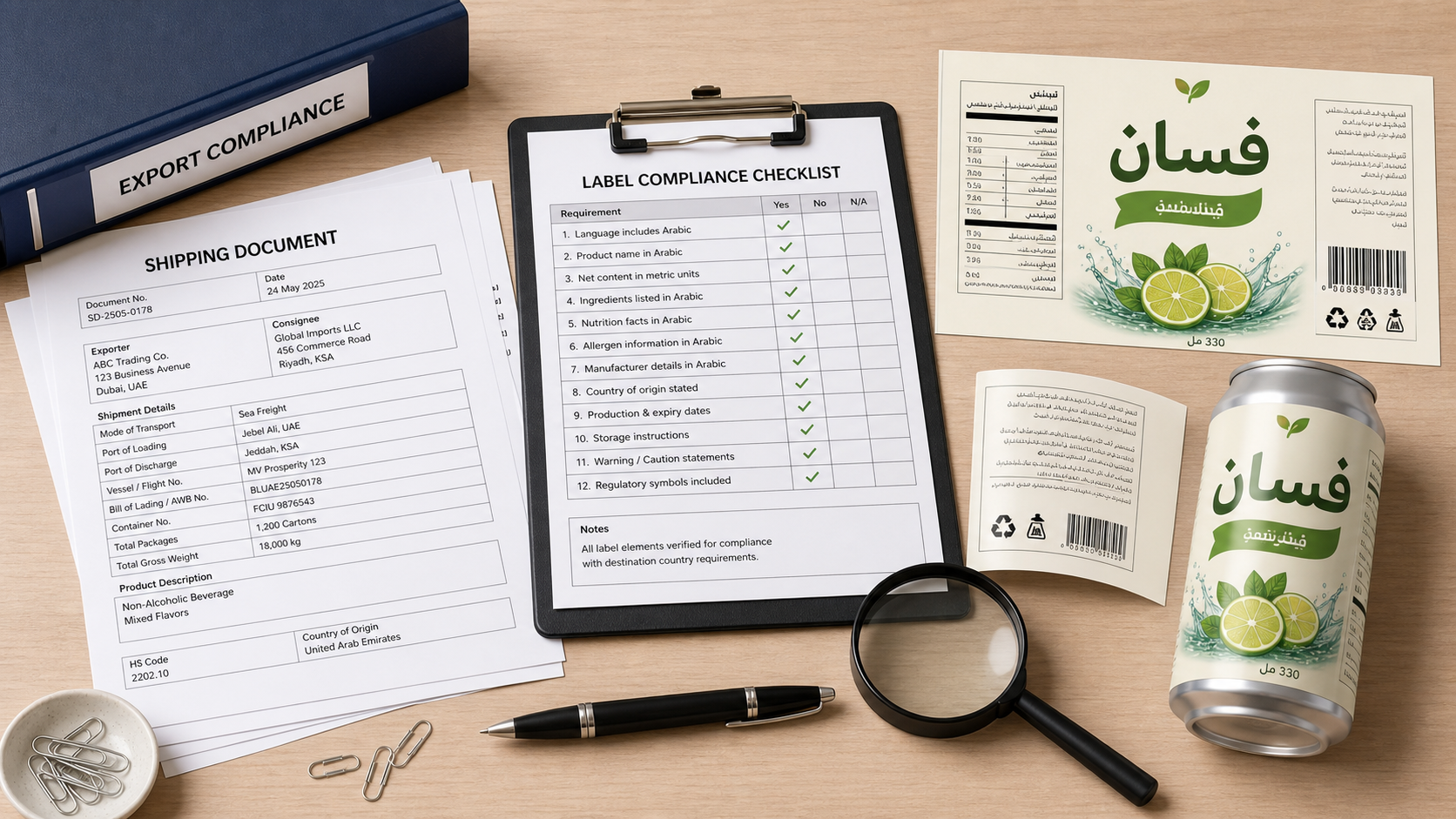
Documentation checklist for beverages (Egypt)
- Commercial invoice with product descriptions consistent with HS code and label naming; include ACID.
- Packing list detailing carton counts, net/gross weight, and palletization.
- Bill of lading showing ACID and exact consignee/importer name as per GOEIC records.
- Certificate of origin issued according to the product’s manufacturing country.
- Health certificate or Free Sale certificate (when applicable to the beverage type).
- Certificate of analysis (CoA) for the shipped lot, aligned to NFSA testing focus (e.g., microbiology, preservatives within allowed ranges).
- Full ingredient list & additives with functions and INS/E-numbers if used; disclose allergens if present.
- Label artwork in Arabic (or bilingual) including net content, production/expiry dates, storage, importer details, and country of origin.
- Shelf-life statement and storage conditions (ambient/chilled), matching label claims.
- Product specification sheet with Brix and acidity for juices/nectars/juice drinks where relevant.
- Outer case markings showing product name, lot/date, and handling orientation where needed.
Labeling and formulation specifics for Egypt
Labels for beverages in Egypt generally need Arabic and must match EOS standards that NFSA applies at import. Expect to show true product name (e.g., 100% juice vs nectar vs juice drink), ingredient order, net content, production/expiry dates, importer details, storage, and country of origin. Additives should conform to Egyptian standards. When in doubt, submit artwork for a pre-check before mass printing.
| Format | What it typically means | Positioning & notes |
|---|---|---|
| 100% juice | Juice only from fruit; no added sugars, flavors, or colors | Declare fruit content accurately; Brix/acidity may be checked |
| Nectar | Juice plus water; may contain permitted sweeteners/additives | State minimum fruit content and permitted additives clearly |
| Juice drink / flavored drink | Lower fruit content; flavors, colors, and sweeteners may be used as allowed | Use correct name; avoid implying 100% juice |
| Tea drink / herbal infusion | Water infusion with tea or botanicals (e.g., hibiscus) | Declare botanicals; manage color and sediment expectations |
| Energy drink | May contain caffeine, vitamins, or other actives | Check allowed levels and any cautionary statements |
- Arabic labeling: Arabic is commonly required on consumer units; bilingual layouts are acceptable if Arabic is complete and legible.
- Dates: Production and expiry dates should be printed, durable, and synchronized with the shelf-life statement.
- Claims: Nutrition or functional claims depend on final formulation, serving size, verified content, and local regulations; do not pre-print unverified claims.
- Alcohol: Alcohol-containing beverages face different market rules and licensing; confirm feasibility before development.
Where will your cargo enter and what happens on arrival?
Egypt’s main entry points for beverages include Alexandria, Damietta, Port Said (East/West), and Sokhna. On arrival, NFSA may inspect and sample. If lab testing is triggered, expect holding in port or bonded areas until results are issued. Accurate ACID data, clean documents, and ready access to product dossiers minimize time at berth.
- Sampling focus: Microbiology for shelf-stable drinks, preservatives within permitted ranges, colorants, and sweeteners within limits, as applicable to the declared product.
- Mismatch triggers: Differences between label, invoice, and ACID data (names, formats, net contents) can cause additional checks.
- Shelf-life sensitivity: Ensure adequate remaining shelf life at arrival to satisfy buyer and distribution requirements.
Practical tips to pass NFSA and GOEIC smoothly
Compliance is mostly won before loading. These practices address the most common failure points seen at Egyptian ports.
- Single source of truth: Lock product name and description across label, invoice, ACID, and packing list to avoid discrepancies.
- Submit clear ingredient functions: Identify sweeteners, preservatives, and colors by name and function; reference INS/E-numbers where relevant.
- Arabic-first label QC: Prioritize Arabic content proofreading and print durability (smudge/abrasion tests).
- Pre-shipment sample retention: Keep sealed retains with complete records (lot, fill date, QC results).
- Temperature-aware logistics: For heat-sensitive drinks, consider reefer or shoulder seasons to reduce thermal load.
- Change control: If you reformulate or switch sites, re-confirm GOEIC/NFSA registration status before shipping.
Commercial terms, shipment planning and risk allocation
Agree Incoterms and responsibilities early. Because ACI/ACID is filed in Egypt, many importers prefer terms where the buyer controls documentation and clearance milestones. Whatever the split, align timelines for factory registration, artwork finalization, ACID issuance, and production windows before sailing schedules are booked.
- Transit and dwell: Build buffer for lab release if your category is often sampled.
- Packing strength: Reinforce carton corners and choose pallets that match the importer’s warehousing system.
- Container selection: Consider reefer or insulated liners for sensitive SKUs; record loading temperatures.
Common pitfalls and how to avoid them
These recurring issues lead to holds or rejections. Address them proactively during product development and pre-shipment checks.
- Factory not registered: No pre-registration with GOEIC/NFSA equals no import. Confirm status in writing before PI issuance.
- ACID missing or incorrect: If the ACID is absent or mismatched on the bill of lading or invoice, expect administrative holds.
- Label misnaming: Calling a nectar a “juice” invites nonconformity; use correct Egyptian naming conventions.
- Incomplete Arabic: Missing importer address or country of origin in Arabic can block clearance.
- Additive levels: Using non-permitted sweeteners/colors or exceeding allowed ranges creates avoidable failures.
- Short shelf life on arrival: If dwell or lab holds are likely, ship earlier in the lifecycle and rotate stock accordingly.
Information for beverage brands and importers
If you are developing SKUs for Egypt, bake compliance into the brief from day one. Lock the product definition, EOS-aligned naming, Arabic artwork, and document templates before your first trial production. Where feasible, align formulas with widely accepted standards to reduce market-specific rework.
- Define your product format and claims early: This guides ingredient approvals, additive choices, and label hierarchies.
- Create a compliance pack: A single PDF with spec sheet, full ingredient list, additive rationale, Arabic label, and draft shipment documents accelerates reviews.
- Plan for variants: If launching multiple flavors, standardize base components to simplify testing and reductions in administrative load.
FAQ
Is factory pre-registration really mandatory?
Yes. Shipments from foreign factories or brands that are not registered with GOEIC/NFSA will not be admitted. Confirm registration status before production or booking.
What is ACI and the ACID number?
ACI (Advanced Cargo Information) is Egypt’s pre-arrival cargo system on NAFEZA. Each shipment receives a unique ACID that must appear on commercial documents and the bill of lading prior to loading.
Do labels have to be in Arabic?
Arabic labeling is generally required in Egypt. Bilingual labels are common provided Arabic content is complete, accurate, and legible.
How long does NFSA lab testing take?
Timelines vary by category, port workload, and requested analyses. Plan buffers and prepare clear dossiers to minimize questions and retests.
Are energy drinks or fortified drinks treated differently?
They can face additional scrutiny on actives (e.g., caffeine) and declared levels. Ensure ingredients and quantities align with Egyptian allowances and labeling expectations.
Sources
- National Food Safety Authority (NFSA) – official guidance and border procedures
- General Organization for Export and Import Control (GOEIC) – importer records and factory/brand registration
- Egyptian Customs/NAFEZA – Advanced Cargo Information (ACI) and ACID workflow
- Egyptian Organization for Standardization (EOS) – labeling and additive standards applied in Egypt