


 Français
 Español
 العربية
 한국어
한국어Beverages from Vietnam entering Spain pay the EU customs duty set by their 10-digit TARIC code, which can fall to 0% under EVFTA with valid proof of origin. On top of duty, importers pay Spanish VAT (21% standard rate, with reduced rates for some foods and drinks) and Spain’s plastic packaging tax of €0.45/kg of non-recycled plastic.
This guide focuses on Spain-specific duty and agreement touchpoints for beverage brands and importers, explaining how to navigate TARIC, use EVFTA with the correct certificate of origin, and add Spain’s plastic packaging tax to your price build-up. For broader steps on the Spanish market and import process, see our pages on the Spain market and how to import beverages into Spain.
What determines Spain beverage import duty?
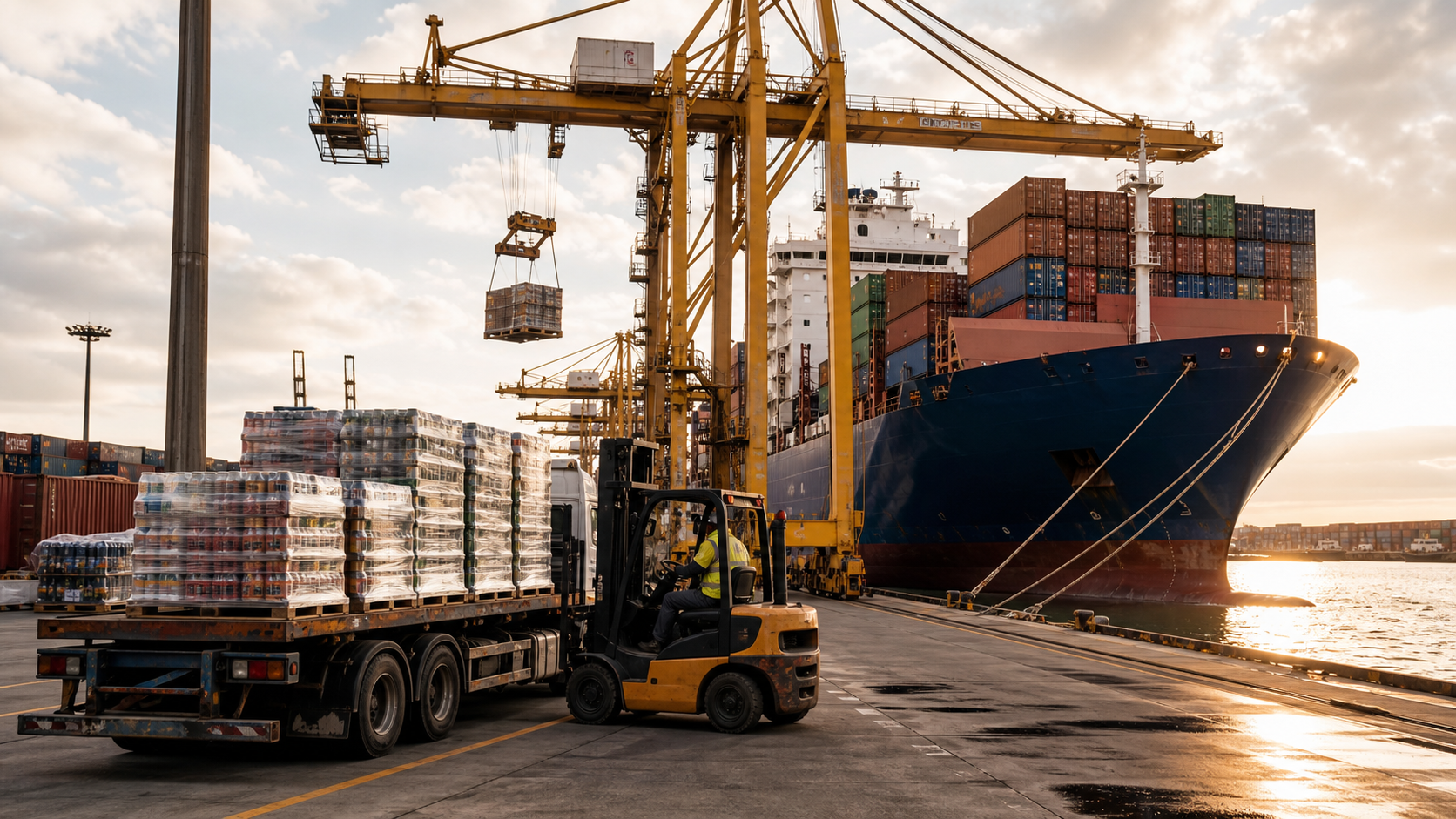
Spain beverage import duty is driven by your product’s HS/TARIC classification, the country of origin, and the customs value. EVFTA can reduce or eliminate EU customs duty for qualifying Vietnamese goods, while Spain’s domestic plastic packaging tax adds a separate cost on non-recycled plastic components.
Three core elements shape your landed duty picture:
- Classification: Beverages fall under HS Chapters 20 and 22 (e.g., 2009 for fruit juices; 2202 for waters and other non-alcoholic beverages; 2203, 2204, 2205, 2206, 2208 for alcoholic drinks). The EU TARIC extends the code to 10 digits, which controls which measures apply.
- Origin & preferences: The EU’s MFN duty may be reduced to a preferential rate under the EU’Vietnam Free Trade Agreement (EVFTA) if the rules of origin (ROO) are met and proof of origin is provided.
- Additional domestic measures: Spain’s plastic packaging tax applies at €0.45/kg on non-recycled plastic in non-reusable packaging, separate from customs duty. Alcoholic beverages are also subject to Impuestos Especiales (excise) administered by Spain’s tax authorities.
Other cost items (brokerage, port fees, warehousing, inland transport) also affect your price build-up but sit outside the customs tariff framework. If you are building a full landed cost model, align your Incoterms, customs value elements (freight and insurance as appropriate), and documentary evidence to support preferential claims.
How do I look up Spain beverage tariffs in TARIC?
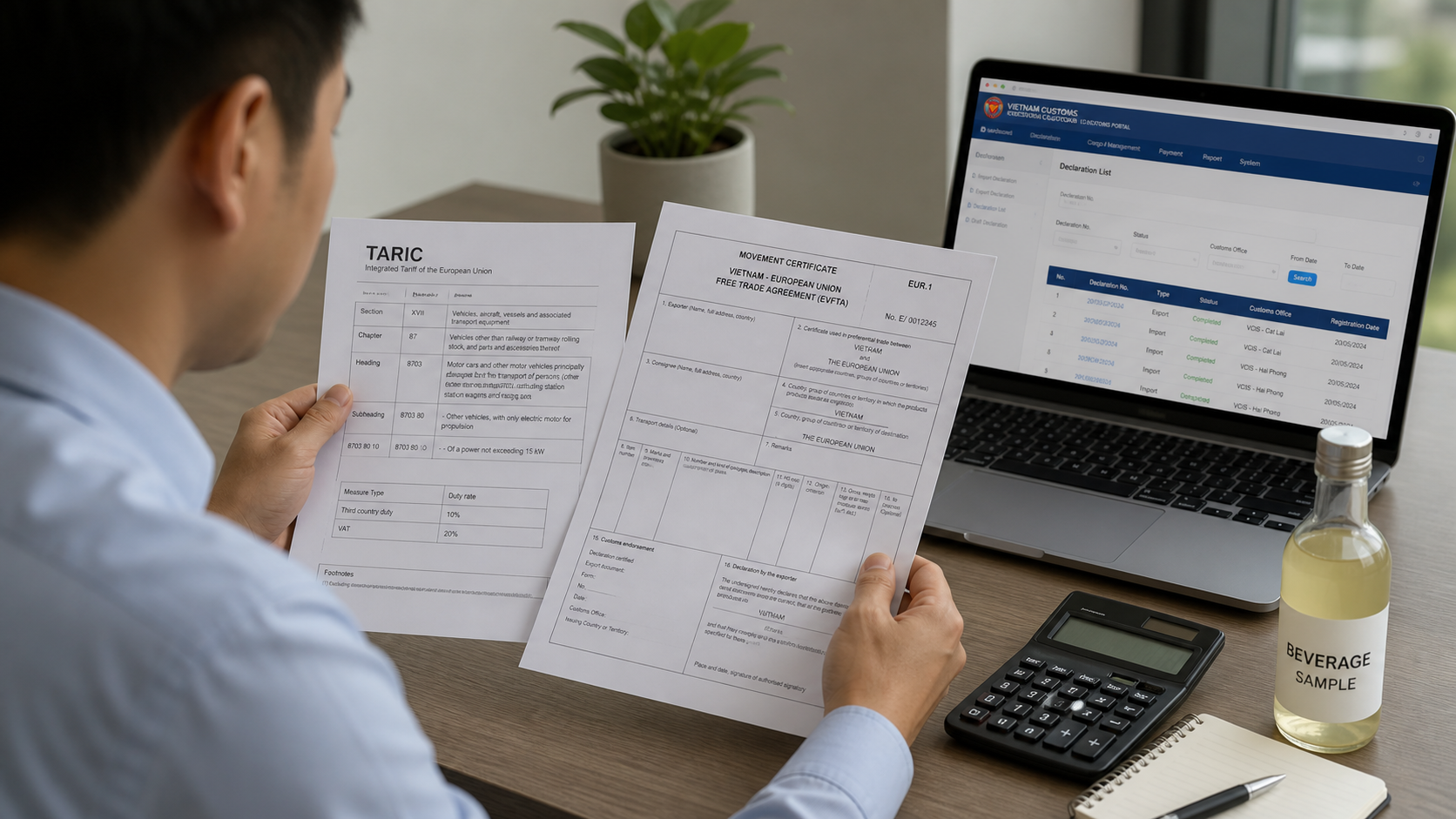
Use the EU TARIC database to find measures for your specific 10-digit code, then confirm Spain’s implementation. TARIC shows MFN duty, preferential schemes (like EVFTA), excise for alcohol, and any extra import requirements or suspensions.
- Identify the correct product code: Start with HS heading (e.g., 2009, 2202, 2203–2208) and refine by composition (fruit content, alcohol by volume, added sugar, carbonation, packaging type) to reach the precise 10-digit TARIC code.
- Search TARIC: Enter the code and select Spain as the Member State to view country-specific applicability and national measures.
- Check measure types: Review MFN duty, preferential duty under EVFTA (if origin is Vietnam and ROO are met), excise/IIEE for alcoholic products, anti-dumping (if any), surveillance, import licenses where applicable, and regulatory measures.
- Note conditions and proofs: If EVFTA preferences appear, expand the conditions to see accepted proofs of origin and any end-use or documentation codes you’ll need in the customs declaration.
- Capture codes for your broker: Record the full TARIC code, preference code, and any additional document or procedure codes. Your customs broker will insert these into Spain’s DUA (Single Administrative Document) filing on your behalf.
Spain’s customs authority is the Agencia Tributaria (AEAT) ’ Departamento de Aduanas e Impuestos Especiales. While TARIC is EU-wide, AEAT publishes Spain-facing guidance and integrates national procedures into its systems for importers and brokers operating at Spanish ports and airports.
EVFTA for Vietnam’Spain beverage trade: what changes?
EVFTA can lower EU customs duty for eligible Vietnamese beverages entering Spain, provided the goods meet the agreement’s rules of origin and you present valid proof of origin at clearance.
Key considerations for beverage brands sourcing from Vietnam:
- Preferential proof of origin: Under EVFTA, preferential origin is typically proven with a Certificate of Origin EUR.1 issued by Vietnamese authorities, or an origin declaration by an approved exporter when permitted by the agreement. Confirm the option that fits your shipment value and exporter status.
- Rules of origin (ROO): Juices, soft drinks, coffee/tea beverages, and alcoholic products each follow specific ROO (e.g., change in tariff heading or limits on non-originating inputs). The final formula and processing in Vietnam must meet the relevant product-specific rule.
- Direct transport: Shipments should comply with EVFTA movement conditions (e.g., direct transport or under customs control in transit). Keep through bills of lading and handling proofs when routing via third countries.
- Record-keeping: Importers should retain proofs of origin and supporting documents for potential verification. Exporters in Vietnam must keep production and input records that substantiate the origin claim.
EVFTA preferences are not automatic. If ROO cannot be demonstrated, MFN duty applies even if the goods physically ship from Vietnam. Align product development and sourcing so that your formulation and processing steps support preferential origin where commercially feasible.
Certificate of origin for Spain under EVFTA: what do buyers need?
To claim EVFTA duty preferences in Spain, the importer of record must submit acceptable proof of origin with the customs declaration. In practice, this usually means a C/O EUR.1 from Vietnam or an origin declaration by an approved exporter when allowed by EVFTA’s implementing provisions.
- Coordinate early: In your purchase contract and product brief, state that the seller will provide preferential origin proof if the product is eligible. Confirm who prepares the EUR.1 and timing relative to vessel departure.
- Data alignment: Ensure the description, tariff code, and quantities on the commercial invoice match the proof of origin and the DUA filing. Inconsistencies can delay preference at clearance.
- Supplier documentation: For composite beverages, request a bill of materials indicating originating/non-originating inputs and processing in Vietnam. This helps the exporter and customs authorities confirm ROO compliance.
- Fallback plan: If timing or ROO conditions are uncertain, model landed cost under MFN duty as a contingency. You can still pursue post-clearance preference where national procedures allow and documents are in order.
Spain’s plastic packaging tax: what should beverage brands budget?
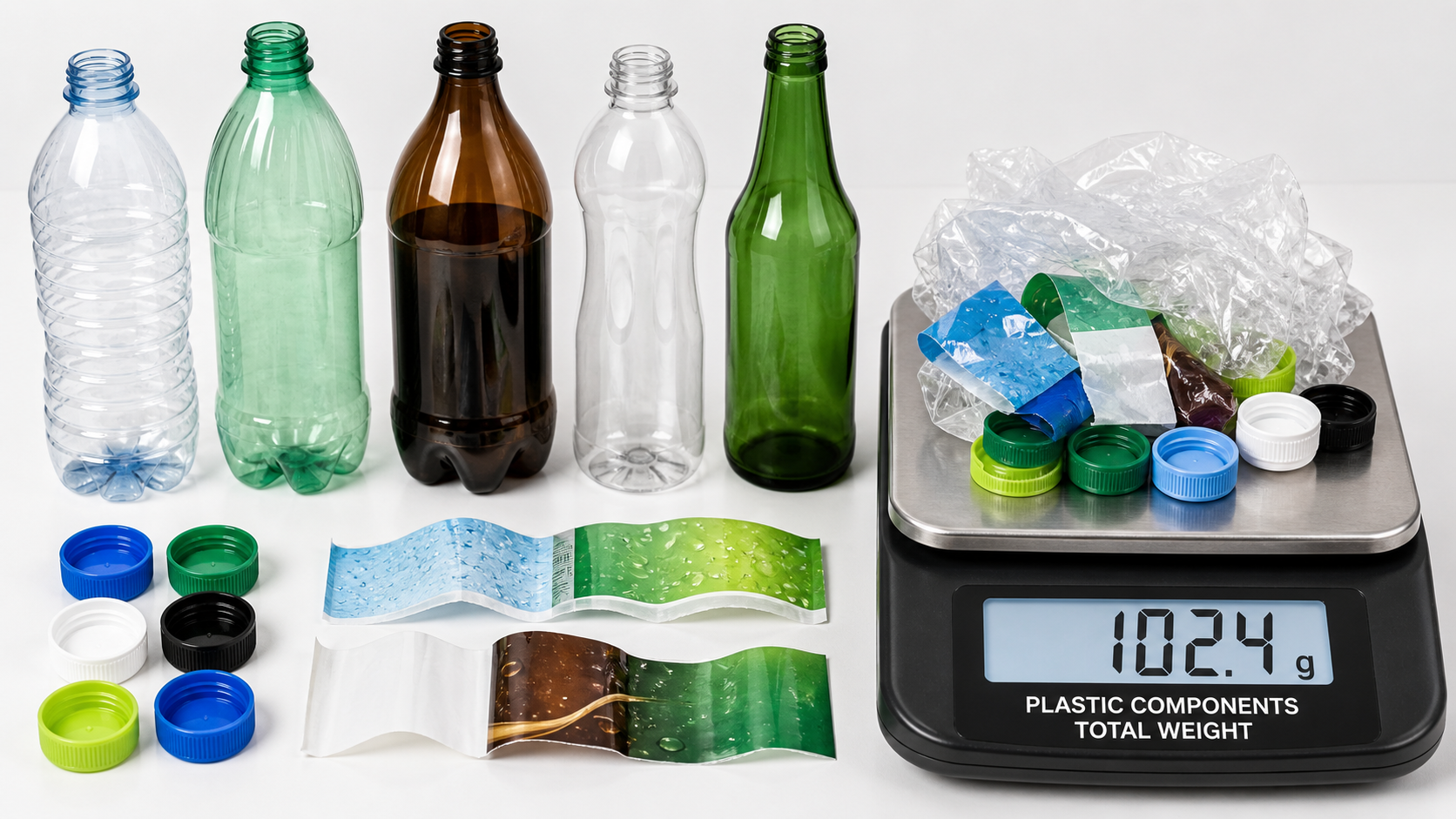
Spain applies a domestic plastic packaging tax of €0.45 per kilogram of non-recycled plastic contained in non-reusable packaging placed on the Spanish market. This includes imports. The tax arises under Spain’s Law 7/2022 on waste and the circular economy and is administered by the AEAT.
- Scope for beverages: Plastic caps, closures, labels, sleeves, shrink-wrap, and multi-pack films are in scope if they are non-recycled plastic components of non-reusable packaging. Primary and secondary packaging can be taxable.
- Who pays: On imports, the importer of record settles the tax, typically at or around customs clearance. For domestic manufacturing or intra-EU acquisitions, separate registration and periodic returns apply.
- Evidence of recycled content: Exemptions or reductions require documented recycled plastic content from suppliers, often with certifications from recognized bodies. Keep certificates, technical sheets, and weight breakdowns.
- Records & controls: Maintain a packaging component weight file by SKU and keep supporting documents for audits. Your customs broker may request component weights to compute the tax accurately on each import line.
- Operational impact: Sourcing caps or films with verified recycled content, reducing plastic thickness, or shifting to reusable formats can materially lower this Spanish tax burden, independent of customs duty.
Important: The plastic packaging tax is separate from customs duty and any EVFTA preference. Budget both when quoting Spain DDP/DDU pricing or when estimating retail shelf cost implications.
Common beverage categories: what should you check in TARIC?
Use the table below as a checklist of what to review for each beverage type. It does not list rates. Always consult TARIC and Spain’s customs portal for the current measures tied to your exact 10-digit code.
| Beverage category | Typical HS heading | What to check in TARIC | Spain-specific notes |
|---|---|---|---|
| Fruit & vegetable juices (incl. blends, concentrates) | 2009 | MFN vs EVFTA preferential duty; rules on added sugar; packaging type; any additives triggering reclassification | Plastic packaging tax on caps/films if non-recycled; major entry ports: Valencia, Barcelona |
| Waters, soft drinks, energy drinks, RTD tea/coffee (non-alcoholic) | 2202 | MFN vs EVFTA; carbonation; sugar content; caffeine; botanicals; container material | Plastic packaging tax applies to non-reusable plastic components on import into Spain |
| Beer | 2203 | MFN vs EVFTA; alcohol by volume; container size; excise (IIEE) applicability | Excise duty handled under AEAT special taxes; main ports include Valencia and Algeciras |
| Wine & vermouth | 2204’2205 | MFN vs EVFTA; alcohol content; grape origin; potential geographical indication measures | Excise oversight by AEAT; ensure GI compliance where relevant |
| Other fermented beverages, cider, mead, etc. | 2206 | MFN vs EVFTA; alcohol level; sugar addition; carbonation; container | Excise may apply; plastic tax on non-recycled components |
| Spirits & liqueurs | 2208 | MFN vs EVFTA; alcohol by volume; flavorings; bottle size | Excise (IIEE) significant; coordinate DUA coding with broker |
Spain-specific customs touchpoints to plan for
Spain has several operational details that affect beverage imports beyond the EU-wide framework. Accounting for these early helps avoid clearance delays and cost surprises.
- Authority & systems: Customs and special taxes are administered by AEAT ’ Departamento de Aduanas e Impuestos Especiales. Import filings use the DUA (Single Administrative Document) format, and Spain participates in the national Ventanilla ’nica Aduanera (customs single window) for coordinated controls.
- Major entry points: The Port of Valencia, Port of Barcelona, and Port of Algeciras are leading container gateways for beverages. Each port’s terminal procedures, inspection capacities, and cut-offs should be aligned with your logistics plan.
- Importer registration: Ensure your EU EORI is active and recognized in Spain’s systems before the first filing. If you act as importer of record for the plastic tax, confirm any additional AEAT registrations required.
- Broker coordination: Share your full 10-digit TARIC code, preference codes, supporting documents (EUR.1 or origin declaration), and packaging component weights so the broker can compute both customs measures and the plastic packaging tax accurately.
- Excise procedures (alcohol): For beer, wine, and spirits, align on excise warehouse status where relevant and ensure product strength/volume documentation matches labels and invoices.
Labeling & market compliance: where to find the EU rules
EU beverage labeling and horizontal food law apply in Spain. Rather than repeating the EU-wide framework here, consult our dedicated hub on EU beverage labeling regulation for scope, responsibilities, and country-language specifics. Use this Spain page alongside that EU guidance to finalize labels and importer details.
Commercial checklist: building a Spain landed price for beverages
Use this step-by-step checklist to craft a robust landed cost and quote for Spain. Adapt to your product and channel.
- Fix the product code: Determine the accurate 10-digit TARIC code based on formula, alcohol content, sugar, carbonation, and packaging.
- Run TARIC scenarios: Capture MFN duty and, if sourcing from Vietnam, the EVFTA preferential path. Note all document codes and conditions.
- Confirm EVFTA feasibility: With your supplier, test the rules of origin, identify any non-originating inputs, and agree who obtains the EUR.1 or makes an origin declaration if eligible.
- Weigh packaging components: Request per-SKU weights for plastic caps, closures, labels, shrink films, etc., plus any verified recycled content certifications, to model Spain’s plastic tax at €0.45/kg for non-recycled plastic in non-reusable packaging.
- Set Incoterms & customs value: Align on FOB/CIF/DDP or other terms, and assemble your customs value elements (product price, freight, insurance as applicable) with documentary support.
- Plan port & broker operations: Choose Valencia, Barcelona, Algeciras, or another suitable entry point; align DUA data, inspection risks, and timelines with your customs broker.
- Model excise (if alcohol): For beer, wine, spirits, include Spain’s excise procedures and cash-flow in your quotation and lead times.
- Recheck labels: Finalize label content per EU rules and Spanish language requirements. Keep technical sheets, nutrition, and allergen statements aligned with the customs declaration to avoid discrepancies.
- Document pack: Prepare commercial invoice, packing list, bill of lading/airway bill, certificate of origin (if using EVFTA), and any additional certificates required by TARIC measures.
- Validate before booking: Have your broker simulate the declaration using your codes and documents to catch issues before cargo moves.
For a market overview and route-to-market considerations, explore the Spain market page. When you’re ready to plan an import operation, see our guide to importing beverages into Spain for workflow and roles among buyer, seller, and broker.
FAQ: Spain beverage import duty, EVFTA, and packaging tax
Is EVFTA applied automatically at Spanish customs?
No. Preferential duty under EVFTA applies only when the goods satisfy the agreement’s rules of origin and acceptable proof of origin accompanies the customs declaration. Without valid proof, MFN duty applies even if the goods are shipped from Vietnam.
What proof of origin is used for EVFTA claims into Spain?
Typically a Certificate of Origin EUR.1 issued by Vietnamese authorities, or an origin declaration by an approved exporter when permitted by EVFTA. Confirm the correct method for your shipment value and exporter status before departure.
Who pays Spain’s plastic packaging tax on imports?
The importer of record. On import, the tax is assessed on the non-recycled plastic kilograms in non-reusable packaging for the goods placed on the Spanish market. Keep packaging weight files and recycled content evidence.
Does Spain have a national soda tax in addition to excise?
Spain administers national excise for alcoholic beverages via AEAT. There is no separate national soda tax for all of Spain akin to an excise; however, always check for regional levies and retailer policies when planning distribution.
Which ports are most commonly used for beverage imports?
The Ports of Valencia, Barcelona, and Algeciras are among Spain’s major container gateways. Select the gateway that best fits your sailing schedules, inland distribution, and inspection risk profile.
Conclusion
Calculating Spain beverage import duty requires three lenses: the 10-digit TARIC classification and origin (for MFN vs EVFTA preferences), Spain’s domestic €0.45/kg plastic packaging tax on non-recycled plastic in non-reusable packaging, and excise procedures for alcoholic SKUs. Build these into your landed cost early, coordinate proofs of origin and packaging weight data with suppliers, and have your broker test the DUA coding before cargo moves. With the right HS code, accurate documents, and a clear EVFTA plan, you can make Spain pricing predictable and competitive while remaining compliant.
Next steps: review the Spain market landscape and align your import workflow with our guide to importing beverages into Spain. Then finalize your codes, documents, and port selection with your customs broker prior to booking.
Spain market overview for beverage brands
Guide to importing beverages into Spain