


 Français
 Español
 العربية
 한국어
한국어Canada beverage import duty is determined by your HS code, tariff treatment and origin. Many qualifying Vietnamese beverages can access reduced or eliminated duty under CPTPP, but importers still account for the federal 5% GST and any applicable provincial charges or container deposits. The right classification and origin documentation drive your landed cost.
This guide explains how to classify beverages, use CPTPP preferences with a self-certified certification of origin, and calculate duty versus taxes. It also highlights Canada-specific agencies and forms you will meet, including CBSA, CFIA and the B3 customs accounting process.
What determines Canada beverage import duty?
Duty is driven by the product’s HS classification, its country of origin and whether a trade agreement such as CPTPP applies. Valuation rules, packaging size, sugar content and alcohol status can also affect the tariff line used at the Canadian border.
- HS code: The specific tariff line for your beverage (e.g., fruit juices vs. soft drinks vs. alcoholic beverages) sets the base duty rate.
- Tariff treatment: MFN, CPTPP or other preferential treatments change the applicable rate if origin rules are met.
- Origin & processing: Ingredients and where processing occurred determine CPTPP eligibility.
- Valuation: CBSA calculates duty on the value for duty under Canadian valuation rules.
- Alcohol vs. non-alcoholic: Alcoholic beverages face excise under the federal Excise Act, 2001, in addition to customs duty and taxes.
How do I classify beverages for Canadian tariffs?
Start by describing the product—ingredients, alcohol content, added sugar, carbonation, and packaging volume. Then find the closest HS heading and subheading that matches its composition and presentation. Non-alcoholic beverages and juices commonly fall under Chapters 20 and 22, while alcoholic beverages fall in Chapter 22.
| Beverage type | Typical HS chapter/heading (illustrative) | Classification notes |
|---|---|---|
| Fruit & vegetable juices | Chapter 20 (e.g., 2009) | Often unsweetened juices by Brix/fruit content; exact subheading varies by fruit and sugar level. |
| Waters, sweetened or flavoured drinks | Chapter 22 (e.g., 2202) | Includes carbonated soft drinks, energy drinks, tea-based and coffee-based beverages prepared for retail sale. |
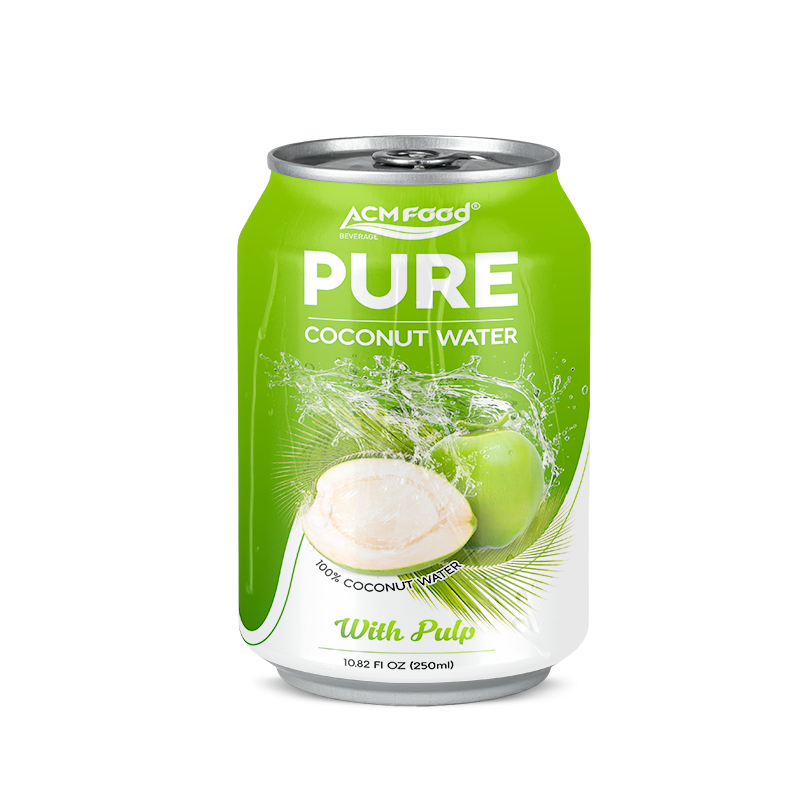
| Coconut water | Commonly Chapter 20 or 22 | Unsweetened coconut water often classifies with juices; sweetened/flavoured versions may move to 2202. |
| Alcoholic beverages | Chapter 22 (2203 for beer, wine, spirits) | Subject to excise and provincial rules in addition to customs duty and taxes. |
Small formulation or packaging differences (e.g., added sweeteners, carbonation, or retail pack size) can move a product between lines. When in doubt, seek an Advance Ruling for Tariff Classification from CBSA.
Using CPTPP preferences for beverages from Vietnam
CPTPP can reduce or eliminate duty for eligible Vietnamese beverages if you meet the agreement’s rules of origin and provide a valid certification of origin at import or via a subsequent claim.
- Confirm origin eligibility: Check the CPTPP rule for your exact HS line. Typical origin tests include a change in tariff classification (CTC), regional value content (RVC), and/or specific processing requirements.
- No government-issued C/O needed: Under CPTPP, an exporter, producer or importer can self-certify origin. This is a certification of origin, not a traditional C/O from a government authority.
- Data elements on the certification: Names and addresses of exporter/producer/importer; HS code (6 digits); origin criterion; description; invoice reference; period covered (if blanket); authorized signature and date. Keep the statement accessible in case CBSA requests it.
- Records & verification: Retain supporting production and material records. CBSA may verify origin via documentation requests or with the exporting customs authority.
If you ship private label coconut water from Vietnam, CPTPP can be a strong lever to lower duty, but only when the recipe and processing meet the exact origin rule for the selected HS subheading.
What documents are checked at the Canadian border?
CBSA administers customs requirements while CFIA oversees food safety compliance. Importers typically work with a licensed customs broker to present accounting and release documents.
- CBSA: Commercial invoice, packing list, bill of lading/air waybill, HS classification, and B3 Canada Customs Coding Form (for accounting) or its electronic equivalent.
- CFIA (food): Many beverages are regulated as foods under the Safe Food for Canadians Regulations (SFCR). The Canadian importer may need an SFC licence and preventive controls depending on product and activity.
- CPTPP claim: Include the certification of origin if you claim CPTPP at import; otherwise file a post-import claim within legal timelines.
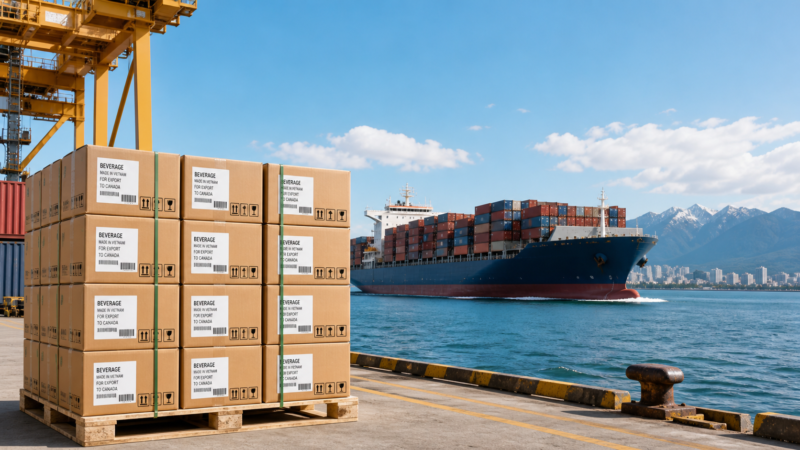
Ocean shipments commonly enter via the Port of Vancouver (West Coast) or Port of Montreal (East Coast), with rail or truck distribution onward. Ensure your documents reflect the correct port of discharge and final consignee in Canada.
Taxes and fees beyond customs duty
Duty is only part of the landed cost. Importers also account for federal GST, possible provincial consumption taxes, and province-run container deposits or recycling fees. Alcoholic beverages may attract federal excise under the Excise Act, 2001.
- GST (federal): 5% on most commercial imports, administered by CBSA at time of accounting. Input tax credits may be available if the importer is GST/HST-registered.
- HST or PST/QST (provincial): Depending on the destination province, harmonized sales tax (HST) or separate provincial taxes may apply. Treatment varies by province and product.
- Container deposits & recycling fees: Provinces operate beverage container programs that add deposits or fees by container type/size. These are not customs duties and typically apply when first supplied in the province.
- Excise (alcohol only): Federal excise applies to alcoholic beverages; rates and structures differ by product category and are separate from customs duty.
How to look up your duty rate safely
The correct way to find your current-year duty is to classify precisely and then consult official tariff sources for the right tariff treatment (MFN vs. CPTPP). Avoid guessing based on product names alone.
- Pin down your HS code: Use your detailed formulation and packaging specs to locate the exact 8-digit Canadian tariff item.
- Select tariff treatment: For Vietnam, check the CPTPP schedule. If your product meets CPTPP origin rules, you may apply the preferential rate instead of MFN.
- Use official sources: Review the CBSA Customs Tariff schedule or a government tariff-finder tool. Confirm the staging category, as some lines phase down over several years.
- Verify conditions: Some subheadings depend on sugar content, Brix, carbonation, alcohol content or packaging size. Choose the line that matches your labelling and specs.
- Document & claim: Keep your classification notes and CPTPP certification of origin to support the claim now or via a subsequent refund request.
For a concrete example pathway, see our guide to importing coconut water from Vietnam, which discusses product formats that often sit near juice vs. flavoured drink lines.
Valuation, Incoterms & landed cost in practice
CBSA calculates duty on the value for duty determined under Canadian valuation rules (commonly the transaction value with specific adjustments). Freight, insurance and other charges can affect your landed cost even if they are not always part of the value for duty in every scenario.
- Incoterms matter: Under CIF/CFR, international freight and insurance are embedded in your price; under FOB, they are separate. Align Incoterms with how you and your broker build the customs value and landed cost.
- Typical route: Ocean FCL/LCL to the Port of Vancouver or Port of Montreal, rail to an inland terminal, then local delivery. Each leg adds to landed cost alongside duty, GST and brokerage.
- Brokerage & compliance: Budget for customs brokerage, potential CFIA inspection fees and any provincial program fees (e.g., container deposits) in your pro forma.
Packaging format can change your tariff line
Tariff lines for beverages can hinge on packaging size (e.g., not exceeding 1 L vs. exceeding 1 L), carbonation, added sweeteners and fruit content. Finalize your label, Brix and pack sizes early, then classify on the finished spec you will ship.
| Specification change | Potential impact | Notes |
|---|---|---|
| Add sweetener/flavour | May shift from Chapter 20 to 22 | Flavoured/sweetened drinks often classify under 2202 rather than 2009. |
| Carbonation | May trigger a different 22 line | Carbonated versions are usually treated as soft drinks. |
| Pack size breakpoint | Different subheading | Some lines distinguish “not exceeding” vs. “exceeding” pack sizes. |
If you are planning Canada-focused SKUs, build duty and tax checks into your product brief alongside formulation and sensory testing. For market background, see our Canada market overview.
Information for beverage brands & importers
The steps below help align compliance with your sourcing and commercialization timeline. They are especially relevant for private label or OEM/ODM developments sourced from Vietnam under CPTPP.
- Confirm classification early: Classify a golden sample (final recipe/label/pack) and freeze specs before quoting landed costs.
- Collect CPTPP evidence: Get a complete certification of origin from the exporter/producer and maintain bill of materials and processing records for potential CBSA verification.
- Coordinate with your broker: Align Incoterms, customs valuation, release strategy and duty/GST cash flow before booking production.
- Plan provincial obligations: Map container deposits/recycling fees and any provincial drink tax treatment by target provinces.
- Right-size logistics: Choose palletization, case counts and container mix to optimize freight, cold-chain (if required) and deconsolidation at your entry port.

FAQ: Canada beverage import duty & CPTPP
Do I need a government-issued certificate of origin for CPTPP?
No. CPTPP uses a self-certified certification of origin completed by the exporter, producer or importer. It must include required data elements and be available for CBSA review.
Does CPTPP guarantee zero duty for drinks from Vietnam?
No. Benefits depend on the exact HS line, the staging schedule for that line and whether your product meets the applicable origin rule. Some lines phase down over time; others may already be duty-free.
Are non-alcoholic beverages subject to excise?
Federal excise under the Excise Act, 2001 applies to alcoholic beverages. Most non-alcoholic drinks are not subject to federal excise, though GST and provincial programs still apply.
Who collects GST/HST at import?
CBSA typically collects the 5% GST (and HST where applicable) when goods are accounted for. Provincial PST/QST obligations are handled separately depending on the province and the importer’s registration status.
Which Canadian agencies are involved?
CBSA manages customs, tariffs and border release. CFIA oversees food safety and licensing under SFCR for many beverages. The Canada Revenue Agency administers business numbers and import/export program accounts for importers.
Where can I find my duty rate?
After you determine your HS code, consult the current CBSA Customs Tariff or an official tariff-finder tool and select the correct tariff treatment (e.g., CPTPP for Vietnam) to view the current-year rate.
Key takeaways
– The biggest drivers of Canada beverage import duty are HS classification, CPTPP eligibility for Vietnam, and valuation.
– Regardless of duty, commercial imports generally pay 5% GST, with potential provincial charges such as deposits.
– Prepare a compliant certification of origin and keep records: under CPTPP, there is no government-issued C/O.
– Align classification with final specs to avoid surprises at CBSA release in ports such as Vancouver or Montreal.
Need deeper context on coconut formats and formulations before classification? Explore our guide to importing coconut water from Vietnam. For broader commercial context, visit the Canada market overview.