


 Français
 Español
 العربية
 한국어
한국어Shelf-ready packaging beverages describes a case or tray design that a retailer can place directly on the shelf, or open into a display, instead of unpacking bottles or cans by hand into a shelf or cooler. The case itself becomes part of the in-store fixture, which is why the format is also called retail-ready packaging.
The added cost sits in the case material, printing, and sometimes a perforation or tear-strip feature. Whether that cost pays for itself depends on your retail channel, case turnover, and how much retailer labor time the format actually saves.
Where the shelf-ready packaging idea came from
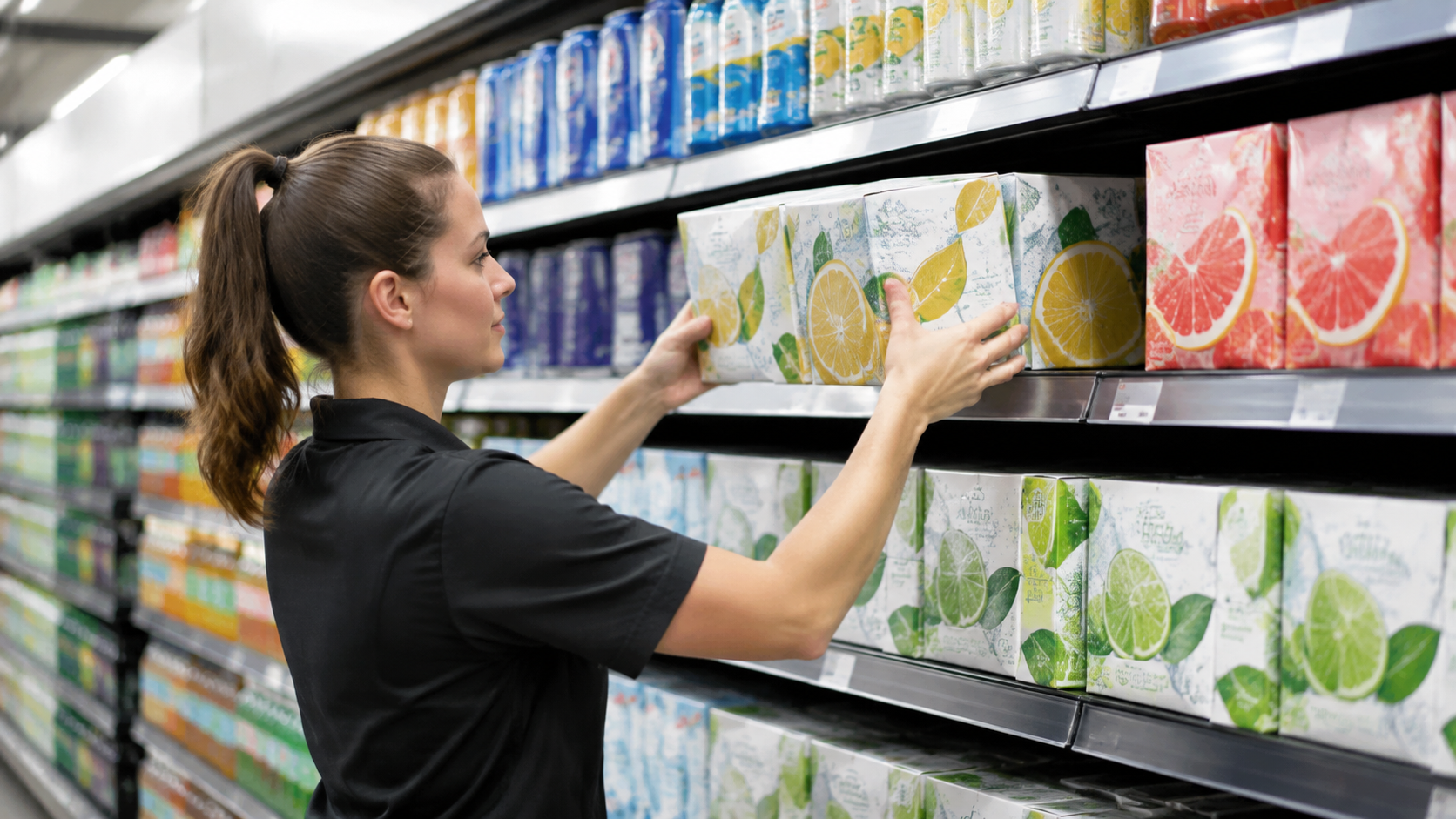
Shelf-ready packaging grew out of large grocery and club-store retailers looking to cut the time staff spend unpacking incoming stock during restocking windows. Rather than asking a supplier to ship loose product in a plain shipping case, retailers began specifying case designs that could go straight from the delivery pallet onto the shelf, with the case exterior doing double duty as in-store signage. The approach has since spread well beyond its original grocery context into convenience, club, and some food-service channels.
What makes a case shelf-ready?
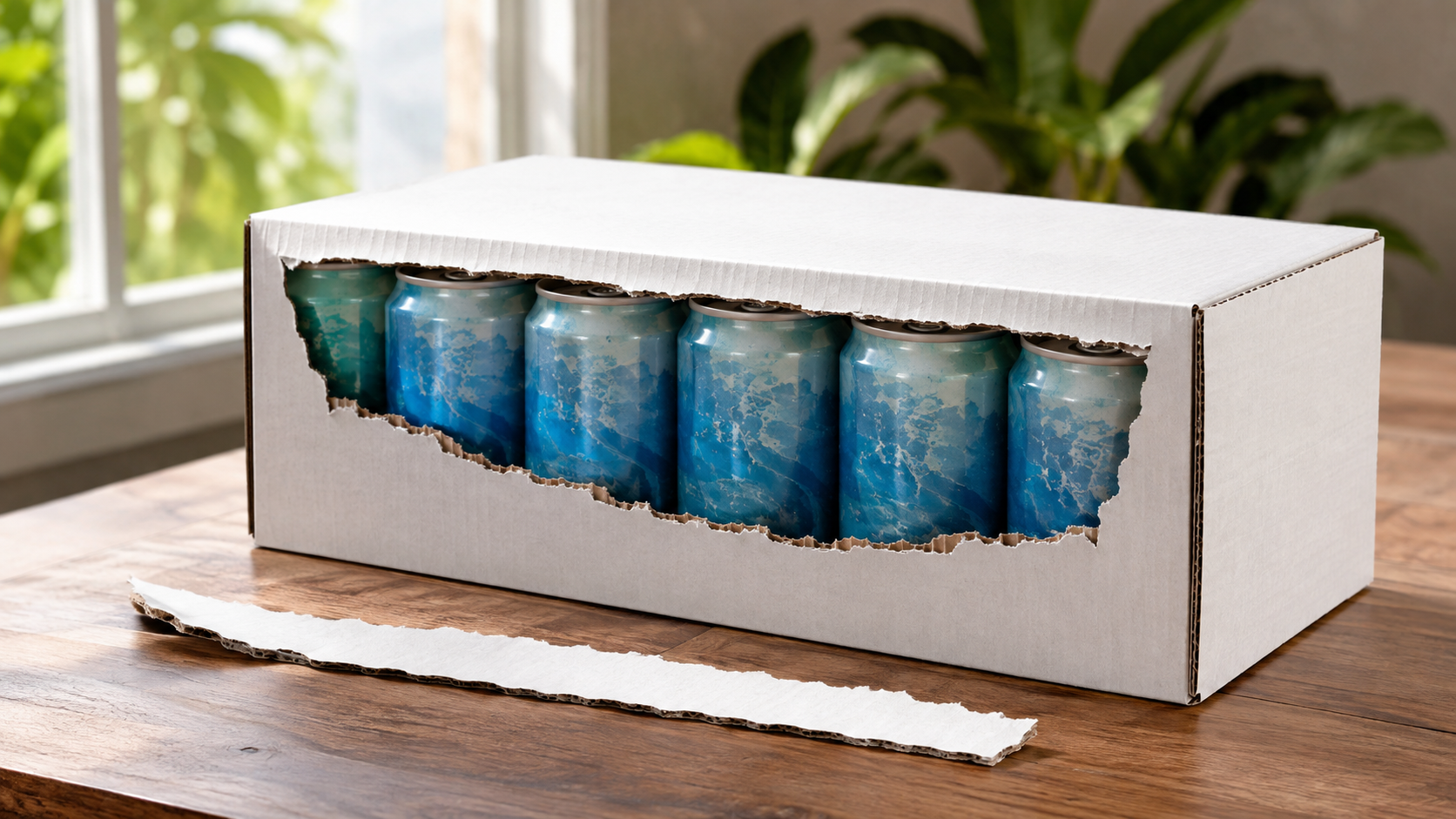
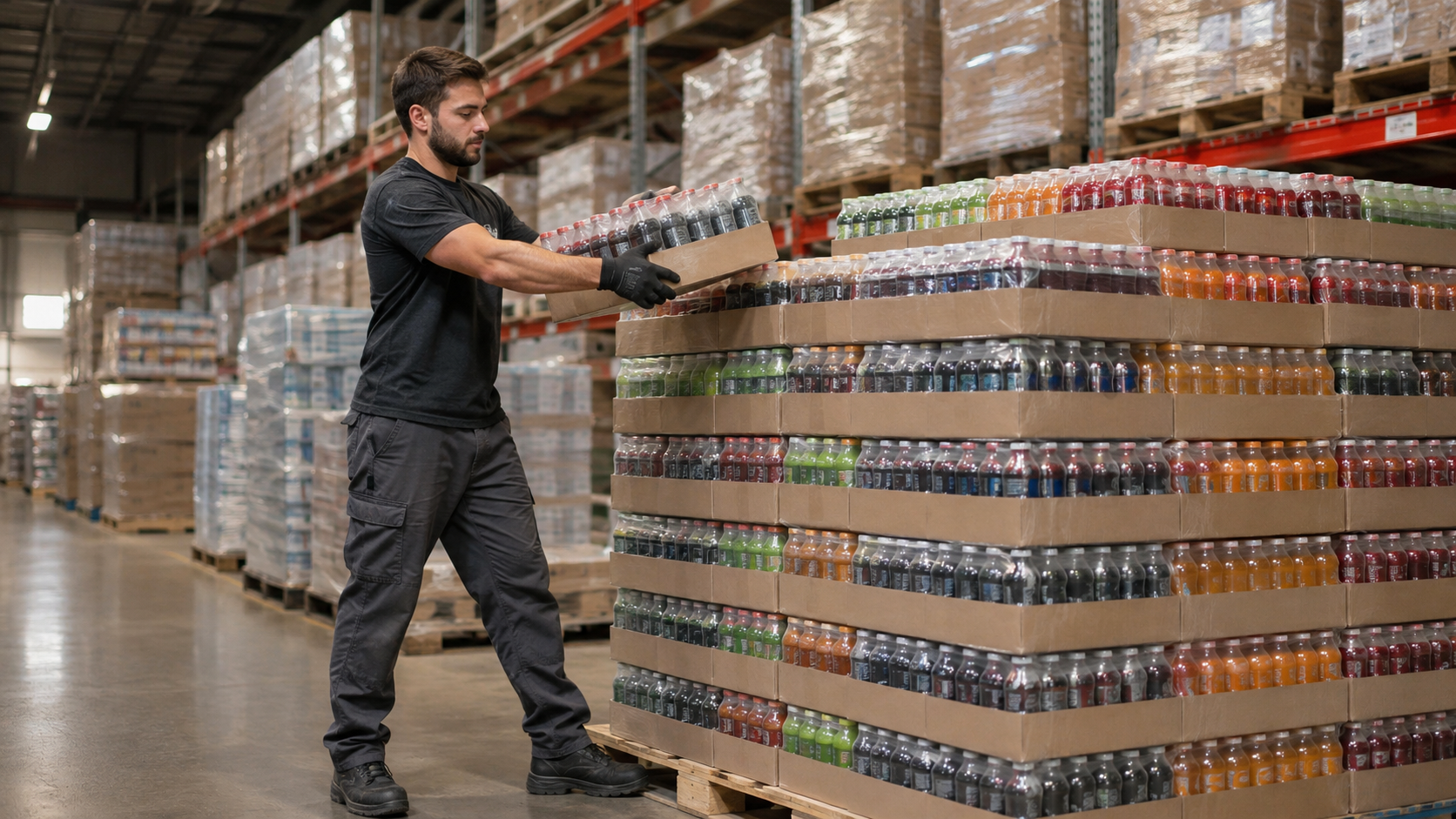
A shelf-ready case is designed to go from pallet to shelf with minimal handling: a tear-strip or perforation opens the case into a display tray, and the printed exterior is designed to face the customer once opened, rather than showing plain corrugate. Some formats fully replace the shelf, doubling as the display fixture itself.
- Full-display trays: The case becomes the shelf display; both the front panel and the tray print carry brand graphics.
- Tear-strip cases: A perforated strip lets staff open the top quickly without a box cutter, but the case still sits inside an existing shelf or cooler.
- Standard shipper cases: No shelf-ready features; cans or bottles are unpacked by hand before shelving.
How opening mechanisms are typically designed
The opening feature is what most distinguishes a shelf-ready case from a standard shipper, and it is usually one of three approaches: a perforated tear-strip along the top or sides, die-cut score lines that let the case fold down into a tray, or a fully removable lid section. Each approach trades off differently between ease of opening, how tidy the resulting display looks, and how much the feature adds to converting cost.
- Perforated tear-strip: quick to open with minimal training, but the torn edge can look less finished than a die-cut fold-down.
- Die-cut fold-down tray: opens into a clean display shape, at a higher tooling and converting cost than a simple perforation.
- Removable lid section: simple to produce, but leaves a taller case profile that some shelf heights cannot accommodate.
Does shelf-ready packaging actually save retailer labor?
Yes, in channels with high case turnover and self-service shelving, because staff open and place a shelf-ready case in one motion instead of unpacking units individually. The time saved per case is small, but it compounds across a store’s full beverage set and across every restock cycle.
The size of the saving also depends on how the case is stocked once it reaches the shelf. A full-display tray that drops straight into a planogram slot saves more time than a tear-strip case that still needs its contents faced or arranged by hand, so the labor case for paying a premium is strongest for formats that remove the most manual steps, not simply for any case carrying a shelf-ready label.
When does the added cost of shelf-ready packaging pay for itself?
| Situation | SRP likely pays for itself | SRP may not be worth the added cost |
|---|---|---|
| Retail channel | Grocery, convenience, and club stores with frequent restocking | Food service, vending, or low-turnover specialty stores |
| Case turnover | High-velocity SKUs restocked multiple times a week | Slow-moving or seasonal SKUs |
| Retailer relationship | Retailers who specifically request or reward SRP compliance | Independent accounts with no SRP programme |
| Brand visibility goal | New launches needing shelf standout | Established SKUs with strong existing facings |
How shelf-ready packaging affects case design and cost
Moving to a shelf-ready format usually changes more than the case itself; it can affect case count, pallet pattern, and print cost together.
- Print complexity: A full-display tray needs brand-quality print on the case exterior, not just a shipping label, which raises per-case cost.
- Case count per pallet: Tray-style cases sometimes stack less efficiently than a simple shipper case, which can affect freight cost per unit.
- Perforation or tear-strip tooling: Adds a converting step and tooling cost compared with a standard case.
- Case strength: A tray with a cut-away front panel still needs enough structural strength to protect product in transit.
Materials commonly used for shelf-ready beverage cases
Most shelf-ready cases are built from corrugated board, with the specific grade and flute profile chosen to balance stacking strength against the thinner walls needed for a clean tear-strip or perforation. A heavier board protects better in transit but can be harder to open cleanly by hand, while a lighter board opens easily but may need reinforcement at stress points such as case corners and the base.
- Single-wall corrugated: The most common choice for cans and lightweight PET bottles, balancing cost against protection for typical case weights.
- Double-wall corrugated: Used for heavier packs, such as multi-litre bottles or glass, where added stacking strength outweighs the extra material cost.
- Coated or laminated exteriors: Improve print quality and moisture resistance for cases that will be displayed rather than only shipped.
Shelf-ready packaging vs standard shipper case: what changes for your brand
A standard shipper case is cheaper and simpler to produce, but places the unpacking and shelving work entirely on retailer staff, with no guarantee of how the product is faced once shelved. A shelf-ready case shifts some of that presentation control back to the brand, at a higher per-case cost.
For a private label or OEM programme, this decision is usually made per SKU or per retailer requirement rather than as a blanket policy across a full portfolio. See private label beverage programmes for how packaging decisions typically fit into a broader private label brief.
Briefing your manufacturer or packaging supplier for shelf-ready cases
A clear brief reduces the number of design rounds needed to finalize a shelf-ready case. At minimum, share your primary pack dimensions, target case count, and the retailer or channel this format is intended for, since a case designed generically without a specific retailer in mind often needs rework once a real compliance requirement is applied.
- Confirm whether the retailer requires a specific tear-strip location or minimum print area before design starts.
- Share your primary pack’s exact dimensions and weight, since these determine case strength requirements.
- Specify your target case count per pallet layer so the converting supplier can check the design against your existing pallet pattern.
- Ask for a physical sample case, not only a digital render, before committing to a full print run.
Questions to ask before specifying shelf-ready packaging
- Does your target retailer have a formal SRP or RRP compliance programme, or is this a nice-to-have?
- What is the expected case turnover per week for this SKU, and does it justify the added print and tooling cost?
- Will the case need to survive the same freight and handling conditions as your current shipper case?
- Does your manufacturing partner’s converting line support the tear-strip or tray format you want?
Retailer compliance programmes and scorecards
Some large retailers formally score suppliers on packaging compliance, including whether cases meet a shelf-ready specification, as part of a broader supplier scorecard that can affect shelf placement or ranging decisions. Where this applies, the retailer’s own packaging guide will typically define minimum requirements such as tear-strip placement, minimum print area, and case dimensions, rather than leaving the design fully open to the supplier.
Confirm whether your target retailer publishes this kind of packaging guide before finalizing case design, since designing to a retailer’s specific requirements from the outset is usually cheaper than redesigning after a compliance rejection.
Sustainability considerations for shelf-ready formats
Shelf-ready packaging can reduce secondary packaging waste in some cases, since a well-designed tray eliminates the need for additional in-store display materials, and reduces the handling damage that leads to shrink. This benefit depends on the specific format: a heavily laminated, hard-to-recycle case can offset the waste reduction from eliminating separate display materials, so material choice matters as much as the shelf-ready feature itself when sustainability is a stated goal.
How this fits into a wider packaging programme
Shelf-ready packaging is one of several packaging decisions that sit alongside primary pack format, closure, and labelling. If you are still finalizing can, bottle, or carton choice for a new SKU, review how packaging format choices are compared for a specific market before locking case design, since primary pack dimensions affect how a shelf-ready case is engineered around it. Many of these decisions are handled together under an OEM beverage manufacturing programme rather than negotiated as a separate packaging-only project.
FAQ: shelf-ready packaging for beverages
Is shelf-ready packaging the same as retail-ready packaging?
Yes, the terms are generally used interchangeably. Both describe case designs built to go from pallet to shelf with minimal additional handling by retail staff.
Does shelf-ready packaging cost more to produce?
Usually yes, because of added print quality on the case exterior and, in some formats, tooling for a tear-strip or perforation. The cost premium should be weighed against expected labor savings and shelf visibility for your specific channel and SKU.
Do all retailers require shelf-ready packaging?
No. Requirements vary widely by retailer and channel; some grocery and club-store accounts have formal compliance programmes, while many independent or food-service accounts have no such requirement.
Can an existing SKU be converted to shelf-ready packaging without changing the product?
Generally yes, since shelf-ready packaging is a secondary packaging change rather than a change to the beverage itself. It does, however, need to be engineered around your existing primary pack dimensions and case count targets.
Conclusion
Shelf-ready packaging pays for itself fastest in high-turnover retail channels where retailer labor savings and shelf visibility are meaningful, and least where turnover is low or a retailer has no compliance requirement for it. Treat the decision per SKU and per retailer relationship, and confirm print, tooling, and pallet-pattern cost impacts before committing case design. A clear brief covering pack dimensions, target retailer, and case count is usually enough to get an accurate quote and a workable sample on the first pass.