


 Français
 Español
 العربية
 한국어
한국어Popping boba is a thin gel membrane holding a liquid core. Put it in a cup at a tea bar and it lasts minutes. Put it inside a sealed can or bottle that has to survive thermal processing, six weeks at sea and months on a shelf, and it becomes one of the harder inclusions in the beverage category.
This page is about that second product: a ready-to-drink beverage with popping boba already inside, sold through retail and distribution. It is a different proposition from buying boba in tubs for a bubble tea counter — different pack, different shelf life, and a set of technical constraints that decide whether the concept is producible at all.
Why brands want it
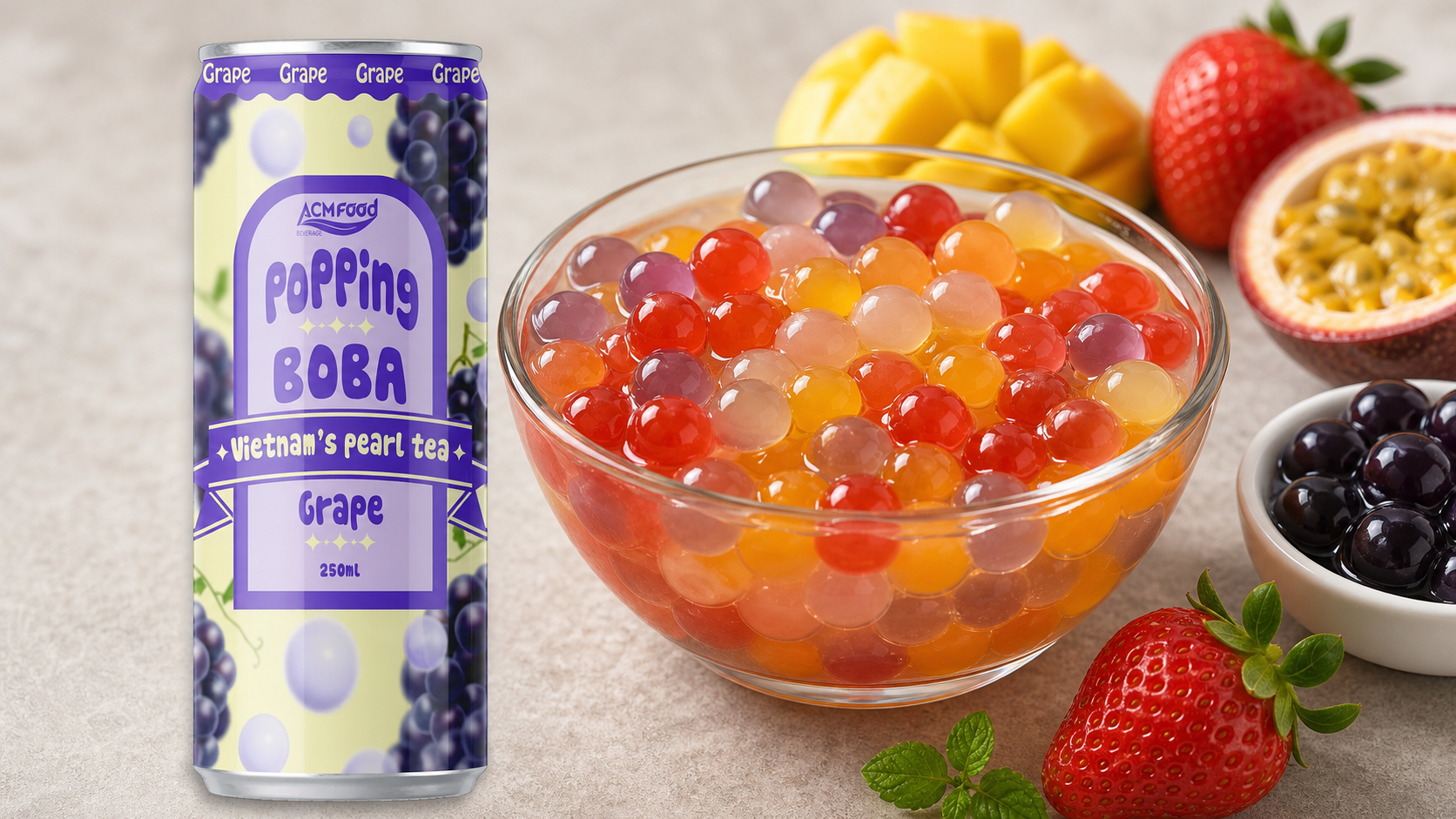
The appeal is straightforward. A drink that bursts in the mouth is a different product experience from a drink you swallow, and it is one a shopper cannot get from any mainstream juice on the same shelf. It carries a price premium without a health claim that needs substantiating, it photographs well, and it reaches a younger convenience shopper who finds plain juice unremarkable.
It also travels. A sealed RTD with boba inside sells in markets where there is no bubble tea culture and no counter to prepare it — which is exactly the market a bulk topping supplier cannot reach.
The hard part: keeping the sphere intact
This is the section most briefs skip, and it is the one that decides feasibility. Popping boba is far more fragile than nata de coco or coconut jelly, and three forces act against it inside a sealed pack.
Osmotic balance. The sphere sits in liquid. If the surrounding drink and the liquid core differ in sugar concentration, water moves across the membrane until they equalise — the sphere swells and bursts, or shrinks and wrinkles. Over a long ambient shelf life this is the single most common failure. The base drink has to be formulated around the core, not the other way round, and the two Brix values belong in the specification together.
Thermal load. The membrane is a gel. Heat softens it, and a process severe enough to make the product shelf-stable at ambient temperature can be severe enough to destroy the burst. This is the real constraint on the category: the more shelf life you ask for, the more thermal treatment you need, and the less likely the boba survives it recognisably. Any sample worth judging must have been through the actual commercial process in the actual container.
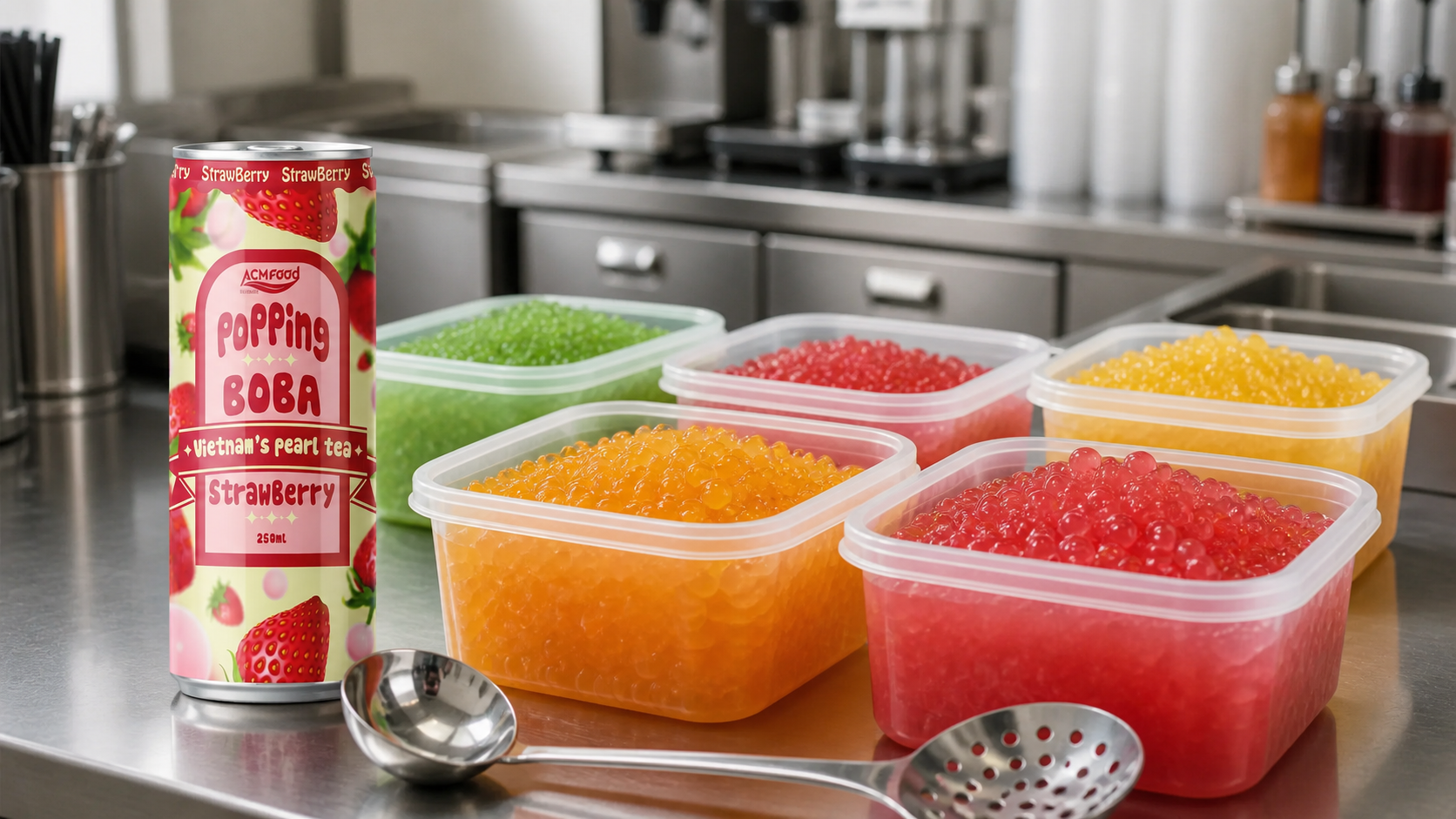
Shear at filling. Pumps, valves and drops break spheres. A line that fills nata de coco without difficulty can turn popping boba into cloudy liquid and empty skins. Ask specifically how the filler handles fragile inclusions, and ask to see a poured sample from a real production run rather than a hand-packed one.
Two consequences follow, and they are worth accepting early rather than discovering after artwork is printed. Chilled and shorter-life formats preserve the burst far better than long ambient ones. And a firmer, thicker membrane survives the process but pops less dramatically — there is a genuine trade-off between shelf stability and the sensation the product is sold on.
What to fix in the specification
These belong in a contract annex with tolerances, because most of them interact with each other.
- Core and base Brix together — as a matched pair, not two independent numbers. This is the osmotic control.
- Sphere diameter — with a tolerance, checked against the pack opening so the spheres actually pour.
- Membrane firmness — stated as a target and understood as a trade-off against burst intensity.
- Inclusion count or weight per unit — and how it is verified in-process, not only at release.
- Intact rate at end of shelf life — the acceptance criterion that actually matters. Define what proportion of spheres must still be whole when a consumer opens the pack.
- Suspension behaviour — whether spheres float, settle or stay distributed, and what pack wording follows.
- Colour stability — the core is dyed; test for bleed into the surrounding drink over time.
- Change control — written approval before membrane system, core recipe or thermal process changes.
How specifications become controlled production is set out in our production process.
Pack format is decided by the inclusion
- Clear PET and glass — the spheres are the product; a pack that hides them removes most of the reason to buy. This argues against opaque formats even where they are cheaper.
- Wide openings — the spheres must pass. A narrow neck that suits plain juice will trap them.
- Chilled versus ambient — chilled protects the burst but restricts distribution to markets with reliable cold chain; ambient reaches further but costs sensory quality. This is the first decision to make, because everything else follows from it.
The trade-offs across every container we run are compared in beverage packaging options.
How to evaluate samples
One chilled sample tells you almost nothing about a fragile inclusion. Three checks are worth insisting on.
Pour into a clear glass and count. Judge how many spheres are whole, how many have collapsed, and whether the liquid has clouded. Do this rather than tasting from the pack.
Sample from different production dates. Intact rate varies more between runs than a liquid specification does. Consistency across batches is what you are buying.
Open one late in shelf life. Hold packs at ambient temperature and open them well into the declared life. A product that bursts beautifully at the filler and is flat at month eight is not a product — and this is the test that most concepts fail.
Common questions
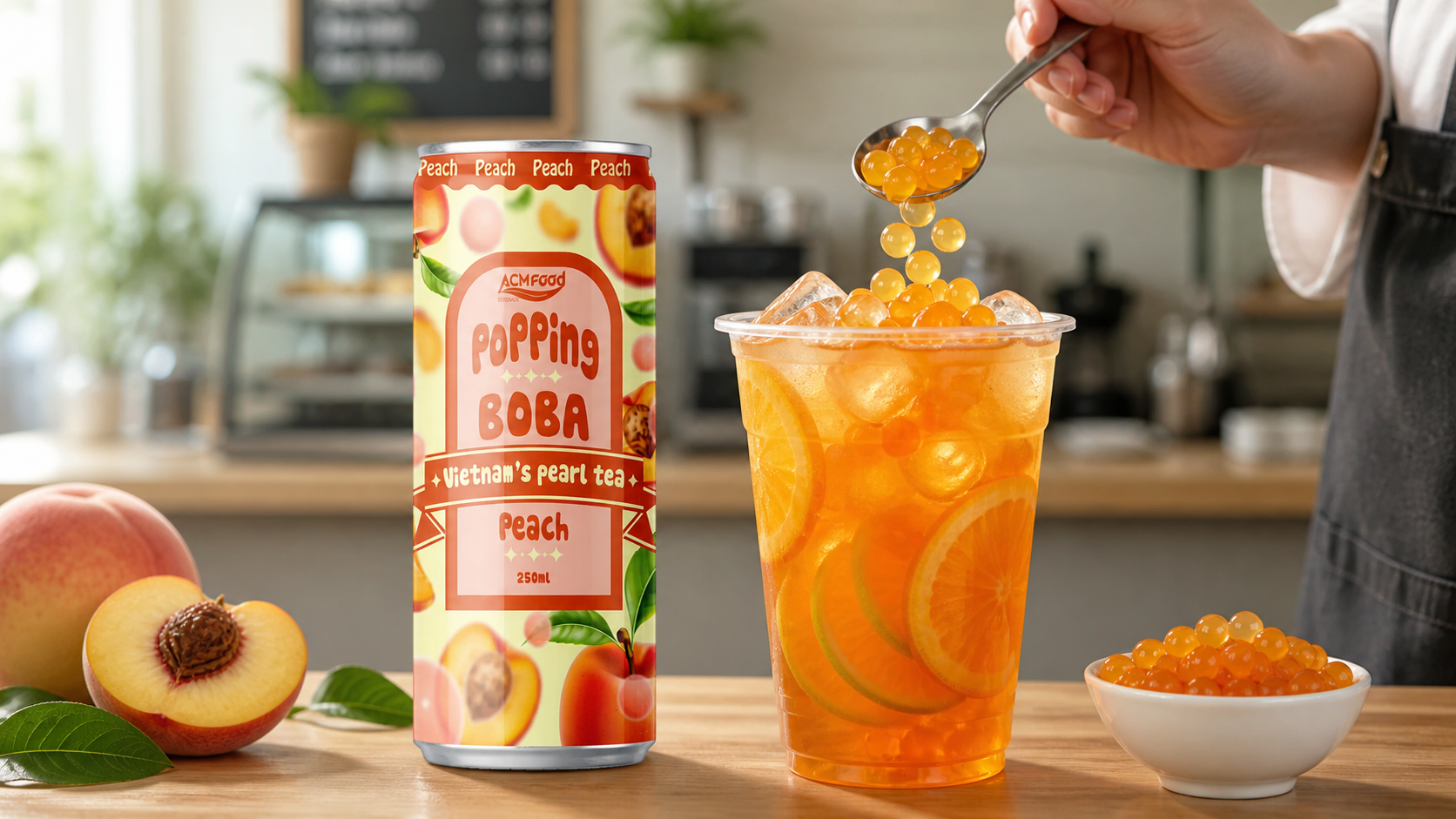
Is this the same as buying popping boba in tubs? No. Tubs are an ingredient a tea bar adds by hand and uses within days. This is a sealed finished drink with the spheres already inside, built to survive distribution.
How does popping boba differ from nata de coco in a drink? Nata is a solid cellulose piece with no liquid core — it is robust, survives heat well and holds its bite for a long ambient life. Popping boba is a membrane around liquid, so it is fragile, sensitive to osmotic imbalance and much more constrained by process. If the concept mainly needs texture rather than a burst, nata is the easier and more reliable product.
And versus tapioca pearls? Tapioca is starch-based and chewy with no liquid centre. It hardens under refrigeration and does not hold well in a sealed pack over a long shelf life, which is why it stays largely a freshly prepared product.
Can we choose our own flavours and colours? Yes, within what the membrane system allows. Bring the target to the brief, because core composition affects the osmotic balance with the base drink.
Can it be used in a hot drink? No. Heat destroys the membrane. These are cold and iced products.
Briefing a project
Send the base drink, the shelf life and distribution temperature you need, the sphere size and burst intensity you want, the pack format and the destination market. The first answer back should be a feasibility view — whether the shelf life you are asking for and the burst you are asking for can coexist — before anyone discusses price. On this product that conversation saves the most time.
For how contract production is structured, see OEM beverage manufacturing; to launch under your own brand, see private label beverages. Minimums are set per SKU — see minimum order quantity. For the wider range of inclusions and formats we run, see beverage product capabilities, or request a quote.
Request a quote