


 Français
 Español
 العربية
 한국어
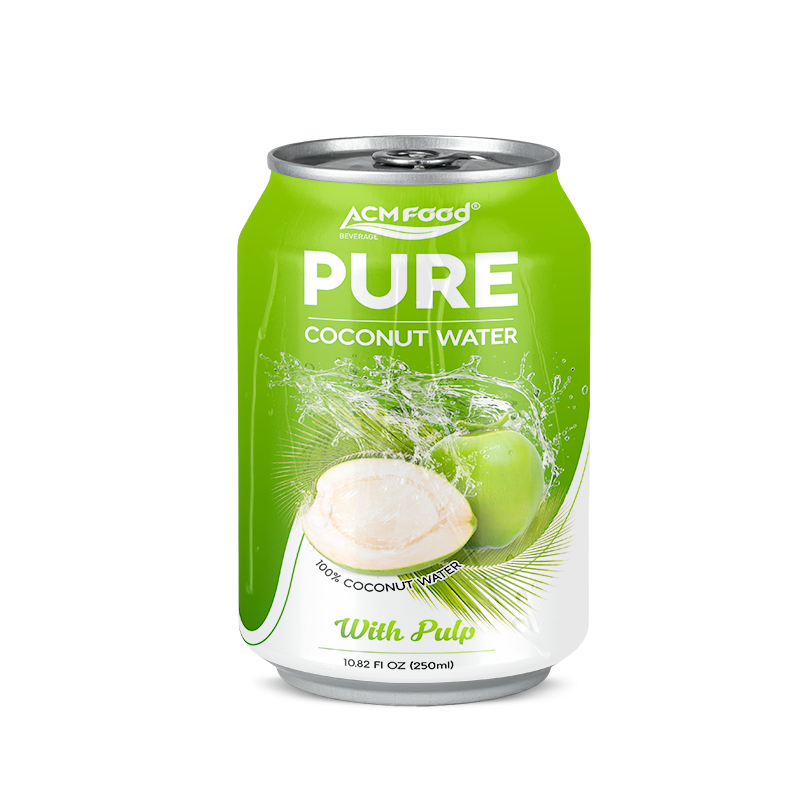
한국어Vietnam and Thailand are the two sourcing origins most often shortlisted for packaged coconut water, and the choice between them changes flavour, seasonality, freight and duty position rather than simply the unit price. Each origin carries a different varietal profile and a different set of commercial conditions.
This comparison sets out the factors that actually separate the two for an importer or brand owner, and where the difference is smaller than it is usually presented. ACMFOOD manufactures in Vietnam, so the framing below is deliberately structural: it is meant to help a buyer ask better questions of any supplier, in either country.
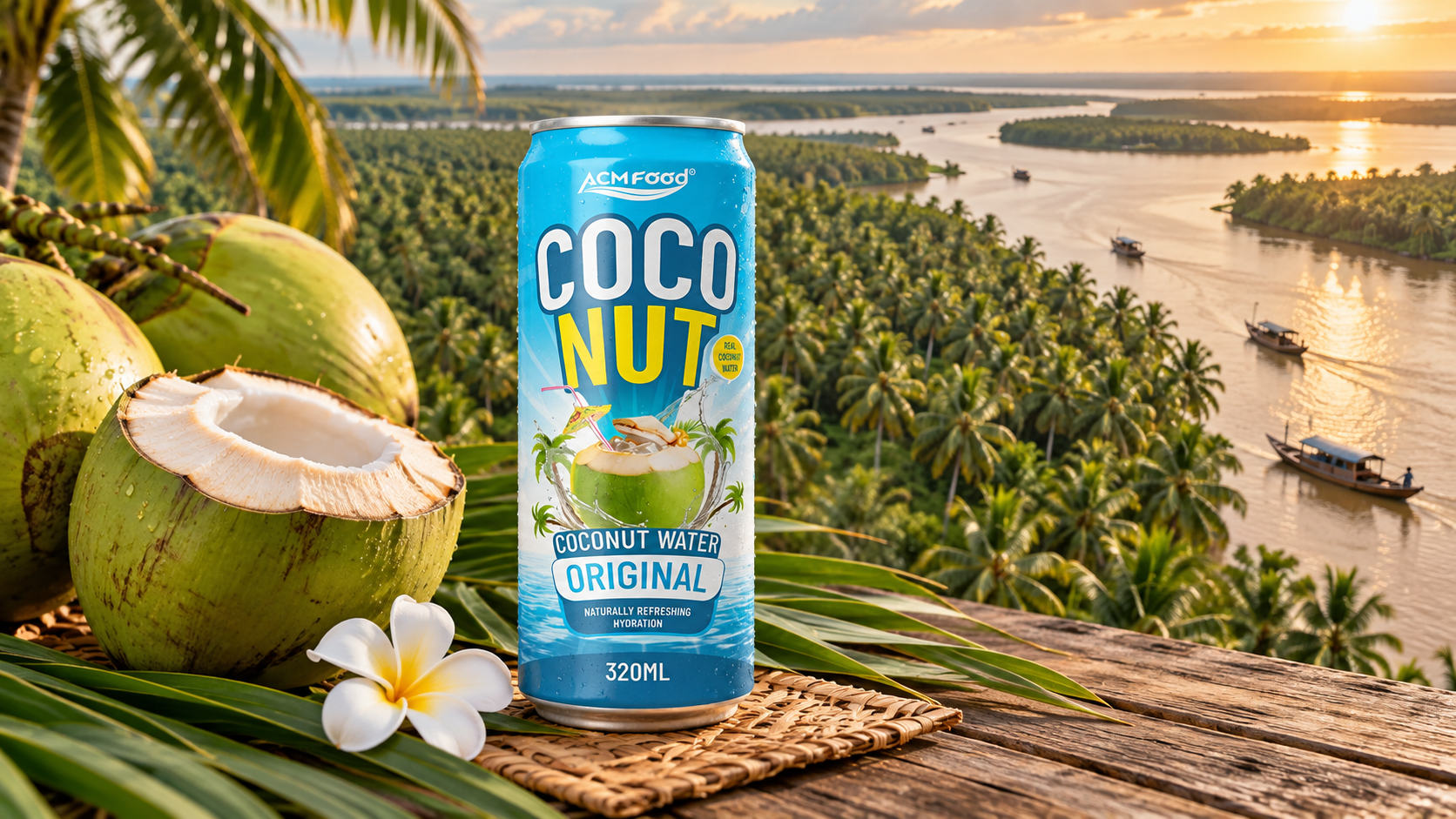
Vietnam vs Thailand as a coconut water supplier: does origin change the product?
Yes, but less than varietal and processing choices do. Origin influences which coconut varieties are available, when they are harvested and how far the product travels. Within one origin, two facilities running different varieties and different thermal processes will produce more dissimilar products than two facilities in different countries running the same specification.
Coconut varieties and what they do to the drink
Coconut water is varietal in the way that grape juice is. Sugar level, aroma intensity and the tendency to pink after heat treatment all track back to the palm, not only to the plant.
Thailand is widely associated with aromatic types, often grouped commercially under the Nam Hom name, which carry a pronounced floral character that some brands build their positioning on. Vietnam’s Mekong Delta supplies a broader mix, including green varieties used widely for both fresh drinking and processing, with Ben Tre acting as the traditional centre of the trade.
Two practical consequences follow. A brand that has built its taste profile on an aromatic variety cannot switch origin without reformulating expectations, and a brand that has not yet fixed its profile has more latitude than it usually assumes. Ask any supplier which variety it runs and whether it can hold that variety year-round, because the answer decides how repeatable your product is.
Seasonality and continuity of supply
Coconut palms fruit through the year rather than in a single window, which makes coconut water less seasonal than most tropical fruits. It is not aseasonal. Rainfall, salinity intrusion in delta growing areas and weather events all move volume and price, and both origins are exposed to these.
What differs between suppliers is how the exposure is managed: contracted farm areas, multiple collection zones, buffer stock of raw material and the willingness to state a position honestly when supply tightens. Our guide to harvest seasons for Vietnamese fruit explains how growing calendars translate into production planning, and the same logic applies to any origin.
| Factor | What to compare | Who it favours |
|---|---|---|
| Varietal profile | Aroma intensity, sweetness, colour stability after heat | Depends entirely on the taste profile you want |
| Year-round availability | Number of collection zones, contracted farm area | Supplier-specific, not country-specific |
| Freight to Europe and North America | Port options, sailing frequency, transit time | Broadly comparable between the two |
| Preferential duty into the EU | Agreement coverage and rules of origin | Check per destination and per product |
| Established export track record | Years shipping to your destination market | Assess by facility, not by flag |
| Minimum runs and flexibility | Line configuration and customer mix | Supplier-specific |
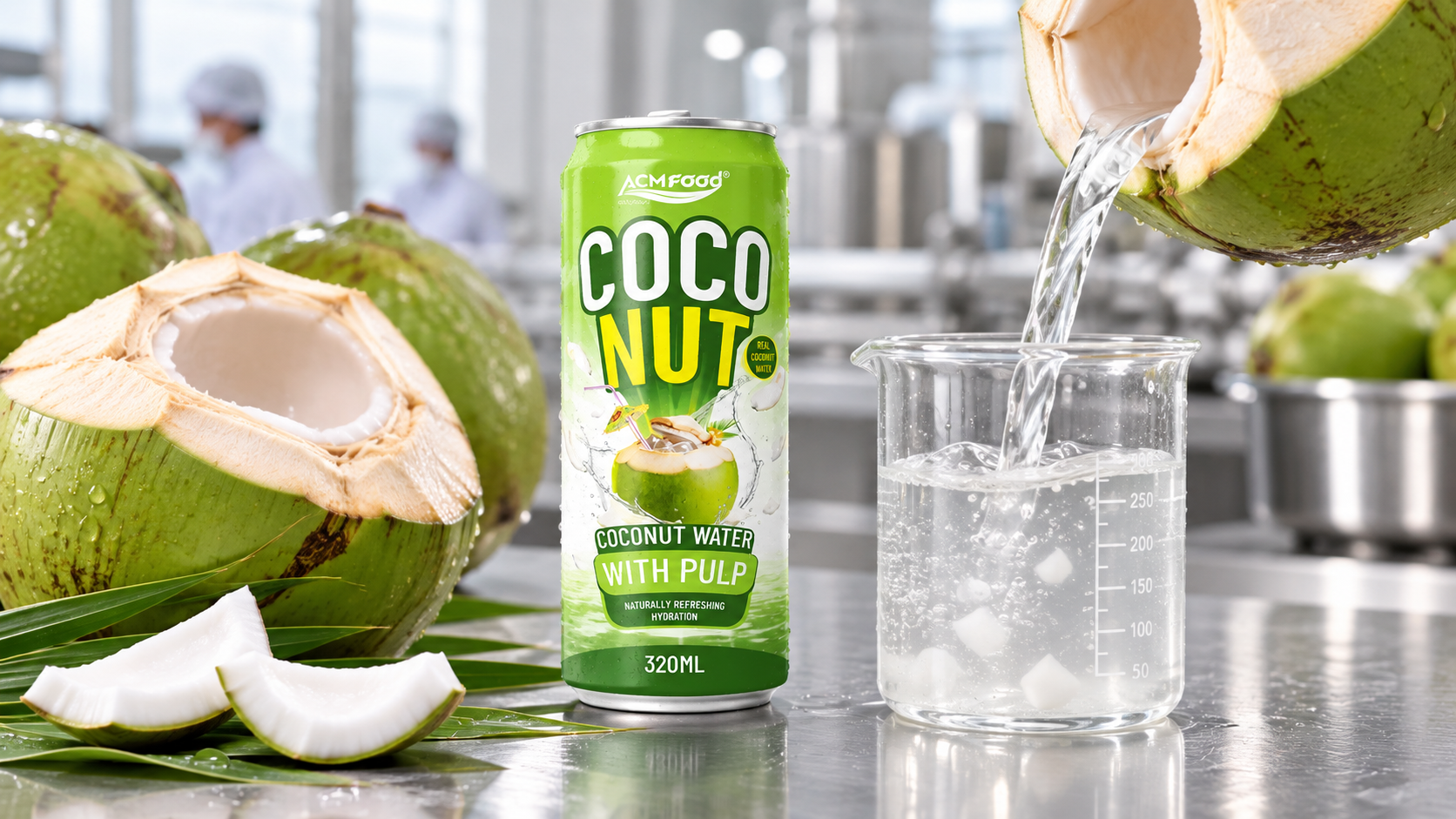
Freight, packing density and landed cost
Coconut water is largely water, so freight is a material share of landed cost and packing density matters more than it does for concentrated products. Both origins ship from well-served deep-water ports with regular sailings to Europe, North America and Oceania, and neither holds a decisive structural advantage on transit time to most destinations.
The levers that genuinely move landed cost sit inside the specification rather than inside the map:
- Pack format and case configuration, which decide how many litres fit in a container.
- Whether the product ships ambient or chilled, which changes equipment and cost per litre.
- Carton strength and pallet pattern, which decide whether the container cubes out or weighs out.
- Order size, because partial container shipments carry a disproportionate freight cost per unit.
Compare quotations on a delivered basis rather than ex-works, and make sure both suppliers have quoted the same pack and the same Incoterm. Our note on sourcing coconut water from a Vietnamese supplier covers the commercial terms that normally sit around these quotations.
Processing choices that outweigh origin
Once the variety is fixed, the processing route decides most of what the consumer experiences. Coconut water is thermally fragile and chemically reactive, and the same raw material can reach the shelf as two very different products.
The first decision is whether the product is filled as not-from-concentrate or reconstituted. The second is the thermal route: a lighter aseptic process retains more of the fresh character and supports ambient distribution, while hot fill and retort apply more heat and shift aroma and colour further from the fresh reference. Neither is wrong; they serve different shelf life, pack and price positions.
Pink discolouration deserves specific attention because it surprises first-time buyers. Coconut water contains naturally occurring enzymes and phenolic compounds that can produce a pink tint after heat treatment or during storage. It is a known technical phenomenon rather than a sign of spoilage, but it affects how a clear pack presents on shelf. Ask any supplier, in either country, how it controls colour and what the product is expected to look like at the end of its stated shelf life, not only at release.
What to put in a coconut water enquiry
A quotation is only comparable if both suppliers are pricing the same thing. For coconut water specifically, an enquiry should state:
- Whether you require not-from-concentrate or will accept reconstituted product.
- Target soluble solids and acidity, with the tolerance you will accept at release.
- Whether pulp is included, and if so the particle size and inclusion level.
- Any additions, and whether the pack must be able to carry a no-added-sugar declaration in your market.
- Pack format, size and the distribution temperature the product must survive.
- Expected shelf life and the colour and sensory window you will accept at the end of it.
- Destination markets, since these govern labelling and documentation rather than the country of manufacture.
Traceability sits alongside these. Retailers increasingly ask where raw material was collected and how far back the chain can be reconstructed, and our page on traceability from coconut farm to shelf covers what that evidence normally looks like.
Trade agreements and the duty position
Duty is the factor buyers most often assume and least often verify. Preferential access under a trade agreement is never automatic: the product must meet the rules of origin for its tariff classification, and the correct proof of origin must travel with the shipment.
Both Vietnam and Thailand sit inside regional and bilateral agreement networks, but coverage differs by destination market and by product, and agreements change. The only reliable approach is to check the classification and origin position for your specific formulation and destination before treating any duty saving as real. Our page on certificates of origin for Vietnamese beverage exports explains what the proof involves in practice.
Why the facility matters more than the country
Country of origin tells a buyer very little about the thing that determines whether a programme succeeds: whether a specific plant holds a specification under commercial pressure. Two facilities in the same province can differ more from each other than the national averages differ.
The assessment that matters is facility-level and covers process control, documentation, traceability back to collection points and the handling of out-of-specification stock. A structured audit of a Vietnamese beverage factory answers these questions, and the same checklist should be applied to a Thai supplier and a Vietnamese one without adjustment.
Supply risk deserves the same treatment. A single-source arrangement carries the same exposure regardless of origin, and reducing it usually means qualifying a second facility rather than choosing a better country.
What changes if you switch origin mid-programme
Switching supply from one country to the other is a project, not a purchase order. Brands underestimate it because the product category feels simple, but the work sits in the places customers notice.
Expect the sensory profile to move first. A different variety, a different collection radius and a different thermal route combine to shift aroma and sweetness enough that a side-by-side tasting will usually reveal it, even when both products meet the same numeric specification. Plan a sampling round and, where the brand has an established taste, a consumer check rather than an internal one.
Artwork and declarations are the second area. Country of origin appears on the pack in most markets, so a switch means new artwork, new plates and a sell-through plan for existing stock. Nutritional declarations may also need revisiting if the new supply sits at a different soluble solids level.
Finally, the documentation chain restarts. Origin proofs, supplier approval records and any retailer-facing evidence are facility-specific, so a new plant means a new approval file rather than an amended one. Where the switch is driven by price alone, these costs frequently absorb the saving in the first year, which is a reason to run the qualification before it becomes urgent rather than after.
FAQ
Is Thai coconut water better than Vietnamese?
Neither is better in a general sense. Thai aromatic varieties suit brands positioning on floral character, while Vietnamese supply covers a broader varietal mix. The meaningful comparison is between two specific facilities running a specific variety to a specific specification, not between two countries.
Can I switch origin without changing my product?
Rarely without some change. Variety, harvest conditions and processing all influence the sensory result, so a switch should be treated as a reformulation exercise with fresh samples and a revised specification rather than a like-for-like substitution.
Should I dual-source across both countries?
Many established brands do, because it reduces exposure to weather events and local supply shocks. It costs more in qualification work and requires a specification tight enough that both facilities can hit the same sensory window, which is the harder part.
How do I compare quotations fairly?
Insist on the same pack format, the same Incoterm, the same specification and the same volume, then compare on a delivered basis. Differences in case configuration alone can move landed cost enough to reverse an apparent price advantage.
Making the decision
Weighing Vietnam vs Thailand as a coconut water supplier is mostly a decision about varietal profile and about the specific facility you intend to work with. Freight and duty differences exist but are destination-dependent and need checking rather than assuming, and continuity of supply turns out to be a supplier attribute rather than a national one.
If you are scoping a coconut water programme, start from the taste profile you want and the markets you intend to ship to, then assess candidate facilities against the same checklist in both countries. ACMFOOD can review a product brief on that basis and set out what is realistic from a Vietnamese supply position.