


 Français
 Español
 العربية
 한국어
한국어A chocolate drink manufacturer on an OEM arrangement produces a cocoa beverage to a brand’s formula, handling cocoa dispersion, stabiliser selection, homogenisation, thermal processing and filling. The technical challenge is not flavour but suspension: cocoa solids are heavier than the liquid around them and will settle unless the formulation and the process are built to prevent it.
This page covers the decisions that determine whether a chocolate or cocoa drink holds together across its shelf life, and what a brand needs to specify before a manufacturer can quote. It is written for product development and sourcing teams rather than for consumers.
Cocoa beverages also sit in a stricter regulatory category than most fruit drinks, because they are typically low-acid and often dairy-based, which raises the bar on both process validation and facility approval.
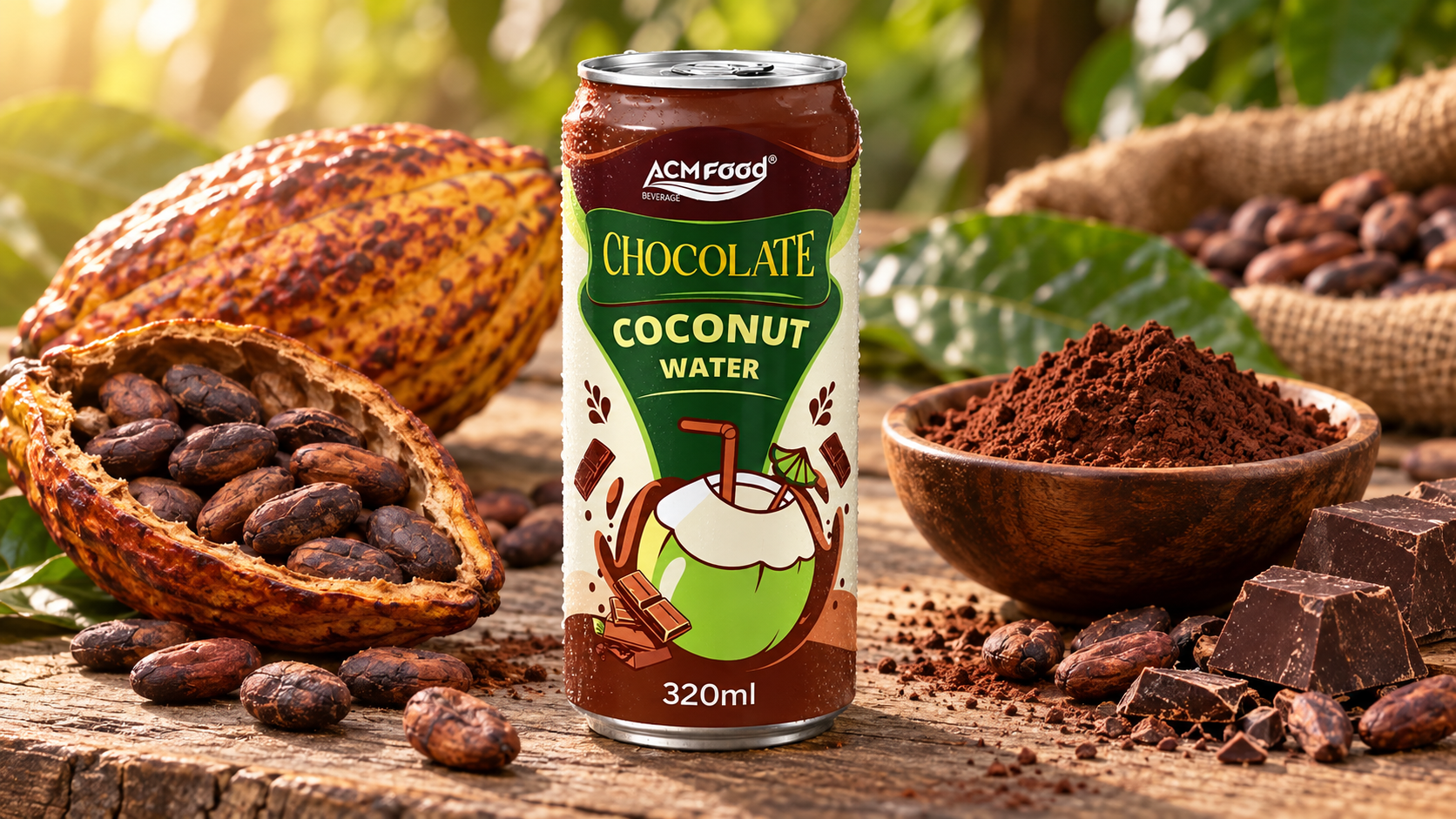
Why do chocolate drinks separate?
Because cocoa particles are denser than the surrounding liquid and gravity acts on them throughout shelf life. Sedimentation at the base, a cream layer at the top and a visible neck ring in clear packaging are all the same underlying problem. Formulation and processing work together to slow that separation to the point where it is not visible within the stated life.
Cocoa selection changes more than flavour
Cocoa powder is not a single ingredient. Fat content, particle size distribution and whether the powder has been alkalised all affect the finished drink in ways that go well beyond taste.
Alkalised, often called Dutched, cocoa gives a darker colour and a rounder, less astringent flavour, and it behaves differently in suspension from natural cocoa. Fat content influences mouthfeel and the tendency to form a cream layer. Particle size drives both sedimentation rate and the perception of grittiness on the palate. A finer particle stays suspended longer but can feel chalky if the rest of the formulation does not support it.
Specify the cocoa by its functional parameters rather than by brand name alone. A manufacturer that has to substitute a powder mid-programme can match a specification; it cannot match a name it has no access to.
The stabiliser system does the structural work
Chocolate drinks rely on a hydrocolloid system to hold cocoa in suspension. Carrageenan is the classic choice in dairy systems because it interacts with milk protein to form a weak network that supports the particles. Cellulose derivatives, gellan and starches are used alone or in combination, particularly in plant-based formulations where milk protein is absent.
Three points matter commercially. Stabiliser systems are formulation-specific, so a system that works in a dairy drink rarely transfers unchanged to an oat or soy base. They are also process-specific: the same system behaves differently under UHT and retort conditions. And they interact with mineral content in the water supply, which is one reason a formula validated in one plant may need adjustment in another.
| Defect | What the consumer sees | Usual formulation or process cause |
|---|---|---|
| Sedimentation | Cocoa layer at the base of the pack | Insufficient suspension, coarse particle size |
| Creaming | Fat layer or ring at the top | Inadequate homogenisation, fat globule size too large |
| Gelation | Product thickens or sets in the pack | Stabiliser overdosed or wrong type for the process |
| Wheying off | Clear liquid separating out | Protein destabilisation, pH or mineral imbalance |
| Cooked or caramel notes | Flavour drifts from the target | Excessive thermal load, particularly under retort |
| Grittiness | Chalky or sandy mouthfeel | Particle size, incomplete hydration before filling |
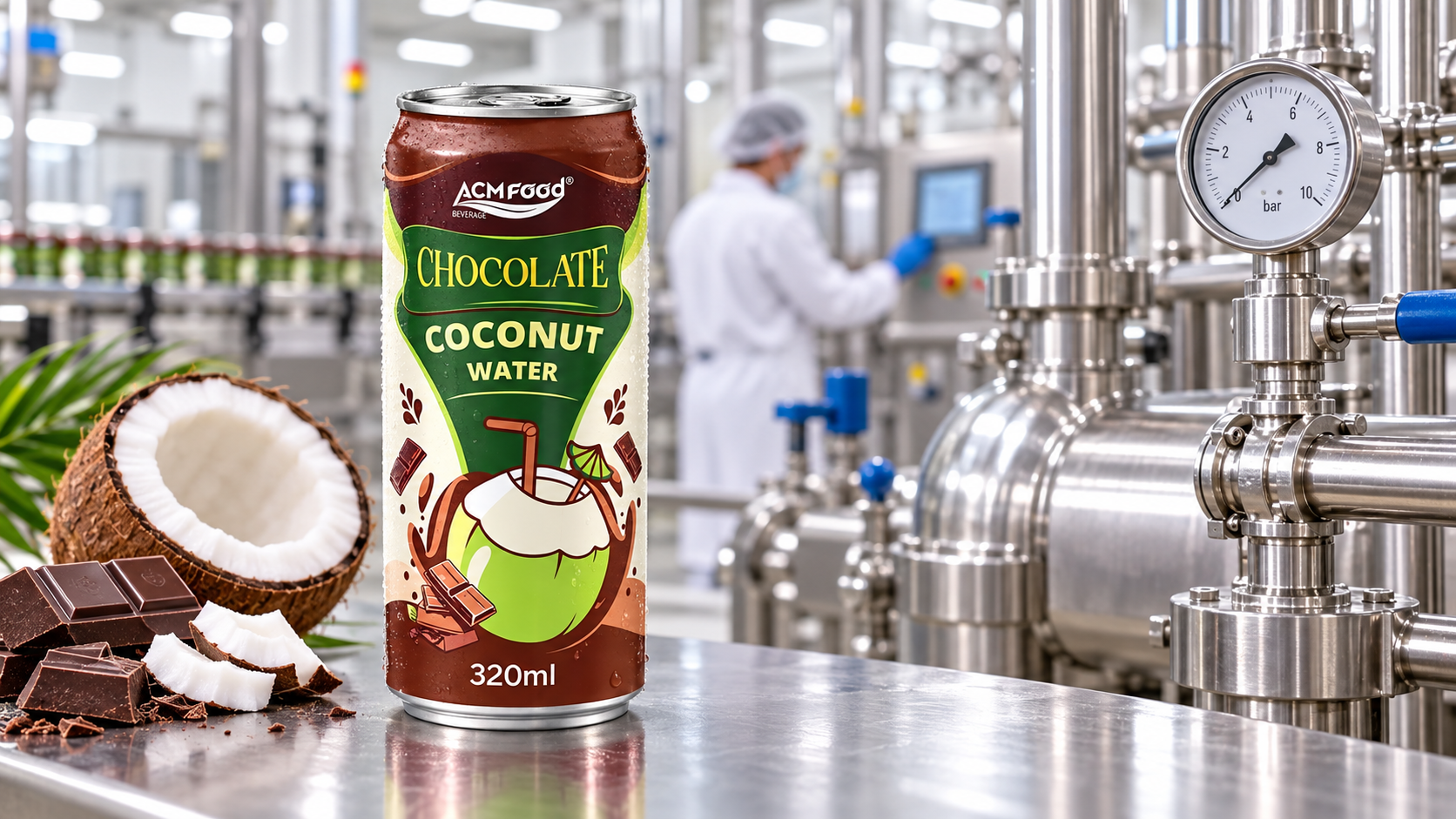
Homogenisation is not optional
Homogenisation reduces fat globule size so that fat stays dispersed rather than rising. For a cocoa drink it does double duty, because the shear also helps disperse cocoa particles and hydrate the stabiliser system fully.
Two-stage homogenisation is common in dairy-type beverages, with the second stage breaking up clusters formed in the first. Pressure, temperature and position in the process line all matter, and homogenising before or after the heat step produces different results. This is one of the clearest cases where a formula cannot be assessed on a bench: the equipment is the formulation.
UHT or retort: the low-acid question
Chocolate drinks are usually low-acid products, which places them under stricter process control than fruit juices. The two routes in common use are ultra-high temperature processing with aseptic filling, and retort, where the sealed container is heated.
UHT applies intense heat for a short time and generally preserves flavour and colour better, supporting an ambient shelf life with a lighter sensory footprint. Retort applies a longer thermal load to the sealed pack and tends to push flavour towards cooked and caramel notes and colour towards darker tones, though it suits certain pack formats and can be more forgiving of particulates.
Our pages on UHT processing for beverages and retort processing for beverages set out how each route works. Because the product is low-acid, the wider requirements discussed in low-acid and non-acidic beverage OEM formulation apply throughout, and not every facility is equipped or approved for this category.
Water, minerals and the plant you run in
Water is the largest ingredient by weight in most cocoa drinks and it is rarely specified by the brand, which is why it surprises people when it causes problems. Hardness, alkalinity and specific ion content all interact with the stabiliser system and with protein.
Calcium and magnesium influence how carrageenan and some cellulose systems build structure. Alkalinity shifts pH, which in a low-acid product affects both sensory outcome and the process requirement. A formula validated with treated water at one facility can behave differently at another drawing from a different source, even with identical ingredients.
The practical implication is that a technology transfer between plants is a revalidation exercise rather than a copy of a recipe card. Where a brand plans to run the same product at more than one site, expect the stabiliser dose and possibly the homogenisation conditions to differ between them while the finished specification stays constant.
Dairy, plant-based or neither
The base changes almost every downstream decision. A dairy chocolate drink relies on milk protein for both mouthfeel and stabiliser interaction. An oat, soy or almond base brings different protein behaviour, different mineral content and often a different flavour background that the cocoa has to work against.
Plant bases also carry their own stability issues, including protein aggregation under heat and a greater tendency to sediment. Allergen management becomes a separate workstream where nut bases are involved. If the intention is to launch dairy and plant variants together, treat them as two development projects sharing a brand rather than as one formula with a substitution.
Pilot trials worth running before committing
Cocoa beverages reward a structured pilot more than most categories, because so many of the failure modes only appear at scale or over time. A short trial programme normally covers:
- A suspension check at full process conditions, held undisturbed and assessed at intervals rather than only on day one.
- A homogenisation pressure comparison, since the optimum is plant-specific and affects both mouthfeel and creaming.
- A thermal comparison where both UHT and retort are viable, tasted blind against the target.
- A pack trial in the actual container, because headspace, geometry and transparency all change what separation looks like.
- A transport simulation, as vibration during distribution can either delay or accelerate sedimentation depending on the system.
Running these together rather than sequentially shortens the calendar considerably, and the cost is small relative to reworking a commercial batch that sets in the pack.
What shifts across shelf life
A chocolate drink that is correct at release can still fail at month six. Colour deepens, flavour flattens or develops cooked notes, and suspension slowly loses the battle with gravity.
The specification therefore needs to state the acceptable window at the end of shelf life, not only at release, and stability testing has to run long enough to see it. Our notes on why colour and flavour drift and on how shelf-life testing is designed cover the study design, which applies to cocoa beverages as much as to juice.
Storage temperature during distribution is part of this. A product validated in a temperate warehouse may behave differently in a hot climate, and accelerated testing is an indicator rather than a substitute for real-time data.
What a manufacturer needs before quoting
A cocoa beverage brief is more demanding than a juice brief because so many parameters interact.
- The base: dairy, a named plant base, or a water-based system.
- Cocoa specification, including fat content, alkalised or natural, and target particle size.
- Target cocoa solids and the sweetness level, with the sweetener system named.
- Whether the pack must carry any nutrition or composition declaration in the destination market.
- Pack format and size, and whether the pack is transparent, since visible separation is only a problem where it can be seen.
- Required shelf life and distribution temperature.
- Allergen constraints, particularly where plant bases or shared lines are involved.
FAQ
Can a chocolate drink be made without stabilisers?
It can be formulated with fewer additives, but some structural support is needed for a shelf-stable product with visible cocoa solids. Options include using finer cocoa, raising viscosity through the base itself, or accepting a shake-before-use instruction on pack. Each has a cost in mouthfeel, clarity of claim or consumer experience.
Why does my sample taste different from the production run?
Because the thermal load differs. A bench sample rarely replicates the heat profile of UHT or retort, and cocoa flavour is sensitive to it. This is the main reason a pilot run on production equipment is worth its cost before committing to a commercial batch.
Does a clear bottle work for a cocoa drink?
It is possible but unforgiving, because any sedimentation or ring formation is immediately visible. Opaque packaging hides normal separation that would otherwise be read as a fault. If a clear pack is central to the brand, the stability specification has to be tighter and validated for longer.
Is chocolate flavour the same as real cocoa?
No, and the difference affects both labelling and process. A flavoured product using a chocolate flavour system behaves differently in suspension from one built on cocoa powder, and the permitted description on pack depends on composition and on the rules of the destination market.
Briefing a chocolate drink manufacturer for OEM production
A chocolate drink manufacturer working on an OEM brief will tell you the same thing: most programmes succeed or fail on suspension and thermal route rather than on flavour direction. Fix the base, the cocoa specification and the process first, because those decisions constrain everything that follows, and plan for a pilot run rather than assuming a bench sample will transfer.
To scope a project with ACMFOOD, share the base you intend to use, the cocoa specification, the pack format and the shelf life and markets you are targeting. Claims and labelling depend on the final formulation, the tested composition, the serving size and the rules of the destination market rather than on the formulation brief alone.