


 Français
 Español
 العربية
 한국어
한국어An organic certified fruit juice supplier is one whose production, and the supply chain feeding it, has been inspected and certified against a specific organic standard such as the USDA National Organic Program or the European Union organic regulation. Certification attaches to the operator and the product, not to the country or to the fruit itself.
This page sets out what the main standards require of a juice supply chain, what evidence a buyer should ask to see, and where organic programmes most often fail during a first audit. It is written for sourcing and product development teams rather than for consumers, and it does not cover nutritional questions.
What does organic certification actually cover?
It covers process, not a laboratory result. An organic standard governs how fruit was grown, how it was handled, what may be added during processing, and how organic and conventional material are kept apart. A finished juice is organic because every step in its chain was certified and documented, not because a test on the final product says so.
USDA Organic and EU Organic are not the same thing
Both standards prohibit synthetic pesticides and fertilisers in cultivation, set a conversion period before land qualifies, and restrict processing aids and additives. They differ in the detail that determines whether a product can carry a particular claim in a particular market.
The differences that matter commercially are the permitted additive lists, the labelling categories and thresholds, the wording and placement of claims, and the recognition arrangements between the two systems. Equivalence arrangements exist and have changed over time, so whether a certificate issued under one scheme is accepted in the other market is a question to verify at the time of shipment rather than to assume from precedent.
The practical consequence for a brand selling into more than one region is that a single certificate may not carry the product everywhere. Decide the destination markets before the programme is designed, because retrofitting a second certification onto an existing supply chain costs far more than building it in.
| Question | Why a buyer asks it | Evidence to request |
|---|---|---|
| Which standard is the certificate issued under? | Determines which markets accept the claim | Current certificate naming the standard |
| Is the processing facility itself certified? | Farm certification alone is not enough | Scope of certification listing the site |
| Is the specific product listed in scope? | Certificates cover named products, not everything made | Product schedule attached to the certificate |
| Who is the certifying body? | Accreditation and market recognition vary | Certifier name and accreditation reference |
| How are organic and conventional runs separated? | Segregation failure is the common audit finding | Procedure plus cleaning and changeover records |
| Can the chain be traced back to the grower? | Mass balance is checked during verification | Traceability records and input purchase documents |
An organic certified fruit juice supplier is certified for a scope, not as a company
The single most common misunderstanding is treating a certificate as a badge belonging to a supplier. It is not. A certificate names an operator, a site and a list of products, and it has an expiry date. A facility can be genuinely certified and still be unable to supply your particular product under that certificate, because the product is not in scope.
Ask for the certificate together with its product schedule, check that the site named is the site that will make your drink, and confirm the validity dates cover the production window rather than only the date of the enquiry. Our page on the document pack for supplier approval covers where this sits in a wider approval file.
Where organic juice programmes usually fail
Failures cluster in predictable places, and almost all of them are documentation rather than contamination.
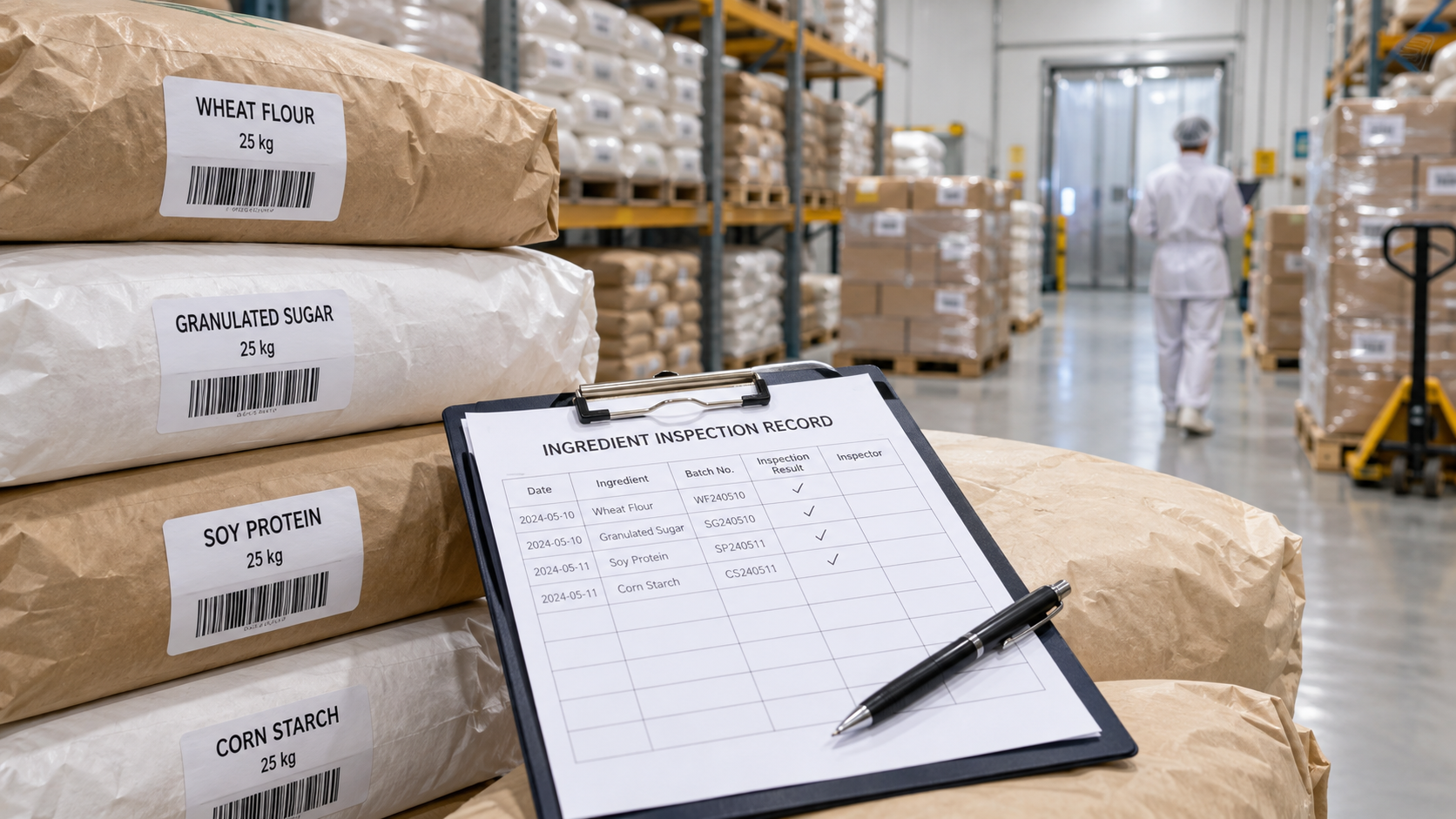
- Segregation on shared lines. Most facilities run organic and conventional product on the same equipment, which is permitted, but only with validated cleaning and clear changeover records.
- Ingredients that are not themselves certified. A single uncertified minor input can disqualify the finished product, and flavours, acidity regulators and processing aids are the usual culprits.
- Mass balance that does not reconcile. Verification compares organic input purchased against organic output sold. Gaps, in either direction, trigger scrutiny.
- Packaging and label wording. Certification marks, percentages and certifier references are regulated, and a compliant product can still carry a non-compliant label.
- Lapsed certificates in the chain. The finished-goods certificate may be current while a grower or an intermediate supplier has lapsed.
Traceability underpins all of these. A chain that can be reconstructed from finished pack back to collection point survives verification; one that relies on memory does not. Our note on traceability from farm to shelf describes the record structure involved.
What to ask for before approving the supplier
An organic approval file is thicker than a conventional one, and assembling it at the point of first order is far easier than reconstructing it during a verification. Request the following as a set rather than piecemeal:
- The current certificate, with the product schedule and validity dates covering your production window.
- The name and accreditation reference of the certifying body, so the certificate can be verified at source.
- The organic control plan, covering receipt, storage, segregation, cleaning and changeover.
- Certificates for every certified input, including flavours and any processing aids.
- A worked traceability example, tracing one finished batch back to grower level.
- The findings and close-out records from the most recent inspection.
Verify the certificate directly with the issuing body rather than relying on the copy supplied. Certificates are occasionally presented after suspension, and the issuing body is the only authoritative source on current status.
Timing the programme around harvest
Certified fruit is available in a narrower window than conventional fruit, because the certified grower base is smaller and its harvest calendar less flexible. A programme planned without reference to that calendar tends to discover the constraint at the worst moment, when artwork is printed and listings are confirmed.
Two planning habits help. The first is to fix the production window against the harvest rather than against the marketing calendar, and to build the launch date backwards from it. The second is to agree with the supplier how a poor season will be handled before it happens: whether the run is deferred, whether a partial quantity ships, or whether conventional material may be substituted with a corresponding change to the pack. That last option is rarely acceptable to a brand positioned on organic, which is precisely why it should be discussed while there is still time to plan around it.
Organic and juice composition are separate questions
Organic status says nothing about juice content, sugar level or whether a product is from concentrate. A juice drink with a low juice percentage can be organic. A one hundred percent juice can be conventional. These are independent axes, and buyers sometimes conflate them when writing a brief.
Write the specification to cover both explicitly: the organic standard and scope on one side, and the compositional targets on the other. Our page on what belongs in an ingredient specification sets out the compositional parameters that normally need stating.
What organic costs a programme
Certified raw material carries a premium, and the size of that premium moves with harvest conditions more sharply than conventional material does, because the certified pool is smaller. Budgeting from a single quotation taken in a good season is a common planning error.
Conversion is the cost buyers see least often, because it sits with the grower rather than on the invoice. Land coming into organic production must be farmed to the standard for a set period before its output qualifies, and the grower carries that cost without being able to sell at organic prices. Where a brand wants volume that the existing certified base cannot supply, someone has to fund that gap, and it usually shows up as a longer lead time or a higher contracted price rather than as a separate line item.
Beyond material cost there are certification fees, annual inspection, the internal administration of maintaining records, and the cost of segregation on shared equipment. Smaller runs feel these disproportionately, because the fixed elements do not scale down.
There is also a supply concentration risk. The certified supplier base for any given fruit is narrower than the conventional one, so a brand committed to organic has fewer alternatives if its primary source has a poor season. Qualifying a second certified supplier early is more valuable in an organic programme than in a conventional one.
Building the sourcing side properly
Organic integrity is decided upstream of the filling line. The questions that matter concern how growers are contracted and inspected, how material is identified on arrival, and how the facility proves that what went into your batch was the material it claims.
Our page on ingredients and sourcing covers the upstream structure, and a site visit remains the most reliable check. A structured audit of a Vietnamese beverage factory should include the organic control plan alongside the general food safety review, because the two are managed by different documents even when they sit in the same quality system.
FAQ
Can a product be part organic?
Standards allow categories based on the proportion of certified ingredients, with different labelling permitted for each. The wording, the placement of any certification mark and whether a front-of-pack claim is allowed all depend on which category the product falls into, so the category should be decided before artwork is drafted.
Does organic mean no pesticide residues at all?
No. Organic standards regulate what may be applied during cultivation and processing rather than guaranteeing a zero residue result, and unintended presence from neighbouring land or shared transport is addressed through procedures rather than through a promise of absence. Residue limits are a separate regulatory question from organic status.
How long does it take to certify a new supply chain?
Longer than most launch plans assume, because land conversion periods apply before a farm’s output qualifies and each operator in the chain must be inspected. Where certified material is already available from an existing certified grower base, the timeline is much shorter, which is why sourcing is usually the first question rather than the last.
Is a certificate enough to approve a supplier?
No. The certificate proves scope and validity, not day-to-day control. A buyer approving an organic programme should see the certificate, the product schedule, the segregation procedure, traceability records and evidence from the most recent inspection, and should verify the certificate directly with the issuing body.
Scoping an organic juice programme
Working with an organic certified fruit juice supplier is mostly an exercise in verifying scope and documentation rather than in trusting a logo. Confirm which standard applies to your destination markets, check the certificate names the site and the product, and treat segregation and traceability records as the real evidence.
If you are scoping such a programme with ACMFOOD, state the destination markets and the organic standard you need at the briefing stage. Certification requirements and their availability should be confirmed in writing for the specific facility and product rather than assumed from a general position, and any claim on pack depends on the final formulation and the rules of the market you sell into.