


 Français
 Español
 العربية
 한국어
한국어Cucumber juice manufacturing turns a very watery vegetable into a stable, bottled or canned drink. Cucumber is roughly 95% water, so the juice is thin, mild and low in solids, and the manufacturer’s job is to protect a delicate fresh flavour and a pale green colour while making the product safe for months of storage.
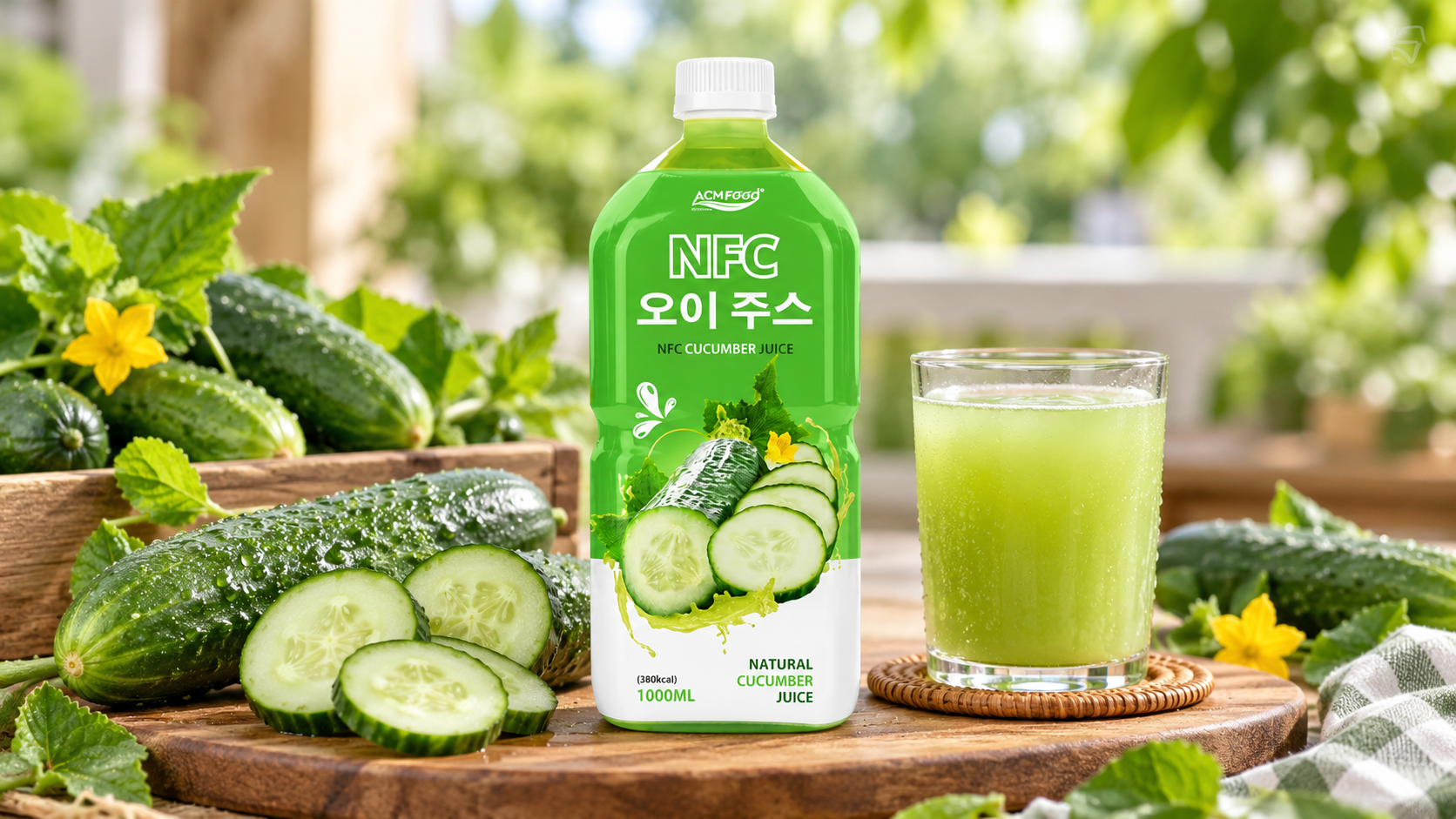
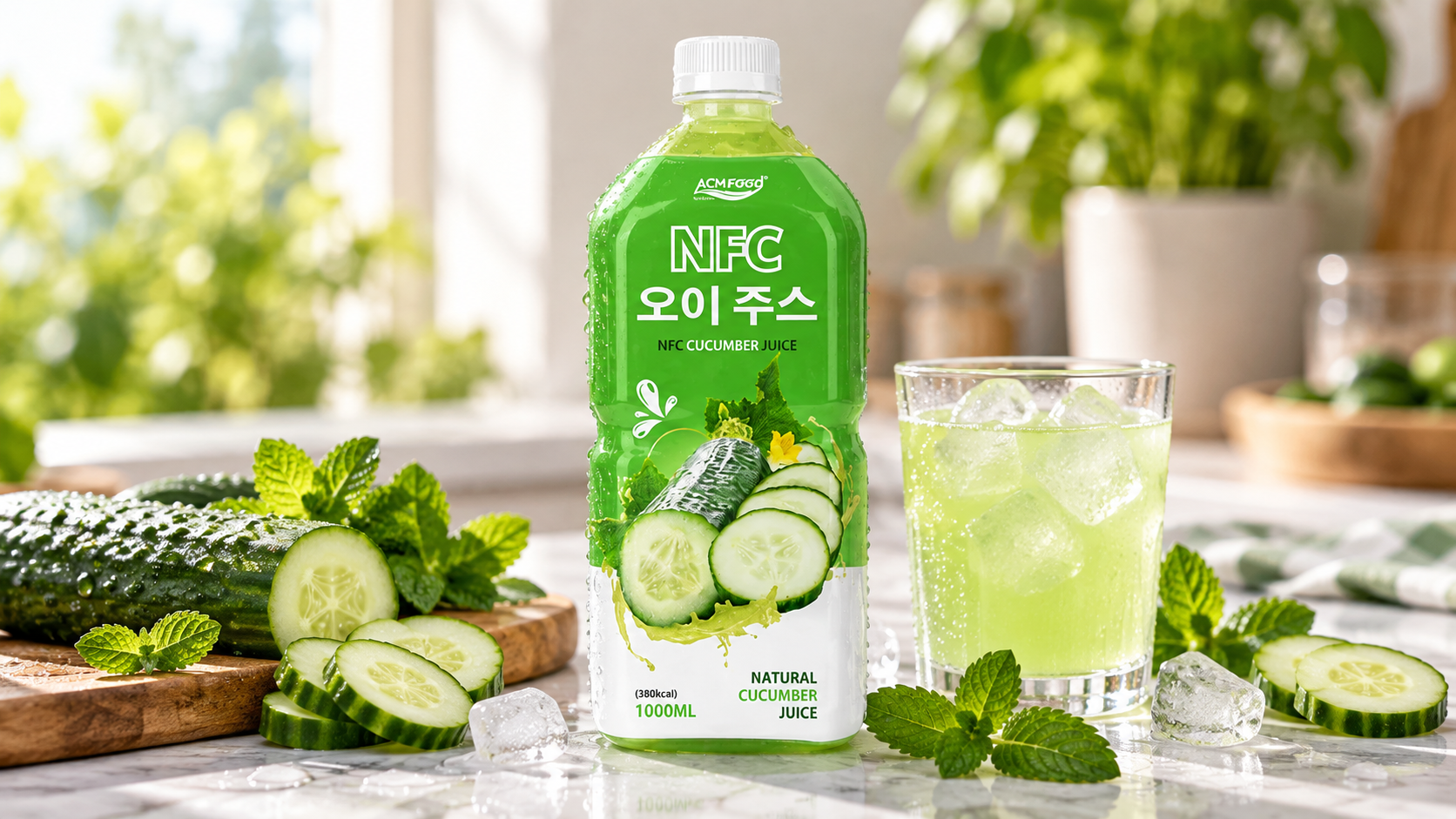
This guide covers the raw material specifications for cucumbers, how juice is extracted, how bitterness, colour and aroma are controlled, which heat routes suit a low-acid vegetable, how the finished drink is packed and which documents support export. ACMFOOD, a Vietnam beverage manufacturer, supplies finished drinks in cans and bottles under OEM, ODM and private label arrangements, and offers a 1L NFC cucumber drink in a PET bottle.
What are the raw material specifications for cucumber juice?
Raw material specifications cover variety, maturity, size, freshness, appearance and residue limits. Because cucumber is mostly water, small differences in raw quality show quickly in taste, colour and bitterness, so incoming inspection is one of the most important controls.
- Variety. Smooth-skinned varieties with mild flavour and low bitterness are preferred. Seeds and skin influence taste and colour.
- Maturity. Young to medium cucumbers give a crisp, mild juice, and overripe ones become seedy and bitter.
- Freshness. Firm, unwilted fruit gives better flavour and yield. Soft or yellowing fruit is rejected.
- Appearance. Visible rot, mould, mechanical damage and heavy soil are reasons for rejection.
- Residues and contaminants. Tested against the limits of the destination market. Cucumbers are often grown in warm, humid conditions where crop protection is common.
- Food safety. Washing water quality and supplier hygiene practices are part of supplier approval.
A written raw material specification, signed by the grower or trader, makes it easy to reject a poor lot without arguments. It should also state which parts of the fruit are used, because peel and seeds change the final colour.
How is juice extracted from cucumbers?
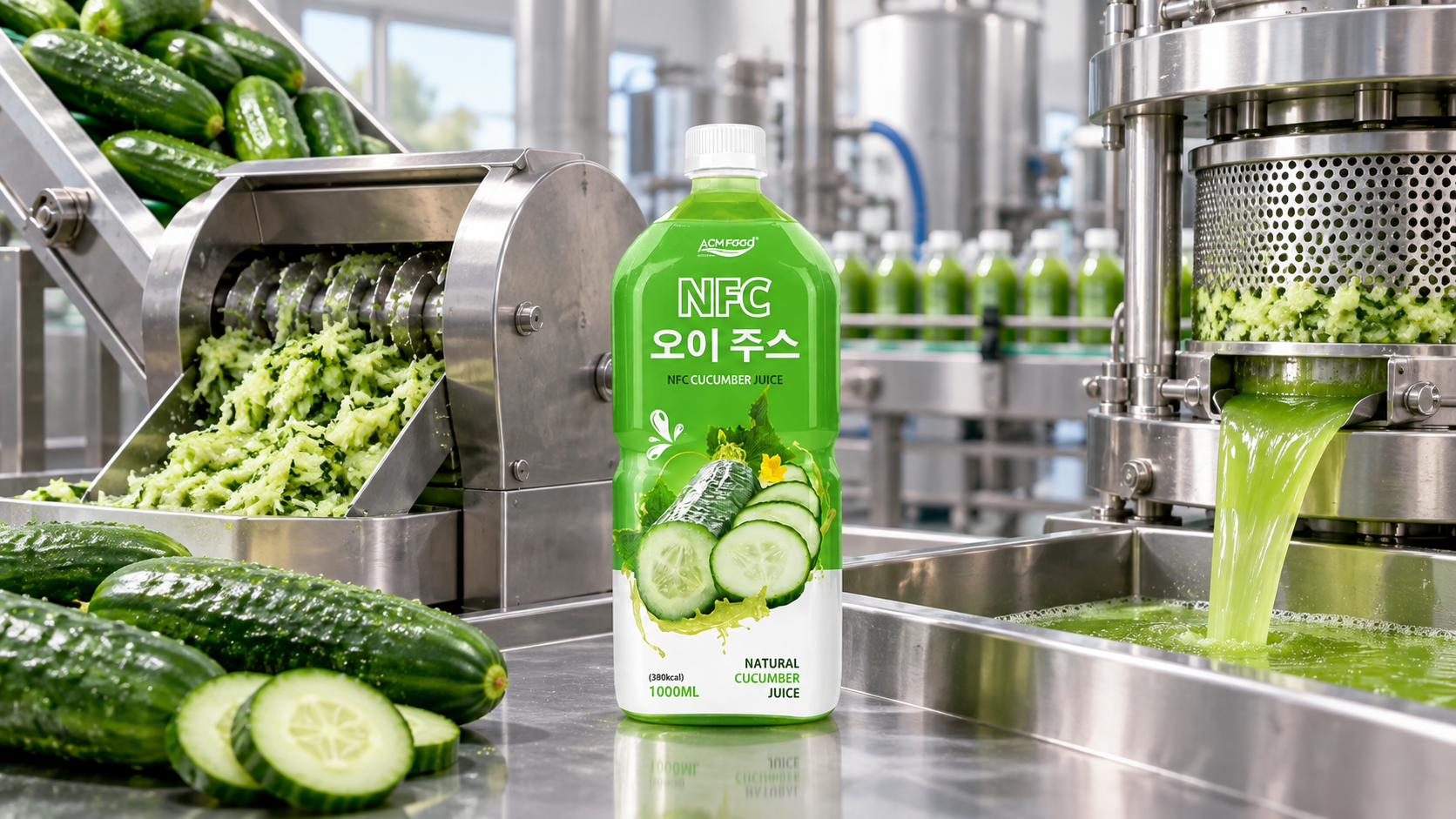
Juice is extracted by washing, trimming, crushing and pressing the cucumbers, followed by filtration. The steps are simple, but time and temperature need tight control because cucumber juice browns, loses aroma and develops off-notes if it waits.
- Washing and inspection. Cucumbers are washed in potable water, and damaged fruit is removed.
- Trimming. Stem and blossom ends, which can be bitter, are cut off.
- Peeling decision. Peeling gives a paler, milder juice, while keeping the skin gives a stronger green colour and more bitterness risk.
- Crushing and pressing. A crusher and a press extract the juice. The high water content gives a high juice yield compared with dense vegetables.
- Filtration. Pulp, seeds and fibre are removed. Fine filtration or centrifugation gives a clearer drink.
- Deaeration. Dissolved oxygen is removed to slow browning and aroma loss.
Yield per tonne of cucumbers is generally high, but the solids content of the juice is low, which makes it thin and mild. That is why many commercial cucumber drinks are blends or carry added acid, lime, mint or honeydew to build body and flavour.
How are bitterness, colour and aroma controlled?
Bitterness comes from compounds called cucurbitacins, which are more concentrated in the stem end, skin and stressed plants. Colour comes from chlorophyll that browns under heat and acid, and the fresh aroma comes from volatile compounds that disappear when the juice is heated or oxidised.
| Attribute | Cause | Control |
|---|---|---|
| Bitterness | Cucurbitacins in stem end, skin and stressed fruit | Variety choice, trimming ends, peeling when needed, sensory check on each lot |
| Colour | Chlorophyll converting to olive pigment under heat and acid | Short heat exposure, deaeration, balanced pH, light-protective packaging |
| Fresh aroma | Volatile aldehydes that break down with heat and oxygen | Fast processing, low oxygen, recipe notes such as lime or mint to support aroma |
| Cloud and sediment | Fine particles and fibre | Filtration or centrifugation, optional homogenisation |
A cooked note is the most common complaint about heat-treated cucumber juice, and recipe design is the main defence against it. Many brands accept a slightly cooked profile and build the product around lime or mint to cover it.
Which heat treatment suits cucumber juice?
Cucumber is a low-acid vegetable, with a pH above 4.6, so shelf-stable cucumber juice needs either acidification with hot-fill or tunnel pasteurisation, or a sterilising route such as retort or aseptic filling. Mild pasteurisation alone supports a refrigerated product only.
- Acidified hot-fill. pH is lowered with lime juice or a food acid, the juice is filled hot into heat-set PET or glass and the closed bottle is held for a short time. This route keeps taste fresher and suits mainstream products.
- Tunnel pasteurisation. Sealed bottles or cans of an acidified recipe pass through a heating and cooling tunnel.
- Retort sterilisation. Sealed cans are heated under pressure. It suits an unacidified recipe but gives a stronger cooked note.
- Aseptic filling. The juice is sterilised in a heat exchanger and filled into sterile bottles. It is gentle on flavour and needs an aseptic line.
- Chilled pasteurisation. A mild heat step with refrigerated distribution for a fresher taste and a short life.
The factory or a process authority sets the minimum pH and heat values for the exact recipe. A change of acid, juice percentage or pack requires a new review. Details on route selection appear in the guide to cucumber juice drinks in cans, which is part of this series, and in the cucumber juice category for current product formats.
Which packaging formats are used?
Cucumber juice is packed in PET bottles, glass bottles and aluminium cans. Clear bottles show the pale green colour, while cans give a full light barrier, and the choice depends on shelf-life target, channel and brand look.
- PET. Light, shatter resistant and practical for large sizes such as 1L. Heat-set PET is needed for hot-fill, and an oxygen barrier helps for longer storage.
- Glass. Premium image, strong barrier, heavier and more fragile.
- Aluminium cans. Full protection from light and oxygen and strong stacking, with a lining suited to a vegetable drink.
ACMFOOD’s cucumber drink is currently offered in a 1L PET bottle as an NFC product, and other formats can be discussed as part of a development project.
How are cucumber juice blends designed?
Blends are designed to give the thin cucumber base more body, aroma and a recognisable taste. Most commercial cucumber drinks combine cucumber juice with a fruit or herb component, and the recipe is built around a clear flavour story such as cool and refreshing or green and light.
- Lime or lemon. Adds acidity for stability and a bright aroma that covers any cooked note.
- Mint. Gives a cooling impression and reinforces the freshness claim without adding sugar.
- Apple or melon. Adds natural sweetness and body. Melon pairs especially well with cucumber, since both belong to the same plant family and share aroma notes.
- Ginger. Adds a light heat that makes the drink more distinctive.
- Light sweetener. A small amount of sugar or an approved alternative rounds the profile for mainstream tastes.
Each addition changes the label, the category name and sometimes the process. A blend with a high share of acidic juice can reach a pH that allows hot-fill, which is one reason many commercial drinks follow this route.
How is quality controlled during cucumber juice production?
Quality is controlled at the raw material, in process and on the finished pack, with each lot linked to a batch record. Because cucumber juice is delicate, taste checks are as important as laboratory tests, and a trained panel compares each batch with an approved reference.
- Incoming inspection. Freshness, bitterness by taste test, appearance and temperature are checked for every delivery.
- Process monitoring. Time between pressing and heating, juice temperature, Brix, pH and colour are recorded.
- Heat step records. Temperature and hold time are logged continuously, with alarms for deviations.
- Filling and sealing checks. Fill level, headspace, closure torque or seam quality are sampled across the run.
- Finished product release. Microbiological tests, sensory review and review of records before the batch is shipped.
- Retained samples. Kept to check taste and colour at the end of the declared shelf life.
Factories that work under HACCP, ISO 22000 or FSSC 22000 follow documented versions of these controls, which makes supplier audits easier for the buyer. The documents should be requested at approval time, along with a sample batch record.
What should a cucumber juice specification include?
- Product definition. Pure cucumber juice, blend or lighter drink, with the juice percentage.
- Raw material. Variety, peeled or unpeeled, and maximum bitterness limit by sensory test.
- Brix and pH. Target ranges. Brix is low for cucumber juice, so measurement tolerance matters.
- Colour and clarity. Reference sample and acceptable change after storage.
- Microbiology and contaminants. Limits suited to the heat route and destination market.
- Pack. Material, size, closure, lining or barrier requirements.
- Shelf life. Duration and storage conditions on which the claim relies.
- Documents. Specification, certificate of analysis, and certificates such as HACCP, ISO 22000 and FSSC 22000.
Which documents support the export of cucumber juice?
Export normally needs a commercial invoice, packing list, certificate of origin where required, certificate of analysis, and any health or inspection certificate demanded by the importing country. The buyer’s importer or broker confirms the exact list, because requirements differ by market.
- Commercial documents. Invoice, packing list and bill of lading or airway bill.
- Origin documents. A certificate of origin supports tariff treatment under trade agreements where it applies.
- Quality documents. Certificate of analysis for each lot, specification sheet and food safety certificates.
- Labelling documents. Approved label artwork, ingredient list and, where needed, translated statements.
- Market-specific documents. Some countries require product registration, import permits or inspection certificates.
Planning the documents early prevents delays at the port. Consumer interest in vegetable and fruit juices is also summarised in the article on vegetable and fruit juice drinking, which provides context on demand without making product claims.
FAQ about cucumber juice manufacturing
Why is cucumber juice so thin?
Because the fruit is about 95% water and contains little sugar or fibre. Brands often blend it with other juices or add lime and mint to give it body and flavour.
Does cucumber juice need to be peeled?
Not always. Peeling gives a milder, paler juice, while unpeeled fruit gives a stronger green colour with a higher bitterness risk. The choice depends on the product style.
Can cucumber juice be stored at room temperature?
Yes, if the recipe is acidified and filled hot or tunnel pasteurised, or if the product is sterilised, and the pack stays sealed. Mild pasteurisation alone calls for refrigeration.
Why does heat-treated cucumber juice taste different?
Heat destroys volatile fresh aroma compounds and can add a cooked note. Recipe design with lime, mint or other juices helps cover the change.
Is cucumber juice sold only in bottles?
No. Both bottles and cans are used. Cans give better colour protection, and bottles give better visibility.
Planning cucumber juice production
Cucumber juice manufacturing depends on careful raw material selection, fast extraction and a heat route matched to a low-acid vegetable. Bitterness, colour and aroma are the three quality points to specify, and the pack and documents should be planned together with the recipe.
Brands that want to develop a cucumber drink can share a brief with ACMFOOD covering style, pack, markets and documents. The team can propose a recipe, confirm the heat route and prepare samples.