




 Français
 Español
 العربية
 한국어
A celery vegetable juice blend combines celery juice with other vegetable juices, most often carrot, tomato and cucumber, to build a drink with a rounder taste and a more attractive colour than celery alone. Formulation decides whether the blend tastes savoury and fresh or flat and bitter, and it also decides how safe and stable the product is in a can or bottle.
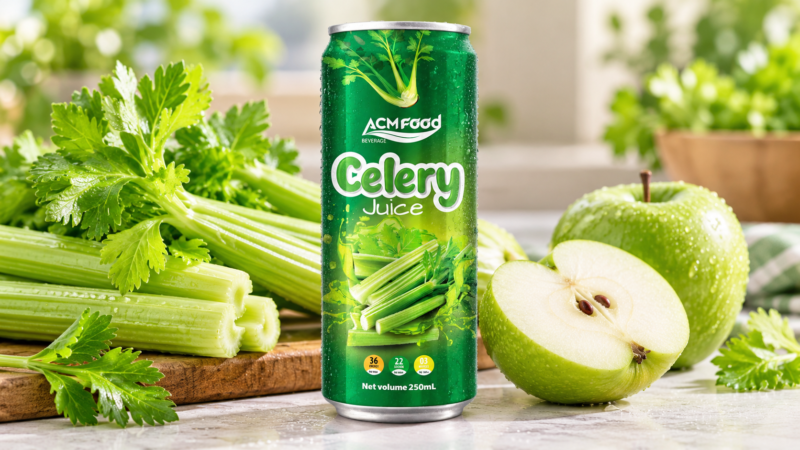
This guide explains how each ingredient behaves, offers starting ratios for bench trials, covers taste, colour and stability and describes the process choices that follow from the recipe. It uses only vegetables already part of the ACMFOOD vegetable range. ACMFOOD, a Vietnam beverage manufacturer, supplies finished drinks in cans and bottles under OEM, ODM and private label arrangements.
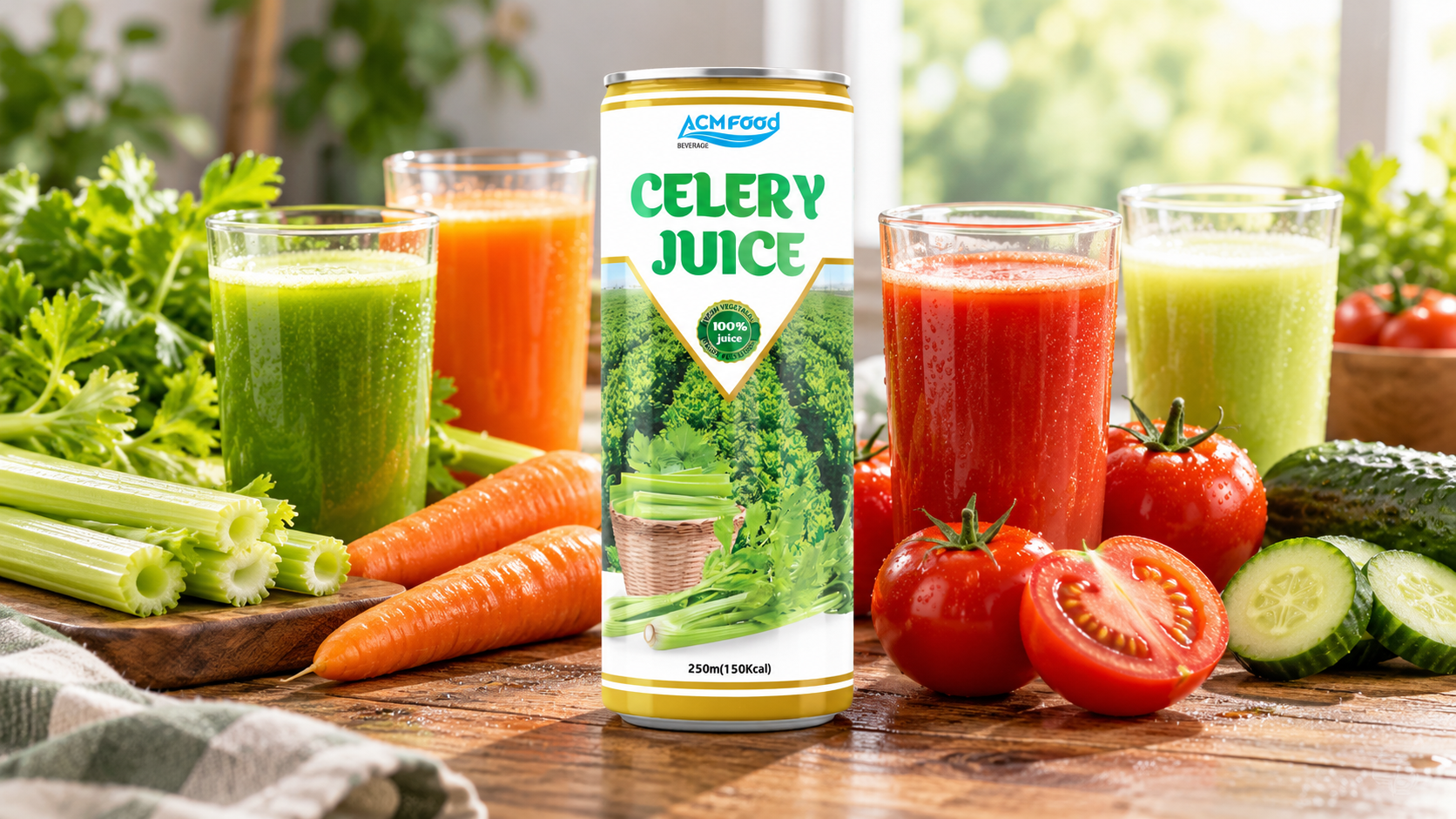
What does each vegetable bring to a celery blend?
Each vegetable brings a distinct contribution: celery gives the savoury green aroma, carrot gives sweetness and body, tomato gives acid, colour and umami, and cucumber gives freshness and dilution. Knowing these roles lets a developer adjust a recipe by purpose rather than by guesswork.
| Ingredient | Main contribution | Watch out for |
|---|---|---|
| Celery juice | Savoury aroma, natural sodium, green note | Bitterness at high share, browning under heat and acid |
| Carrot juice | Sweetness, body, orange colour | Can mask the celery note, shifts colour toward brown-orange |
| Tomato juice | Acidity, red colour, savoury depth | Lowers pH, which helps safety but changes the green colour |
| Cucumber juice | Freshness, light body, mild green tone | Thin flavour, high water content, short-lived fresh aroma |
Other vegetable pages describe each ingredient in more depth. For celery alone, see the celery juice category, and for how blends fit the wider range, see the mixed vegetable juice category.
Which starting ratios work for bench trials?
Starting ratios are a way to begin tasting, not final recipes. A typical approach is to build four base blends that cover different directions, taste them side by side and adjust the best candidate in small steps before running stability tests.
- Green and fresh. Celery as the largest share, with cucumber to dilute and a small amount of carrot for sweetness. The colour is pale green and the taste light and savoury.
- Sweet and rounded. Carrot as the largest share with celery as a supporting note. The colour is orange and the drink approachable.
- Savoury and bright. Tomato as the largest share with celery and a little carrot. The colour is red and the drink resembles a classic savoury vegetable cocktail.
- Balanced three-vegetable. Roughly equal parts of celery, carrot and tomato, with cucumber for lightness.
The exact percentages should come from the developer’s tasting, the target market and the supplier’s raw material quality. Changing the share of any one vegetable shifts taste, colour, pH and Brix at the same time, which is why each change should be made one step at a time and recorded.
How is the taste balanced?
Taste is balanced by managing sweetness, acid, salt and bitterness together. Celery adds bitterness and a savoury note, carrot adds sweetness and tomato adds acid, so the blend can often be balanced by changing proportions before adding any additional ingredient.
- Sweetness. Carrot is the main source. If the drink tastes flat, a slightly higher carrot share is usually better than added sugar.
- Acid. Tomato and, if needed, lemon juice or a food acid brighten the taste and lower the pH.
- Salt. Celery already contains natural sodium, and a savoury blend may need little or no added salt. Added salt must be declared and affects any low-sodium claim.
- Bitterness. If celery bitterness dominates, reducing the share, selecting milder stalks or trimming leaves can help.
- Aroma. Heat reduces fresh aroma, so the final taste test should use a heat-treated sample.
A tasting panel of trained or target-consumer tasters should compare the candidates blind, and the winning recipe should be re-tasted after several weeks of storage.
How do ingredients affect colour?
Colour in a blend is the sum of chlorophyll from celery and cucumber, carotenoids from carrot and tomato, and the changes caused by pH and heat. Blends with tomato tend toward a stable orange-red, whereas blends with a high green share face the usual olive shift.
- Green-dominant blends. Appear pale green when fresh and shift to olive after heat. Adding a little carrot can mask the shift by moving the colour toward yellow-green.
- Orange-dominant blends. Carotenoids are comparatively stable, so colour holds well in a can.
- Red-dominant blends. Lycopene in tomato gives a red colour that is stable to moderate heat but sensitive to light and oxygen over a long period.
- Mixed blends. Often settle into a brownish or reddish-orange tone, which is natural but should be accepted in the specification.
A colour reference with an acceptable range after storage helps the buyer and the factory agree on what is normal.
How does the recipe affect pH, safety and process?
The recipe controls the final pH, and the final pH controls which heat route is safe. Tomato is acidic enough to lower the pH of a blend, while celery, carrot and cucumber are low in acid, so a tomato-rich blend may reach a safe acidified level and a green blend may not.
Developers therefore check the pH of every candidate recipe, not only of single juices. When the blend stays above 4.6, shelf-stable cans or bottles require either added acid or a sterilising process such as retort or aseptic filling. When the pH is below the limit, acidified hot-fill or tunnel pasteurisation is available, which preserves more fresh taste. The factory’s process authority sets the target and validates it, and each change in ratios requires a review. The reasons are explained in more detail in the vegetable juice manufacturing guide.
How is stability managed in blends?
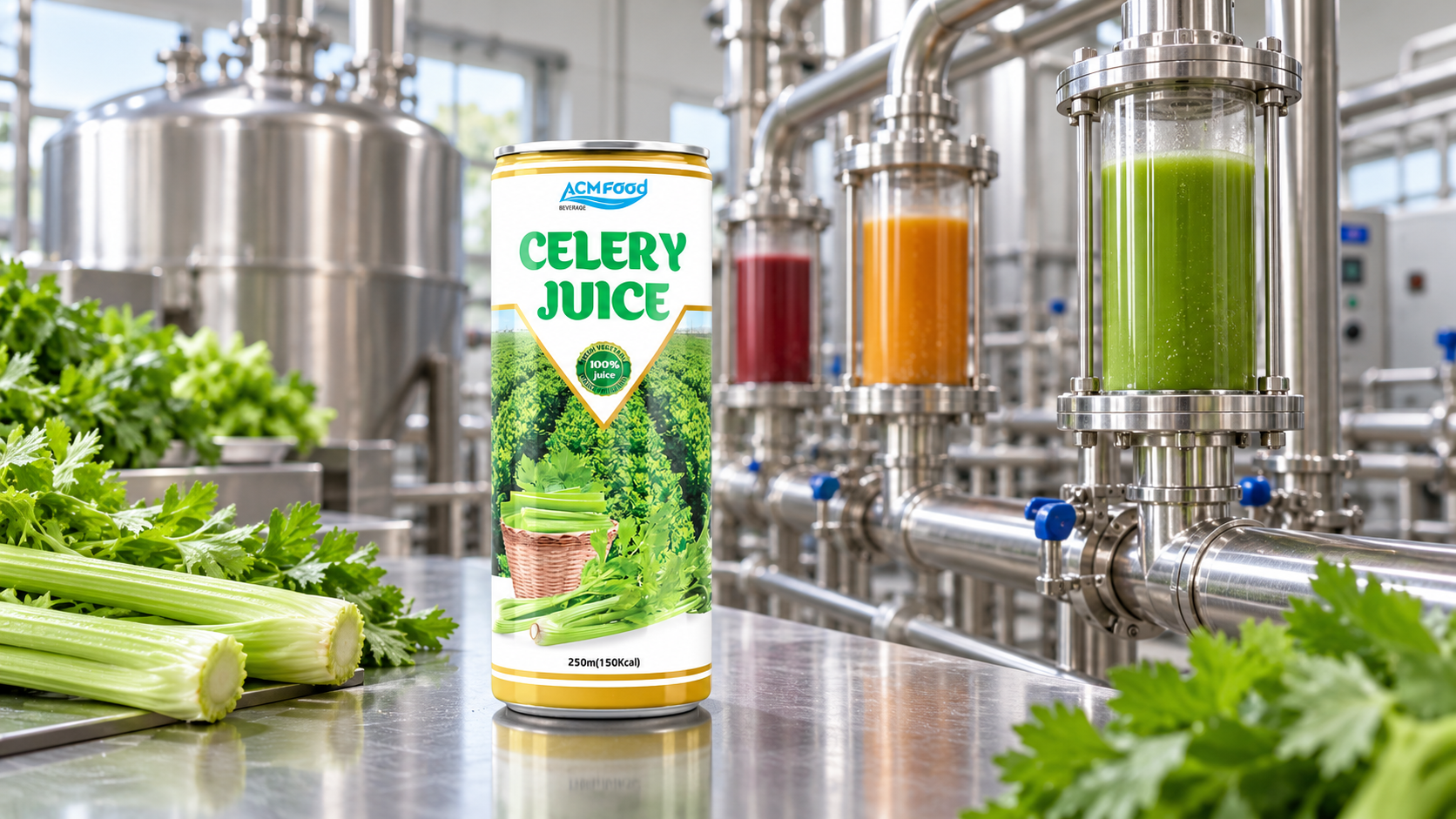
Stability is managed through controlled particle size, deaeration, acidity and packaging. Blends with carrot and tomato contain more suspended solids and can separate, while thin green blends can look watery, so each style needs its own physical stability approach.
- Cloud and sediment. Fine filtration or mild homogenisation keeps particles suspended.
- Oxidation. Deaeration and low headspace slow colour and flavour change.
- Light. Cans block light fully, and tinted or covered bottles reduce exposure.
- Temperature. Warm storage shortens quality life, so shipping and warehouse conditions matter.
- Stabilisers. If used, they must be permitted in the target market and declared on the label.
Which pack suits a celery vegetable blend?
Cans suit blends with delicate green colour, and bottles suit blends with strong carotenoid colour that benefits from being seen. A single recipe can run in both formats after the heat treatment is confirmed for each.
For single-serve products, a slim 250 ml can has a modern look and fits convenience channels. For households and foodservice, a larger PET bottle lowers the cost per litre. Whichever format is chosen, the shelf-life claim must come from tests on that exact pack.
How should a blend be scaled from bench to production?
Scaling a blend from bench to production means moving from small hand-mixed samples to large tanks with metered inline blending, and the main risk is that the taste, colour and pH drift during the transfer. A pilot run on the real line, with the real pack, is the safest way to confirm the recipe before commercial production.
- Bench trials. Several candidates are prepared in litre quantities and compared by tasting and measurement.
- Pilot batch. The winning candidate is produced in a small tank with production equipment, including deaeration, heat treatment and filling.
- Parameter check. Brix, pH, colour, viscosity and taste are compared with the bench sample, and any differences are corrected.
- Stability storage. Pilot packs are stored at ambient and warm conditions for the planned shelf life.
- Commercial run. The recipe is frozen, raw material specifications are agreed and batch records are prepared.
Raw material variation is the main reason for adjustment. A new season’s celery or tomato can shift the blend, so the specification should allow a defined tolerance, and the factory should record the adjustments made for each batch.
What labelling points apply to a vegetable blend?
The label must list the ingredients in order of weight, show the juice percentage where required and avoid claims that the recipe cannot support. A blend of several vegetables can be named by its dominant ingredient or by a descriptive name, depending on local rules.
- Ingredient order. Ingredients are listed from highest to lowest weight, and added acid, salt or sweetener must be included.
- Juice percentage. Some markets require a statement of the share of juice, and others restrict how the claim appears on the front of the pack.
- Naming. A name such as vegetable juice blend must match the composition, and a name that suggests a single vegetable should be avoided when another one dominates.
- Nutrition panel. Values should come from analysis of the finished drink, because natural variation changes sugars and sodium between batches.
- Allergen and additive declarations. Celery itself is a declared allergen in several markets, so any recipe containing celery must be checked against the destination rules.
The last point is easy to miss. Celery and celery products are listed as allergens in some jurisdictions, including the European Union, and a celery-based drink may need a clear allergen statement. Buyers should confirm the requirement for each market before artwork is finalised.
What should a blend brief include?
- Style. Green and fresh, sweet and rounded, savoury and bright, or balanced.
- Ingredient shares. Starting ratios for celery, carrot, tomato and cucumber, with tolerance.
- Taste targets. Sweetness, acid, salt and bitterness references.
- pH and process. Target pH and heat route agreed with the factory.
- Colour reference. An accepted range after storage.
- Pack. Can or bottle, size, closure and lining.
- Shelf life. Duration and storage conditions.
- Market and documents. Label wording, certificates and test reports needed.
A development example for another vegetable appears in the carrot juice OEM guide, and the same approach applies to blends.
FAQ about celery vegetable juice blends
Can celery be blended with fruit juices instead?
Yes. Apple and lemon are common partners, and they change the taste toward a lighter, fruitier profile. The blend should be named and labelled according to its composition.
Why add tomato to a celery blend?
Tomato adds acidity, savoury depth and a red colour. It also lowers the pH, which can help the process choice, though it moves the colour away from green.
Does the blend need added salt?
Often not, because celery has natural sodium and tomato adds savoury depth. If salt is added, it must be declared, and it affects low-sodium claims.
Is cucumber just water?
No. Cucumber adds a fresh aroma and a mild green tone, but it contributes little flavour intensity, so it is used for balance and dilution rather than for strength.
How many vegetables should a blend contain?
Two to four are common. More ingredients make consistency and labelling harder, so many brands choose a simple, clearly named blend.
Building a celery blend recipe
A celery vegetable blend works best when each ingredient has a clear job and the recipe is tested in the final pack. Taste, colour and pH change together, so small steps and good records are the best way to reach a stable, appealing drink.
Brands that want to develop a vegetable blend can send ACMFOOD a brief with style, ingredient shares, pack and markets. The team can propose starting recipes, plan samples and confirm the heat route.