


 Français
 Español
 العربية
 한국어
Fresh cucumber juice has a very short life: it starts to lose aroma and colour within hours and becomes unsafe to keep at room temperature almost immediately. Producing it at scale means turning that short-lived product into a stable one through speed, cleaning, heat treatment and packaging, while keeping as much of the fresh character as the process allows.
This guide explains how long cucumber juice lasts at each stage, which pasteurisation and filling routes extend its life, what changes when production grows from a juice bar to a factory and how packaging affects the result. ACMFOOD, a Vietnam beverage manufacturer, supplies finished drinks in cans and bottles under OEM, ODM and private label arrangements.
How long does fresh cucumber juice last?
Untreated cucumber juice lasts only a short time, usually a day or two under refrigeration, and it should not be left at room temperature. The exact period depends on hygiene, temperature and handling, so there is no safe single figure for every case.
Three things limit life:
- Microbial growth. Cucumbers carry soil organisms, and cucumber juice is a low-acid, watery medium where bacteria and yeasts grow when the temperature is not low enough.
- Oxidation. Contact with air darkens the juice and removes fresh aroma, and the colour moves from bright green to dull.
- Separation. Fine particles settle, and the juice looks less appealing even when it is still safe.
For a commercial product with weeks or months of life, each of these limits must be addressed through process design, not through hope that cold storage will be enough.
What stages does shelf life move through?
Shelf life moves from hours for untreated juice, to days for a refrigerated pasteurised product, to months for an acidified or sterilised pack stored at room temperature. Each step up requires more process control and usually costs some fresh taste.
| Stage | Storage | Life, in general terms | What makes it possible |
|---|---|---|---|
| Untreated fresh juice | Refrigerated | Very short, days at most | Clean raw material, immediate cooling |
| Chilled pasteurised | Refrigerated | Short, up to a few weeks depending on the process | Mild heat and cold chain |
| Chilled with high pressure processing | Refrigerated | Longer chilled life | Non-thermal treatment in flexible PET |
| Acidified and hot-filled or tunnel pasteurised | Ambient | Many months | Lowered pH, validated heat, sealed pack |
| Sterilised, retort or aseptic | Ambient | Many months | Commercial sterility and sealed pack |
The actual number of weeks or months must come from a study on the specific recipe and pack. The table shows the direction of change, not guaranteed values.
Why does cucumber juice need special care in pasteurisation?
Cucumber juice needs care because it is low in acid and low in solids, with a delicate aroma. Heat that is strong enough to make it safe also removes much of the fresh note, so the process is designed to use as little heat as safety allows.
Developers use four ideas to protect quality:
- Acidify first. Lowering the pH lets a milder heat step give safety, and lime juice adds aroma at the same time.
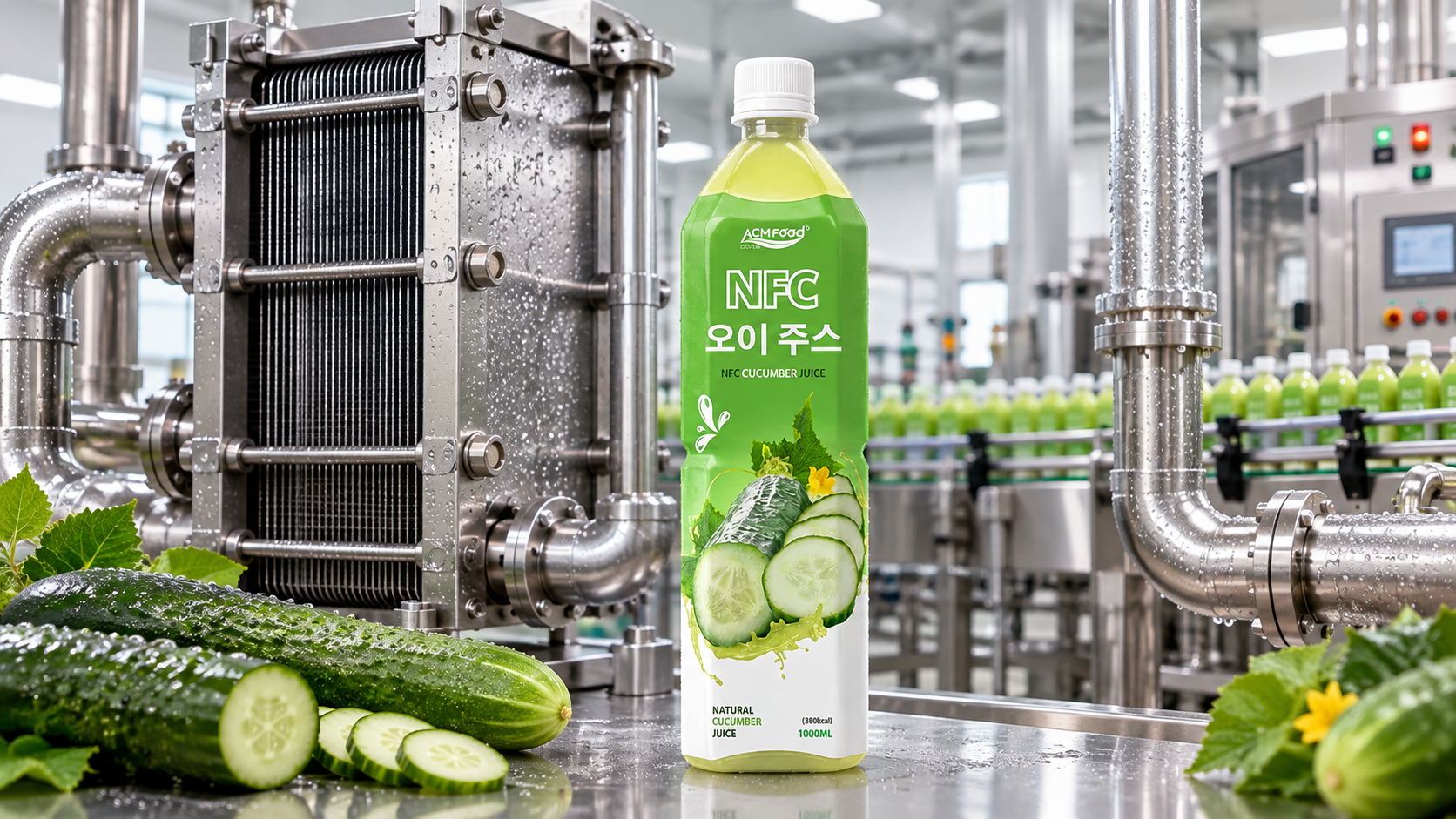
- Heat quickly. A plate heat exchanger brings the juice to temperature in seconds and cools it just as fast.
- Remove oxygen. Deaeration before heating reduces browning and flavour loss.
- Protect the final pack. Light-blocking cans or tinted bottles and good closures hold the result after filling.
The process authority or the factory’s food safety team sets the minimum heat and acidity. A recipe change, even a change in lime juice share, can alter the requirement.
What changes when production moves to scale?
At scale, time becomes the main risk. A juice bar makes a glass in minutes, while a factory handles tonnes of cucumbers, tanks, pipes and filling lines, and any waiting time between extraction and heating lets quality fall and microbes grow.
- Batch size and throughput. Press capacity and heat exchanger capacity must match so that juice does not wait in tanks.
- Intermediate cooling. If juice must be held, it is cooled quickly and kept cold, with a maximum hold time in the procedure.
- Cleaning in place. Tanks, pipes and filler lines are cleaned on a schedule, with verification such as swab tests.
- Raw material planning. Cucumbers arrive in a limited window and cannot be stored for long, so deliveries and processing need to be scheduled together.
- Filler speed. A fast filler can create bottlenecks if it stops, so buffer tanks and stop procedures are designed in advance.
- Quality sampling. Taste and measurement checks are repeated through the run, not just at the start.
Which filling and packaging options suit cucumber juice?
Hot-fill into heat-set PET or glass, tunnel pasteurisation of cans or bottles, aseptic filling into PET or glass, and retort in cans are the four main options. The choice depends on recipe pH, target shelf life and the pack style the brand wants.
- PET bottles. Light, practical, available in family sizes such as 1L. Hot-fill needs a heat-set design, and long storage benefits from an oxygen barrier.
- Glass bottles. Premium and a strong barrier. Heavier and breakable.
- Aluminium cans. Full light barrier and strong stacking, with a lining suited to a vegetable drink.
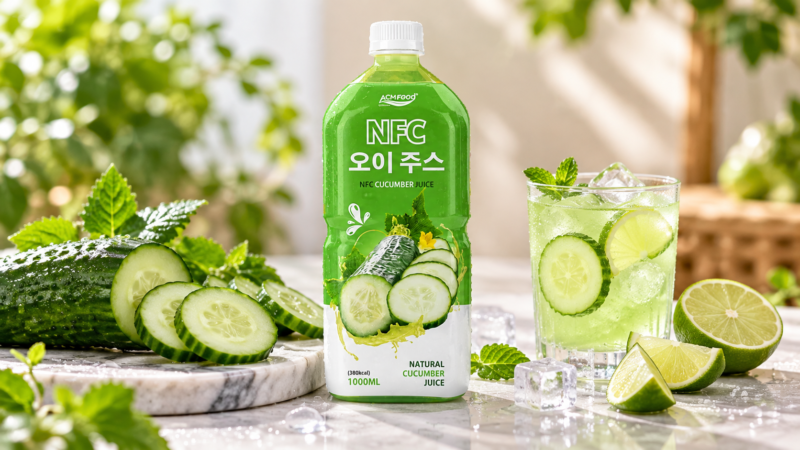
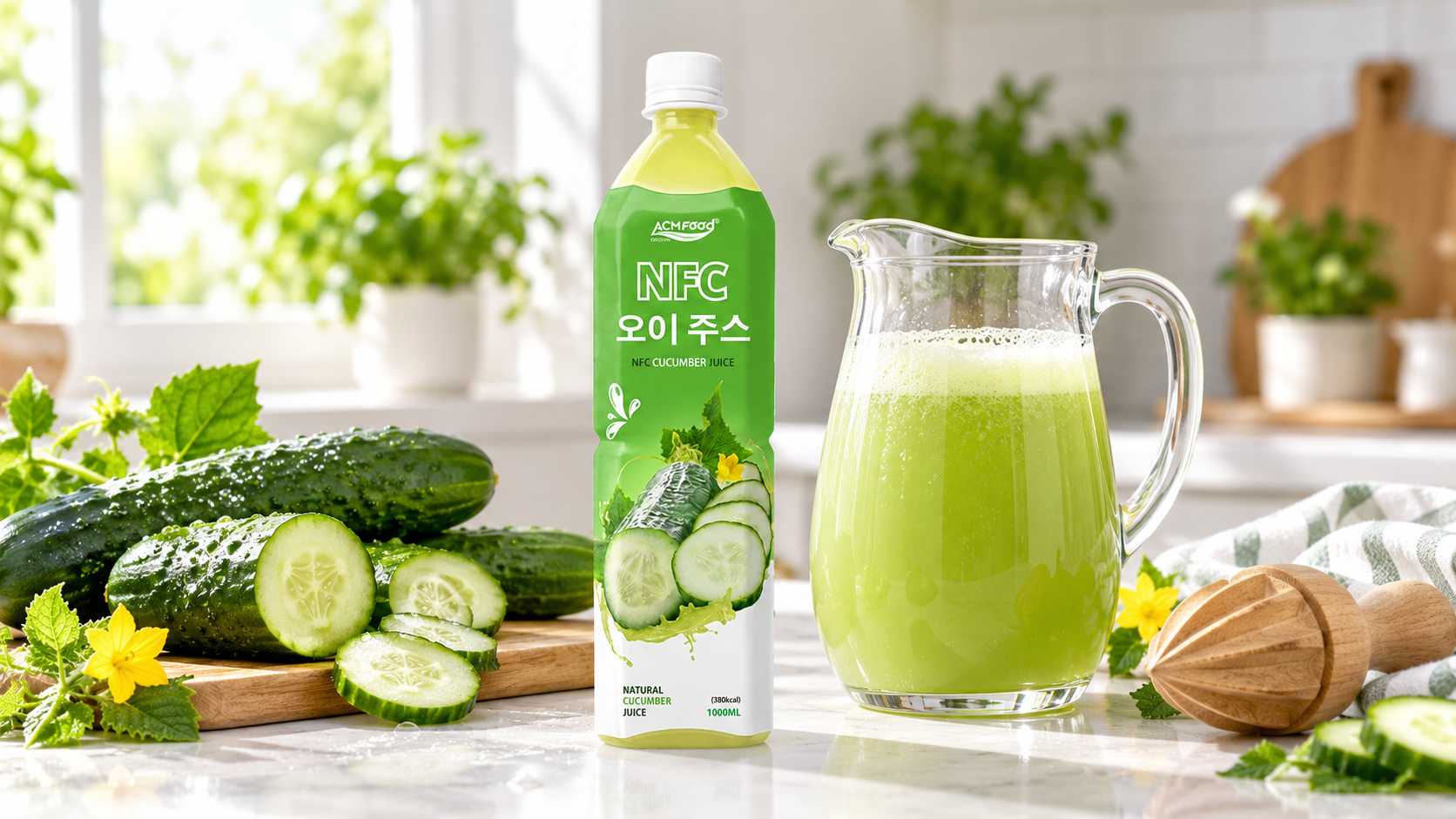
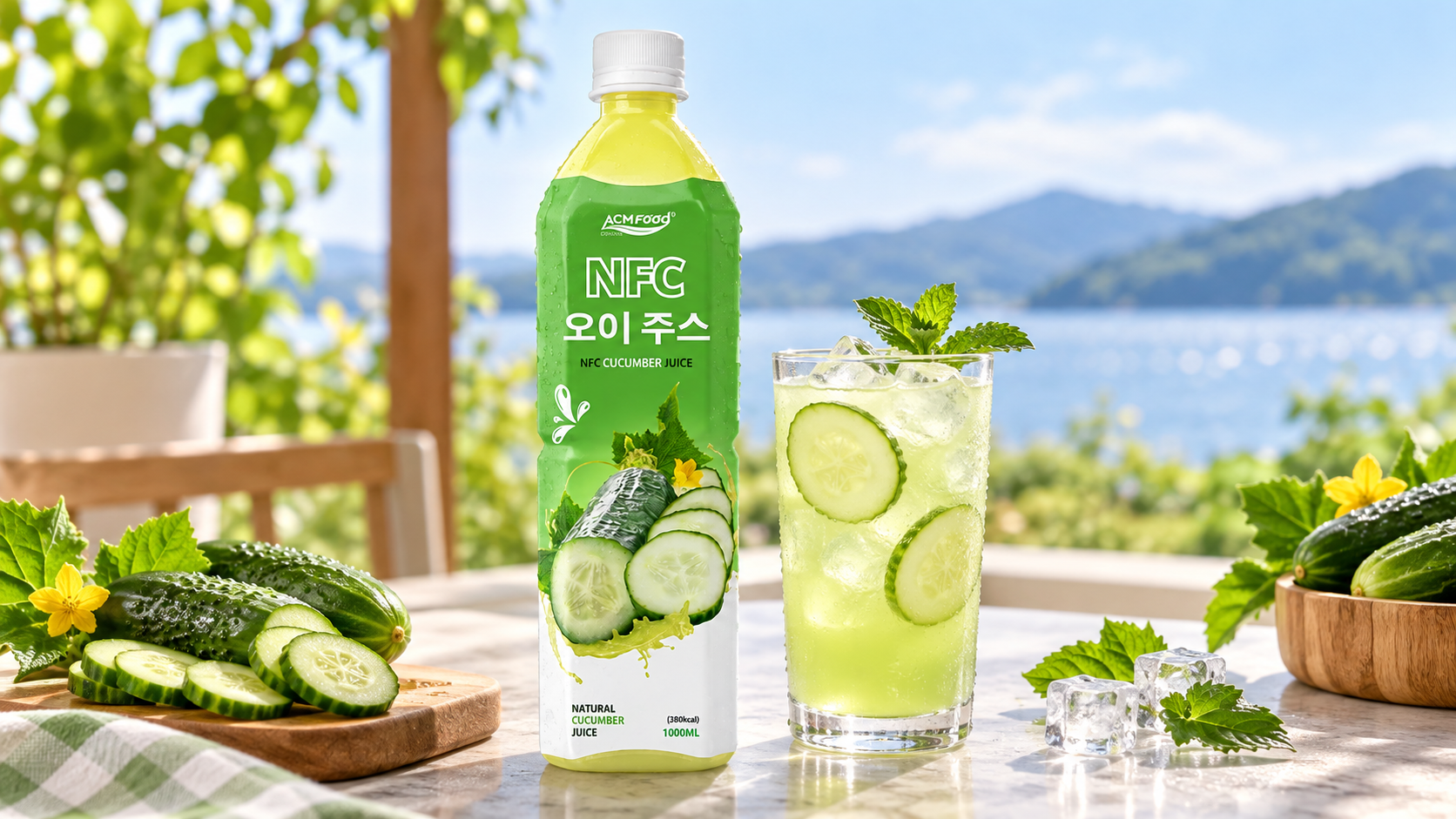
ACMFOOD currently offers a 1L NFC cucumber drink in a PET bottle, and other formats can be discussed as a development project. Product formats are listed in the cucumber juice category.
What hygiene risks does cucumber carry?
Cucumbers grow close to the ground, are often irrigated and are eaten raw, so they can carry soil bacteria, faecal indicator organisms and spoilage yeasts. Because the juice has no strong natural barrier, a factory has to treat hygiene as part of the recipe.
- Water quality. Washing water must be potable, with a sanitiser level checked at set intervals.
- Surface sanitising. A wash step with an approved sanitiser lowers surface microbes before crushing.
- Cross-contamination. Raw receiving areas are separated from the pressing and filling zones, and staff movement follows a defined route.
- Equipment cleaning. Presses, screens and conveyors are cleaned frequently because plant residues grow microbes quickly.
- Supplier controls. Growers are assessed for water source, manure use and harvest hygiene.
These measures belong in the HACCP plan, and a supplier that holds HACCP, ISO 22000 or FSSC 22000 certificates, as ACMFOOD publishes, has a documented system for them. The heat step then deals with whatever remains, but it works best when the incoming load is low.
How is fresh aroma preserved as far as possible?
Fresh aroma is preserved by working fast, keeping oxygen out, using the mildest safe heat and adding natural flavour support. No process keeps all of the raw cucumber aroma, so the goal is a product that still reads as fresh when it is opened.
- Pressing and heating within minutes. Minimising the wait between extraction and heating slows enzyme-driven change.
- Cooling juice immediately if any hold is unavoidable, with a maximum hold time written in the procedure.
- Deaeration under vacuum to remove dissolved oxygen before the heat step.
- Short-time heating and fast cooling in a plate heat exchanger.
- Aroma support from lime, mint or melon where the brand’s concept allows.
- Low-oxygen filling and a closure that does not let air in.
The tasting panel should always evaluate the heat-treated and stored sample, not the freshly pressed one. A drink that looks good only on the day of production will disappoint buyers and consumers a few months later.
How does temperature history change shelf life?
Temperature history changes shelf life because chemical and biological changes speed up as the product gets warmer. A pack that spends weeks in a hot warehouse or container ages faster than one kept cool, even when it was perfectly made.
For a shelf-stable cucumber drink, the key points are:
- Before shipping. Finished goods should be stored in a cool, dry warehouse, away from direct sun.
- During transport. Containers on deck in warm regions reach high internal temperatures, so lanes, seasons and container types matter.
- At the importer. Clean, cool storage and first-in-first-out rotation keep older stock from reaching the shelf.
- At the shop. Chilled display improves the experience, but a shelf-stable product should not depend on it.
A stability study that includes a warm storage arm shows how much margin a product has. Buyers should compare the claimed shelf life with the real conditions their shipments will meet and ask the supplier to confirm the match in writing.
What does a scale-up checklist look like?
A scale-up checklist turns a successful bench recipe into a repeatable factory process. It lists the points that must be confirmed before the first commercial batch, so that nothing depends on memory or a single expert.
- Raw material specification signed by the supplier, including bitterness limit and freshness.
- Recipe sheet with ingredient quantities, acid dose and tolerances.
- Process flow with times, temperatures and maximum hold times.
- Validation report for the heat step at the final pH and pack.
- Cleaning schedule and verification method.
- Quality plan with sampling points and acceptance limits.
- Packaging specification for the can or bottle, closure and carton.
- Stability study plan with sample numbers and test dates.
How is shelf life verified for a commercial product?
Shelf life is verified through a stability study on production samples stored at ambient and warm conditions, with scheduled checks of taste, colour, pH, Brix and microbiology. The end of shelf life is set at the point where any parameter leaves its limit, with a safety margin.
- Define the limits. Colour range, taste scores, pH, microbial limits and sediment level.
- Store the samples. At the claimed storage temperature and at a warmer temperature that speeds up change.
- Test at intervals. Early and frequent at first, then spaced out.
- Record and decide. Results are plotted, and the shelf life is set below the point where limits were crossed.
- Keep retained samples. Samples from commercial batches are kept for later reference.
Buyers should ask for the summary of this study, including the storage conditions it relied on.
FAQ about cucumber juice shelf life
Can homemade cucumber juice be kept for a week?
It is not advisable. Untreated juice should be consumed quickly and kept cold. A week is outside the safe range for a juice with no heat or acid treatment.
Does lime juice extend the life of cucumber juice?
It lowers the pH, which helps, but a small amount does not make an unheated juice safe for long storage. Shelf-stable products combine acid with a validated heat step.
Is HPP the same as pasteurisation?
No. HPP uses pressure instead of heat. It still needs refrigeration for a low-acid juice like cucumber.
Why do some cucumber drinks taste cooked?
Heat removes fresh aroma compounds. Manufacturers use lime, mint and rapid heating to reduce the effect, but a trace of cooked note often remains.
Which pack gives the longest shelf life?
Cans and glass give the strongest barrier, while PET with an oxygen barrier can also perform well. The heat route and the sealed closure matter as much as the material.
Scaling cucumber juice with confidence
Fresh cucumber juice cannot simply be scaled up. It needs speed, hygiene, a heat route matched to a low-acid vegetable and a pack that protects colour and aroma. Shelf life is the result of these decisions, confirmed by a stability study.
Brands that want to move from a fresh concept to a shelf-stable product can share their recipe and target shelf life with ACMFOOD. The team can recommend a route in cans or bottles and prepare samples for testing.