


 Français
 Español
 العربية
 한국어
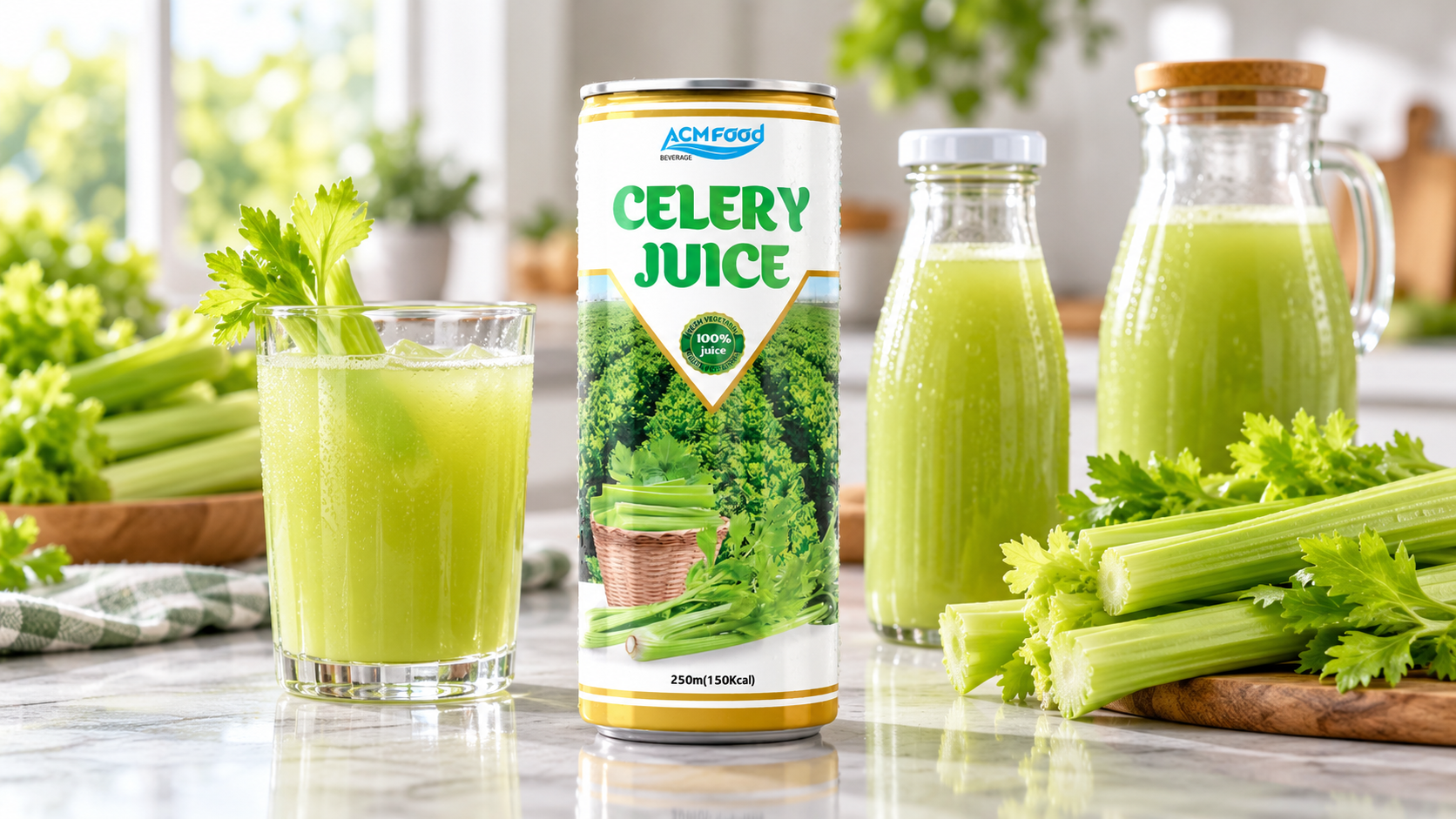
Bottled celery juice is celery juice that has been heat treated and filled into PET or glass bottles so it can be shipped and stored. Because celery is a low-acid, oxygen-sensitive vegetable, the pasteurisation route, the bottle material and the closure together decide how long the drink stays safe and keeps its colour and flavour.
This guide covers the heat treatment options for bottled celery juice, how PET and glass compare, how oxygen and light are controlled and what shapes shelf life. It is written for brand owners who need to brief a manufacturer clearly. ACMFOOD, a Vietnam beverage manufacturer, supplies finished drinks in bottles and cans under OEM, ODM and private label arrangements.
What makes bottled celery juice different from other bottled juices?
Bottled celery juice differs because it is low in acid, low in sugar and highly sensitive to oxygen. Most fruit juices have a pH below 4.0 and are protected by their own acidity, while celery juice sits well above 4.6 and needs a deliberate process to be safe and stable on a shelf.
- Low acidity. Celery juice cannot rely on its own pH. Safety must come from acidification, sterilisation or refrigeration.
- Thin body. The juice is mostly water, so flavour defects and oxygen effects are easy to notice.
- Delicate colour. Chlorophyll browns under heat and acid, and the pale green tone changes over time.
- Savoury profile. Natural sodium and celery aroma give a savoury impression that does not tolerate off-flavours from packaging or oxidation.
These traits are why celery needs technical attention in bottle selection and in process design, rather than the standard fruit juice approach.
Which pasteurisation routes are used for bottled celery juice?
The main routes are acidified hot-fill, tunnel pasteurisation, aseptic filling and chilled pasteurisation. The choice depends on whether the product must be stored at room temperature, on the bottle material and on the acidity the recipe can tolerate.
| Route | How it works | Storage | Main trade-off |
|---|---|---|---|
| Acidified hot-fill | pH is lowered, juice is filled hot, bottle is closed and held | Ambient | Acid changes taste and colour; bottle must tolerate heat |
| Tunnel pasteurisation | Filled bottles pass through heating and cooling zones | Ambient for acid or acidified recipes | Longer heat on the bottle contents |
| Aseptic filling | Juice is sterilised by short high heat, cooled and filled into sterile bottles | Ambient | Needs aseptic line and strict hygiene |
| Chilled pasteurisation | Moderate heat, then cold chain | Refrigerated, short life | Cold logistics required |
A recipe pH below the safety limit makes hot-fill and tunnel pasteurisation possible. Without acidification, the juice needs an aseptic or sterilising route, or must be kept cold. The factory’s process authority sets the exact values, and a recipe change usually requires revalidation.
Why does oxygen matter so much for celery juice?
Oxygen matters because it drives browning and flavour change. Dissolved oxygen in the juice, air in the headspace and oxygen that passes through the bottle wall or closure all attack chlorophyll and aroma compounds, and the effect shows up as a duller colour and a stale taste.
Control starts before filling and continues in the pack:
- Deaeration. A vacuum step removes dissolved air from the juice before heating and filling.
- Low headspace. Filling close to the neck leaves little air in the bottle. In hot-fill, the cooling juice contracts and creates a vacuum that further limits oxygen.
- Nitrogen flushing. Where used, nitrogen displaces air from the headspace before capping.
- Closure liner. A good liner and a correctly applied cap reduce ingress through the closure.
- Bottle barrier. Glass is almost impermeable, PET passes small amounts of oxygen, and barrier or scavenger layers lower that rate.
When a supplier proposes a bottle, ask for the oxygen transmission rate of the bottle and the closure. Together with the shelf-life target, it tells you whether the pack is suited to the product.
PET or glass: which is better for celery juice?
PET is lighter and safer to ship, while glass offers the strongest barrier and tolerates hot filling easily. For a short to medium shelf life PET works well, and for a premium or long shelf-life product glass often gives a better result.
- PET. Low weight, lower freight cost, shatter resistance and flexible shapes. Hot-fill requires heat-set PET, and oxygen protection needs attention for long storage.
- Glass. Strong barrier, premium look, high heat tolerance. Weight and breakage raise logistics cost and risk.
- Tinted material. Amber or green glass and tinted PET cut light exposure, which helps hold the colour of a pale green juice.
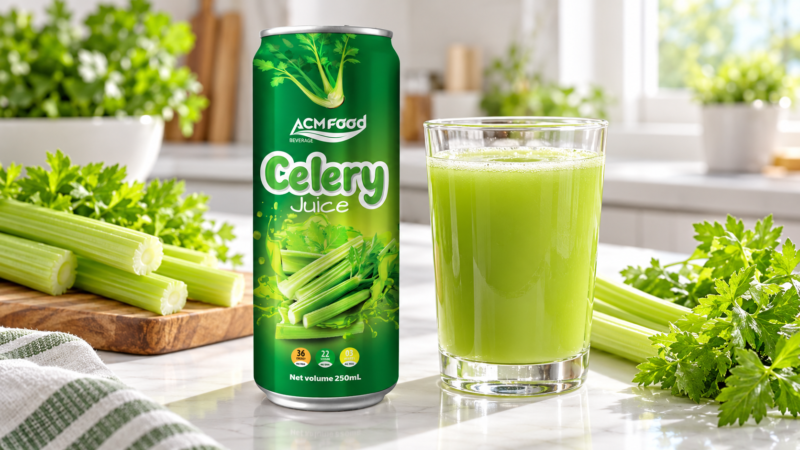
Cans are also an option for celery juice and give full light protection, as described in other ACMFOOD vegetable drink guides, but this article concentrates on bottles. Current vegetable drink formats are listed in the celery juice category.
How do bottle size and closure affect quality?
Size and closure affect quality because they control the amount of air a bottle contains and how well it reseals after opening. A smaller bottle is finished faster and exposes the juice to less oxygen after opening, while a larger bottle needs a closure that reseals reliably.
- Single-serve bottles. Suit on-the-go and trial use. Less juice is exposed to air after opening.
- Family sizes. Cost less per litre but demand a quality cap and clear storage advice after opening.
- Tamper-evident caps. Provide a visible sign that the bottle has not been opened, which supports safety and consumer trust.
- Neck finish. Must match the cap, the hot-fill requirement and the filling line.
- Liner material. Chosen for oxygen barrier, flavour neutrality and resistance to heat.
What affects the shelf life of bottled celery juice?
Shelf life depends on the heat route, recipe pH, oxygen control, light protection and storage temperature. A figure applies only to the exact recipe, bottle and storage condition tested, so it must come from a stability study and not from a different product.
A practical stability plan stores bottles at ambient and warm conditions and checks colour, pH, taste, sodium and microbiology at set intervals. The end of shelf life is defined by the point at which colour or flavour falls outside the agreed limits, or by microbiological limits, whichever comes first. Buyers should ask for the study summary and a statement of the storage conditions on which the claim relies.
How is hot-fill temperature controlled?
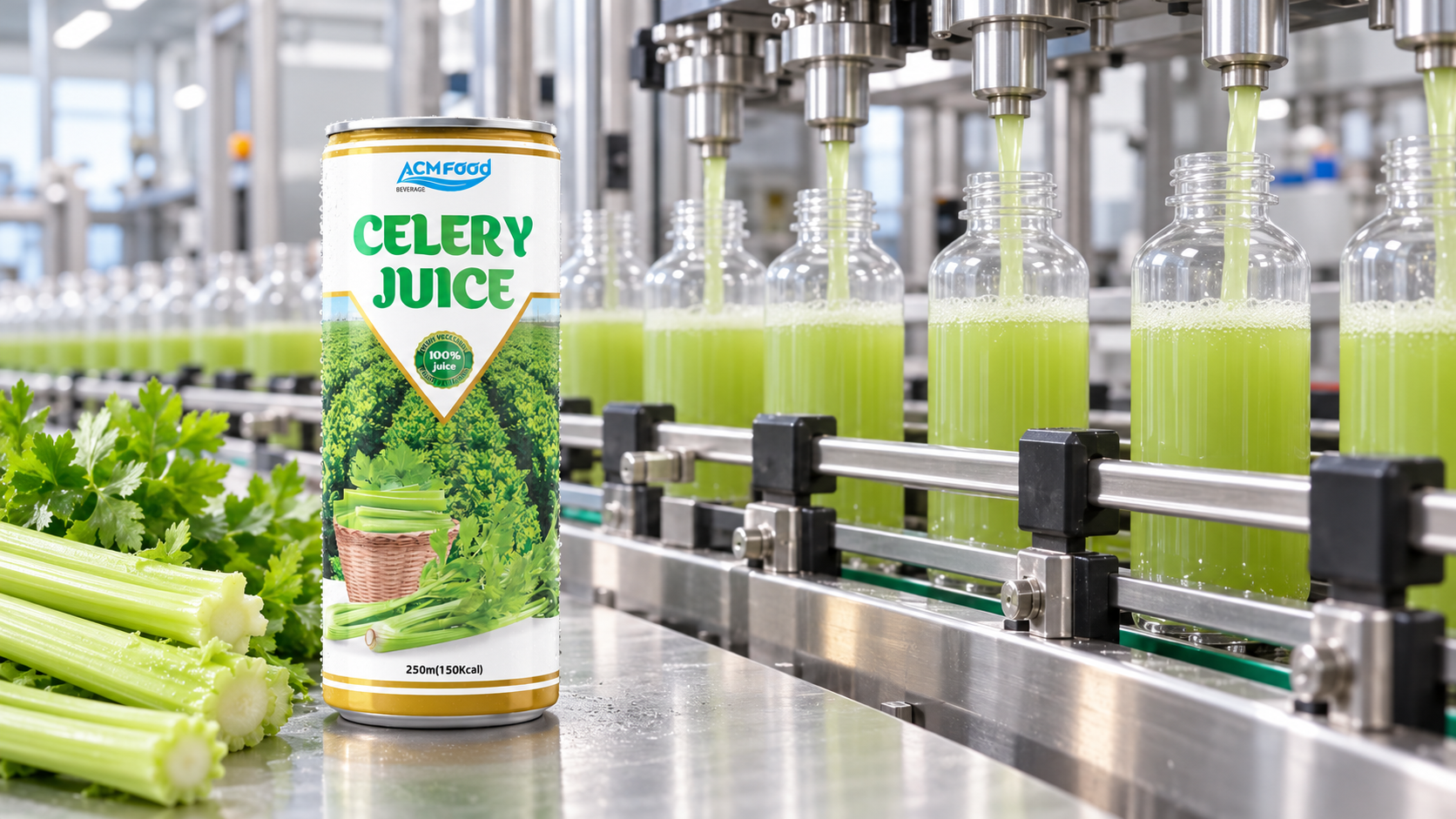
Hot-fill temperature is controlled by monitoring the juice temperature at the filler and verifying it at the capper, because the heat of the juice is what sterilises the bottle interior and the closure. If the juice cools below the validated value before capping, the process is no longer valid and the batch must be held.
- Heat exchanger outlet. The juice leaves the heater at a set temperature, which is recorded continuously.
- Filler temperature. A sensor at the filler confirms the juice has not lost too much heat along the pipe.
- Hold time. Bottles are held, and in some systems inverted, for a defined time so the hot juice contacts the entire inner surface and cap.
- Cooling. A controlled cooling tunnel brings bottles down gradually to avoid stress and deformation.
- Alarm and hold rule. Any drop below the limit triggers an alarm, and the affected bottles are isolated and reviewed.
Heat-set PET bottles are designed to resist these temperatures, but they can still deform if the fill temperature rises above their design or cooling is too fast. For this reason a bottle should be qualified on the actual line, not on a data sheet alone.
How are bottle closures tested?
Closures are tested by measuring cap torque, checking the liner and sealing surface, and running leak and vacuum tests on samples from each batch. A weak closure lets in oxygen and microbes, so the test results are as important as the heat step.
- Application torque. The force used to apply the cap is checked at regular intervals, because both loose and overtight caps cause problems.
- Removal torque. Confirms the consumer can open the bottle and that the tamper band behaves as designed.
- Vacuum or pop-up check. For hot-fill, a slight vacuum after cooling shows a good seal.
- Leak test. Bottles are inverted or pressurised in a test to detect leaks at the neck.
- Visual inspection. Cap position, liner and tamper band are checked on the line.
Records of these checks, tied to batch numbers, show whether a complaint relates to the product or to the pack, and they are part of a typical supplier audit.
What logistics issues affect bottled celery juice?
Logistics issues come mainly from heat, light and handling. Long sea freight through warm regions can speed up colour change in a pale green juice, and rough handling can damage caps and necks, so shipping conditions should be part of the shelf-life discussion.
- Container temperature. Dark containers sitting in warm ports reach high temperatures, so shipping lanes and season matter.
- Carton protection. Strong cartons and dividers protect glass bottles, and well-designed trays hold PET bottles upright.
- Pallet stability. Stretch wrapping and corner protection stop leaning and crushed cartons.
- Light exposure. Cartons keep bottles in the dark in transit, while retail displays put them under strong light.
- Stock rotation. First-in-first-out handling at the importer keeps older stock from reaching the shelf.
Buyers can ask the supplier for suggested storage guidance and include it in the supply agreement, so each party knows who is responsible for conditions at each stage.
What should a bottled celery juice brief include?
- Product style. Pure celery juice, blend with apple, cucumber or lemon, or a lighter drink.
- Storage target. Ambient or refrigerated, and the number of months required.
- Heat route. Hot-fill, tunnel or aseptic, confirmed by the factory.
- Bottle. PET or glass, size, colour, neck finish and barrier requirement.
- Closure. Cap type, liner and tamper evidence.
- Quality targets. Colour reference, sodium level, Brix and pH ranges.
- Market and label. Destination country, language and claim wording.
- Documents. Specification, certificate of analysis and certificates such as HACCP, ISO 22000 or FSSC 22000.
FAQ about bottled celery juice
Can bottled celery juice be stored at room temperature?
Yes, if it is acidified and hot-filled, tunnel pasteurised in a validated process or sterilised and aseptically filled. A mild pasteurisation without these steps requires refrigeration.
Why does celery juice need acidification for hot-fill?
Because celery is a low-acid vegetable, and without lower pH, spore-forming bacteria could grow in the sealed bottle at room temperature.
Is glass always better for celery juice?
No. Glass offers a stronger barrier, but PET is lighter and cheaper to ship. The right choice depends on shelf-life target, market and brand positioning.
Will the colour stay green?
It will usually shift toward olive over time. Heat, acid and oxygen influence the rate, and fast processing, deaeration and a light barrier slow the change.
How should opened bottles be stored?
In a refrigerator, closed, and consumed within the period stated on the label. Opened celery juice is no longer protected by the factory process.
Is celery a labelled allergen?
In several markets, including the European Union, celery is on the list of allergens that must be declared, and a celery juice product may need a clear allergen statement. Brands should confirm the rule for each destination before the label is finalised.
Choosing a bottle format for celery juice
Bottled celery juice needs a validated heat route, strong oxygen control and a bottle and closure that protect colour and flavour. PET suits most mainstream uses, glass suits premium or long-life products, and every recipe change should trigger a review of the process.
Brands that want to develop a bottled celery drink can share a brief with ACMFOOD covering style, bottle, storage target and market. The factory can then propose a route and plan samples for evaluation.