


 Français
 Español
 العربية
 한국어
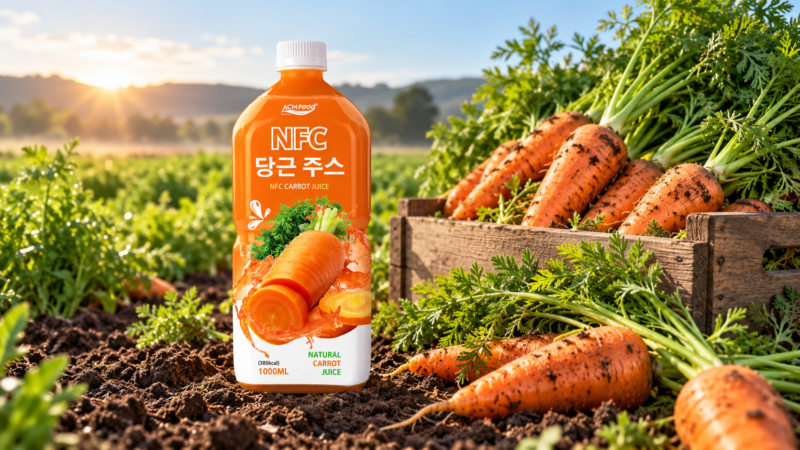
Pasteurized carrot juice is carrot juice heated for a controlled time and temperature to destroy spoilage organisms and enzymes, then filled into bottles. The exact heat route decides whether the bottle can sit at room temperature or must stay cold, and carrot’s low acidity makes that decision more important than it is for fruit juice.
This article explains the main heat treatment routes, how carrot’s chemistry shapes them, what drives shelf life and how PET and glass bottles compare. It is written for brand owners and buyers who need to brief a manufacturer clearly. ACMFOOD, a Vietnam beverage manufacturer, supplies finished drinks in bottles and other formats under OEM, ODM and private label arrangements.
What does pasteurized carrot juice mean?
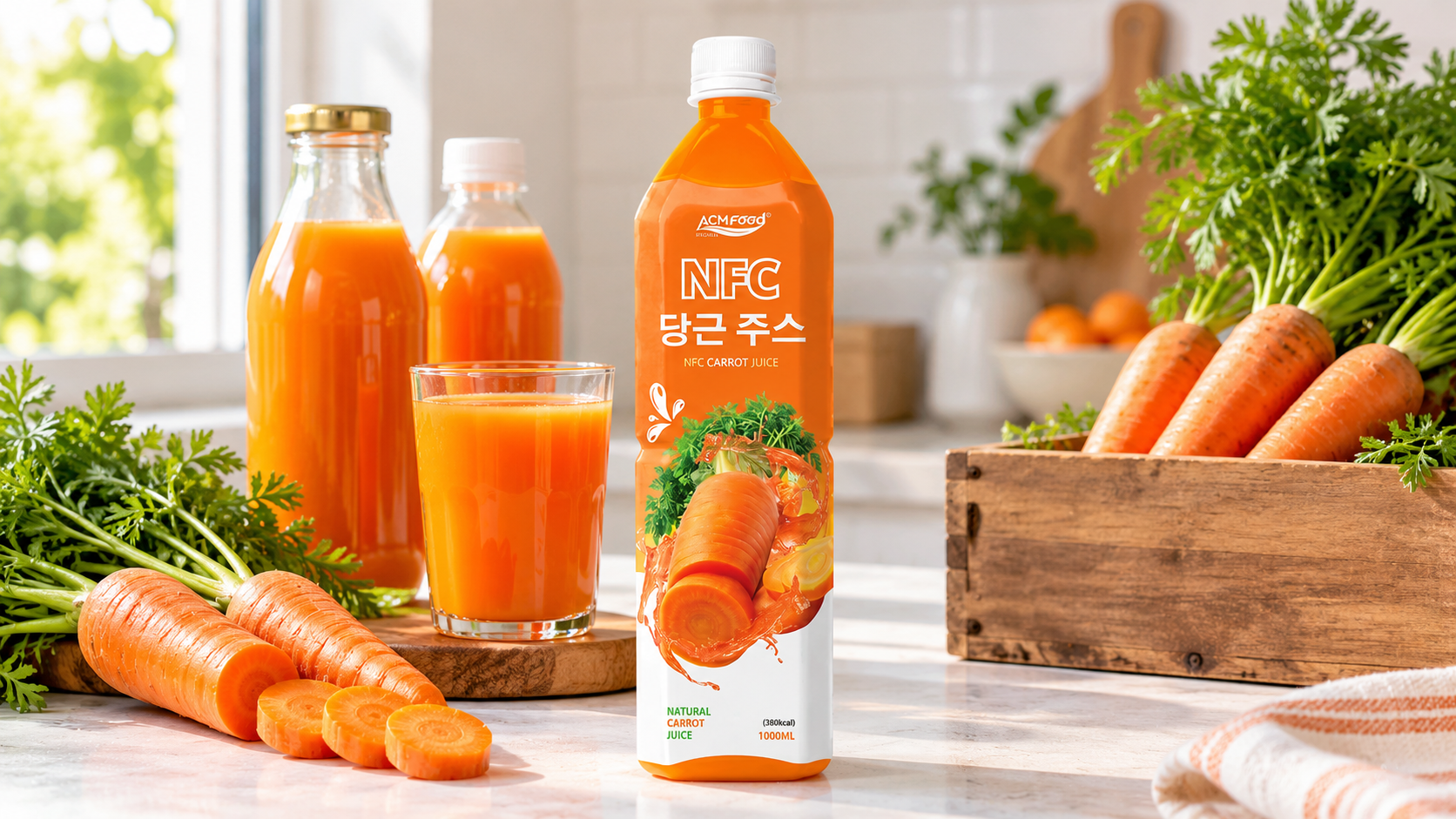
Pasteurized carrot juice is juice that has gone through a heat step designed to reduce microorganisms to a safe and stable level. The term does not describe one single temperature, since several time and temperature combinations are used, and it does not by itself say whether the product is chilled or shelf stable.
Three ideas are often confused:
- Pasteurisation. A moderate heat step, often followed by cold storage. It protects safety and extends shelf life for a chilled product.
- Sterilisation or commercial sterility. A stronger heat step that allows storage at room temperature for months.
- Raw or cold-pressed juice. Juice with no heat step, kept cold and consumed quickly. It is outside the scope of this article.
For export, most buyers need shelf-stable or at least long-life chilled bottles, so the technical discussion usually concerns hot-fill, tunnel pasteurisation and aseptic filling.
Why does carrot juice need careful heat treatment?
Carrot juice needs careful heat treatment because carrots are a low-acid vegetable. Their juice has a pH above 4.6, the usual boundary under which most dangerous spore-forming bacteria cannot grow, so mild pasteurisation alone cannot make an unacidified carrot juice safe at room temperature.
The challenge has three sides:
- Safety. Spores of certain bacteria survive pasteurisation temperatures and can grow in a low-acid juice if it is stored warm. The process must either lower the pH or reach a sterilising effect.
- Enzymes. Carrots contain enzymes that break down structure and affect cloud stability. Heat inactivates them, and the timing affects viscosity and sedimentation.
- Quality. Heat gives carrot juice a cooked flavour and can dull aroma. Carotenoid colour is comparatively heat stable, but taste and freshness are not.
The aim of process design is to deliver a safe product with as little loss of quality as possible, and that is why several different routes exist.
Which heat treatment routes are used?
The main routes are hot-fill of an acidified juice, tunnel pasteurisation of filled bottles, aseptic filling of sterilised juice and chilled pasteurisation. The table compares them in general terms, and the right choice depends on recipe pH, bottle type and target markets.
| Route | How it works | Suits | Points to watch |
|---|---|---|---|
| Acidified hot-fill | Juice pH is lowered, then filled hot and the bottle is closed and held | Carrot blends with apple, orange or lemon; glass or heat-set PET | Taste changes with added acid; bottle must tolerate temperature |
| Tunnel pasteurisation | Filled, closed bottles pass through heating and cooling zones | Acid or acidified recipes in glass or PET | Gradual temperature steps to avoid bottle stress |
| Aseptic filling | Juice is sterilised by short high heat, cooled and filled into sterile bottles | Unacidified carrot juice in PET or glass | Needs aseptic line, strict hygiene and validation |
| Chilled pasteurisation | Moderate heat followed by cold storage | Short-life refrigerated products | Cold chain required, limited export range |
The route has to be validated by the factory or a process authority, because it depends on the exact recipe, the fill temperature, the hold time and the bottle design. A recipe change, even a small one, can require re-validation.
How does the acidified hot-fill route work for carrot juice?
In acidified hot-fill, the carrot juice is blended or adjusted with an acidulant until its pH falls to a safe level, heated, filled hot into bottles and closed. The hot juice sterilises the inside of the bottle and the cap area, and the bottle is held or inverted for a short time before cooling.
Acidification changes the taste, so developers often use a blend: carrot with apple, orange or lemon juice. The added juice contributes sweetness and flavour, which balances the acid. Because the heat exposure is short, the colour and the sweet carrot taste remain fresh. The limits are the bottle and the closure: glass handles hot filling well, while PET needs a heat-set design that does not deform.
When is aseptic filling the better route?
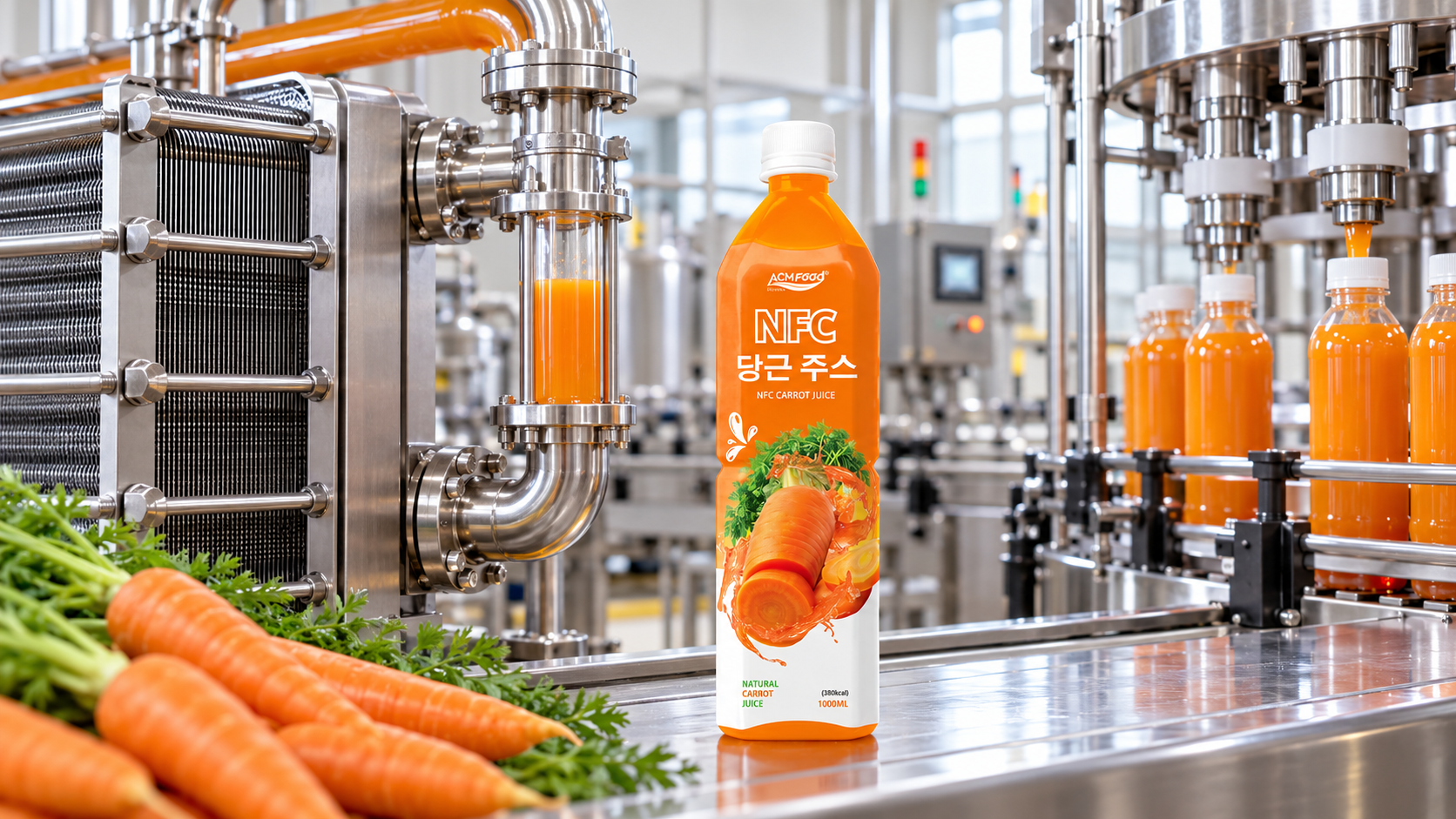
Aseptic filling is better when a brand wants a plain, unacidified carrot juice that stays stable at room temperature. The juice is heated to a sterilising level for a very short time, cooled and filled into pre-sterilised bottles in a clean environment, which preserves more flavour than a long sterilisation in the pack.
The trade-offs are investment and discipline. Aseptic lines need sterile air, sterile packaging and strict hygiene, and their validation and monitoring requirements are high. For brands, the benefit is a product that looks and tastes closer to fresh carrot juice with a long ambient shelf life. A related discussion of non-acidic formulations is available in the guide to clean label juice formulation.
What affects the shelf life of pasteurized carrot juice?
Shelf life depends on the route, the recipe pH, the bottle barrier, the closure and the storage temperature. There is no single figure that applies to every bottle, so the number printed on the label must come from stability studies on the exact product.
- Heat route. Sterilised products can last for many months at room temperature, while chilled pasteurised products last for days or weeks under refrigeration.
- Oxygen. Dissolved oxygen and headspace oxygen reduce flavour and colour over time. Deaeration and low headspace help.
- Light. Carotenoids fade slowly under strong light, so clear bottles on bright shelves lose colour faster than closed cartons.
- Closure quality. A well-sealed cap and liner prevent air ingress and leakage.
- Storage temperature. Warm storage speeds up all quality changes and increases the risk of spoilage if the heat step was marginal.
- Sedimentation and cloud. Carrot particles settle with time. This is normal, but it should be explained on the label or managed through homogenisation.
How do PET and glass compare for carrot juice?
PET is lighter and cheaper to ship, while glass is a stronger barrier to oxygen and tolerates hot filling more easily. Both can carry pasteurised carrot juice successfully, and the choice depends on the sales channel and the shelf-life target.
- PET. Light, shatter resistant, available in many sizes and good for e-commerce and foodservice. Hot-fill needs a heat-set bottle, and long storage may need an oxygen barrier layer.
- Glass. Premium image, excellent barrier and good heat resistance. It is heavy, and breakage and freight cost are higher.
Whatever the material, clear packaging shows the bright orange colour that consumers associate with fresh carrot. For long storage, tinted or well-covered labels reduce light exposure.
How are cloud and viscosity managed in carrot juice?
Cloud and viscosity are managed through enzyme control, particle size and, where needed, homogenisation. Carrot juice naturally holds fine particles in suspension, and a stable cloud looks fresh and full-bodied, while a juice that separates into clear liquid and sediment looks old even when it is perfectly safe.
Three tools are common. Heat inactivates pectin-degrading enzymes early in the process, which keeps the structure of the juice stable. Fine filtration or particle reduction produces a uniform texture and slows settling. Homogenisation under pressure breaks particles into smaller sizes that stay suspended longer. Each tool changes mouthfeel, so the developer matches the texture to the target consumer: a thick, rustic carrot juice or a smoother, lighter one.
Stability tests should include simple observations of sediment height after several weeks and after transport vibration, since a shipment can shake a bottle for weeks before it is placed on a shelf.
Which quality checks follow a pasteurisation step?
A pasteurisation step is verified by temperature records, microbiological tests and checks on finished bottles. These checks prove that the heat treatment reached its target and that the bottle stayed sealed afterward.
- Temperature and time logs. The heat exchanger or tunnel records the actual values for each batch, and deviations trigger a hold on the product.
- Fill temperature at the filler. For hot-fill, the juice must still be at or above the specified temperature when the cap is applied.
- pH and Brix. They confirm that the recipe matches the validated formulation, especially for acidified products.
- Microbiological tests. Samples from the batch are incubated and checked for growth, often with a hold period before release.
- Closure and seal checks. Cap torque, liner position and leak tests verify that nothing can enter after filling.
- Retained samples. Samples are stored to check colour, flavour and sediment at the end of the declared shelf life.
These controls are normally written into a HACCP plan, which identifies the heat step and the closing step as critical. Suppliers working under HACCP, ISO 22000 or FSSC 22000 are used to this style of documentation and can usually provide the records on request.
What should a pasteurized carrot juice brief include?
- Product style. Pure carrot juice, blend with fruit juice, or a lighter drink, with a target juice percentage.
- Storage target. Ambient or refrigerated, and the number of months required.
- Heat route. Hot-fill, tunnel or aseptic, as proposed and validated by the factory.
- Bottle. PET or glass, size, neck finish, colour and closure.
- Texture. Cloudy and thick, or smoother and more homogenised.
- Market and label. Destination country, language, juice percentage wording and sugar statements.
- Documents. Specification, certificate of analysis and food safety certificates.
ACMFOOD publishes HACCP, ISO 22000 and FSSC 22000 certificates and works on OEM, ODM and private label projects. Its current range of carrot drinks can be explored in the carrot juice category.
FAQ about pasteurized carrot juice
Is pasteurized carrot juice the same as sterilized carrot juice?
No. Pasteurisation uses a milder heat step and often requires cold storage. Sterilisation uses a stronger step and allows ambient storage. A label should describe the actual process.
Why does carrot juice need to be acidified for hot-fill?
Because carrot is low in acid and could support the growth of dangerous spore-forming bacteria at room temperature. Lowering the pH makes the product safe under hot-fill conditions.
Does heat treatment destroy the colour of carrot juice?
Not significantly. Carotenoids are fairly heat stable, although prolonged heat, strong light and oxygen can reduce colour over a long storage period.
Why does carrot juice separate in the bottle?
Fine carrot particles settle over time. Homogenisation or a short instruction to shake the bottle keeps the drink uniform.
Is glass always better than PET?
Not always. Glass is a better barrier, but PET is lighter, safer and cheaper to ship. The right choice depends on the market and the shelf-life target.
Choosing a heat route for carrot juice
Carrot juice calls for a deliberate heat route because of its low acidity. Acidified hot-fill, tunnel pasteurisation and aseptic filling each give a safe, shelf-stable product, with different effects on taste, equipment and cost. The label’s shelf life should be backed by tests on the actual bottle.
Brands that want to launch a carrot juice in bottles can send ACMFOOD a brief covering juice content, bottle size, storage target and market. The team can propose a route and plan samples.