


 Français
 Español
 العربية
 한국어
Organic cabbage juice supply starts with certified cabbage, runs through washing, pressing and heat treatment, and ends with sealed cans or bottles accompanied by organic paperwork. Cabbage is a hardy, storable vegetable, which helps supply planning, but its sulfur flavour, low acidity and field pests create challenges that a buyer should understand before choosing a supplier.
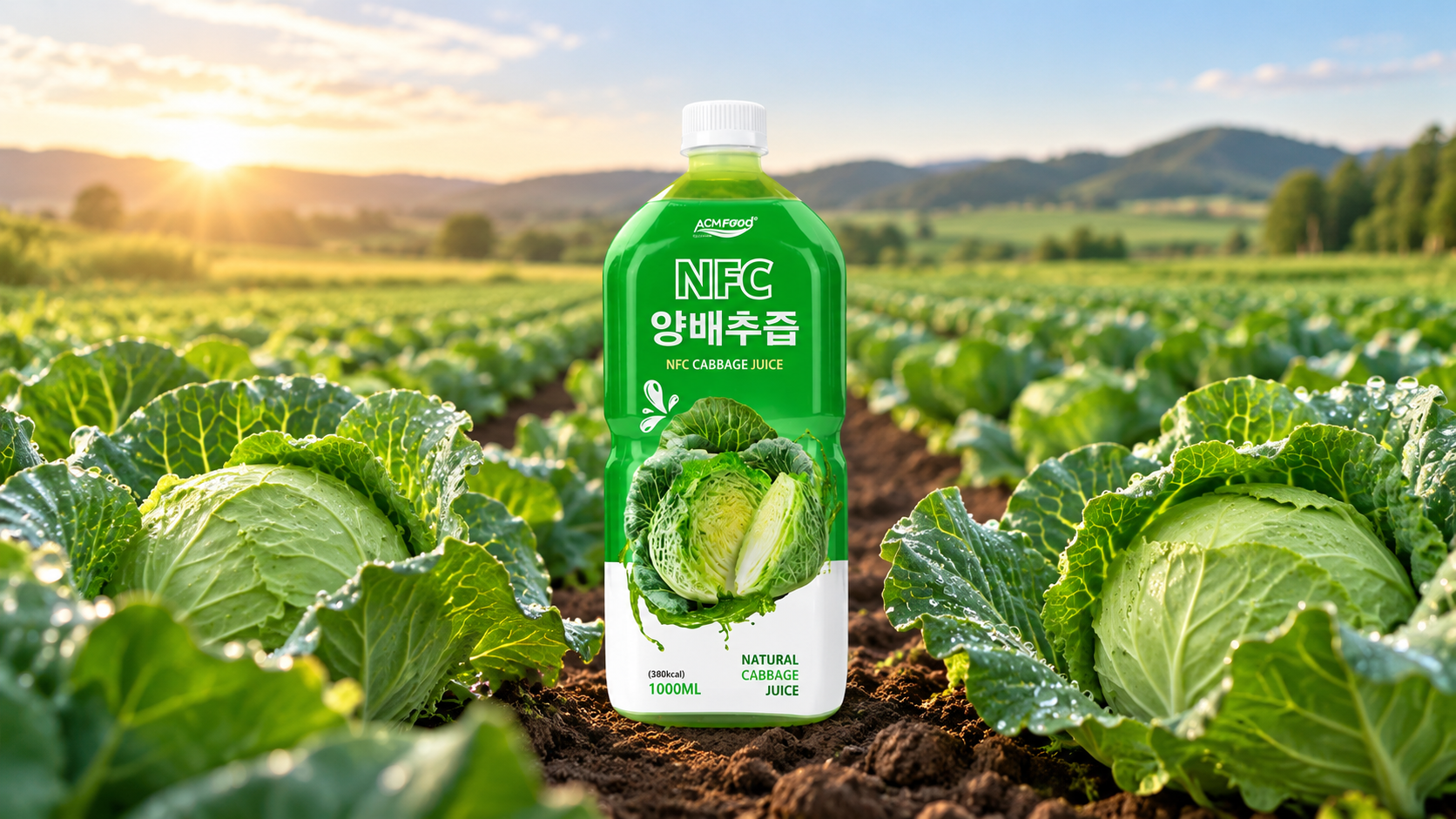
This guide explains how organic cabbage is sourced, how it is pressed and heat treated, how cold-pressed and pasteurised routes compare and which documents to request. ACMFOOD, a Vietnam beverage manufacturer, publishes HACCP, ISO 22000 and FSSC 22000 certificates and supplies finished drinks in cans and bottles. Organic status is not among its published certificates, so organic lots must be confirmed with the factory before an order.
How is organic cabbage sourced?
Organic cabbage is sourced from certified farms that grow it under an organic standard, with documents for each field and delivery. Because cabbage is a cool-season crop that stores well, a processor can plan supply across several months, although quality and sugar content change with variety and weather.
- Grower certification. Each farm holds an organic certificate that lists the crop and the area. The processor keeps copies and checks validity dates.
- Variety selection. Smooth, juicy varieties with mild flavour give better juice than tough, strongly flavoured ones.
- Pest management. Cabbage is attacked by caterpillars, aphids and other pests. Organic growers use crop rotation, netting, beneficial insects and approved biological products.
- Harvest and trimming. Heads are harvested at the right maturity and trimmed. Damaged outer leaves are removed.
- Storage. Cabbage keeps well in cool, humid storage, which supports supply outside the harvest window, but long storage reduces sugar and increases sulfur notes.
- Testing. Residues, nitrate and microbiological indicators are tested against market limits.
Organic does not guarantee zero residues or zero insects. Factory washing, trimming and inspection are therefore part of every organic run.
What does an organic cabbage supplier need to show?
A supplier needs to show organic certificates for the factory and the growers, traceability from head to bottle, cleaning and segregation records and a food safety system. The scope of the factory certificate must include vegetable juice and the production site named in the contract.
| Item | What to check |
|---|---|
| Factory organic certificate | Scope, site, validity date, certification body recognised by the destination |
| Grower certificates | Crop, area and validity at harvest |
| Traceability | Ability to trace a finished pack to the cabbage lot |
| Segregation | Separate storage, cleaning verification and records for organic runs |
| Permitted ingredients | Acidulants, antioxidants and aids that the organic scheme allows |
| Food safety certificates | HACCP, ISO 22000 or FSSC 22000, which prove food safety management but not organic status |
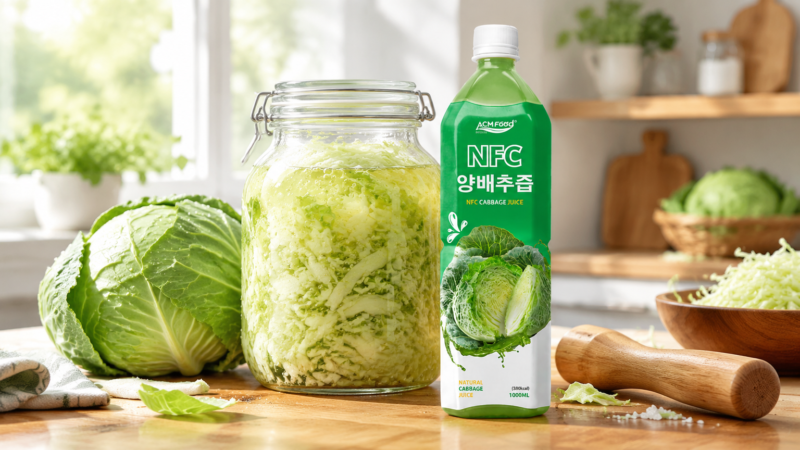
Information on the cabbage products currently offered can be found in the cabbage juice category.
How is cabbage pressed into juice?
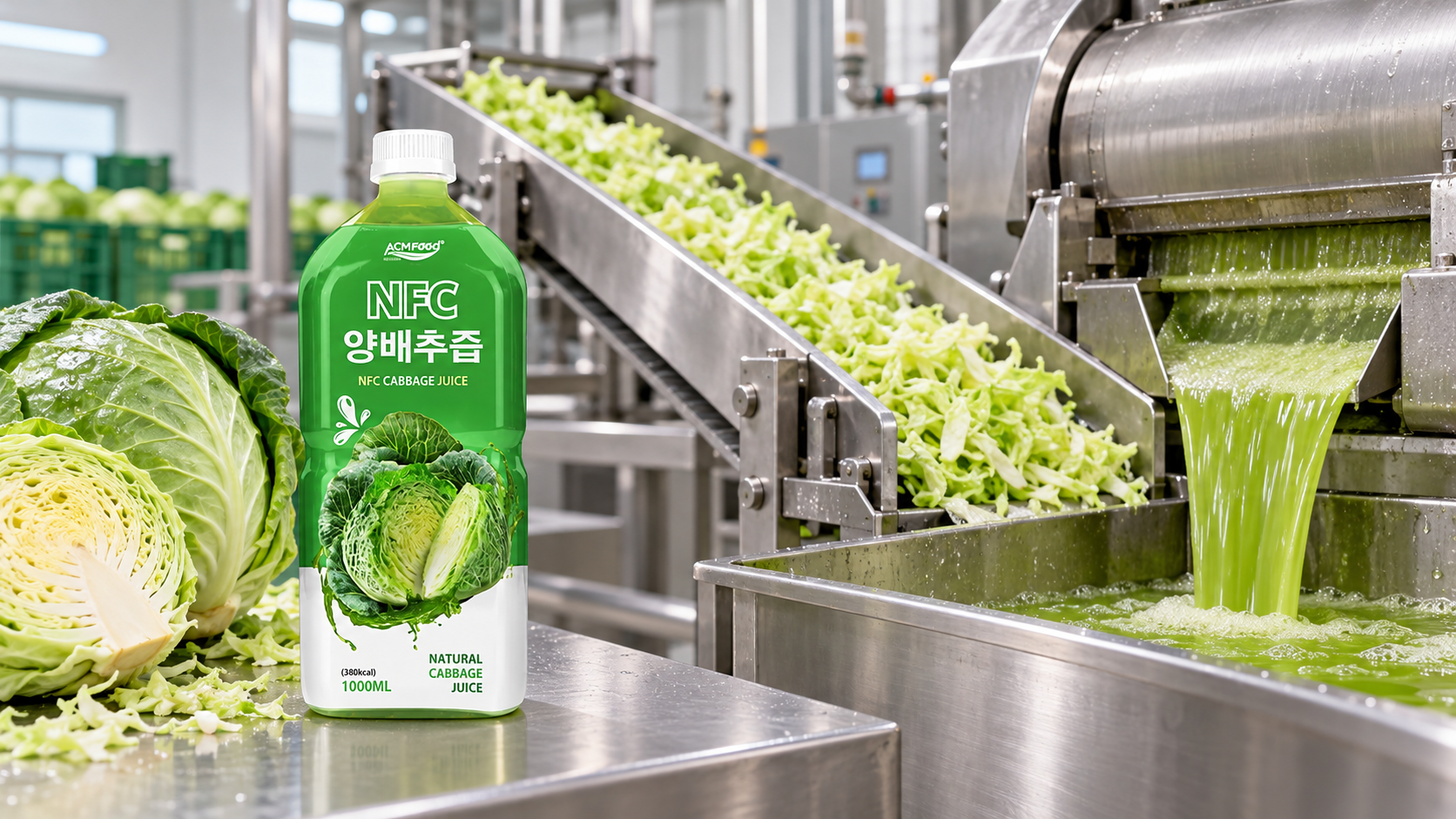
Cabbage is pressed after washing, trimming, coring and shredding. The shredded cabbage is crushed, and the juice is extracted by a press or a decanter, then filtered to remove fibre and particles. Pressing speed and pressure shape both yield and flavour.
- Coring and trimming. The core is hard and bitter, and the outer leaves carry soil and damage, so both are removed.
- Shredding. A fine cut releases more juice, though excessive crushing releases more sulfur compounds.
- Pressing. Belt presses and screw presses are common. Gentle pressure gives a cleaner taste, and strong pressure raises yield but also bitterness and fibre.
- Enzymes. Some producers use enzymes to increase yield or clarity, within the organic rules.
- Filtration. Screens and fine filters give a smooth juice, with optional centrifugation for clarity.
Cabbage is mostly water, so the yield is relatively high, but the juice is thin and mild. Many commercial cabbage drinks are blends with apple, carrot or lemon to improve flavour and body.
Why does heat treatment matter for cabbage juice?
Heat treatment matters because cabbage juice is low in acid and can support microbial growth, while heat also changes its flavour toward a cooked-cabbage note. The process must be strong enough to make the product safe and gentle enough to keep the taste acceptable.
Cabbage has a pH above 4.6, so an ambient shelf-stable product needs acidification with hot-fill or tunnel pasteurisation, or a sterilising route such as retort or aseptic filling. Plain mild pasteurisation is only suitable for refrigerated juice. In an organic recipe, the permitted acids are limited to those accepted by the scheme, so developers may rely on lemon or apple juice to lower the pH.
The factory or a process authority validates the heat step for the recipe. A change in the share of apple or lemon juice, or a different cabbage lot with a higher pH, can require a new review, which is why the specification should give pH limits rather than a single value.
How do pasteurised and cold-pressed routes compare?
Pasteurised routes give a longer life and can be shelf stable if acidified or sterilised, while cold-pressed routes give a fresher taste but need refrigeration and a short shelf life. For export in cans or bottles, the pasteurised and acidified route is the practical choice.
- Pasteurised and acidified, hot-fill. Ambient storage, brighter taste, requires a recipe pH within the validated limit.
- Retort or aseptic. Ambient storage for unacidified recipes, with a stronger cooked note in retort and a gentler profile in aseptic filling.
- Cold-pressed with or without HPP. Chilled distribution, fresher flavour, shorter life, flexible PET bottles only.
Cabbage’s sulfur compounds are one reason the cold-pressed route is popular with fresh-juice brands: heat increases cooked sulfur notes, and some consumers dislike them. A brand should taste both routes before choosing, preferably after storage.
How are organic runs scheduled around the cabbage season?
Organic runs are scheduled around harvest and storage windows, because the best-tasting juice comes from fresh, in-season cabbage. A factory may plan one main campaign soon after harvest and a second, smaller campaign from stored cabbage, and the buyer should know which one their order falls in.
- Harvest campaign. Fresh cabbage gives the sweetest, mildest juice, and it is the best time to produce flavour-critical products.
- Storage campaign. Cabbage kept in cool storage still gives usable juice, although sugar falls and sulfur notes rise, so blending or recipe changes may be needed.
- Gap periods. Between campaigns the factory cannot make organic cabbage juice from fresh supply, so buyers should order enough finished stock to cover the gap.
- Planning horizon. Organic growers plant according to agreed volumes, so forecasts shared early help them plan.
A supply agreement can define the forecast, the campaign dates and what happens if the harvest is short. Because organic land and crops cannot be switched on quickly, flexibility is more limited than in conventional supply.
How is the sulfur flavour controlled in organic recipes?
The sulfur flavour is controlled by fresh raw material, gentle pressing, short heat and blending with other juices. Organic rules do not change the chemistry, but they restrict some processing aids, so developers rely more on recipe design and process control.
- Start with fresh cabbage. Older cabbage develops stronger sulfur notes.
- Press gently and quickly. Rapid handling after shredding limits the formation of strong-smelling compounds.
- Use short heat. A plate heat exchanger shortens exposure compared with long batch heating.
- Blend with fruit juice. Apple or lemon juice masks sulfur notes and also lowers pH, which is useful for hot-fill.
- Taste after storage. Flavour moves during the first weeks, so approval should be based on stored samples.
Organic apple and lemon juices are available in organic supply chains, but each additional organic ingredient adds paperwork. A simpler recipe is easier to document and to trace, which is a practical reason to keep the number of ingredients low.
What logistics and storage points apply?
Finished organic cabbage juice should be stored cool and dry, with batch records and certificates kept together. Segregation continues after production, because organic packs must stay identifiable through the warehouse and the shipment.
- Warehouse labelling. Organic pallets are marked and kept apart from conventional stock.
- Documents. The transaction or inspection certificate travels with the shipment, and its number matches the batch codes.
- Temperature. Warm containers speed up colour and flavour change, so shipping lanes and seasons matter.
- Importer storage. The importer must also be certified in some markets before organic products can be handled and relabelled.
What specification points should be set?
- Organic scheme and certification body for the destination market.
- Cabbage type such as white, green or red, and variety if relevant.
- Composition. Juice share, blending juices and permitted acidulants.
- Brix and pH. Target ranges with tolerance.
- Sensory limits. Sulfur note, bitterness, colour and cloud.
- Microbiology and contaminants. Limits suited to the process and market.
- Packaging. Can or bottle, size, closure and lining.
- Shelf life and storage. Duration and conditions of the claim.
- Documents per shipment. Certificate of analysis and transaction certificate where required.
FAQ about organic cabbage juice
Why does cabbage juice smell like sulfur?
Cabbage contains sulfur compounds that form pungent and cooked-smelling substances when the plant is cut or heated. Gentle processing and blending reduce the effect.
Can organic cabbage juice be sold in cans?
Yes, with suitable lining and a heat treatment matched to a low-acid vegetable, and with packaging components that meet food-contact and organic requirements.
Is organic cabbage juice free of pesticides?
Not necessarily. Organic farming restricts synthetic pesticides, but traces can reach crops. Testing against market limits remains part of quality control.
What is the best cabbage for juice?
Fresh, firm, smooth varieties with mild flavour work best. Old or stored cabbage gives a stronger sulfur taste and less sugar.
Does an organic certificate replace HACCP?
No. Organic certification covers the production standard, while HACCP and related certificates cover food safety management. A supplier should hold both for an organic export project.
How should a trial order for organic cabbage juice be handled?
Start with a small production run on the final pack, with the same cabbage type, recipe and documents as the commercial order. Store part of it at ambient and warm conditions, review colour, sulfur note and pH after several weeks and confirm that the transaction certificate is accepted by the importing authority before placing a larger order.
Can organic cabbage juice be blended with non-organic juice?
Not if the finished drink is sold as organic. Every agricultural ingredient must be organic or fall within the limited exceptions allowed by the scheme, and the percentage of organic content determines which label wording is permitted.
Selecting an organic cabbage juice supplier
An organic cabbage juice supplier combines certified cabbage, controlled pressing, a validated heat route and clear documents. Buyers should read certificate scopes, confirm the permitted acid system, taste both pasteurised and cold-pressed options and agree on a specification.
Brands that want to discuss an organic cabbage juice in cans or bottles can send ACMFOOD a brief covering style, pack, markets and documents. The factory can confirm what is possible for organic lots and prepare a sample plan.