


 Français
 Español
 العربية
 한국어
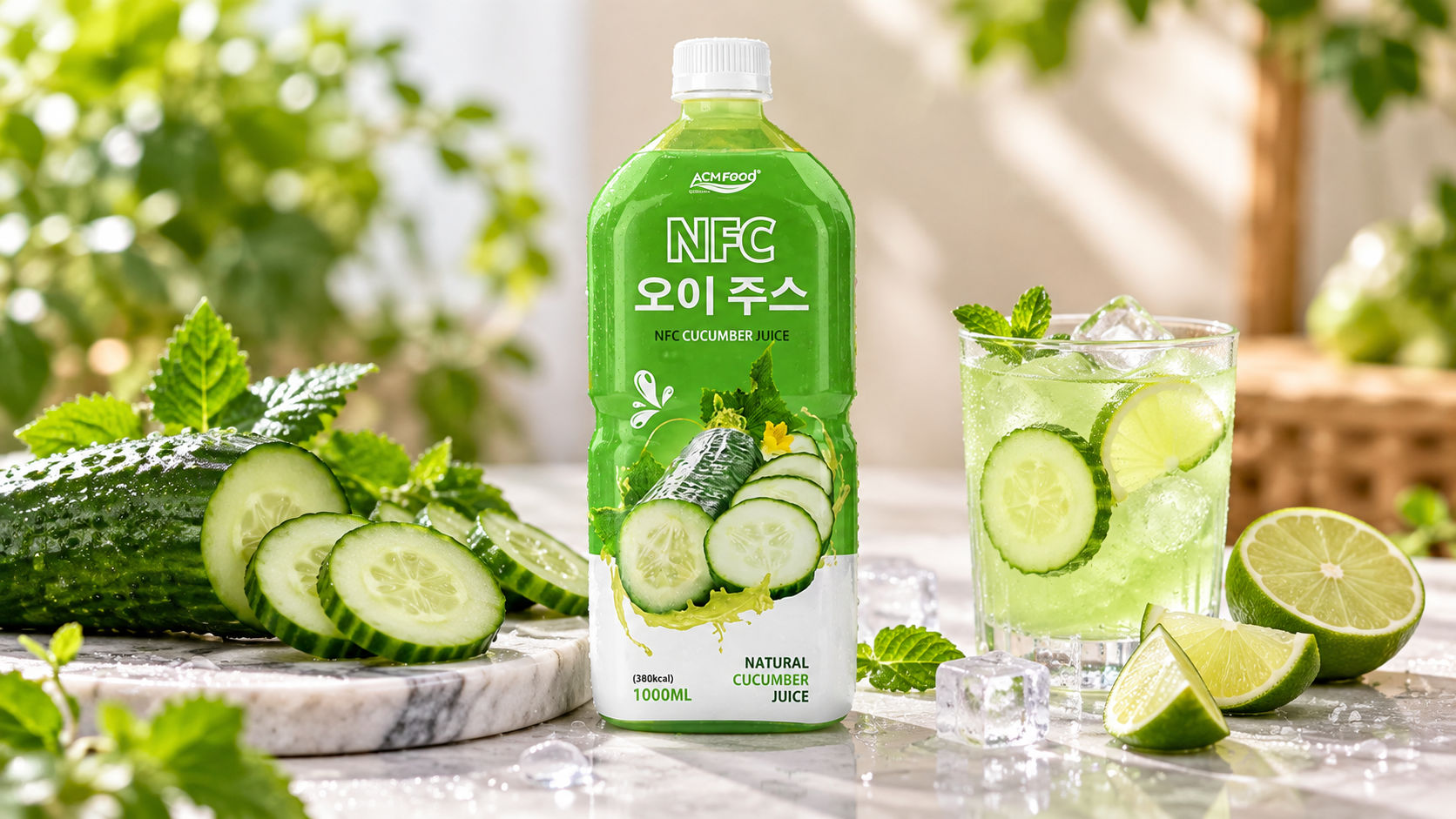
A cucumber juice drink in cans is a light, refreshing beverage that combines cucumber juice with water, a little acid and a supporting flavour so it can sit safely on a shelf for months. The recipe is the hard part: cucumber has little taste of its own once it is heated, so formulation has to rebuild freshness without hiding the cucumber.
This guide explains how to design a shelf-stable cucumber drink for aluminium cans, how filling and heat treatment work, how stability is protected and how shelf life is set. It is written for brand owners planning a private label range. ACMFOOD, a Vietnam beverage manufacturer, supplies finished drinks in cans and bottles under OEM, ODM and private label arrangements.
How is a shelf-stable cucumber drink built?
A shelf-stable cucumber drink is built from a juice base, water, an acid system, a flavour support and, where wanted, a light sweetener. Each element has a job: the juice gives identity, the acid gives safety and brightness, the flavour restores freshness lost in heat and the sweetener rounds the taste.
A simple way to plan the recipe is to choose a tier:
| Tier | Cucumber juice share | Supporting elements | Result |
|---|---|---|---|
| Light | Lower | Water, lime, a little sweetener, natural flavour | Refreshing, mild, mainstream price |
| Medium | Moderate | Lime or lemon juice, mint, light sweetener | Balanced cucumber and citrus profile |
| High | Higher | Acid system, minimal sweetener, optional mint or ginger | Stronger cucumber character, more premium |
The exact percentages are a decision for the developer and the brand, based on tasting and cost. The table only shows how the balance changes as juice share rises. Cucumber is low in solids, so a higher share does not add sweetness or body, and it raises the cost of the drink without a proportionate gain in flavour.
Which flavours support the cucumber taste?
Lime, lemon, mint and a hint of honey or apple are the most common supports. They add aroma and a clean acidity that mimics the crisp, cooling impression of fresh cucumber, which heat treatment would otherwise flatten.
- Lime. The classic partner. It adds acid, aroma and a green, bright note.
- Mint. Gives a cooling impression and works well in small amounts.
- Melon. A sweet, watery note that matches cucumber’s own aroma family.
- Ginger. A light warmth that makes the drink more distinctive and adult.
- Honey or apple. A gentle sweetness without a sharp sugar taste.
Natural flavours must be declared and must be allowed in the destination market. Whether a drink can be called cucumber juice drink, cucumber flavoured drink or something similar depends on the juice share and local naming rules.
How is acid used to protect the drink?
Acid lowers the pH below the level at which dangerous spore-forming bacteria can grow, which is critical for a low-acid vegetable. Cucumber juice sits above pH 4.6, so a shelf-stable recipe adds lime juice or a food acid until the target pH is reached.
The target is set by the process authority for the chosen heat route, and the recipe must reach it consistently. Acidification has two effects on quality: it brightens the taste, which is welcome in a cucumber drink, and it speeds up chlorophyll change, which dulls the green colour. Developers therefore aim for the highest pH that is still safe, with a margin, and then test colour over time.
How are cucumber drink cans filled and sealed?
Cans are rinsed, filled with the drink at the right temperature, dosed with liquid nitrogen if needed, seamed shut and heat treated. The line is similar to that of other still drinks, with a few points that matter for a delicate, low-solids product.
- Drink preparation. Cucumber juice, water, acid, flavour and sweetener are mixed in a tank and checked for Brix and pH.
- Deaeration. Dissolved air is removed to slow oxidation and avoid foaming at the filler.
- Heating. For hot-fill, the drink is heated to the validated temperature just before filling.
- Filling. Cans are filled to a controlled level with low headspace.
- Nitrogen dosing. A drop of liquid nitrogen is added to still drinks in thin cans to give internal pressure.
- Seaming. The lid is double-seamed to the can body, and seam dimensions are measured.
- Holding and cooling. Hot-filled cans are held for the validated time, then cooled and dried.
- Coding and packing. Batch code and best-before date are printed, and cans are packed into trays and cartons.
The seam is the most important mechanical control. A faulty seam admits air and microbes and defeats the heat step, so seam inspection is frequent and documented.
Which heat treatment is used?
Most cucumber drinks use acidified hot-fill or tunnel pasteurisation, because both are gentle enough to keep flavour. Retort sterilisation is possible, but it adds a stronger cooked note that is more noticeable in a light, delicate drink.
- Acidified hot-fill. Short heat, fresh taste, requires a recipe below the safety pH.
- Tunnel pasteurisation. Cans are filled, sealed and heated in a tunnel before cooling. It suits recipes that are acid enough for pasteurisation.
- Retort. Stronger sterilisation for unacidified recipes. It is rarely the first choice for cucumber drinks.
The validated values depend on the exact recipe, so any change of juice share, acid or sweetener requires a review. The factory records heat step data for each batch, and the batch is held until the check is complete.
What protects stability and colour over shelf life?
Stability and colour are protected by low oxygen, light protection, moderate pH and storage at moderate temperatures. Cans already give excellent light and oxygen barriers, so the main work happens at formulation and filling.
- Deaeration and headspace control. Slow oxidation of aroma and chlorophyll.
- Can lining. A lining suited to acidic, low-solids drinks prevents metallic taste and corrosion.
- Cool storage. Heat accelerates colour change and flavour fade.
- Light-coloured labels or printing. Not needed for protection, since cans block light, but they help the green colour read as fresh on shelf.
- Stabilisers where needed. A small amount of permitted stabiliser can hold fine particles in suspension when the recipe contains cloudy juice.
How is shelf life set?
Shelf life is set from a stability study on the actual recipe, can and storage condition. Samples are stored at ambient and warm temperatures and tested for colour, taste, pH, Brix and microbiology at intervals, and the end of shelf life is the point where any parameter leaves its agreed limits.
A figure from one product cannot be copied to another. Even a small recipe change can alter colour stability, so buyers should request the study summary and the storage conditions in writing. Current formats of ACMFOOD’s cucumber drinks and their published shelf-life data can be seen in the cucumber juice category.
Which tests confirm the quality of a cucumber drink batch?
A batch is confirmed by laboratory measurements, sensory evaluation and package checks before release. The laboratory tests show whether the drink matches the recipe and the safety limits, and the sensory test shows whether it tastes right, which no instrument can fully replace.
- Brix and pH. Confirm that the blend matches the recipe and that the acid level meets the safety target.
- Colour. Measured by instrument and compared with the reference at filling and at later checks.
- Taste panel. Aroma, freshness, sweetness, acidity balance and any off-note are scored against the reference.
- Microbiology. Counts from samples held after filling confirm that the heat step worked and the can is sealed.
- Can checks. Seam dimensions, fill level, internal pressure and external appearance.
- Retained samples. Kept for review at the end of shelf life.
The set of results forms the batch record, which the buyer can request with the certificate of analysis. If a complaint arrives later, the record shows whether the batch met its specification on the day it was released.
How should the drink be positioned and priced?
A cucumber drink is usually positioned as a light, refreshing and low-intensity alternative to sweet soft drinks, with an everyday or wellness feel. Pricing follows the juice share, the can format and the sales channel, so the brand should decide the positioning before it sets the recipe.
Three positioning routes are common. A mainstream route uses a lower juice share, a light sweetener and a familiar flavour such as lime, aimed at convenience and vending. A premium route uses a higher cucumber share, minimal sweetener and a clean ingredient list, aimed at specialty retail and cafes. A functional-style route adds a supporting ingredient such as ginger or mint, aimed at adults who look for a distinctive taste. Whatever the route, label claims should stay within what the recipe and the local rules support, and health claims should be avoided unless the market approves them.
What logistics points matter for cucumber drink cans?
The points are heat, dents and moisture. Light drinks in thin cans are sensitive to rough handling, and warm containers shorten the period of good quality, so packing and shipping conditions should be part of the supply agreement.
- Carton and tray strength. Protects the can rims and seams during stacking and transport.
- Container temperature. Choose shipping lanes and seasons carefully, or use ventilated or insulated containers for sensitive loads.
- Moisture control. Desiccants and dry cartons limit rust at the can rims during sea freight.
- Warehouse practice. First-in-first-out rotation and regular checks for dents or bulging cans.
A bulging can must be withdrawn from sale, and the batch code should be reported to the supplier, which then investigates using its batch record.
What should a cucumber drink brief include?
- Tier and juice share. Light, medium or high, with a target percentage.
- Flavour support. Lime, mint, melon, ginger or honey, with reference samples.
- Acid and sweetness targets. pH and Brix ranges.
- Can specification. Size, printing, lining and lid.
- Heat route. Confirmed by the factory.
- Colour reference. Acceptable range after storage.
- Shelf-life target. Duration and storage conditions.
- Market and documents. Label wording, certificates such as HACCP, ISO 22000 and FSSC 22000, and test reports.
FAQ about cucumber drinks in cans
Why does cucumber drink taste milder after heat treatment?
Heat destroys the volatile compounds that give fresh cucumber its aroma. Lime, mint and other flavours restore a sense of freshness.
Can a cucumber drink be carbonated?
Yes, a sparkling version is possible, but it is a different recipe and process with its own can pressure and filling requirements. It should be developed as a separate product.
Does the drink need to be refrigerated?
Not before opening, if the drink is acidified or sterilised and the can is intact. Many consumers prefer it chilled, and opened cans should be kept cold and finished quickly.
Which can size works best?
Slim 250 ml and sleek 320 ml cans are common for light, refreshing drinks. The final choice depends on the channel and the filling line.
How do I know if the can lining is suitable?
Ask the supplier for the lining specification and for stability data with a similar drink. Early signs of lining problems include metallic taste and colour change in warm storage.
Developing a cucumber drink for cans
A cucumber drink in cans works when the recipe, acid level, filling and heat route are developed together. The product must be safe for a low-acid vegetable, taste fresh after processing and keep its colour for the agreed shelf life.
Brands that want to launch a cucumber drink can send ACMFOOD a brief with tier, flavour support, can specification and markets. The team can propose a recipe, confirm the heat route and prepare samples.