


 Français
 Español
 العربية
 한국어
한국어U.S. beverage label requirements set the baseline information that must appear on packaged drinks sold in the United States, from the front-of-pack name to the Nutrition Facts panel and allergen disclosures. For importers and brand owners, getting these details right before print prevents costly relabeling, holds at the border, or retailer rejections.
This checklist turns complex rules into practical steps you can act on. It is written for non-prescription, non-alcoholic beverages entering the U.S. market and focuses on conventional foods (not dietary supplements). Regulations can change and some rules depend on product type and pack size, so always run a final review with your regulatory counsel or compliance partner before production.
What are U.S. food label requirements for beverages?
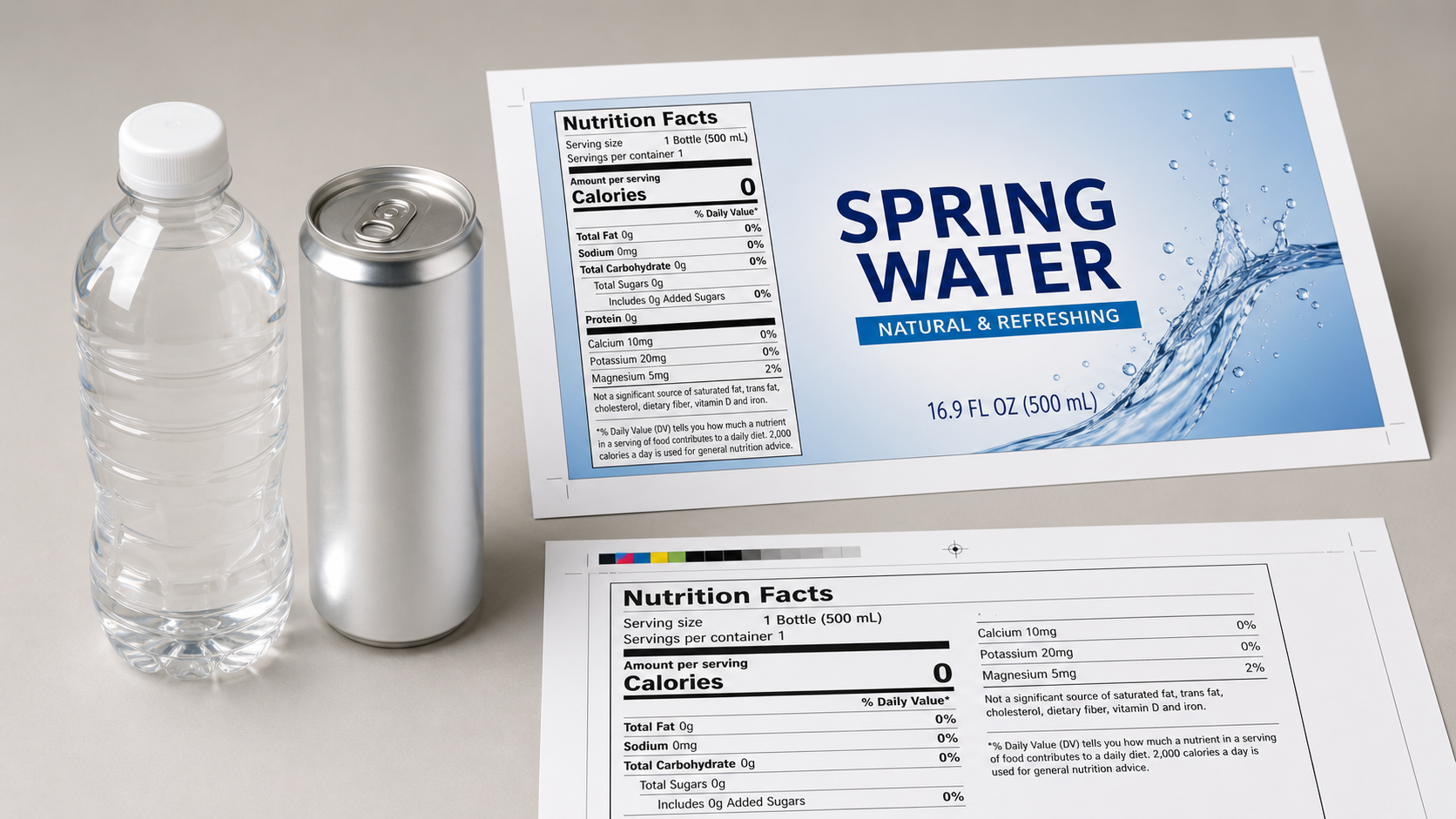
In short, most imported beverages sold at retail need: a clear statement of identity (product name), net quantity statement in U.S. customary and metric units, an ingredient list with sub-ingredients as applicable, allergen labeling when present, a Nutrition Facts label, and name & place of business. Juice-containing beverages also require a juice percentage declaration. Country-of-origin marking is generally required under customs law.
While the exact formatting and placement rules are technical, you can structure your artwork process to ensure the right elements appear on the correct panels at readable size, with consistent terminology and compliant claims. The sections below explain each element and give you a packaging-ready checklist.
Which labels and panels appear on a beverage package?
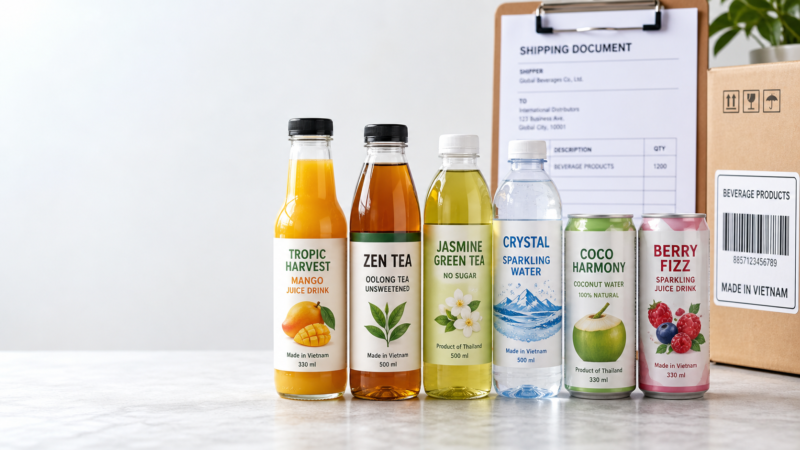
A typical U.S. beverage label uses two key spaces: the principal display panel (PDP) and the information panel. The PDP is the main front face a shopper sees; it carries your statement of identity and net quantity statement. The information panel (usually the panel immediately to the right of the PDP when facing the product) houses the ingredient list, allergen disclosures, and the Nutrition Facts label, along with the name and place of business.
Round or contoured containers can change what counts as the PDP, and multipacks add outer-carton requirements. Choose a consistent panel layout early, lock dielines, and keep required elements together to simplify compliance and retail proofing.
Statement of identity: naming your beverage legally
The statement of identity is the product’s common or usual name. It tells shoppers what the beverage is, not just what the brand calls it. Examples include terms like “sparkling water beverage,” “orange juice,” “apple juice drink,” “ready-to-drink tea,” or “coffee beverage.” Flavor declarations should be accurate (e.g., “mango flavored beverage” if flavor is added rather than coming primarily from juice).
Good practice for imported beverages is to choose the U.S.-appropriate name early. Avoid reliance on home-market naming conventions if they differ from U.S. usage. If you use characterizing flavors, ensure the wording clearly communicates whether flavor is natural, artificial, or a combination, and list flavoring ingredients in the ingredient list accordingly.
Net quantity statement: how to present amount of contents
The net quantity statement tells consumers how much beverage is in the package. In the U.S., beverages use volume declarations in U.S. customary and metric units together (for example, fluid ounces and milliliters). The statement belongs on the PDP, in a legible type size and contrasting color, oriented parallel to the package base, and separated from clutter.
For multi-unit or multipacks, present the outer-package net contents appropriately (e.g., total count and per-unit volume) and ensure inner units also carry compliant declarations if they are sold individually. Consistency between artwork, dielines, and actual fill is essential to avoid rework later.
Ingredient list: order, sub-ingredients, flavors, colors
List ingredients in descending order of predominance by weight as formulated. Compound ingredients (like a base, syrup, or concentrate) may need declared sub-ingredients in parentheses. Flavorings and colors must be identified according to U.S. naming conventions. For example, approved color additives that require certification are typically listed by their specific names, while caramel color is listed as “caramel color.”
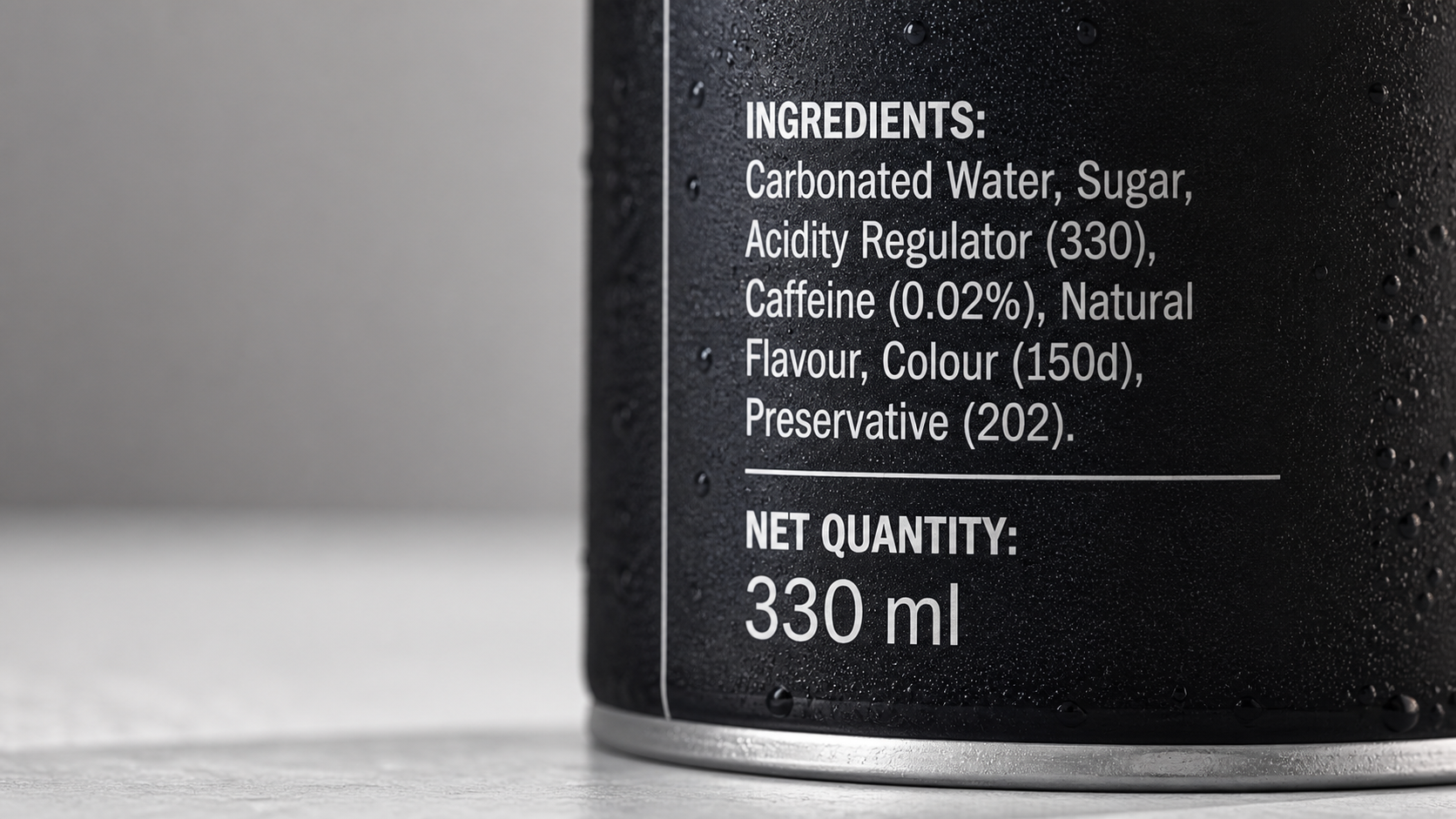
Water often appears first when beverages are formulated as aqueous solutions. If you use sweeteners, acids, stabilizers, or preservatives, each must be declared by its appropriate name in the ingredient list. When you rely on suppliers for bases or flavors, obtain complete, current specifications and a breakdown of sub-ingredients so the final label is accurate.
Allergen labeling in the U.S.: what must appear?
The U.S. recognizes the following as major food allergens for labeling: milk, egg, fish, crustacean shellfish, tree nuts, wheat, peanuts, soybeans, and sesame. If your beverage contains any of these or their derivatives, declare them clearly according to U.S. requirements.
For tree nuts, identify the specific nut (e.g., almond, cashew). Allergen disclosure can appear either in the ingredient list using parenthetical statements after the ingredient that contains the allergen or in a separate “Contains” statement placed immediately after the ingredient list. Keep your allergen management data synchronized with formulation and supplier documentation so future flavor changes don’t invalidate the label.
When is a juice percentage declaration required?
If a beverage contains any amount of fruit or vegetable juice, U.S. rules generally require a percentage juice declaration. This can apply to 100% juices, juice blends, nectars, and beverages where juice is used primarily as a flavor or color component.
Place the statement where shoppers can easily find it, typically near the statement of identity or in the information panel. Use honest, non-misleading language and ensure that the labeled percentage matches the actual formulation as made. Maintain formulation records to support the declared percentage for retailer and regulatory reviews.
Nutrition Facts label for beverages: core rules
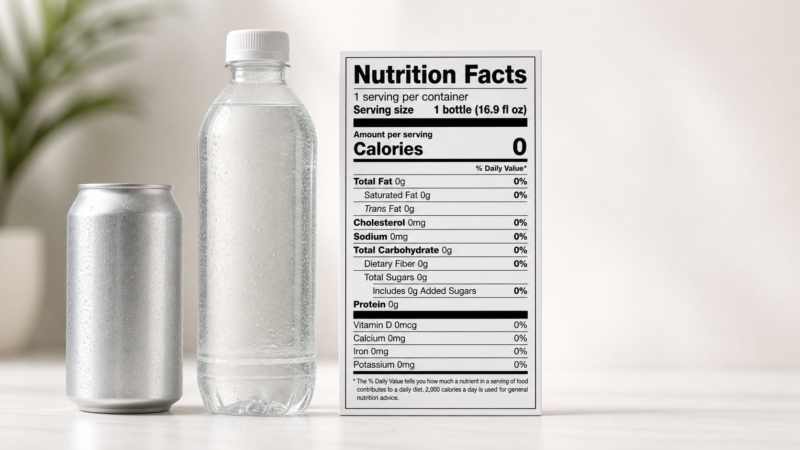
The Nutrition Facts label provides standardized nutrition information. Most beverages require this panel unless an exemption applies (for example, some small business scenarios or very small packages). Use the appropriate U.S. layout, typography, and order of nutrients, including calories, macronutrients, and the specified vitamins and minerals in the required format.
Key considerations for beverages:
- Serving size and servings per container should follow U.S. serving-size rules for beverages, based on reference amounts customarily consumed (RACCs) and package size.
- Added sugars, if present, must be declared on the Nutrition Facts label according to U.S. rules.
- For multi-serve packages, consider whether a dual-column label is required or recommended to show nutrition per serving and per container.
- For single-serve packages, use the appropriate single-serving format so the panel reflects the full container.
- Use consistent rounding and units as specified for the U.S. Nutrition Facts format, not other markets’ layouts.
Do not rely on supplier spec sheets alone; verify that your finalized formula and actual fill claims produce the expected nutrition profile. If you reformulate for sweetness, fiber, or fortification, reassess the panel and any related claims before print.
Sweeteners, caffeine, and special disclosures
Declare high-intensity sweeteners (e.g., sucralose, acesulfame potassium, stevia extracts) in the ingredient list by their appropriate names. If using aspartame, include the phenylalanine disclosure required for that sweetener. Sugar alcohols and bulking agents appear in the ingredient list as used, and may also appear on the Nutrition Facts panel in accordance with U.S. formatting rules.
Caffeine, when added as an ingredient, must be declared in the ingredient list. Many brands also voluntarily declare total caffeine per serving for transparency, though this is distinct from mandatory ingredient declaration. For botanicals or extracts (e.g., guarana) that contribute caffeine, declare them in the ingredient list according to their common or usual names.
If a beverage is marketed as a dietary supplement (e.g., a shot positioned and labeled as a supplement), it typically uses a Supplement Facts panel and follows different rules. Decide your regulatory category early and label consistently with that category.
Claims and marketing statements: keep them compliant
Any nutrient content claim (e.g., “low calorie,” “good source of [nutrient],” “no sugar added”) must meet the U.S. definitions, including conditions that may depend on serving size and formulation. Functional benefit statements must be truthful, non-misleading, and consistent with the final product and applicable rules. Avoid implying disease treatment or prevention on conventional foods.
Other common front-of-pack statements to handle carefully:
- “Organic”: Use only when certified under the appropriate program and follow placement and seal usage rules.
- “Non-GMO”: Ensure your verification standard and supplier documentation are consistent with the claim.
- “Natural”: Use with caution and ensure it is not misleading; keep formulations and processing aligned with your policy.
- “Gluten-free”: Only if the product meets the U.S. definition for that claim.
- “No preservatives,” “no artificial colors”: Ensure the formulation and ingredient list support the statement.
Keep written substantiation files for each claim. Align label copy, marketing, and e-commerce descriptions to avoid inconsistencies that invite retailer or regulatory questions.
Country of origin and importer details
Country-of-origin marking is generally required under U.S. customs law for imported goods. Food labels should clearly communicate the origin to the ultimate purchaser with accurate wording that matches how the product is imported and sold at retail. Work with your customs broker to confirm acceptable placement and phrasing for your packaging and any outer cartons.
Labels must also show the name and place of business of the manufacturer, packer, or distributor. If you are not the manufacturer, use qualifiers such as “Distributed by” or “Imported by” with the proper business address. Keep this information consistent across inner units and multipacks as applicable.
For logistics and compliance interactions, coordinate your label decisions with your shipping plan. For a broader view of moving finished goods into the U.S., see Shipping beverages from Vietnam to the United States in this guide: Shipping beverages from Vietnam to the United States.
Languages, legibility, barcodes, date codes, and lot codes
Required label information must appear in English. You may present additional languages, but any language you include must carry complete required information for that language version, not partial translations that create confusion.
Use clear, readable type with sufficient contrast. Avoid script fonts for critical information. Keep required items free of visual clutter and ensure adequate spacing.
Barcodes (UPCs) are a retail requirement rather than a federal labeling law, but most U.S. retailers require them. Date coding (e.g., “Best if used by”) is generally market-driven for conventional beverages, with exceptions for specific categories. Lot codes are essential for traceability and are typically printed or ink-jetted; they should be legible and consistently placed to support recalls or quality holds if ever needed.
Outer cases, multipacks, and e-commerce formats
Outer cases used for distribution need markings that support warehouse handling and retailer receiving. If the outer case is a consumer-facing multipack (e.g., a 6-pack shrink wrap or carton), it must carry the required consumer information for sale as a unit, including net contents for the multipack. If inner units are not intended for individual sale, mark them accordingly and confirm how retailers will merchandise them.
For e-commerce channel packs, ensure that digital imagery of the label is consistent with the physical packaging and that any online nutrition and allergen info matches your latest label version.
Category notes: carbonated, still, juice, dairy alternatives
Labeling principles are consistent across beverage categories, but a few practical differences matter:
- Carbonated soft drinks: Commonly include acids, flavors, and color additives—check flavor naming and color declarations carefully.
- Still flavored waters: Pay attention to flavor declarations and sweeteners; avoid implying juice presence if none exists.
- Juice and juice drinks: Apply the juice percentage declaration; use accurate names like “juice drink” or “juice beverage” when the product is not 100% juice.
- Ready-to-drink tea/coffee: Caffeine may be naturally present; if you add caffeine or flavors, declare them appropriately.
- Plant-based milks: Assess allergens (e.g., almond, soy, oat processing aids) and ensure allergen labeling is complete and specific.
If you are evaluating different development models for your brand build, compare how the production route affects packaging and labeling workflows in this overview: differences between private label, white label and OEM beverages.
Common labeling pitfalls for imported beverages
Prevent these frequent issues that delay launches or trigger relabeling:
- Using a home-market Nutrition Facts layout instead of the U.S. format.
- Missing or incorrect dual net quantity units (U.S. customary and metric).
- Forgetting the juice percentage on drinks that contain juice.
- Allergen statement doesn’t match the final ingredient list or sub-ingredients.
- Flavor naming implies more juice or naturalness than the formula supports.
- Claims on the front of pack aren’t backed by the Nutrition Facts or formulation.
- Out-of-date supplier specs used to build the label.
- Illegible type or poor contrast on small containers.
- Inconsistent or missing “Distributed by”/“Imported by” information across SKUs.
A practical workflow from artwork to approval
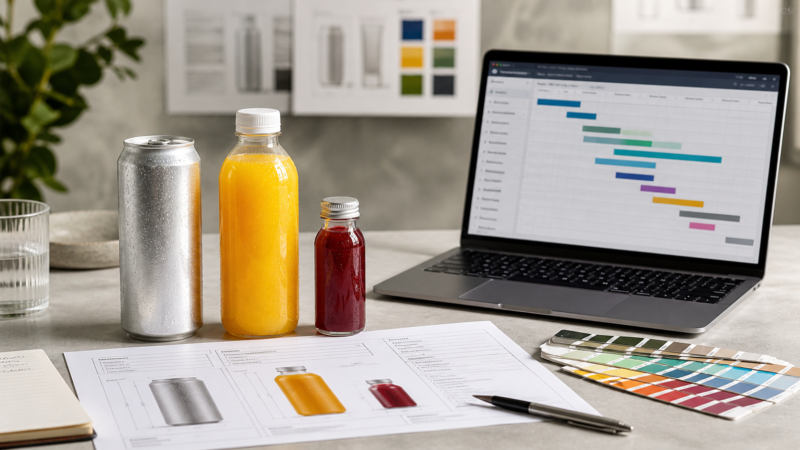
Build these steps into your commercialization plan and keep them in your project timeline:
- Regulatory scoping: Confirm the product category, ingredient status, and whether you are a conventional food or a dietary supplement.
- Master formulation lock: Finalize the formula and secure up-to-date supplier specs, including sub-ingredients and allergen content.
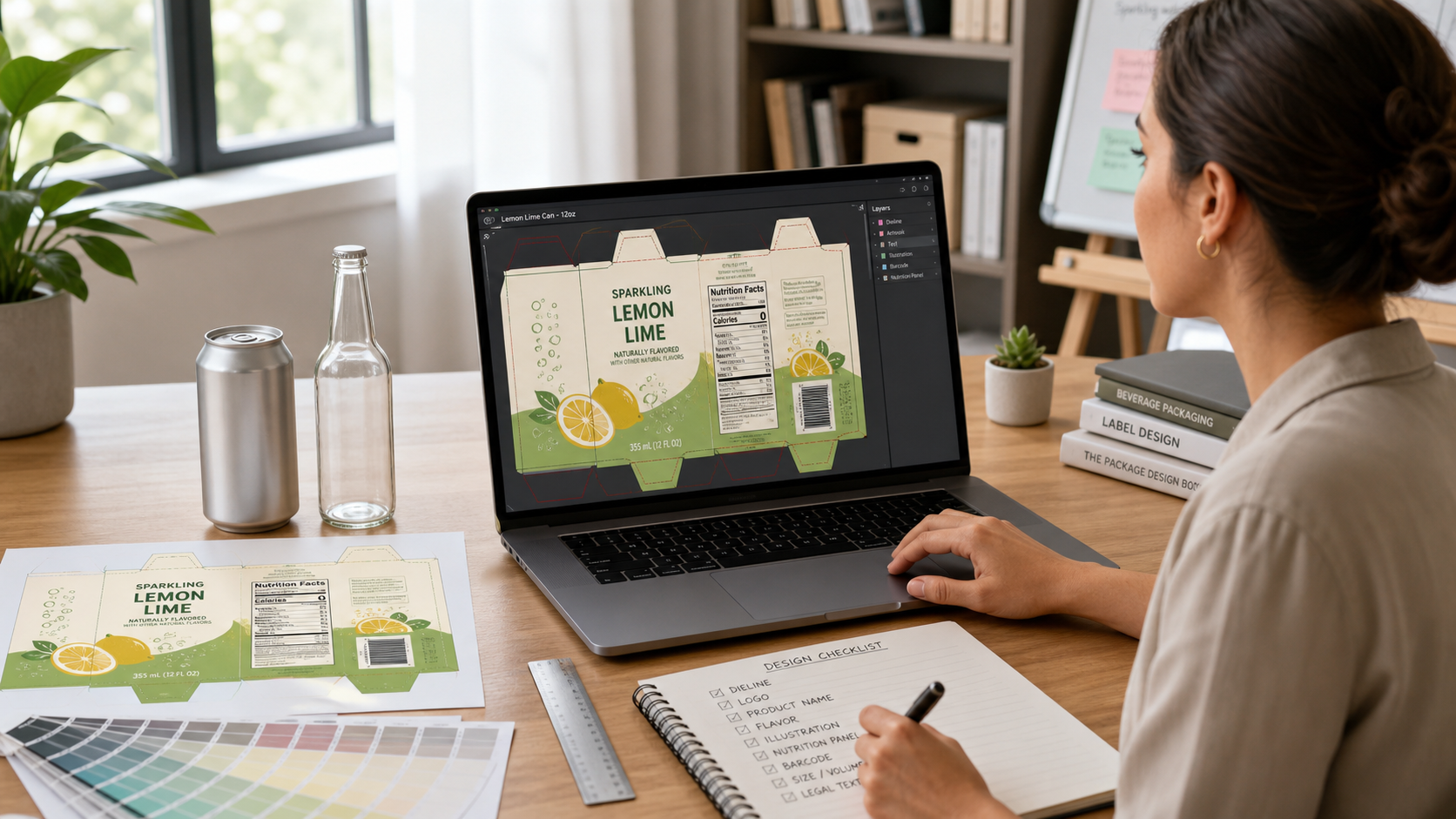
- Panel map: Assign PDP and information panel areas on the dieline; place statement of identity and net quantity on the PDP, and ingredients, allergens, and Nutrition Facts on the information panel.
- Draft copy: Write ingredient list (with sub-ingredients), flavor naming, and any claims; draft the country-of-origin marking and business address line.
- Nutrition workup: Calculate nutrition and format the U.S. Nutrition Facts panel for serving size and package type.
- Claims substantiation: Assemble evidence files for each claim you keep on pack.
- Regulatory review: Run an internal and external compliance review; resolve comments before color proofing.
- Print proofing: Check legibility, contrast, dielines, barcodes, and lot/date code fields; conduct a packaging line test if possible.
- Final sign-off: Freeze artwork, version-control the file, and archive all documentation tied to the SKU and revision.
If your retail plan includes club packs or seasonal multipacks, confirm minimum order quantities and packaging lead times early. For U.S.-specific volume planning, see this overview: Beverage MOQ for U.S. private label projects.
Document checklist your team should hold
Keep a centralized compliance folder per SKU with:
- Finalized formula and processing description (as commercialized).
- Supplier specifications and certificates, including sub-ingredient breakdowns and allergen statements.
- Nutrition analysis worksheets and the final Nutrition Facts artwork file.
- Ingredient list copy with sub-ingredients and allergen declaration text.
- Front-of-pack copy, claims list, and claim substantiation evidence.
- Country-of-origin statement and business address line as printed.
- Artwork revision history, color proofs, and press approvals.
- Lot code and date code format explanation for QA and traceability.
- Retailer compliance checklists and approvals (if provided).
Table: core label elements by beverage type
This qualitative table summarizes which elements often require extra attention. Always verify specifics for your exact formula and pack.
| Beverage type | % juice declaration | Allergen risk examples | Positioning & notes |
|---|---|---|---|
| 100% juice | Required | Generally low unless blended with allergenic components | Use accurate fruit names; ensure Nutrition Facts matches actual sugars |
| Juice drink/nectar | Required | Possible from added ingredients (e.g., soy-based stabilizers) | Name should not imply 100% juice; flavor and sweetener declarations matter |
| Flavored water | Not applicable if no juice | Low; check processing aids and flavors | Be precise about flavor source; manage sweetener declarations |
| RTD tea/coffee | Not typical unless juice added | Milk if dairy-based; tree nuts/soy in plant versions | Consider caffeine declaration practices; align claims with Nutrition Facts |
| Energy drink | Varies (some include juice) | Potential from added components; check all suppliers | Declare added caffeine and other actives; ensure claim substantiation |
| Plant-based milk | Not typical unless juice added | Tree nuts, soy, or oats (cross-contact) | Allergen specificity and clear identity naming are critical |
Retailer and marketplace expectations
Major retailers and online marketplaces often maintain their own label and data standards. These sit on top of regulatory requirements and can include image angles, e-commerce copy conventions, and data fields for allergens, dietary attributes, and certifications. Ensure your product data sheets and digital assets mirror your label and keep revision numbers aligned.
How to synchronize formulation changes and labels
Set a cross-functional process so R&D, regulatory, and packaging work from the same version-controlled files. Any change in sweetener system, juice content, acidity regulators, stabilizers, or added vitamins/minerals may affect ingredient order, allergen status, and the Nutrition Facts label. Freeze artwork only after formulation is final for the launch batch and coordinate change control for future revisions.
State-level considerations and special cases
U.S. federal labeling rules apply nationwide, but some states or retailers have additional expectations or warnings in limited situations. Coordinate with your legal advisors if your product uses ingredients that may trigger state-specific notices or if you plan to feature voluntary disclosures (for example, caffeine per serving) as part of your brand positioning.
Cross-market lessons for global brands
Many importers adapt a global master artwork to multiple regions. Keep the U.S. Nutrition Facts panel separate from other countries’ nutrition formats and avoid mixing legal terms across markets. If you also sell into Australia, compare formatting, terminology, and panels using this overview: Australian food label checklist for beverages. Plan sufficient lead time for region-specific proofreading and printer plate changes.
Artwork quality: print, contrast, and durability
Good labels are readable in real retail lighting. Choose ink and substrate combinations that preserve contrast for fine type on the information panel. Make space for lot codes that won’t smudge under condensation. If you shrink-sleeve or print on metallic substrates, test that the Nutrition Facts and ingredient list remain legible and non-reflective.
Preflight audit: a one-page beverage label checklist
Use this quick preflight before releasing final files to print:
- PDP: Statement of identity is accurate and prominent; net quantity appears in U.S. customary and metric units with clear contrast.
- Information panel: Ingredient list in descending order, sub-ingredients declared, flavor and color names appropriate.
- Allergens: “Contains” statement (if used) matches the ingredient list; tree nut type is specified; sesame considered where relevant.
- Nutrition Facts: Correct U.S. format for your pack; serving size logic is correct; added sugars (if present) declared.
- Business line: “Manufactured by,” “Distributed by,” or “Imported by” with name and address.
- Origin: Country-of-origin marking consistent with customs expectations.
- Claims: Each claim substantiated and aligned with the Nutrition Facts and formula.
- Technicals: Barcodes scannable; legibility verified; lot/date code fields reserved.
- Files: Dielines accurate; version controlled; color proofs approved.
If you are coordinating labeling alongside sourcing and logistics for the U.S., align timelines with your inbound plan. This resource covers freight, paperwork, and scheduling factors: Shipping beverages from Vietnam to the United States.
FAQ: U.S. beverage labeling for imports
Do all beverages need a Nutrition Facts label?
Most do. There are limited exemptions, but many brands either do not qualify or choose to include the panel for retailer acceptance. Confirm applicability for your exact product, package, and sales volume before relying on an exemption.
Where should I place the percentage juice declaration?
When required, present the juice percentage where shoppers can see it easily and in a manner consistent with U.S. rules. Many brands place it near the statement of identity or within the information panel. Ensure the number reflects your commercial formulation.
Can I call my drink “natural” in the U.S.?
“Natural” is interpreted cautiously in the U.S. Use clear, non-misleading language, and ensure the claim aligns with your ingredients and processing. Keep documentation that supports your use of the term and review retailer policies before printing.
Is caffeine content per serving required on label?
Declaring caffeine as an ingredient is required when added. Listing the total caffeine amount per serving is commonly done for transparency but is distinct from mandatory ingredient declaration. If you choose to include it, ensure consistency across packaging and marketing materials.
How should I label imported multipacks?
If sold as a unit, the outer pack needs consumer-facing required information (including net contents for the multipack). Inner units also need compliant labeling if they are sold individually. Align your artwork plan with how retailers will merchandise the product.
What’s the difference between private label, white label, and OEM for labeling?
The core compliance elements are the same, but responsibilities for copy development, proofing, and sign-off can differ. If you are weighing development paths, this comparison can help structure roles and timelines: differences between private label, white label and OEM beverages.
Conclusion
A compliant U.S. beverage label consistently covers the essentials: a clear identity name, accurate net quantity in dual units, a complete ingredient list with allergens, an appropriate Nutrition Facts panel, origin marking, and truthful, substantiated claims. Getting those right early protects your launch schedule and reduces rework at the printer or port.
Treat this as a living checklist tied to your formulation and supplier specs. Each change in flavor system, sweetener, juice level, or packaging format can trigger label edits. Build a disciplined review process and keep your documentation tight so your brand scales smoothly in the U.S. market.
Manufacturing for U.S. brands
If you are sourcing for the U.S. market, three pages cover what buyers ask first. The OEM route sets out how a specification becomes a shipped container; certifications and food safety systems covers the documents customs and retailers will ask you to produce; export and logistics covers shipping terms and the document pack. To price a programme, request a quote.
Sources
Label requirements on this page follow FDA guidance. Verify current wording and formatting against the primary source before artwork is signed off.
- U.S. Food and Drug Administration — Guidance for Industry: Food Labeling Guide
- FDA — Changes to the Nutrition Facts Label
Where to go next
Sourcing for the U.S. market? The United States beverage market page covers the full OEM and private label programme for U.S. brands and importers: MOQ 500 cartons per SKU, 15-30 day production, HACCP / ISO 22000 / FSSC 22000, and shipping from Ho Chi Minh City. Request a quote and we reply within 24 hours.