


 Français
 Español
 العربية
 한국어
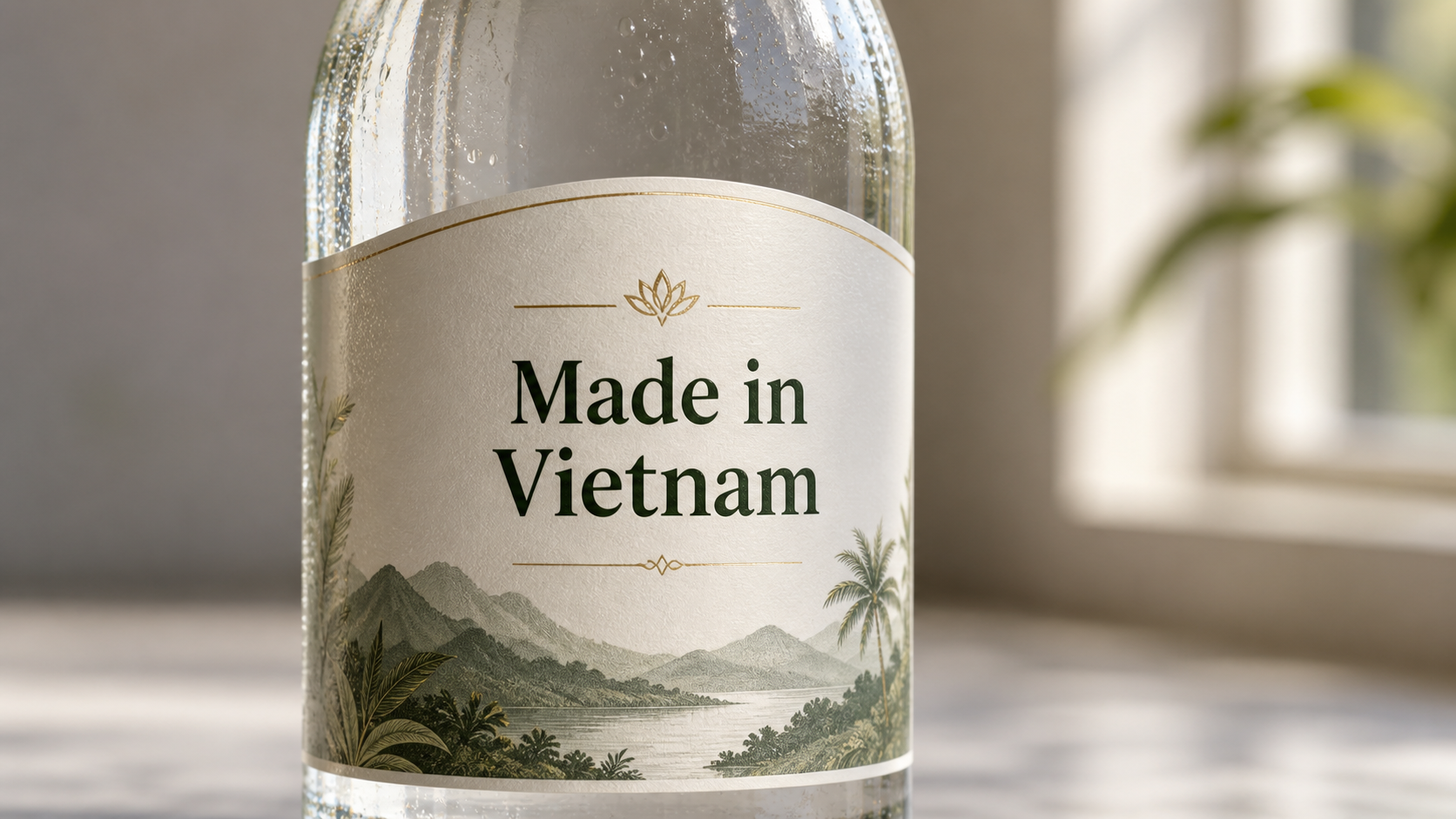
한국어Country-of-origin marking for imported beverages in the U.S. is the requirement to state the beverage’s true country of origin, in English, so the ultimate purchaser can easily understand where it was made. In practice, that means printing a clear statement such as “Made in Vietnam” or “Product of Thailand” on the retail bottle, can, or sealed retail container before it enters U.S. commerce.
This guide explains what to write, where to place it, how it interacts with FDA label rules, and how to avoid costly rework at the border. It is designed for beverage importers, private-label brands, and product developers who must ensure compliant, practical labels from the first print run, with examples and checklists tailored to beverages. The focus keyword for this topic is country of origin marking imported beverages USA, and the content below addresses that intent directly.
What is country-of-origin marking for imported beverages in the U.S.?
It is a U.S. customs requirement that imported goods, including retail beverage containers, be conspicuously and permanently marked in English with the country where they were made. The marking must be easy to find and read, and it informs the ultimate purchaser—typically the retail consumer—of the product’s origin.
Under U.S. customs law (commonly referenced as 19 U.S.C. 1304 and 19 CFR Part 134), the country name must appear in English (“Vietnam,” “Thailand,” “Mexico,” etc.). For beverages sold in bottles, cans, or multi-packs, the best practice is to put the origin right on the retail label or unit that reaches the consumer. If the retail unit cannot be marked, a qualifying container may be acceptable, but beverages are usually expected to carry origin on the primary container.
Who is responsible and when is it enforced?
The importer of record is responsible for ensuring proper marking. U.S. Customs and Border Protection (CBP) checks compliance at or near the time of entry. If labels are incorrect or missing, CBP can require re-marking under supervision, assess marking duties, or refuse entry until the issue is corrected. Because beverages are typically ready for retail upon arrival, discovering a marking issue at the port can be expensive and logistically complex.
To avoid delays, the importer should confirm origin statements with the manufacturer before printing, verify samples and proofs, and ensure cartons carry correct marks that align with invoices and entry data. If labels will be applied or over-stickered in a U.S. warehouse, plan and document that re-marking process in advance.
Where should the country of origin appear on beverage containers?
Place the origin statement on the primary display label or a secondary label that is obvious to the consumer under normal handling. It does not have to be on the principal display panel by rule, but it must be conspicuous and not hidden by seams, curves, or multipack overwraps. For cans, sidewalls near the ingredient panel often work well; for bottles, the back label or a dedicated line on the main label are common choices.
When beverages are sold in sealed multi-packs where the consumer normally does not remove individual units before purchase (e.g., a shrink-wrapped 6-pack), marking the multi-pack can be acceptable, provided the statement remains clear to the ultimate purchaser. If individual units will be sold separately, mark each unit. If an imported retail unit truly cannot be marked, CBP may accept marking on the immediate container, but you should not rely on this as a primary plan for beverages.
How to write the origin statement correctly
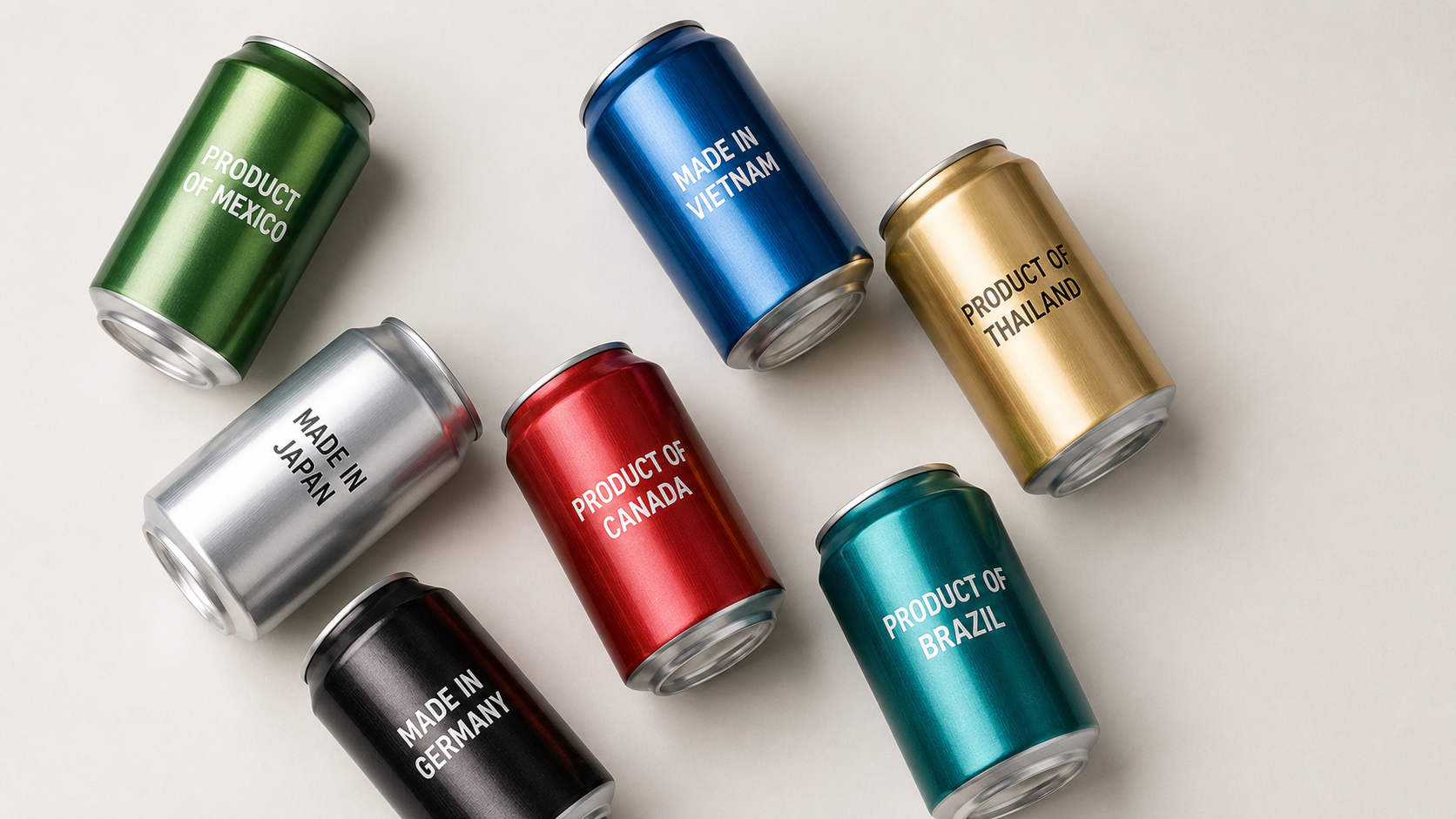
Use the full English name of the country. Typical acceptable phrases include “Made in [Country],” “Product of [Country],” or “Manufactured in [Country].” Do not substitute a city, province, or region for the country name. Avoid abbreviations unless they are customary and unambiguous for the country name in English. “Vietnam,” “Thailand,” “Mexico,” “Italy,” and “Japan” are straightforward examples.
- Keep it direct and unambiguous: “Product of Vietnam.”
- Avoid qualifiers that confuse origin, such as “Designed in the USA” on a beverage. Origin for customs purposes is about where the beverage was produced.
- If different operations occur in different places, ensure the statement still conveys the true origin of the finished beverage. For example, “Bottled in Country B” does not, by itself, establish that Country B is the origin if the beverage’s substantial transformation occurred elsewhere.
- Match the label statement to your import paperwork to avoid discrepancies.
U.S. address on the label: the “close proximity” rule
If your label shows a U.S. city or address—often required for FDA’s name & place of business—CBP requires the country of origin to appear close to that U.S. reference and in at least a comparable size, using clear wording such as “Made in [Country]” or “Product of [Country].” This prevents a consumer from being misled into thinking the product is made in the U.S. simply because a U.S. address appears on the label.
Practical placement approaches include putting “Product of Vietnam” on the same back-label panel near “Distributed by ABC Imports, New York, NY,” and using a type size that is not dwarfed by the U.S. address. Avoid hiding the origin in a crease or under a fold, and do not let decorative graphics overwhelm the statement.
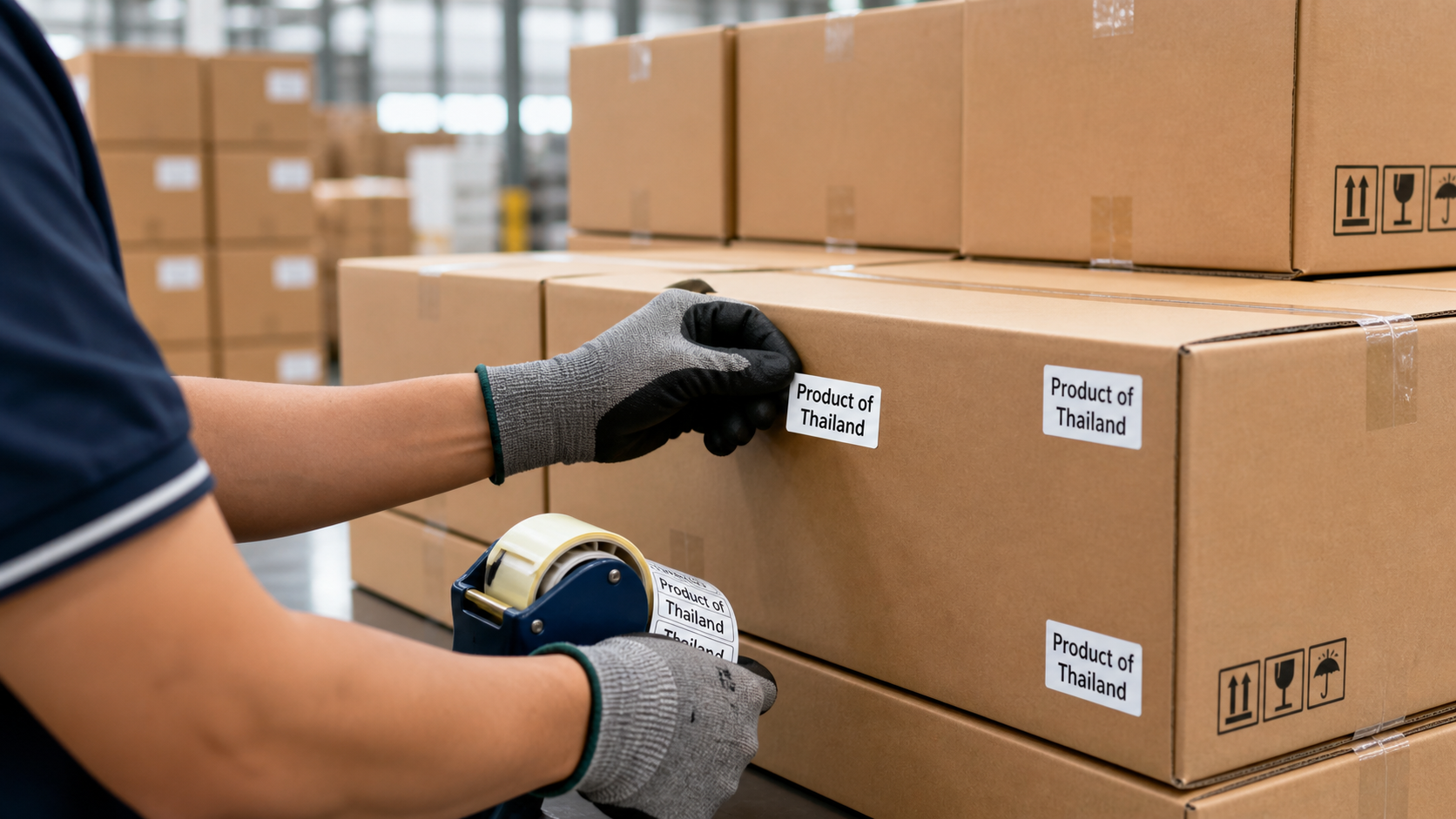
Examples of compliant and risky wordings
Clear examples help teams align artwork, packaging, and supplier instructions before the first print run. Here are illustrative patterns commonly seen in beverage projects.
- Compliant: “Product of Vietnam” placed on the back label, 2–3 lines below “Distributed by XYZ Beverages, Los Angeles, CA.” Comparable type size and easy to spot.
- Compliant: “Made in Thailand” on the can sidewall near ingredients, high-contrast ink, not obscured by the curve or seam.
- Compliant: “Manufactured in Mexico” printed on each bottle and repeated on the sealed 6-pack overwrap.
- Risky: “Bottled for ABC, California” with no country-of-origin statement anywhere on the retail unit.
- Risky: Origin statement printed only on the bottom of a can, faintly embossed, hard to read during normal handling.
- Risky: Prominent “New York” callout on the front label, but origin appears elsewhere in tiny type or on a different face.
These examples are for guidance only. CBP evaluates actual labels in context, and importers should review artworks as printed on the real container—not just on a flat PDF proof—before shipment.
Multi-country sourcing, concentrates, and substantial transformation
Beverage supply chains often involve concentrates, flavors, and packaging from different countries. Customs origin is generally determined by substantial transformation—the country where the product became the article of commerce that is imported. For beverages, substantial transformation can depend on how component ingredients are processed and combined.
- Reconstituting concentrate and blending sweeteners, acids, and flavors into a finished beverage may establish origin in the country where that blending and bottling occur, but this is fact-specific.
- Simple bottling or repackaging of a finished beverage without changing its character typically does not change origin.
- If lots may originate in different countries across the year, each lot must carry the correct country name for that lot. “Made in EU” or “Made in Multiple Countries” is generally not an acceptable substitute.
- When in doubt, align your formula, process description, and invoices so the chosen origin can be reasonably supported.
Outer cartons, inner packs, and repacking after import
CBP typically expects the retail unit to be marked. If not feasible, marking the immediate container may be considered. For shipping cartons, you should also mark the country of origin so warehouse teams and inspectors can identify the origin quickly and so that labeling in the supply chain stays consistent with entry paperwork.
If you will remove or alter labels in the U.S. (for example, adding a U.S. Nutrition Facts panel or changing flavors on a shared label template), you may be considered to be repacking. In that case, importers often need to certify to CBP that correct origin marking will appear on the repacked retail units. Plan repacking carefully and keep records tying the new labels to the imported lots.
Legibility, permanence, and placement tips for bottles and cans
CBP requires marking to be legible, indelible, and permanent to the extent permitted by the nature of the article. In beverage practice:
- Favor printed-on labels or direct print on cans and bottles. If using stickers, choose an adhesive suitable for condensation and distribution handling.
- Use high-contrast text against the label background; avoid placing the statement in busy graphic areas.
- Keep the statement away from sharp curves, seams, shrink-film joins, or undercaps. Consumers should not have to rotate the product multiple times to find it.
- On multi-packs, avoid placing the only origin statement where it is obscured by shelf-ready packaging or corner guards.
Interaction with FDA labeling and other claims
FDA’s food label rules require the name & place of business (manufacturer, packer, or distributor) with a city, state, and ZIP for U.S. firms, or a full address for non-U.S. firms. When a U.S. address appears, CBP’s “close proximity” principle requires a clear country-of-origin statement near that address, using “Made in [Country]” or “Product of [Country].”
Country-of-origin is a CBP customs marking issue. FDA does not generally prescribe a specific country-of-origin line for beverages, but including it on your label is how you satisfy the customs requirement for the ultimate purchaser. For a broader view of FDA components that typically appear alongside origin on beverage labels, see our U.S. food label checklist and this concise U.S. beverage regulations guide.
CBP marking exceptions and edge cases (brief)
Customs regulations include limited exceptions (e.g., when marking the container is sufficient, or where marking is impracticable). However, beverages are normally expected to show origin on the retail unit. Do not rely on an exception unless you have a clear, documented basis and a practical plan for consumer-facing disclosure.
- Small or difficult-to-mark items: consider printed multipacks that remain the retail unit.
- Samples and non-retail formats: discuss ahead of time with your broker so origin is clear and consistent on documents and packaging.
- Trademarks or trade names that include geographic terms: special proximity and conspicuousness rules can apply; position the origin to avoid confusion.
Common beverage scenarios: what to mark
The table below summarizes frequent import scenarios and practical marking approaches for beverage teams. It does not replace legal analysis but gives project managers and designers a reliable starting point.
| Scenario | What determines origin | How to mark | Positioning & notes |
|---|---|---|---|
| 100% juice produced and bottled in Vietnam | Origin generally Vietnam if the beverage is manufactured there | “Product of Vietnam” or “Made in Vietnam” | Place on back label near address; ensure high contrast and comparable type size |
| Concentrate from Country A, reconstituted, blended, and bottled in Country B | Often Country B if substantial transformation occurs there; fact-specific | “Made in [Country B]” if supported by process | Document processes and keep supplier declarations; align with invoices |
| U.S. address appears for distributor | Origin is still the manufacturing country | “Made in [Country]” near the U.S. address | Use comparable type size and close proximity to avoid confusion |
| Private-label product with U.S. brand name | Origin is the non-U.S. manufacturing country | “Product of [Country]” clearly on the retail unit | Front label is optional, but placement must be conspicuous and easy to find |
| Variable origin across lots during the year | Each lot takes its own origin | Use overprint or stickers per lot: “Made in [Country]” | Control artwork versions and lot traceability to prevent mismatches |
Documentation and entry: aligning labels, invoices, and carton marks
CBP expects your commercial documents, carton marks, and label statements to tell a consistent story. Before shipment:
- Ensure the commercial invoice states the correct country of origin for each SKU and lot.
- Align label artwork lines exactly with the country on the invoice (“Product of Vietnam,” not a different country or phrasing).
- Print carton marks with the same country, visible on at least one side that warehouses can scan quickly.
- Where preference claims or special programs apply, verify those certificates are compatible with the labeled origin.
- Keep supplier attestations about where manufacturing took place, especially if your formula enables substantial transformation in a second country.
Pre-print checklist for country-of-origin on beverage labels
Use this practical checklist before you approve the first production run:
- Exact country name in English, spelled correctly.
- Acceptable phrase chosen (“Product of [Country]” or “Made in [Country]”).
- Positioned conspicuously on the retail unit, not hidden by curves, seams, or overwraps.
- High-contrast, readable type; not overwhelmed by graphics.
- If a U.S. address appears, the origin is in close proximity and comparable size.
- Consistent across label, carton marks, invoice, and other shipping documents.
- Plan for variable origin by lot—version control or origin stickers where necessary.
- Legible and durable print method suitable for cold chain and condensation.
- Physical mockup reviewed: origin location confirmed on the actual container.
- Broker review or internal compliance sign-off captured before shipment.
Notes for private-label brands, retailers, and distributors
Private-label beverages frequently use a U.S. distributor’s or brand owner’s address for FDA’s name & place of business. Ensure the country-of-origin line sits close to that address and is not minimized in size. When your program spans multiple factories or seasonal origins, implement a strict artwork and over-sticker protocol so each lot ships with the correct country.
If you are developing a new line, align your regulatory timeline with sourcing, MOQ, and print lead times. Early in the process, review core FDA elements, then add the customs origin line and run a holistic check before you lock plates. For practical resources that complement this topic, explore Private label beverages for U.S. brands, typical Beverage MOQ for U.S. private label projects, and how to Import beverages into the United States.
FAQ
Quick answers to common questions about country-of-origin marking for beverage imports.
Do beverages imported into the U.S. need a country-of-origin statement?
Yes. Imported beverages must be marked in English with their country of origin so the ultimate purchaser knows where they were made. Mark the retail unit or a qualifying immediate container so the statement is conspicuous and permanent.
Where should I place “Made in [Country]” on a can or bottle?
Use a readable, high-contrast location on the can sidewall or bottle label. Back-label placement near the address line is common. Avoid seams, curves, or locations typically hidden by multipack overwraps.
If my label shows a U.S. distributor address, what else is required?
Place a clear country-of-origin statement close to the U.S. address in comparable type size, for example: “Product of Vietnam.” This prevents confusion about where the beverage was made.
Can I say “Made in EU” or “Made in Multiple Countries” for fluctuating origins?
Generally, no. Each imported lot should show its specific country (“Made in Spain,” “Made in Italy,” etc.). Use versioned artwork or accurate lot-specific stickers.
We fill U.S. Nutrition Facts panels after arrival. Is that repacking?
Applying or changing retail labels in the U.S. can be repacking. Importers who repack typically need to ensure the new retail units carry correct origin statements and may need to certify that marking post-entry is completed properly.
What is the difference between FDA’s address requirement and CBP’s origin marking?
FDA requires the name & place of business of the responsible firm; CBP requires the product’s true country of origin. If a U.S. address appears, place “Made in [Country]” nearby to keep the total label clear and compliant.
How does this relate to the FTC’s “Made in USA” standard?
FTC’s “Made in USA” applies to domestic-origin claims. For imported beverages, you must disclose the non-U.S. origin. Do not imply U.S. origin when the beverage is made abroad.
Conclusion and next steps
For beverages entering the U.S., a clear, conspicuous country-of-origin line is both a legal requirement and a practical safeguard against costly border delays. Choose an unambiguous phrase (“Product of [Country]”), position it near any U.S. address in comparable size, and align it with invoices and carton marks. Because supply chains and formulas vary, anchor your decision in how the beverage is actually manufactured and document it.
To round out your compliance plan, pair this guide with a structured label review using our U.S. food label checklist, a refresher on the broader U.S. beverage regulations guide, and the logistics steps in Import beverages into the United States. If you are building a private-label program, align regulatory decisions with sourcing and print runs via Private label beverages for U.S. brands and plan capacity through Beverage MOQ for U.S. private label projects. Done together, these steps keep origin marking accurate, visible, and ready for customs inspection.
Manufacturing for U.S. brands
If you are sourcing for the U.S. market, three pages cover what buyers ask first. OEM beverage manufacturing sets out how contract production works; certifications and food safety systems covers the documents customs and retailers will ask you to produce; export and logistics covers shipping terms and the document pack. To price a programme, request a quote.
Sources
Country-of-origin marking is enforced by U.S. Customs and Border Protection under Section 304 of the Tariff Act of 1930. Label copy is governed separately by FDA.
- U.S. Customs and Border Protection — Marking of Country of Origin on U.S. Imports
- U.S. Food and Drug Administration — Guidance for Industry: Food Labeling Guide
Where to go next
Sourcing for the U.S. market? The United States beverage market page covers the full OEM and private label programme for U.S. brands and importers: MOQ 500 cartons per SKU, 15-30 day production, HACCP / ISO 22000 / FSSC 22000, and shipping from Ho Chi Minh City. Request a quote and we reply within 24 hours.