







 Français
 Español
 العربية
 한국어
한국어FDA prior notice for a beverage shipment is an electronic filing that must reach the agency before a food or beverage shipment arrives in the United States. It tells FDA what is coming, from whom, on which conveyance and where it will arrive, so that the agency can decide whether to examine the consignment. Without a valid filing the goods may be refused admission and held at the port.
This page covers when the filing is due, what information it requires, who normally submits it and what happens when it is wrong. It deals only with prior notice; the separate obligation on the importer to verify its supplier is covered in our page on FSVP for imported drinks.
When must FDA prior notice for a beverage shipment be filed?
Before the shipment arrives, with the deadline set by how it travels. Filings are due no less than a defined period ahead of arrival, and that period is shortest for road and air and longest for ocean freight. Filing too early can be as problematic as filing late, because the submission must reflect the shipment as it will actually arrive.
Prior notice sits alongside other requirements, not instead of them
It is one of several obligations attaching to the same consignment, and each is independent. The foreign facility must be registered with FDA. The importer must hold an FSVP file. The product and its label must comply. Prior notice covers the movement itself.
Satisfying one does nothing for the others. A shipment from a properly registered facility, with a complete FSVP file behind it, will still be refused if prior notice was not filed or was materially inaccurate. Our overview of the US beverage import procedure shows how the pieces fit together.
| Obligation | Applies to | Frequency |
|---|---|---|
| Facility registration | The foreign plant | Once, then renewed periodically |
| Prior notice | Each individual shipment | Every consignment, before arrival |
| FSVP | The US importer | Ongoing programme |
| Label compliance | The product | Continuous |
What the filing has to contain
Prior notice asks for a precise description of the consignment rather than a summary. The submission generally covers the product identity including its FDA product code, the manufacturer, the shipper, the grower where relevant, the country of production, the importer, owner and ultimate consignee, the carrier and mode of transport, the anticipated arrival port and time, and the registration number of the foreign facility.
Accuracy matters more than completeness in one specific sense: a plausible but wrong entry is worse than an obviously missing one, because it may pass validation and fail later at the port. The facility registration number is the field most often wrong, usually because it was copied from an earlier shipment after the registration had been renewed or the facility had changed.
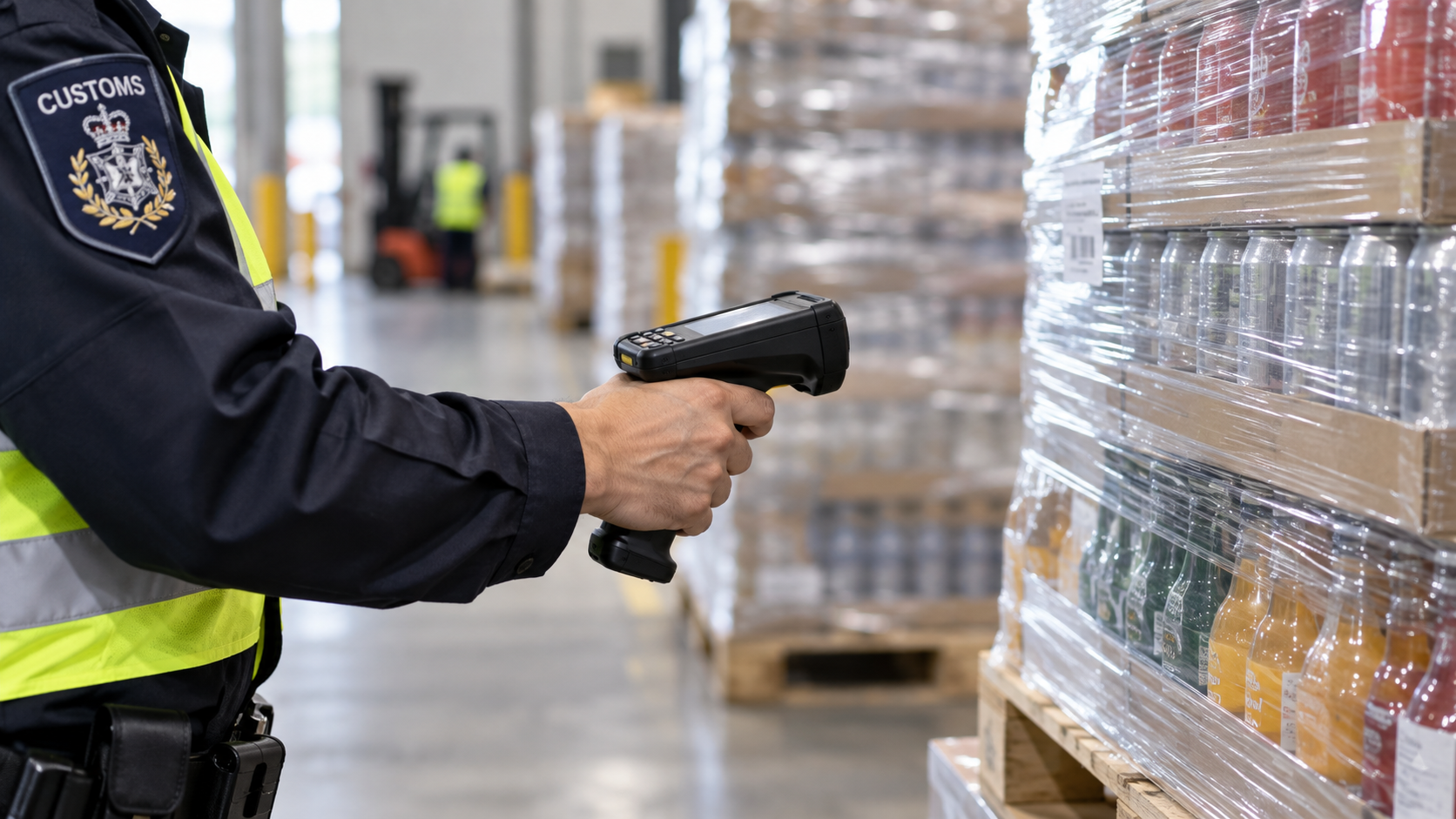
Getting the data right the first time
Most rejected or amended filings fail on a small number of fields, and each has a reliable way to verify it before submission:
- The facility registration number, confirmed directly with the manufacturer for the current registration period rather than copied from a previous shipment.
- The product code, checked against the actual product rather than reused from a similar item in the same range.
- The manufacturer of record, which must be the plant that actually made the goods, not the brand owner or the trading company.
- The ultimate consignee, which is where the goods are really going rather than a head office address.
- Arrival details, matched to the final booking confirmation rather than the original plan.
Where a single container carries several products, each requires its own coverage. Mixed consignments are a recurring source of partial filings, particularly when a brand adds a new flavour to an established shipping routine and nobody updates the filing template.
Multi-country and transhipped routes
Routes that pass through a third country add complexity. The filing asks for the country of production rather than the country of departure, and these differ whenever goods are consolidated, stored or transhipped along the way.
A consignment manufactured in Vietnam, consolidated in Singapore and shipped onward to the United States is still of Vietnamese production for this purpose, and the manufacturing facility named must be the Vietnamese plant with its own registration. Naming the consolidator instead is a straightforward way to create a mismatch between the filing and the accompanying documents.
Where goods change hands during transit, the chain of parties on the filing has to reflect the real transaction rather than the simplest version of it. Clarify this before the first shipment on any indirect route, because correcting it under time pressure at the port is considerably harder.
Who actually submits it
Any party with the required information may file, and in practice it is usually the customs broker or the importer. The exporter can file, but rarely does, because much of the required data concerns the US side of the transaction.
What matters commercially is that responsibility is assigned explicitly. The most common failure pattern in a new import programme is not an incorrect filing but an absent one, where the brand assumed its freight forwarder was handling it and the forwarder assumed the broker was. Confirm in writing who files, and ask for the confirmation number on each shipment as proof that it happened.
When the shipment changes after filing
Shipments change constantly. Vessels are delayed, consignments are split, quantities are adjusted and ports are switched. Prior notice must reflect the shipment as it arrives, which means a material change requires the filing to be updated or resubmitted before arrival.
Minor timing slippage is usually accommodated, but a change of port, carrier, product or quantity is not a detail. Build a check into the pre-arrival routine so that the filing is reviewed against the final documents rather than against the booking made weeks earlier.
What happens when prior notice is wrong
The consequences escalate, and the commercial cost is usually the delay rather than any penalty.
- Goods arriving without adequate prior notice may be refused admission and held at the port or at a secure facility.
- Holding costs accrue during the hold, including demurrage, detention and storage, and these fall on the importer.
- Chilled or short shelf life products lose saleable life while held, sometimes enough to make the consignment commercially worthless even if it is eventually released.
- A pattern of inaccurate filings attracts attention and can lead to closer examination of subsequent shipments.
- Refused goods must generally be exported or destroyed, both at the importer’s cost.
For beverages the shelf life point is the sharp one. A drink with a long ambient life can usually absorb a delay of days; a chilled product often cannot, and retailers applying a minimum remaining shelf life requirement may refuse delivery of stock that was held.
Keeping the confirmation as part of the shipping file
The filing produces a confirmation number, and that number is the evidence the shipment was covered. Treating it as a piece of freight correspondence rather than as a commercial record is a small habit with real consequences.
Keep it with the invoice, packing list and transport document for each consignment, so that any later query about a particular shipment can be answered from one place. Where a broker files on the importer’s behalf, require the number to be returned as part of the standard document pack rather than supplied on request, since a broker relationship can end while the record retention obligation continues.
This also makes an internal check possible. Comparing the number of confirmations against the number of consignments received in a period is a crude control, but it surfaces the gap that matters most: a shipment that travelled without anyone filing at all.
Reducing the risk on a new programme
Prior notice failures are almost entirely preventable, and the preventive work is administrative rather than technical.
Verify the foreign facility’s registration number directly with the manufacturer before the first shipment, and again whenever a renewal falls due. Assign filing responsibility in writing and require the confirmation number to be returned with the shipping documents. Check the product code against the actual product rather than reusing a code from a similar item. Where a consignment contains several products, confirm that each is covered rather than assuming one filing covers the container.
Timing discipline helps too. Agreeing with the forwarder that the filing happens at a fixed point in the documentation sequence, rather than as late as the deadline permits, leaves room to correct an error before arrival. Our page on shipping beverages from Vietnam to the United States covers the wider documentation flow, and how to import beverages into the United States sets out the sequence from order to clearance.

FAQ
Does the filing deadline depend on the mode of transport?
Yes. The minimum notice period differs between road, rail, air and ocean freight, with ocean carrying the longest requirement and land and air the shortest. Because a single programme may use more than one mode, the deadline should be checked against the actual booking rather than applied from habit.
Does prior notice apply to samples?
It applies to food offered for import, and small quantities sent for evaluation are frequently caught by the requirement. Because samples often travel by courier with minimal documentation, they are a common source of surprise holds. Check the position before sending rather than after a shipment is stopped.
Can prior notice be filed after arrival?
The requirement is that adequate notice is given before arrival, so a filing made afterwards does not cure the problem. In practice the consignment is held until the situation is resolved, which may involve refusal. Treating the deadline as firm is the only workable approach.
Who pays when a shipment is held?
Costs normally fall on the importer regardless of which party made the filing error, unless the supply contract allocates them differently. This is one reason to state responsibility for filing, and liability for failures, in the agreement rather than leaving it to the freight relationship.
Is prior notice needed for every shipment from an approved supplier?
Yes. Approval of the supplier, registration of the facility and a complete FSVP file do not remove the per-shipment obligation. Prior notice is about the movement of goods, so it repeats for every consignment however routine the trade lane has become.
Building it into the routine
FDA prior notice for beverage shipments is a small administrative step with disproportionate consequences when it goes wrong. The controls that matter are assigning responsibility explicitly, verifying the facility registration number rather than reusing it, updating the filing when the shipment changes, and keeping the confirmation with the shipping file.
Labelling compliance should be settled on the same timeline, since a held shipment and a non-compliant label create the same commercial outcome. Our US food label checklist for imported beverages covers that side. Requirements and timings should be confirmed with FDA or a qualified customs adviser for your specific product and route.