


 Français
 Español
 العربية
 한국어
한국어A Nutrition Facts label for beverages in the United States is the standardized panel required by FDA to disclose serving size, calories, and specific nutrients on packaged drinks sold at retail. This guide explains the nutrition facts label beverages requirements in practical terms so brand owners, importers, and product developers can plan formulas, packaging, and timelines with fewer surprises.
Rules can vary by package size, beverage type, and the claims you choose to make. The details below focus on core FDA labeling principles for drinks, highlight decisions that affect your design and formulation, and outline a compliant workflow. Always confirm your final label against current FDA regulations and market-specific guidance before printing.
What is the Nutrition Facts label for beverages?
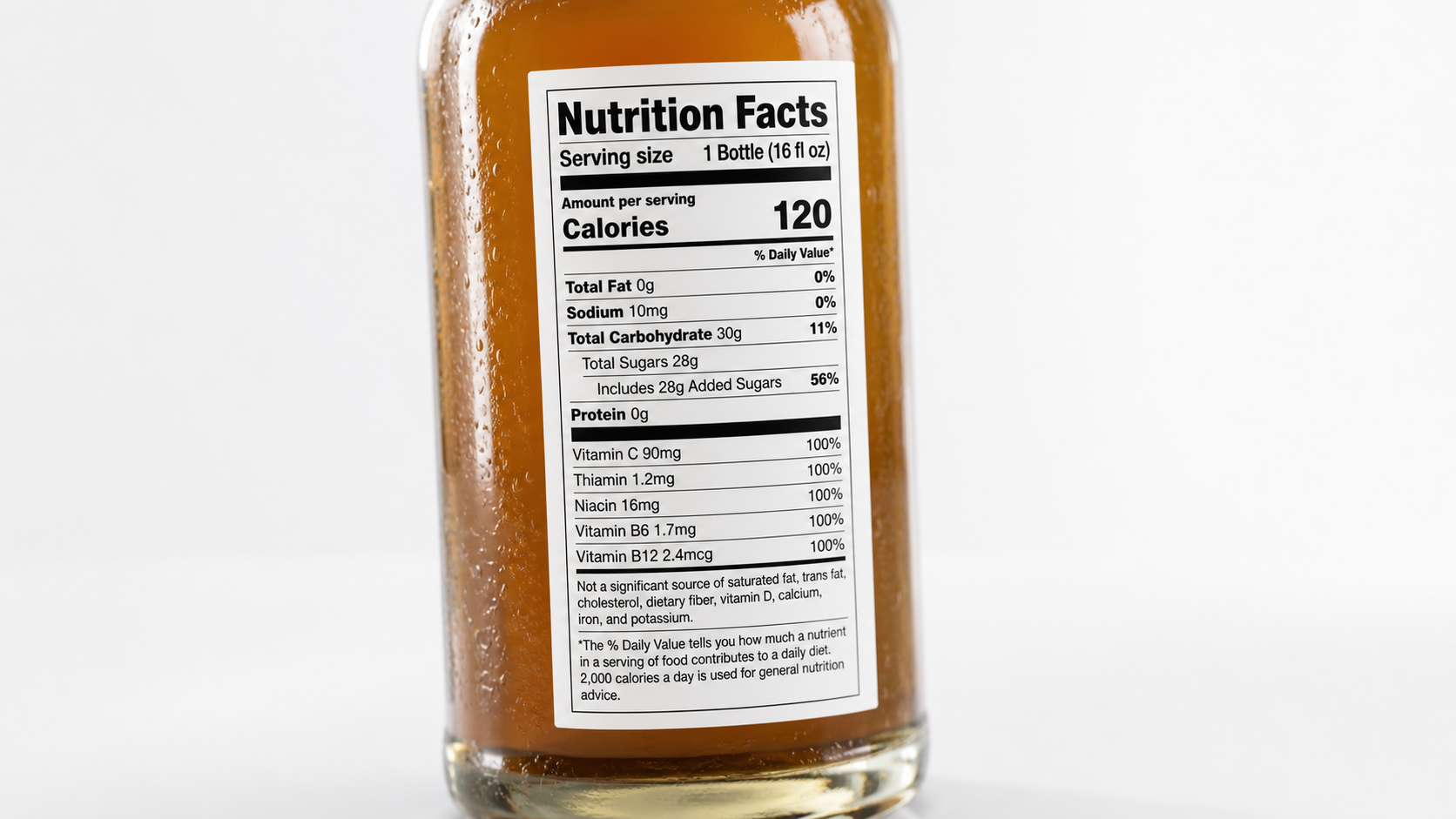
The Nutrition Facts label is the mandated U.S. panel that declares serving size, servings per container, calories, and a set of standardized nutrients in a precise order and format. For beverages, the panel must follow FDA formatting conventions and use a serving size derived from reference amounts customarily consumed (RACCs) for the applicable drink category.
Beyond the required nutrients, the label also shows % Daily Value (%DV) for each nutrient that has a Daily Value established by FDA. The panel is not a marketing space; typography, order, spacing, and line rules are prescribed. Optional elements may be allowed in certain cases, but any additions must not detract from legibility or contradict FDA requirements.
Which FDA rules govern beverage Nutrition Facts?
In general, the Nutrition Facts label is governed by FDA’s food labeling regulations (including 21 CFR 101) and related guidance documents. Beverages sold in interstate commerce or imported for retail sale in the United States are typically required to comply. There are narrow exemptions (e.g., qualifying small businesses or food served for immediate consumption), but importers and brand owners should not assume an exemption without a documented basis.
In practice, you will work across several sources: the master regulation for the Nutrition Facts format, serving size tables based on RACCs, and FDA guidance for specific nutrients (such as added sugars) and formatting allowances (such as dual-column or simplified formats). When in doubt, check the most up-to-date FDA guidance and consider a compliance review before print.
How do you determine serving size for drinks in the USA?
Serving size for beverages is not a marketing choice; it is anchored to the RACC for the appropriate beverage category and expressed in a common household measure (for example, fl oz) along with its metric equivalent. You then determine how many servings are in the container and present “Serving size” and “Servings per container” accordingly.
A practical workflow many teams use:
- Identify the correct beverage category in FDA’s RACC tables (e.g., juice, soft drink, sports drink, coffee/tea, flavored water, etc.).
- Adopt the RACC as your serving size basis, then convert to the household measure and metric declaration that best fits the drink (fluid ounces and mL are common for beverages).
- Calculate “Servings per container” by dividing net contents by serving size. Round as permitted by FDA conventions, and ensure the final count aligns with your selected label format (single-serve, multi-serve, or dual-column).
- Confirm that the declared serving size matches how consumers typically drink the product. The RACC framework is intended to reflect customary consumption, not prescriptive nutrition guidance.
Packages that contain up to and including a single-serving amount are labeled as one serving per container. Packages with amounts that fall between a standard single-serving size and larger multi-serve formats may trigger dual-column labeling (see the dedicated section below). Larger multi-serve containers generally use the standard single-column format with per-serving values.
When is a dual-column Nutrition Facts label required?
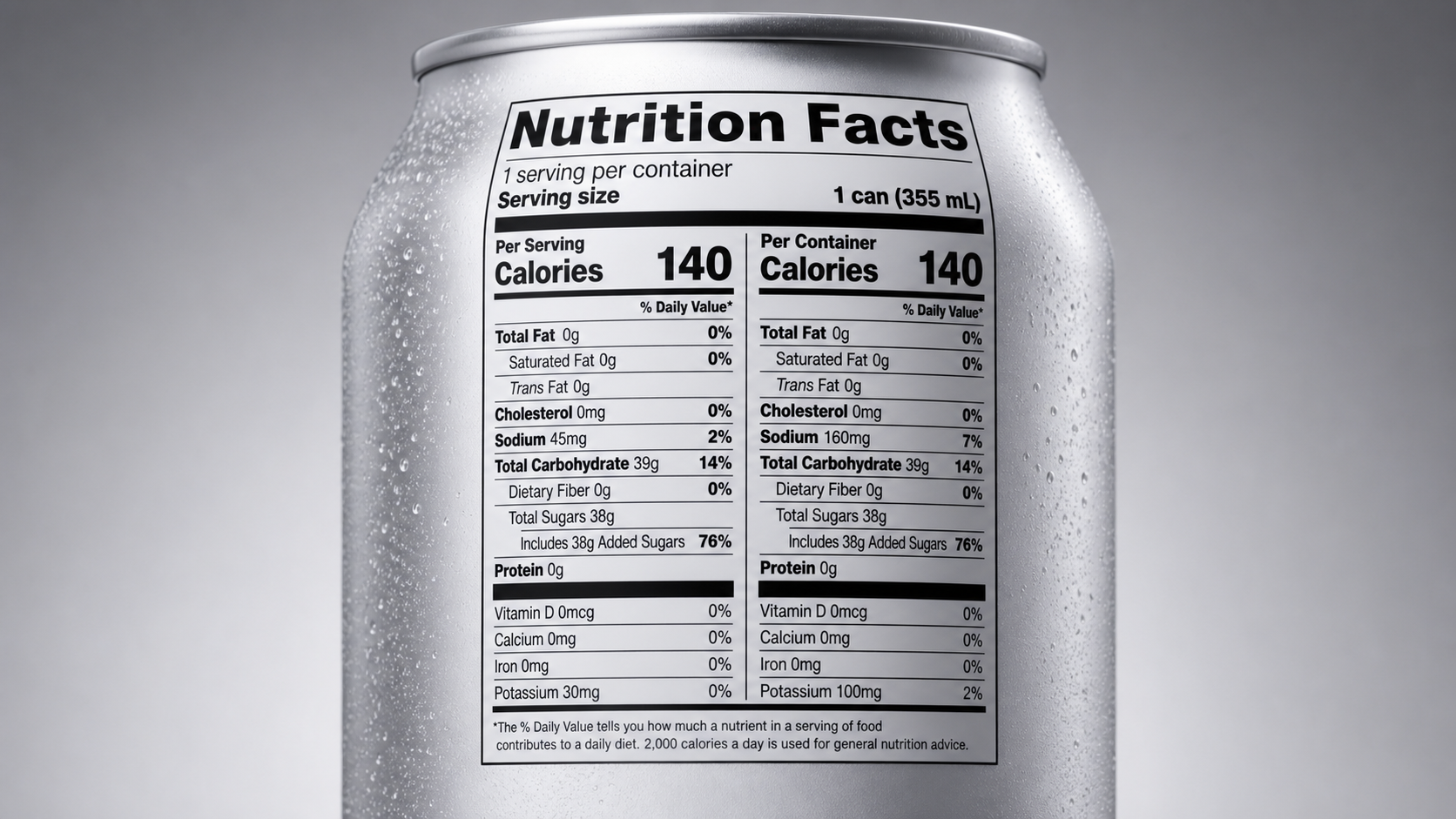
Dual-column labeling is required for certain packages that could be consumed in one sitting or multiple sittings, typically when the package contains at least two servings but not an excessively large amount. In these cases, the label must present nutrition information per serving and per container side-by-side so consumers can see both views clearly.
Common beverage scenarios that often lead to dual-column labels include:
- Medium-size bottles or cans that reasonably provide about two servings.
- Single containers that exceed one serving but not by a large margin, creating consumer ambiguity about whether it is one or multiple servings.
- Formats where consumption patterns vary (e.g., energy drinks or sports drinks in mid-size packages) and a per-container perspective improves transparency.
For very small packages at or below a single-serving amount, labels are treated as one serving per container. For large multi-serve containers, standard single-column labels (per serving) are typical, and dual-column may not be required. Review the current FDA thresholds and examples to confirm the correct approach for your net contents and category.
Which nutrients must appear and in what order?
FDA prescribes the order and formatting of mandatory elements on the Nutrition Facts label. For beverages, the panel typically includes:
- Serving size and Servings per container
- Calories
- Total Fat, Saturated Fat, Trans Fat
- Cholesterol
- Sodium
- Total Carbohydrate, Dietary Fiber, Total Sugars, and Includes Added Sugars
- Protein
- Vitamin D, Calcium, Iron, Potassium
The %DV must be declared for most of these nutrients. Additional nutrients may be declared voluntarily if present and if you follow FDA rules for which nutrients can be added voluntarily and how they must be presented. Rounding, indentation, and type size for each line follow specific format rules to preserve consistency and readability.
Added sugars on beverage labels: what must be shown?
For beverages, “Total Sugars” includes all sugars present, both naturally occurring and added. “Includes X g Added Sugars” is a mandatory sub-declaration that identifies how much of the total comes from added sources. The %DV for added sugars is also shown. This distinction helps consumers differentiate inherent sugars (for example, in 100% juice) from sugars introduced during processing or formulation.
In beverage development, ingredients that typically count as added sugars include sweeteners such as sugar, syrups, honey, and certain fruit juice concentrates used as sweeteners beyond normal reconstitution. By contrast, sugars that are intrinsic to whole fruit or the sugars that result from properly reconstituting a 100% juice from concentrate are not considered added sugars. Always verify each ingredient’s function: if it sweetens the beverage, it likely contributes to added sugars on the label.
Because many beverages are sweetened, your formulation choices will significantly influence the “Includes Added Sugars” line and its %DV. Reformulating to limit added sugars may reduce calories per serving and adjust your label positioning, but confirm sensory impact and shelf stability before finalizing changes.
Choosing the correct Nutrition Facts format
FDA provides several standardized formats, and the correct choice depends on your container size, shape, and available label area:
- Standard vertical format: The most common layout for most beverage packages with adequate panel space.
- Simplified format: Allowed when certain criteria are met (for example, when only a few nutrients are present in significant amounts). Confirm eligibility before use.
- Tabular format: Used when the available vertical space is limited but sufficient horizontal space exists (often on small panels or tight sleeves).
- Linear format: A single-line layout for very small packages where neither vertical nor tabular formats fit.
- Dual-column formats: Required in scenarios discussed above, showing both per serving and per container. There are also specialized dual-column variations for discrete units or for situations involving multiple distinct preparations.
For shrink sleeves, curvy bottles, and small-diameter cans, the available print area can drive format choice. Lock your dieline early and confirm that the panel can hold the prescribed minimum type sizes, rules, and spacing before finalizing artwork.
Allergens, caffeine, and other statements near the panel
While the Nutrition Facts panel has a defined scope, beverage labels often carry other regulated statements nearby. Examples include allergen labeling for major allergens present in added ingredients, caffeine declarations when desired or required in certain contexts, and safe handling or storage statements. If you choose to make nutrient content claims (for example, claims relating to calories, sugars, or vitamins) or other voluntary statements, ensure they align with your verified lab data and that your Nutrition Facts presentation supports them under FDA rules.
Remember that all marketing copy must be truthful and not misleading. If you plan claims (e.g., related to sugars or calories), confirm that your label values, serving size, and formulation consistently support the claim across all package sizes and production lots.
Common pitfalls that delay beverage label approval
Small oversights can snowball into printing delays or relabeling costs. Watch for these issues in beverage projects:
- Serving size mismatch: Declaring a serving that does not align with the appropriate RACC for your beverage category.
- Incorrect dual-column eligibility: Missing dual-column when required, or using it where the standard single-column is expected.
- Added sugars misclassification: Treating sweetening ingredients as intrinsic sugars instead of added, or vice versa.
- Formatting deviations: Incorrect type sizes, rule weights, indentations, or order of nutrients.
- Inconsistent values: Artwork values that do not match final lab results or database calculations.
- Crowded panels: Trying to squeeze claims or graphics around the Nutrition Facts panel and compromising legibility.
- Translation and import issues: For imported beverages, English-language panel and U.S. format are typically required; foreign formats are not substitutes.
Single-serve vs multi-serve vs dual-column at a glance
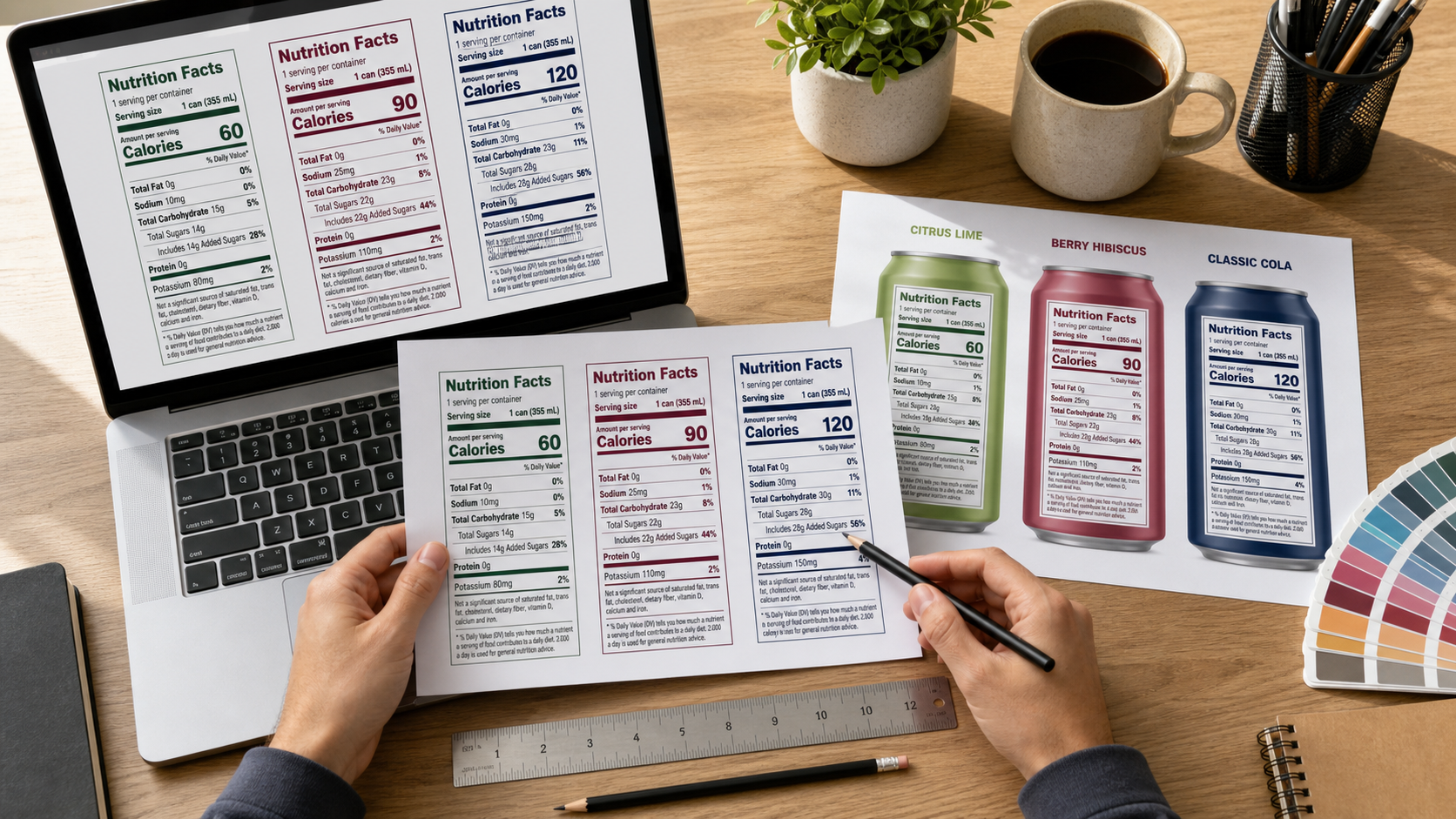
The summary below can help teams align format choice with container strategy. Confirm exact thresholds and exceptions with current FDA guidance during finalization.
| Format | When it applies | Key layout notes | Positioning & notes |
|---|---|---|---|
| Single-serve (per container) | Packages at or below a single-serving amount for the applicable beverage RACC | Declare Servings per container as 1; Calories and nutrients shown per container | Often used for small cans/bottles designed for one sitting |
| Standard single-column (per serving) | Multi-serve containers exceeding common single-serve amounts | Declare a serving size based on the RACC; show per-serving values | Common for family-size jugs or multi-serve PET bottles |
| Dual-column (per serving & per container) | Packages that reasonably provide about two servings (not excessively large) | Two aligned columns: one per serving, one per container | Improves transparency for mid-size bottles and cans |
| Tabular / Linear | Small or constrained label panels where vertical format will not fit | Follow FDA rules on order, type size, and separators | Use only when the standard format cannot be accommodated |
Workflow to create an FDA-ready beverage Nutrition Facts label
A structured process reduces rework and helps align R&D, regulatory, and design:
- Define the product brief: Beverage category, target net contents, packaging type, sweetener strategy, and intended claims. Decide early whether mid-size packages may require dual-column.
- Collect supplier documentation: Obtain specifications and certificates of analysis for all ingredients (including sweeteners and concentrates) and for processing aids where relevant.
- Establish the serving size: Identify the correct beverage RACC, convert to an appropriate household measure and metric equivalent, and determine servings per container.
- Build a nutrition database model: Use validated ingredient data and your formula to estimate calories, macronutrients, and added sugars. Create variants if you plan multiple sizes or sweetener systems.
- Pilot and lab verification: Where appropriate, verify results with an accredited laboratory using finished product samples that represent your final recipe and process.
- Draft the Nutrition Facts panel: Select the correct format (standard, dual-column, tabular, linear). Apply FDA typography, spacing, and order. Place the panel on the dieline where it prints cleanly.
- Regulatory review: Cross-check serving size, format eligibility (especially dual-column), added sugars classification, and any claims against your verified numbers.
- Artwork QA: Confirm numbers, %DVs, and footnotes match your approved spec. Ensure barcodes, net contents, ingredient list, and allergen statements are consistent and legible.
- Print controls: Approve proofs at actual size. Confirm that final ink weight, contrast, and substrate keep the panel readable under normal retail lighting.
- Change management: If formula or supplier changes occur, re-validate the panel before the next print run.
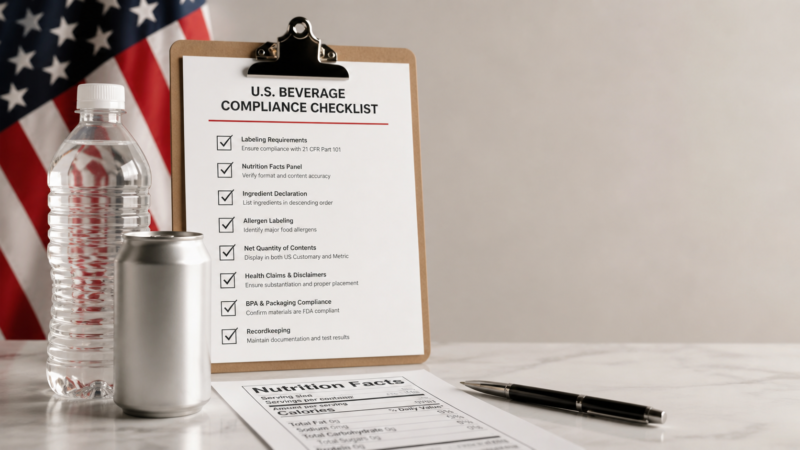
For a broader packaging review, see the U.S. food label checklist for imported beverages to align your Nutrition Facts work with other mandatory elements.
Formulation decisions that impact your Nutrition Facts panel
Even small recipe changes can alter how your panel looks and what it communicates to consumers. Consider these factors early:
- Sweetener strategy: The type and amount of sweetener drives calories and the “Includes Added Sugars” line. Reducing added sugars may support your positioning, but test for flavor, mouthfeel, and stability.
- Juice content and concentrates: In 100% juice, properly reconstituted concentrate does not count as added sugars; using concentrate to sweeten a non-juice beverage generally does. Document your intent and formulation.
- Acids and pH management: Acidulants affect perceived sweetness and can reduce the sweetener load. Validate sensory impact against your sugar targets.
- Fortification: If adding vitamins or minerals for positioning, confirm allowable forms, units, and that the label can support any voluntary claims you plan to make.
- Serving size and package architecture: Choosing mid-size packages may trigger dual-column requirements. Lock the format early to avoid redesigns.
- Thermal processing and shelf life: Heat can slightly shift measured values (e.g., soluble solids). Verify with the actual finished product.
If you are planning a retail-ready SKU, you may also find it helpful to review private label beverages for U.S. brands to align product strategy, claims, and packaging standards with retailer expectations.
Designing for readability and compliance
The Nutrition Facts panel is a technical document with strict visual rules. Good design supports compliance:
- Type and contrast: Use the required type sizes and weights. Maintain high contrast between text and background.
- Spacing and rules: Keep mandated hairlines and spacing between nutrient groups. Don’t compress lines to fit extra marketing copy.
- Clear margins: Leave room around the panel so it doesn’t get crowded by images or claims.
- Dieline realities: On curved containers, check for distortion and legibility after application (especially shrink sleeves).
- One source of truth: Lock your final, approved nutrition spec and prevent ad-hoc edits in design files.
Imported beverages and U.S. retail compliance
For imported drinks, the U.S. Nutrition Facts format is generally required even if a foreign-language panel exists. Do not assume an EU or other international format is acceptable in place of the U.S. panel. Ensure English-language declarations, the correct serving size basis, and U.S.-specific nutrient order and footnotes are used.
If you are building a market entry plan, coordinate labeling with logistics, customs, and retailer timelines. These guides may help: how to import beverages into the United States and shipping beverages from Vietnam to the United States.
Quality assurance and documentation
Keep an auditable trail that shows how you derived every number on the panel:
- Ingredient specifications and certificates of analysis
- Formulation worksheets and batch records
- Nutrition database calculations (with version history)
- Lab reports for finished product verification when used
- Artwork proof approvals at actual print size
- Change logs for any formulation or supplier updates
Retailers and regulators expect consistency between your formulation, lab data, and printed panel. A robust documentation set streamlines questions and keeps teams aligned across updates.
Practical checks before sending to print
Run these quick checks on your final artwork:
- Serving size and servings per container align with the correct RACC and container net contents.
- Calories, nutrients, and %DVs match your approved nutrition spec.
- Added sugars are declared and classified correctly.
- Panel format (single, dual-column, tabular, or linear) is appropriate for the container.
- Type sizes, rule weights, and spacing follow FDA formatting rules.
- Ingredient list, allergen statements, net contents, and barcodes are consistent and legible.
When your label is part of a new brand launch or retailer program, confirm operational assumptions such as project minimums and lead times. For planning, see beverage MOQ for U.S. private label projects.
Examples of beverage-specific nuances
Every category has its own wrinkles. A few examples to consider during development:
- 100% juice vs. juice drinks: The role of concentrates and any added sweeteners will change both your ingredient list and your added sugars line. Keep documentation clear on when concentrate is used for reconstitution versus sweetening.
- Sweetened coffees and teas: Syrups and flavored bases often contribute added sugars. Serving size conventions may differ from carbonated soft drinks.
- Functional beverages: Fortification and claims may trigger additional rules for voluntary nutrients or disclosures; ensure that label values support any intended claims.
- Energy and sports drinks: Mid-size formats may require dual-column; caffeine declarations and claims need alignment with verified data and retailer policies.
- Flavored waters: Lightly sweetened formulas can help manage calories and added sugars, but verify lab values to ensure label consistency across batches.
Coordination with retailers and co-packers
Retailers often have style guides that layer on top of FDA requirements. Co-packers (or contract manufacturers) may also specify minimum type sizes for certain substrates or impose panel location constraints. Build a single checklist that merges FDA rules, retailer requirements, and your printer’s technical limits.
If you are developing a store brand or expanding a portfolio, align early with category targets, claims strategy, and dielines. For capability planning and development routes, see private label beverages for U.S. brands.
FAQ
Do imported beverages need a U.S. Nutrition Facts label?
Yes, if they are sold at U.S. retail and fall under FDA’s packaged food rules. Foreign nutrition formats (e.g., EU) do not substitute for the U.S. panel. Limited exemptions exist but should be confirmed with documentation before assuming they apply.
Can I reuse my EU or other foreign nutrition label in the United States?
No. The U.S. Nutrition Facts panel has different required nutrients, order, formatting, and serving size conventions. You must convert to the U.S. format, verify the numbers, and meet FDA design specifications.
Do zero-calorie or unsweetened beverages still need the panel?
In most retail scenarios, yes. Even products with very low or zero values must present the Nutrition Facts panel in the correct format, following FDA’s rounding and presentation rules.
When do I have to show vitamin or mineral amounts?
Certain vitamins and minerals (including vitamin D, calcium, iron, and potassium) are part of the standard Nutrition Facts panel. If you voluntarily add other vitamins/minerals or make specific nutrient content claims, additional rules apply to how they are declared. Confirm with current FDA guidance before making claims.
Do mid-size bottles and cans require dual-column labels?
Often yes, when a package reasonably provides about two servings and could be consumed in one or multiple sittings. Dual-column shows per serving and per container side-by-side to improve transparency. Verify eligibility based on your exact net contents and category.
Conclusion
Designing the Nutrition Facts label for beverages in the United States starts with the correct serving size, format eligibility (including dual-column, when applicable), and accurate added sugars classification. From there, consistent calculations, lab verification where appropriate, and precise formatting ensure a label that is both compliant and consumer-friendly. Build a single source of truth for your numbers, coordinate early with printers and retailers, and lock your dielines before creative refinements.
If your compliance plan is part of a larger market entry, align timelines with logistics and customs. These guides can help you sequence tasks and avoid rush changes: how to import beverages into the United States and shipping beverages from Vietnam to the United States. With the right workflow, your beverage can move from formulation to shelf with a clean, compliant Nutrition Facts panel that sets clear expectations for consumers.
Manufacturing for U.S. brands
If you are sourcing for the U.S. market, three pages cover what buyers ask first. OEM beverage manufacturing services outline how contract production is run; certifications and food safety systems covers the documents customs and retailers will ask you to produce; export and logistics covers shipping terms and the document pack. To price a programme, request a quote.
Sources
Label requirements on this page follow FDA guidance. Verify current wording and formatting against the primary source before artwork is signed off.
- U.S. Food and Drug Administration — Guidance for Industry: Food Labeling Guide
- FDA — Changes to the Nutrition Facts Label