


 Français
 Español
 العربية
 한국어
한국어U.S. buyers can select the right overseas beverage manufacturer by defining a precise product brief, building a qualified shortlist, performing structured due diligence, validating samples and shelf life, locking down specifications and contracts, and aligning logistics, regulatory, and quality plans before the first purchase order.
This guide breaks the process into practical steps tailored to U.S. import conditions, so you can confidently choose beverage manufacturer USA–compliant partners overseas. Requirements vary by product type and market; consider this a practical framework to coordinate your teams and external experts, not legal advice.
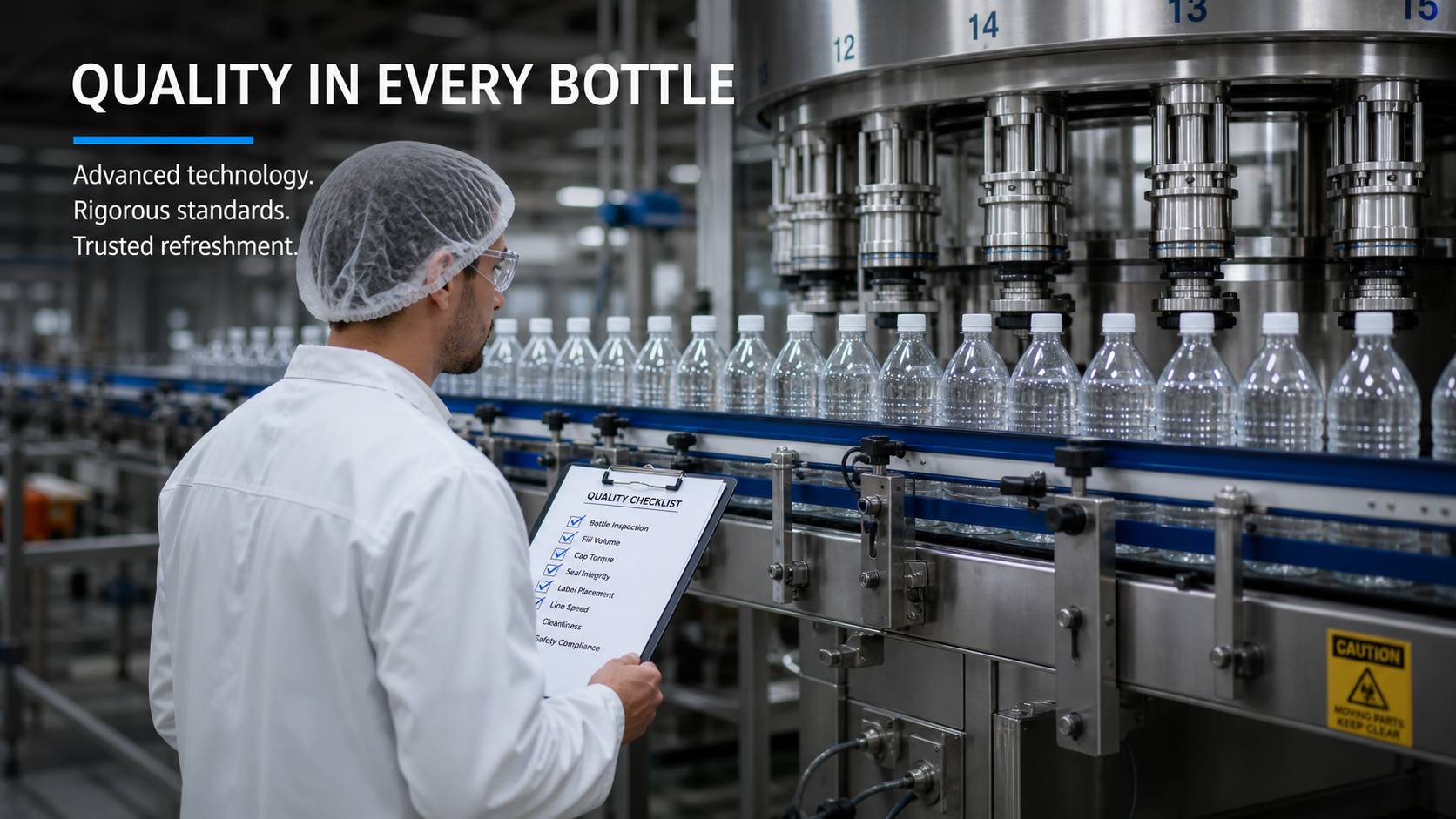
What does an overseas beverage manufacturer mean for U.S. brands?
An overseas beverage manufacturer is a partner outside the United States that formulates, processes, and fills your beverage to an agreed specification, then ships finished goods or components to your U.S. supply chain. Depending on your engagement model, they may provide turnkey formulation, procure ingredients and packaging, or simply fill your materials.
Common engagement models include:
- OEM/Contract manufacturing: You own the formula & brand; the factory produces to your spec.
- Private label: The factory offers standard formulas that you brand and customize lightly.
- White label: Ready-to-brand product with minimal or no formula changes.
Not sure which route best fits your goals? See a structured comparison in Private Label, White Label and OEM Beverages Compared.
When should U.S. buyers look overseas instead of domestic?
Consider overseas manufacturing when it enables access to specialized processes, ingredient origins, or cost structures that support your positioning while still meeting U.S. regulatory, quality, and service requirements. Equally, weigh added complexity—lead times, logistics risk, and cross-border compliance—against clear, quantifiable advantages.
- Compelling reason: Distinctive capability, proprietary technology, ingredient origin, or sustainable cost-to-value that is hard to match domestically.
- Operational readiness: Your team can manage longer planning cycles, documentation, and quality oversight.
- Compliance confidence: The partner can meet U.S. food regulations and labeling expectations for your category.
How do I build a buyer-ready beverage product brief?
Create a concise, unambiguous brief that lets suppliers price, plan, and de-risk your project quickly. A strong brief accelerates apples-to-apples quotes and reduces misinterpretation during development and scale-up.
- Product definition: Category (e.g., juice drink, RTD tea, coffee, functional water), flavor(s), sweetness target, presence of pulp/particulates, carbonation level, color expectations.
- Composition: Key ingredients and their preferred forms (e.g., NFC juice, concentrate, extracts), target Brix/acidity profile, inclusion of botanicals, caffeine, or electrolytes if applicable.
- Processing & shelf life: Hot-fill, tunnel pasteurization, retort, or aseptic; target shelf life (and storage temperature); stability constraints (e.g., color fade, cloud stability).
- Dietary & marketing constraints: Sugar reduction approach, no artificial colors/flavors if required, allergen avoidance, and any country-of-origin preferences for ingredients.
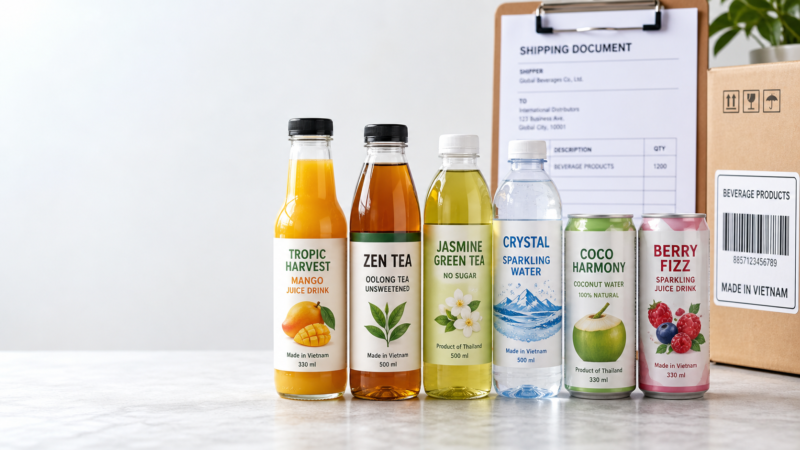
- Packaging: Primary format (can, glass, PET, aseptic carton, pouch), closures, fill volume(s), secondary and tertiary packaging, pallet pattern, and preferred case pack.
- Labeling scope: Who provides artwork; languages and markets; plan for U.S. Nutrition Facts and required statements.
- Quality targets: Organoleptic benchmarks, micro limits, physical-chemical ranges (e.g., pH window), and release criteria. Call out required certificates of analysis (COA) and retain samples.
- Commercial constraints: Annual forecast by SKU, target ex-works or FOB price ranges (if you have them), delivery windows, and desired Incoterms.
- Compliance statements: Confirmation that the formulation and process can be made compliant for the United States; any special category notes (e.g., low-acid/acidified processing if relevant).
What screening criteria define a strong supplier shortlist?
Target three to six factories that can clearly deliver your category, process, packaging, and compliance needs. Focus on evidence: real category references, responsive communication, credible quality systems, and willingness to share documentation under NDA.
- Category fit: Proven runs in your beverage style (e.g., hot-filled juices, cold-fill carbonates, or aseptic plant-based).
- Process coverage: Matching thermal process, filtration, homogenization, and filling lines your product requires.
- Export maturity: Experience shipping to the U.S., familiarity with U.S. labeling expectations, and robust shipping paperwork.
- Quality system: Documented food safety plan, allergen control, traceability, and recall readiness; openness to audits and third-party testing.
- Commercial transparency: Clear MOQs, lead times, change-control, and price revision logic; proactive risk communication.
- Communication: Fast, clear technical answers; good meeting hygiene; redlines on specs and contracts that show real understanding.
| Evaluation criterion | What to verify | Positioning & notes |
|---|---|---|
| Process capability | Line specs, typical changeover times, heat treatment type, filling temperatures | Match to your product’s thermal & packaging needs; avoid forced process compromises |
| Packaging formats | Supported can sizes, bottle neck finishes, closure options, carton formats | Prefer native formats to minimize tooling and scale-up risk |
| Quality system | Food safety plan, allergen & sanitation procedures, traceability tests | Ask for sample SOP excerpts and recent internal audit summaries |
| U.S. export readiness | Prior U.S. shipments, labeling familiarity, typical import documents | Faster path to first delivery and fewer documentation loops |
| R&D responsiveness | Iteration speed, sample turnaround, formulation notes | Critical for private label customization and OEM innovation |
| Commercial clarity | MOQs, lead times, price drivers, surcharge logic | Supports reliable forecasting and launch economics |
What beverage factory due diligence should U.S. buyers perform?
Combine document review, interviews, and an on-site or virtual audit to validate claims about capability, quality, compliance, and capacity. Then confirm product performance through lab testing and targeted pilot runs before committing to a launch-size PO.
- Document review: Organizational chart, floor plan, line capabilities, sanitation & allergen controls, preventive maintenance, training programs, and batch/lot traceability workflow.
- Audit (onsite or virtual): Observe critical control points; check utilities, filtration, and temperature monitoring; verify label control and finished-goods holds before COA release.
- Lab testing: Independent microbiology and chemistry for samples (e.g., pH, Brix, preservative content if applicable); ongoing verification during scale-up.
- Stability & distribution: Ambient/accelerated stability observations; transport simulation if heat/cold swings could impact product quality.
- Legal entity & references: Company registration, banking details, and references for similar export clients.
- Spec alignment: Ensure every test and tolerance in your specification is feasible on their lines and reflected in COA templates.
What is the U.S. regulatory pathway for non-alcoholic beverages?
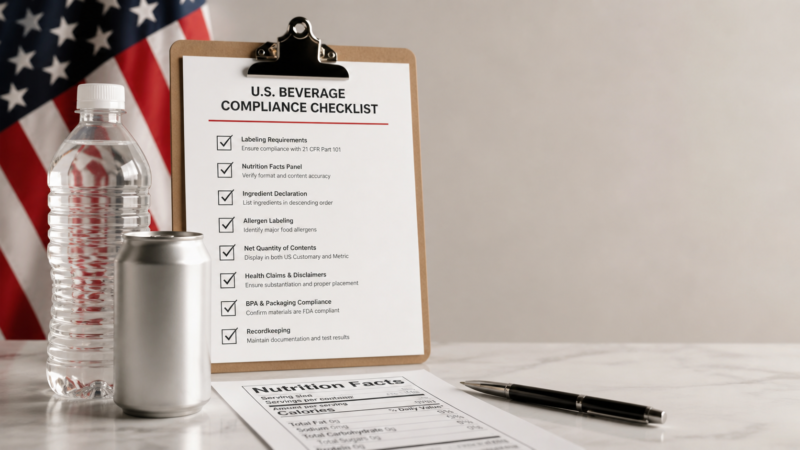
Most non-alcoholic beverages sold in the U.S. fall under federal food regulations that address safety, labeling, and facility obligations. Your importer and supply chain should ensure the product, process, and label meet current requirements for your category and claims.
- Product & process: Align formulation and processing with applicable U.S. food regulations for your beverage style. Certain categories or processes may have additional obligations.
- Facility & import: Confirm your supply chain responsibilities as a U.S. importer and verify that required registrations or programs are in place as applicable.
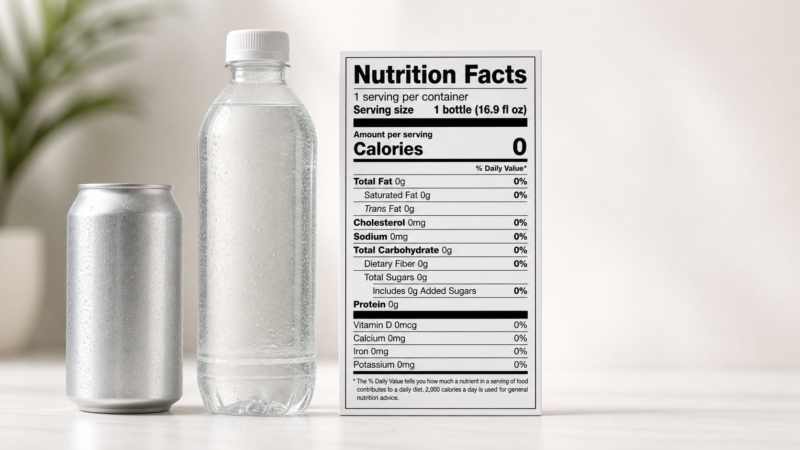
- Labeling: Ensure the Nutrition Facts format, ingredient statement, allergens (if any), and statements appear as required for the U.S. market.
For a practical overview tailored to beverage teams, see U.S. Beverage Regulations: A Practical Guide.
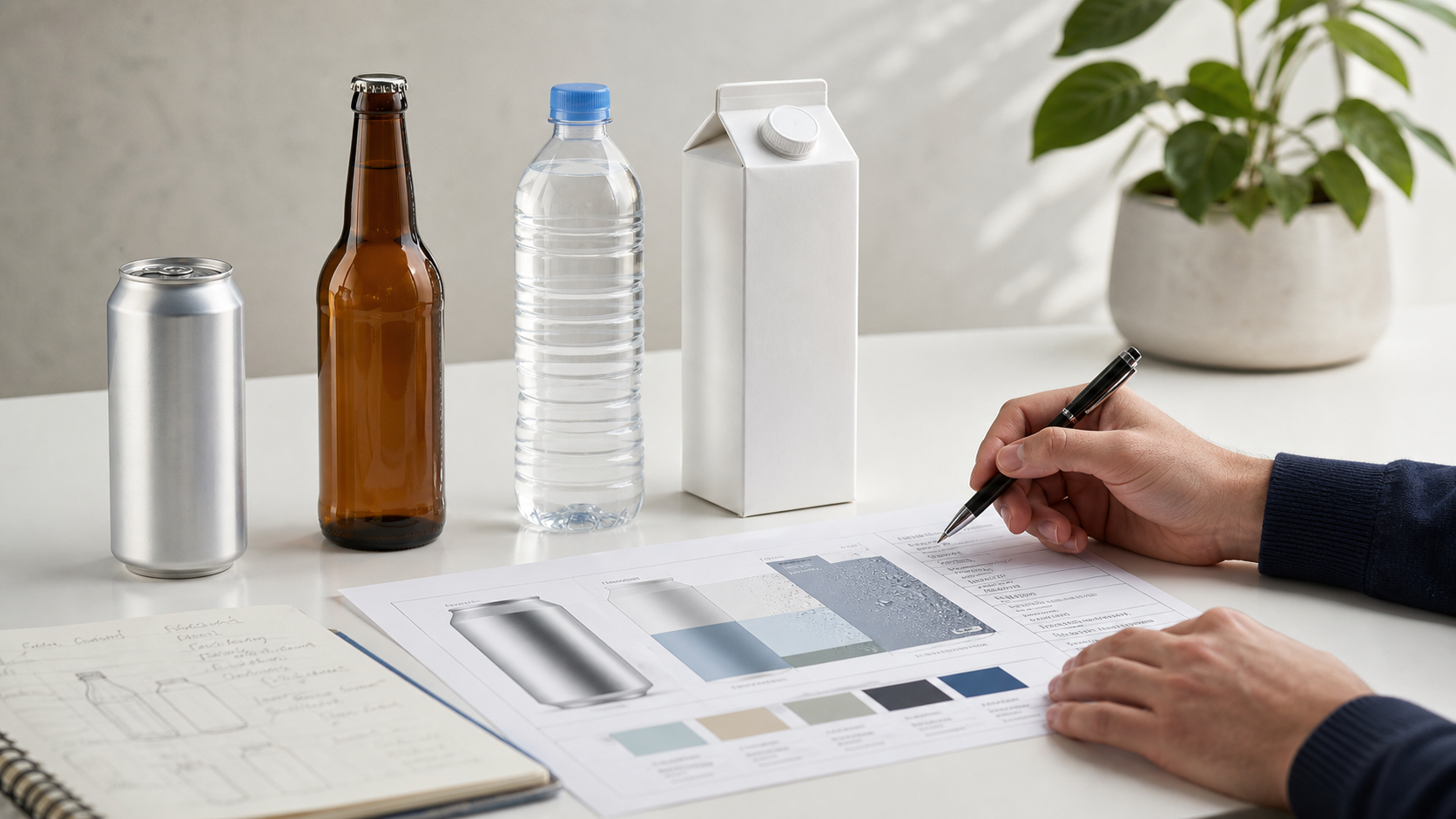
Packaging choices and shelf-life planning
Packaging, process, and sensory goals are interdependent. Decide early which combination delivers your shelf life, flavor integrity, cost target, and brand look without forcing process compromises.
- Cans: Excellent light/oxygen protection and portability; confirm lining compatibility with acids or botanicals.
- Glass: Premium feel and heat tolerance; heavier and fragile; consider closure and pasteurization method.
- PET: Lightweight and shatter-resistant; match to hot-fill or cold-fill requirements and barrier needs.
- Aseptic carton/pouch: Ambient shelf-stable with aseptic capability; strong sustainability story in some markets.
Align your choice with processing (hot-fill, tunnel pasteurization, retort, aseptic), target shelf life, and distribution temperatures. For format trade-offs and U.S. retail norms, visit Beverage Packaging for U.S. Brands.
Costing, MOQs, and commercial terms
Understand cost drivers and constraints up front so quotes are comparable and predictable. Overseas manufacturers commonly plan around batch-size efficiency, packaging line changeovers, and supply variability for ingredients and components.
- Cost drivers: Ingredients and processing intensity, packaging components, changeover frequency, quality testing scope, and logistics to port.
- MOQs: Often tied to packaging runs and efficient batch sizes; negotiate pilot-size runs for validation and consider phased ramp-ups.
- Lead times: Account for ingredient/packaging procurement, production schedule, quality holds, and sea/air transit where relevant.
- Payment & currency: Align on milestones and currency exposure; plan for bank processing time and documentation.
- Incoterms: Choose terms that reflect your logistics capability and risk appetite; clarify who handles export clearance and insurance.
To set expectations for order size in the U.S. context, review Beverage MOQ for U.S. Private Label Projects.
How to run samples, pilots, and scale-up without surprises
Move from benchtop excitement to commercial reliability through staged trials with clear acceptance criteria. Each phase should reduce risk and document learnings in your specification and quality plan.
- Bench samples: Align on flavor targets, color, sweetness, and mouthfeel. Capture early stability notes and filtration requirements.
- Pilot run: Validate process parameters on the line; confirm fill volumes, closures, torque, seam, or seal integrity; produce retains for stability.
- First production: Pre-approve labels and codes; monitor critical control points; agree on COA tests and release protocol; retain start/middle/end-of-run samples.
- Post-run review: Evaluate micro/chemistry results, sensory at T0 and during aging, and any deviations or CAPA items.
Managing ongoing quality and change control
Great suppliers make quality visible. Establish routines that catch issues early and keep your product consistent through seasonal ingredient shifts and packaging variability.
- Specifications & COAs: Keep a single source of truth for every SKU; require COA lots to match shipped goods; specify hold-and-release rules.
- Supplier KPIs: On-time delivery, right-first-time batch rate, complaint rate, corrective action closure timing.
- Change control: Written approval before any formula, process, line, or component changes; define what constitutes a change and notification timing.
- Ongoing testing: Periodic micro/chemistry verification; shelf-life checkpoints; packaging integrity checks on each lot.
Shipping, customs, and delivery to the U.S.
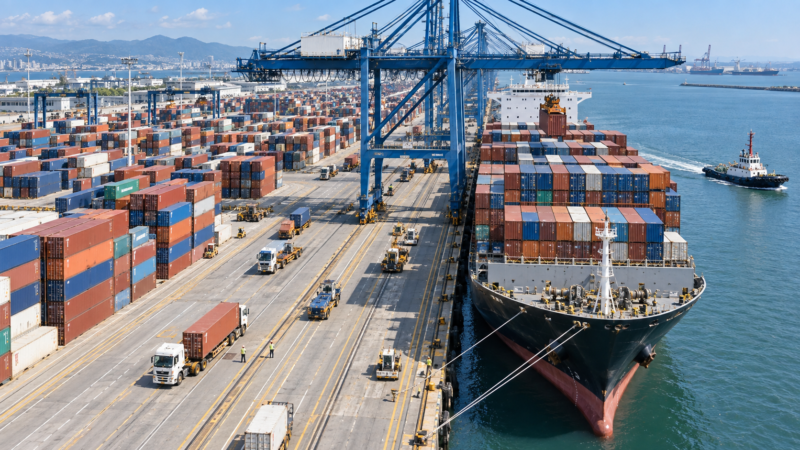
Build logistics into your critical path. Transit time, temperature swings, and documentation accuracy can make or break your first shipment, especially for temperature-sensitive products.
- Mode & route: Balance time, temperature control, and cost; align with shelf-life and launch date.
- Export & import documents: Commercial invoice, packing list, and other documents as applicable for your product and chosen Incoterms.
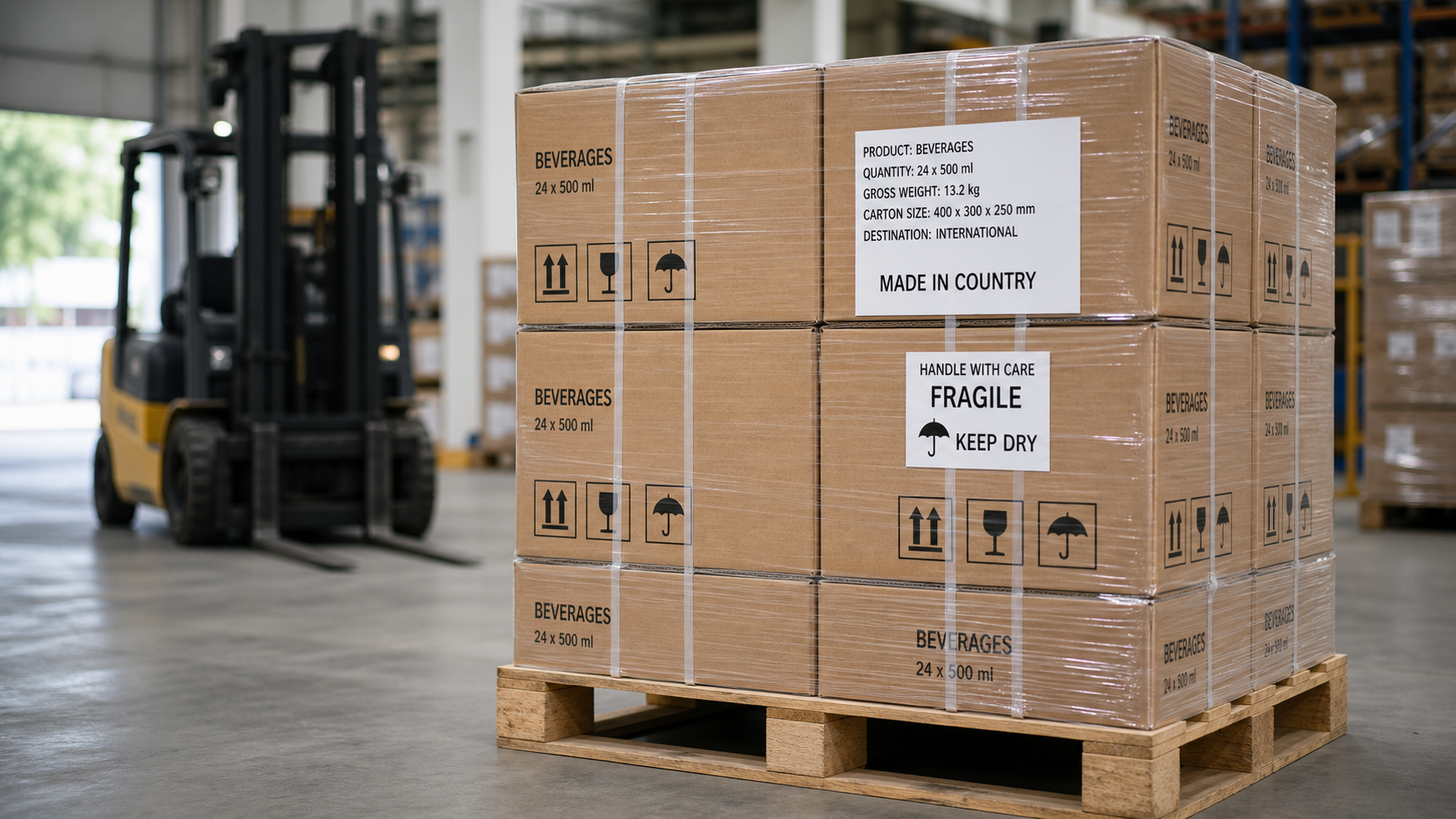
- Cargo care: Palletization, bracing, and climate considerations consistent with product sensitivities.
- Receiving plan: Pre-book distribution slots; QC checks on arrival; retain samples and document temperature conditions if relevant.
If you are evaluating Southeast Asia as a supply base, this route-focused primer can help: Shipping Beverages from Vietnam to the United States.
Contracts, IP, and confidentiality with overseas partners
Put your agreements on the same level as your formulation and quality plan. Clear contracts prevent ambiguity when teams change or schedules slip.
- Confidentiality & IP: Mutual NDAs covering formulas, processing parameters, artwork, and data; define ownership of creations and improvements.
- Quality addendum: Specifications, test methods, sampling plans, COA requirements, deviation handling, and recall coordination.
- Commercial terms: Price adjustment triggers, payment milestones, Incoterms, liability caps, and force majeure language.
- Change management: Written approvals for any process, ingredient, or packaging changes; update specs and labels accordingly.
- Dispute framework: Jurisdiction, governing law, and escalation path; agreed language for official notices.
How do I actually choose beverage manufacturer USA–level partners?
Shortlist factories that can meet your product, process, packaging, and compliance needs, then pick the one that proves it with documentation, audits, successful pilots, reliable COAs, and clear commercial terms. Prioritize capability and evidence over promises.
- Scorecards: Use weighted criteria across capability, quality, responsiveness, cost, and risk.
- Proof points: Require labeled COAs, sample lot traceability, and stability snapshots.
- Total landed view: Compare true end-to-end cost and service, not just ex-works price.
- Trial success: Choose the partner that delivered repeatable pilot outcomes and transparent problem-solving.
Private label manufacturer checklist
Use this condensed checklist to align teams and accelerate supplier qualification for private label or OEM projects.
- Brief locked: Category, formula constraints, processing, packaging, shelf life, specs, and labeling responsibilities defined.
- Supplier shortlist: 3–6 factories with matching capability; NDAs executed; document pack requested.
- Due diligence: Quality system review, audit (onsite/virtual), capability confirmation, references, and sample testing.
- Regulatory path: Label plan for the U.S.; responsibilities mapped; documentation checklist prepared.
- Commercials: MOQs, lead times, pricing logic, Incoterms, payment milestones, and change-control acceptance.
- Pilot & validation: Trial schedule, acceptance criteria, retain plan, and third-party testing.
- Contract package: Manufacturing agreement, quality addendum, IP & confidentiality, and specification attachments.
- Launch logistics: Production slot booking, transport plan, import paperwork, and U.S. receiving QC.
If you are still deciding how much customization you need, review Private Label, White Label and OEM Beverages Compared before finalizing your sourcing strategy.
FAQ
Do I need to visit the factory in person?
No, not always. Virtual audits, real-time video walkthroughs, and third-party inspectors can give strong visibility. That said, an initial in-person audit can deepen trust and speed problem-solving, especially before your first commercial run.
Which Incoterms work best for first shipments?
There is no single best term. Choose terms that match your logistics expertise and risk appetite. Many first-time importers prefer suppliers to manage early legs, while experienced teams may assume more control for cost and schedule benefits.
Can one manufacturer handle multiple beverage categories?
Sometimes. Many factories specialize in certain processes and packages. Validate that each category you need is truly compatible with their lines, sanitation protocols, and quality targets before combining SKUs.
How long does development take?
Timelines vary with formula complexity, packaging, and regulatory/lab review. Plan for multiple sample iterations, a pilot run, stability checkpoints, and artwork/label reviews in your critical path.
What if a shipment fails incoming QC testing?
Follow your quality addendum: quarantine, investigate root cause with the manufacturer, review batch records and COAs, and agree corrective actions. Clear specifications, retains, and documented acceptance criteria reduce disputes.
Where can I learn more about U.S. labeling and category rules?
For a structured overview of key considerations, see U.S. Beverage Regulations: A Practical Guide. Pair it with packaging choices in Beverage Packaging for U.S. Brands when finalizing your brief.
Conclusion
Choosing an overseas beverage partner is a process, not a leap. Define a crisp brief, qualify capability with evidence, validate with pilots and testing, align contracts and change control, and plan logistics and U.S. compliance before placing a launch-size PO. Keep decisions anchored in proof—not promises—so your first shipment performs like your best one.
As you finalize your plan, revisit your engagement model, packaging, MOQs, and regulatory path. These resources can help: Private label vs. white label vs. OEM, Beverage packaging for U.S. brands, Beverage MOQs in the U.S., and route planning via shipping beverages from Vietnam to the U.S. Start with a strong brief and a disciplined qualification flow to choose beverage manufacturer USA–ready partners with confidence.
Manufacturing for U.S. brands
If you are sourcing for the U.S. market, three pages cover what buyers ask first. Manufacturing to your own specification explains what the production side covers; certifications and food safety systems covers the documents customs and retailers will ask you to produce; export and logistics covers shipping terms and the document pack. To price a programme, request a quote.
Request a quoteWhere to go next
Sourcing for the U.S. market? The United States beverage market page covers the full OEM and private label programme for U.S. brands and importers: MOQ 500 cartons per SKU, 15-30 day production, HACCP / ISO 22000 / FSSC 22000, and shipping from Ho Chi Minh City. Request a quote and we reply within 24 hours.