


 Français
 Español
 العربية
 한국어
한국어In-process quality control is the set of checks you run while the line is running to keep a beverage within specification, compliant, and safe. Done well, these controls detect drift early, prevent costly rework, protect your brand, and make audits straightforward.
This guide lays out exactly what to check during a production run, how often to check it, who signs for it, and how to document it. It applies to canning and bottling, hot-fill and cold-fill, carbonated and still, and products from clear RTD teas to pulpy juices and inclusion drinks. Where parameters differ by process, we call that out so your SOP can reflect real risk.
What is in-process quality control in beverage production?
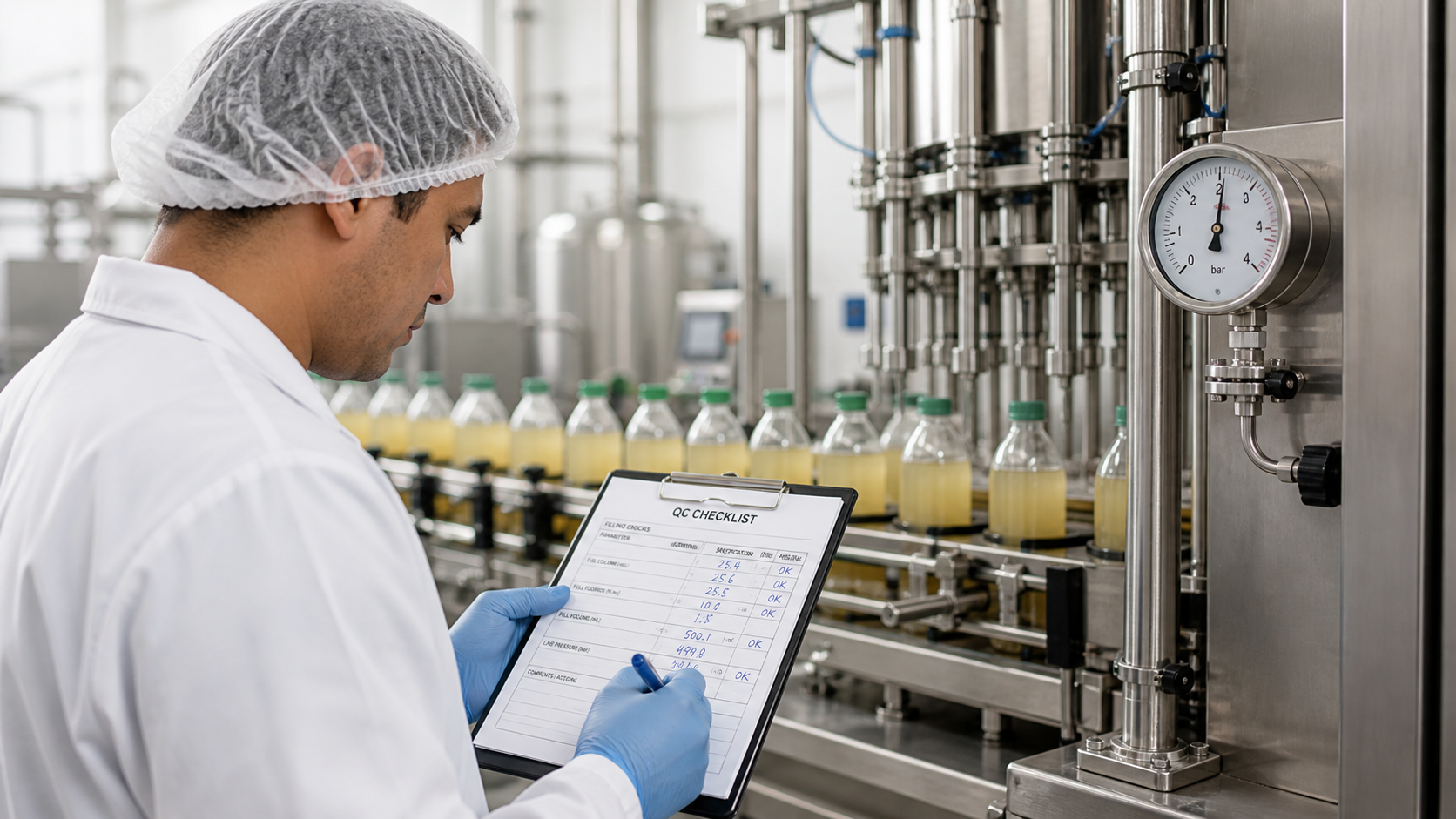
It is the routine, documented monitoring of critical product and packaging attributes during a run, with defined acceptance limits, escalation paths, and sign-offs. In-process control complements pre-op checks and final-release testing by ensuring your product continuously meets spec while equipment, ingredients, and operators change through the shift.
In practical terms, you are verifying net content, composition (e.g., Brix and acidity), closure and seam performance, thermal or aseptic conditions, coding and labeling, and secondary packaging—at a set cadence and after any intervention. It sits under your HACCP/food safety plan and your quality system. See related principles in Quality and Food Safety.
Which checks belong in a line start-up?
Start-up checks establish that the line is clean, set up correctly, and producing within specification before you release the first sellable units.
- Pre-op hygiene sign-off: Completed sanitation, allergen changeover clearance, no foreign objects, guards in place.
- Materials verification: Correct SKU, pack size, closures, ends/caps, labels, cartons, pallet pattern, and codes loaded.
- Spec availability: Current product spec, packaging drawings, coding format, and acceptance criteria at the line.
- Instrumentation & calibration: Thermometers, scales, torque meters, seam gauges, DO/CO2 meters, refractometers, pH meters verified or checked against standards.
- Trial run and first-off approval: Produce a defined number of units, measure all critical attributes, sign off by operator and QA/QC before full release.
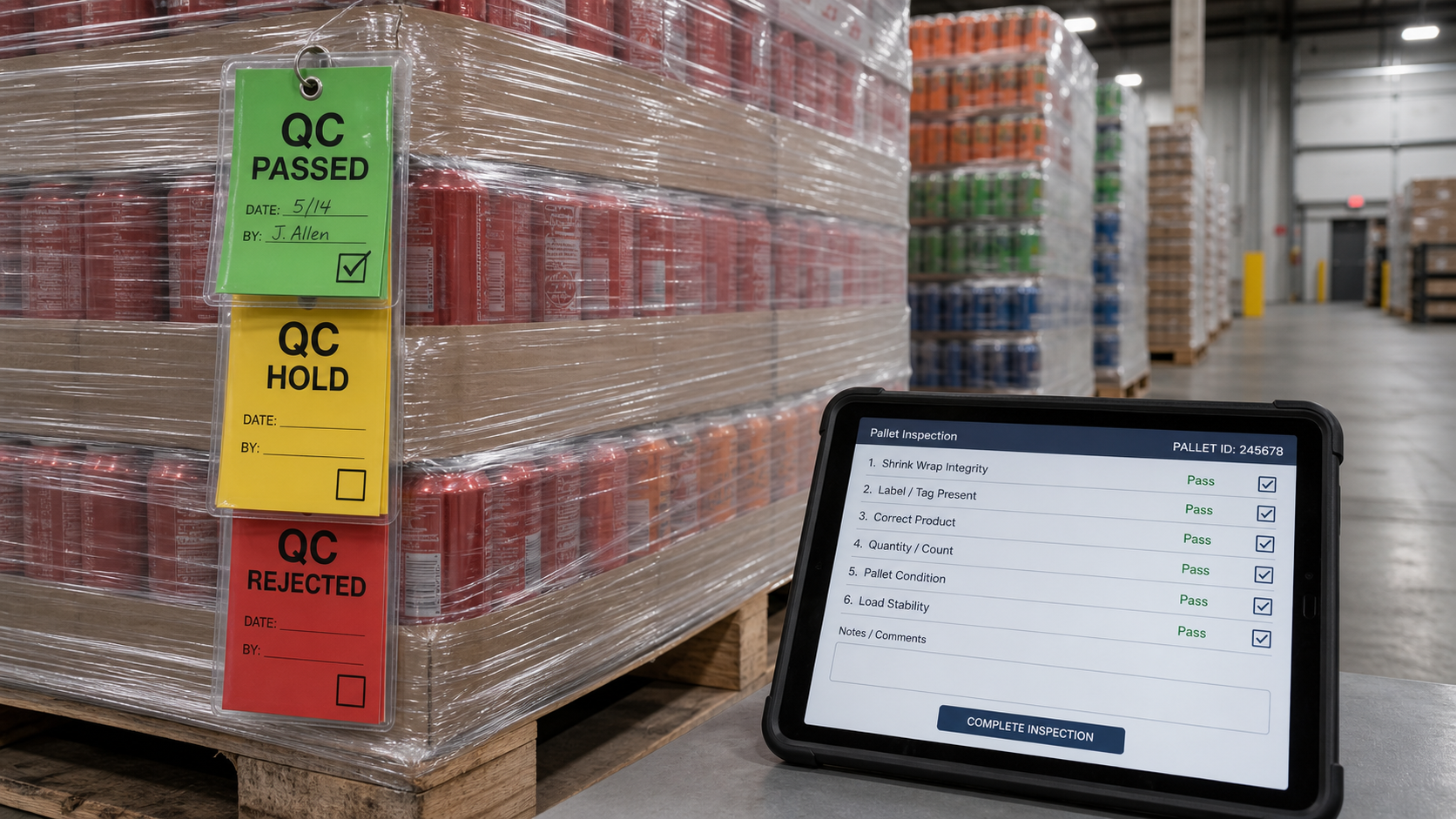
- Hold status: If any attribute is borderline or sample test pending, place the batch or pallet on quality hold with clear tagging.
Codify these as a start-up checklist within your broader Production Process so every run begins with the same discipline.
What do routine in-process line checks cover?
They cover product composition, container integrity, closures, net content, thermal or aseptic parameters, gas control, coding and labeling, foreign-body control, and finished packaging quality. The checks below are common across beverage categories; adapt acceptance criteria to each SKU.
Product composition
- Brix (soluble solids): Handheld or bench refractometer to confirm sweetness/strength against spec.
- Acidity (pH and/or titratable acidity): pH meter and TA titration as defined in the spec to manage flavor and preservative systems.
- Appearance: Color, clarity or haze, phase separation, sediment, inclusion distribution; compare to control sample.
- Temperature: Product temperature at filler bowl, post-fill, and (for hot-fill) at cap-on; record continuous readouts if available.
Net content and headspace
- Fill weight/volume: Check against legal metrology and label claim; consider density-temperature conversion if weighing.
- Headspace: Visual or measured headspace to accommodate thermal expansion or gas content.
Closures and seams
- Cap torque: Application torque within spec; verify tamper band integrity for bottles.
- Vacuum (hot-fill glass/PET): Gauge vacuum inside containers once cooled; correlate with cap panel height if applicable.
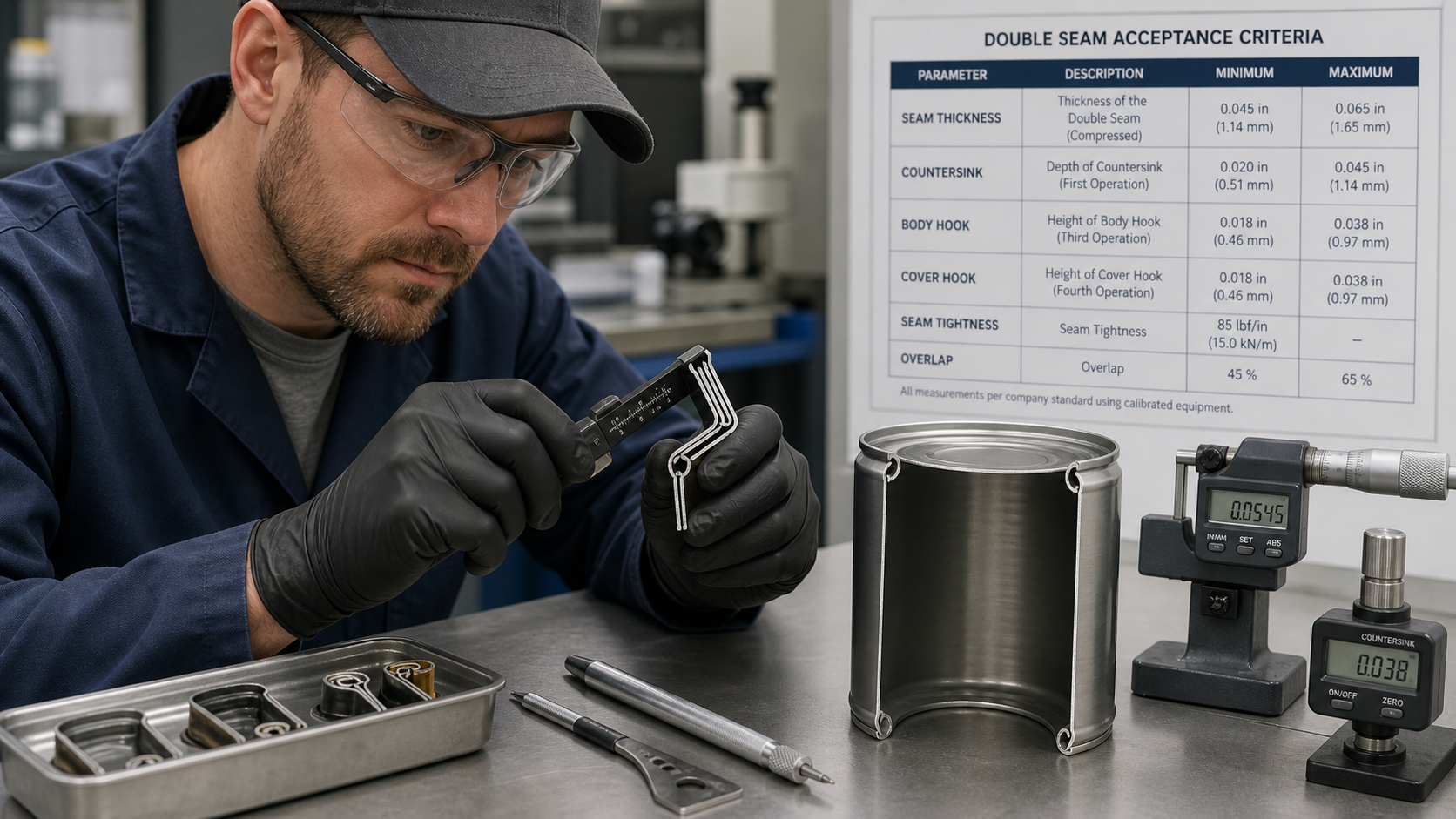
- Double seam integrity (cans): Visual checks for seam appearance; scheduled teardown with seam thickness, overlap, body hook, end hook, and tightness measurements.
Gas management
- Dissolved oxygen (DO): Particularly for beer, tea, juice, and functional drinks; measure at the filler discharge and in-package.
- CO2 volumes (carbonated): Zahm or other approved method at start-up and routine intervals.
- Nitrogen dosing (still cans/PET): Confirm dose consistency via dome/buckle or by weight change.
Foreign-body control and filtration
- Filter differential pressure: Monitor and record; change filters as per SOP when delta P indicates fouling.
- Metal detector/X-ray: Start-up challenge with test pieces (ferrous, non-ferrous, stainless), then routine challenges at set intervals.
Coding, labeling, and secondary packaging
- Date/batch coding: Correct format, legibility, position, and content; verify with each label/code change.
- Label application: Presence, alignment, bubbles/wrinkles, and art version per BOM.
- Case/carton checks: Case count, barcode scanability, print clarity, and case weight if used for control.
- Pallet build: Pattern, corner boards, top sheet, stretch-wrap coverage, and load tag accuracy.
Sensory and on-line organoleptic
- Quick sensory: Trained operator or QC compares taste and aroma to control; escalate if off-notes appear.
- Visual defects: Dents, scuffs, paneling, leakers, or stress cracks.
How often should you perform each check?
Set frequencies using risk assessment (product, process, pack), legal requirements, and customer expectations. A practical approach is to define start-up checks, routine interval checks, and event-based checks after any adjustment, stoppage, or changeover.
- Start-up: Full parameter set before release of saleable product.
- Every 30 minutes: Fill weight/volume, cap torque, coding legibility/content, label presence/alignment, visual seam check, vacuum (where applicable).
- Hourly: Brix, pH or TA, CO2 volumes (for carbonated), filter differential pressure, case/carton barcode scan, pallet build spot-check.
- Every 2 hours: Can seam teardown (minimum defined samples per filler/seamer head), DO measurement, nitrogen dose verification.
- Event-based: After any intervention (recipe change, filler head adjustment, capper or seamer setting change, code change, break or stoppage), repeat the full check set relevant to the change.
- End-of-run: Retention samples, reconciliation of counts and holds, final pallet verification, and shift supervisor countersignature.
For thermally processed or aseptic products, include process-specific monitoring as outlined in Aseptic filling vs hot fill.
Who signs, and how should records flow?
Operators collect most readings at-line; a QC/QA technician verifies critical attributes on a defined cadence; the production supervisor reviews exceptions and signs each batch or shift; QA reviews holds, deviations, and releases. Electronic records with time stamps and user IDs simplify audits and trend analysis.
- Operator sign-off: Completes the checklist at the specified interval, dates/times entries, and immediately flags out-of-spec.
- QC/QA verification: Performs independent checks on key attributes (e.g., seam teardown, Brix/pH, DO, CO2) and co-signs.
- Supervisor approval: Confirms corrective actions, documents event-based rechecks, and signs the run summary.
- Record retention: Store batch records, checklists, and retains per your policy; align with batch traceability in production.
What acceptance criteria should be defined?
Acceptance criteria must be specific to each SKU and pack. They include numeric limits for composition, physical packaging targets, and legal or labeling requirements.
- Composition: Brix target and tolerance; pH and/or TA range; color/appearance descriptors or instrumental color targets if used.
- Net content: Declared volume or weight compliance in line with local metrology law; define individual and average fills as applicable.
- Closures: Cap torque range and tamper-evidence intactness; vacuum range for hot-fill packs.
- Seams: Double seam teardown criteria (body hook, end hook, overlap, tightness) per can/end supplier recommendations.
- Gas control: CO2 volumes for carbonation; maximum acceptable DO at pack for oxygen-sensitive products.
- Coding/labeling: Exact code content/format, legibility standard, label orientation and version.
- Secondary packaging: Case print/barcode standards, pallet pattern and stability requirements.
- Foreign-body controls: Detector sensitivity and challenge piece response requirements.
Changeovers, interventions, and after-break checks
Any time the line changes state, verify the parameters most likely to drift. This prevents off-spec product from spanning the pre- and post-change period.
- Changeovers: Confirm correct materials, re-zero scales, validate capper/seamer settings, clear obsolete labels/codes, allergen clearance.
- Adjustments: After filler bowl level or head height changes, immediately recheck fill weight/volume, headspace, and closures.
- Stops/restarts: Reconfirm temperature, DO/CO2, coding content and legibility, and first-off quality before restarting at full speed.
- Maintenance interventions: Inspect for loose tools/parts, verify guards, rerun metal detector/X-ray challenges, and perform a targeted hygiene check if risk dictates.
Special cases: inclusions, carbonation, and heat process
Certain beverage formats require extra in-process attention.
- Inclusions (e.g., popping boba, nata de coco): Check inclusion integrity, distribution per pack, and valve/nozzle performance; confirm seals remain intact for fragile spheres. See process considerations in Drinks with popping boba.
- Carbonated beverages: Verify syrup ratio, CO2 volumes, cap torque/seam integrity, and foam management; monitor DO closely.
- Hot-fill/still beverages: Monitor fill temperature and hold/recirculation parameters, cap-on temperature, cooling curve, vacuum levels, and panel height where relevant. Compare approaches in Aseptic filling vs hot fill.
- Aseptic filling: Record sterilization temperatures/times, sterilant concentration, packaging material sterility checks, and periodic sterility tests according to the validated process.
A practical in-process check matrix
Use this example matrix to formalize your run controls. Adapt parameters, frequencies, and sign-offs to your product risk, equipment, and customer/regulatory needs.
| Check | Purpose | Typical cadence | Primary tool | Sign-off |
|---|---|---|---|---|
| Start-up first-off approval | Baseline all parameters before release | Once per SKU start | Full kit (scale, refractometer, pH, torque) | Operator + QC/QA |
| Fill weight/volume | Legal net content, consistency | Every 30 min and after adjustments | Calibrated bench scale or volumetric gauge | Operator; QC verifies hourly |
| Brix and pH/TA | Strength, flavor, preservative balance | Hourly and at changeovers | Refractometer; pH meter and titration | QC/QA |
| Cap torque or seam visual | Closure integrity, leak prevention | Every 30 min and post-stoppage | Torque meter; visual seam criteria | Operator |
| Can seam teardown | Seam integrity metrics | Every 2 hours minimum | Seam micrometer and projector | QC/QA |
| Vacuum (hot-fill) | Pack stability and seal performance | Every 30 min | Vacuum gauge or cap panel gauge | Operator |
| CO2 volumes / DO | Gas content and oxygen pickup | Hourly; DO also start/mid/end | Zahm or approved meter; DO meter | QC/QA |
| Coding & labeling | Traceability and regulatory info | Every 30 min; each code change | Visual check; barcode scan | Operator |
| Metal detector/X-ray challenge | Foreign-body control | Start-up; hourly | Test wands/cards; X-ray test packs | Operator + QC/QA |
| Case/pallet QA | Logistics integrity and stability | Hourly; end-of-run | Barcode scanner; pallet checklist | Operator; Supervisor at end |
Common mistakes to avoid
These pitfalls create avoidable waste and audit findings:
- Chasing noise, not signal: Overreacting to single outliers without confirming a trend or re-measuring on a second instrument.
- Unlinked weight and volume: Weighing cold and hot packs interchangeably without density/temperature correction.
- Skipping event-based checks: Failing to recheck after changeovers, code changes, and maintenance interventions.
- Poor instrument control: Using unverified torque meters, refractometers, or pH probes; not logging calibration checks.
- Incomplete coding control: Wrong lot/date or unreadable codes due to inkjet settings or condensation.
- Undefined acceptance limits: Vague specs like “tight seam” or “good vacuum” that cannot be verified.
- Weak documentation: Illegible, backfilled, or unsigned records; missing retains or reconciliation.
- No escalation path: Team doesn’t know who to call or when to hold product on an out-of-spec.
Information for beverage brands and buyers
If you use a co-man, ask to see their in-process checklists, tool verification logs, and deviation workflow. Confirm how they set frequencies (risk-based, customer-driven, or historical capability), who signs each record, and how they handle holds and releases. Align this with your brand’s labeling and regulatory needs, and ensure their documentation integrates with your own QMS and ERP for seamless traceability.
- Clarify which parameters are customer-critical (e.g., Brix, CO2, torque) and require dual verification.
- Agree on retain sample quantity and storage time for each SKU and market.
- Define acceptable recovery actions (e.g., rework vs. scrap) and who authorizes them.
- Map documentation inputs to your batch record; see the broader Production Process and Quality and Food Safety frameworks.
For inclusion beverages or advanced processes, build checklists that reflect real risks (e.g., fragile inclusions, oxygen pickup, or thermal impact). Our technical notes on Drinks with popping boba and processing choices in Aseptic filling vs hot fill can help shape that brief.
FAQ
Are in-process checks different from final release testing?
Yes. In-process checks control the process while it runs, preventing drift and defects. Final release testing confirms that finished goods meet specification before shipment. Both are necessary; in-process control reduces the chance of surprises at release.
Do I need statistically valid sampling for line checks?
For attributes with natural variation (fill, torque), define sampling that reflects risk and capability. Many plants use SPC-based or AQL-inspired sampling plans for attributes that benefit from trend monitoring; document the rationale in your quality plan.
When should I stop the line on an out-of-spec?
Escalate immediately, segregate affected product, and apply your decision tree: verify the reading and instrument, assess scope (since last good check), correct the cause, recheck, and only then restart. Place suspect pallets on hold until disposition.
What is the difference between line checks and CCP monitoring?
CCP monitoring (e.g., thermal kill step, packaging sterility) is a food safety control with strict limits and corrective actions under HACCP. Line checks can include quality and safety attributes; treat CCPs with their defined critical limits and verification, and manage other checks under your quality plan.
Bringing it all together: an audit-ready in-process quality control program defines clear parameters, realistic cadences, who measures and who verifies, and how you document and escalate. Start with high-risk attributes, automate where you can, and integrate records with batch traceability in production. The result is fewer deviations, less rework, and a more consistent consumer experience.