


 Français
 Español
 العربية
 한국어
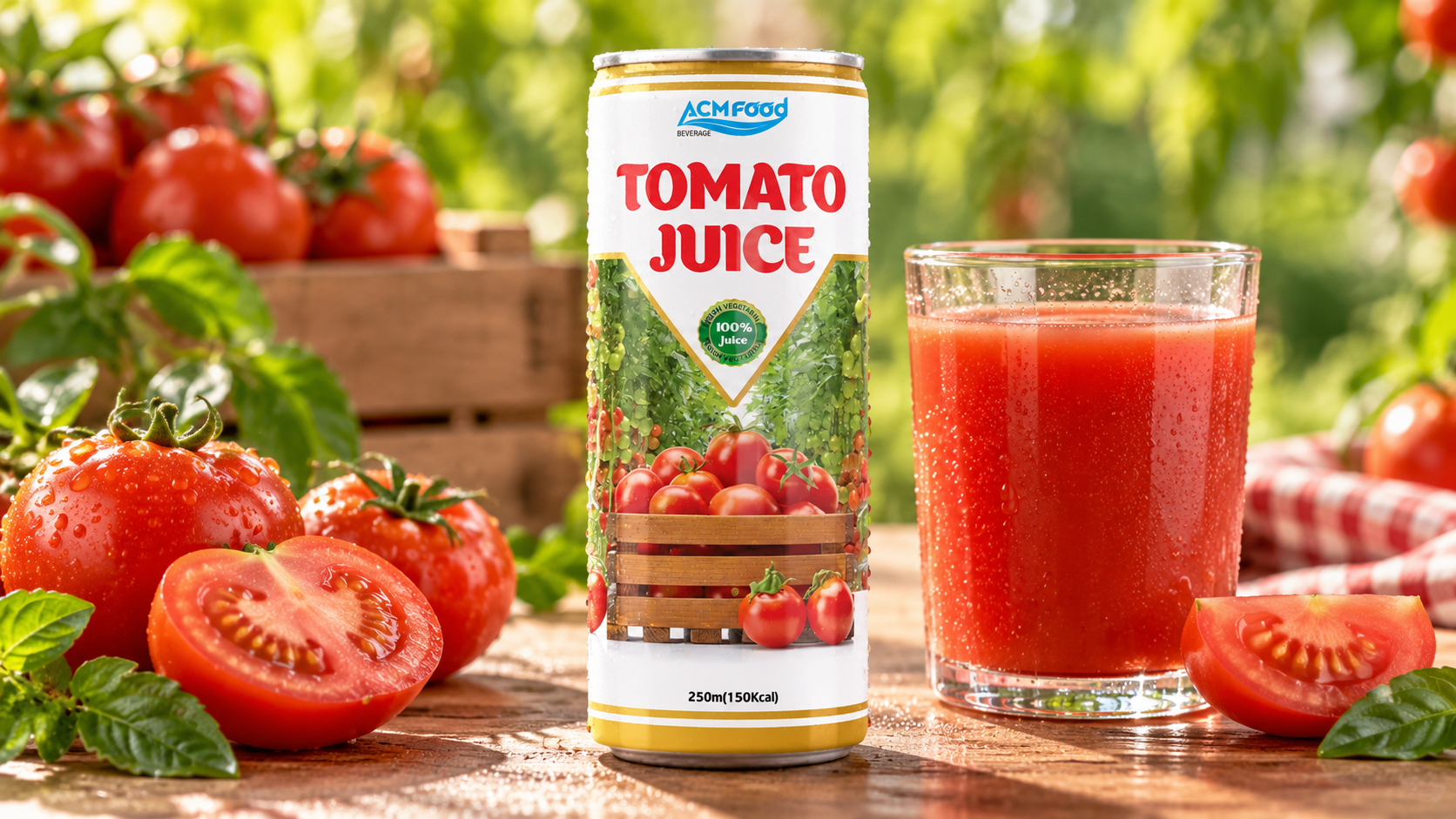
한국어Tomato juice from concentrate is made by diluting tomato concentrate or paste back to drinking strength, while NFC (not from concentrate) tomato juice is pressed, treated and packed without a concentration step. Buyers often meet three labels on offers, “from concentrate”, “NFC” and “not from concentrate”, and the last two usually mean the same thing. This guide explains the terms, compares what changes for importers and brands, and lists what to confirm before you choose.
The aim is to help you set a clear purchasing specification. It does not rank one form as better, because the right choice depends on positioning, price, freight and the labelling rules of your destination market. ACMFOOD’s tomato juice range is described in the product pages, and the process route for any specific item should be confirmed on its specification sheet.
What do “from concentrate”, “NFC” and “not from concentrate” mean?
“From concentrate” means the juice was concentrated, usually by evaporation, and later diluted with water to a target Brix. “NFC” and “not from concentrate” both describe juice that was not concentrated before packing. In practice they are two names for one category, so a clear quotation should use a single term and define it.
A fourth wording appears in the tomato trade: juice made from tomato paste. Paste is a heavily concentrated tomato product, so juice made from it falls under the from-concentrate side, even if the supplier does not use that exact phrase. When you read an offer, ask which starting material is used, because the label wording, the cost and the taste depend on it.
How does each form compare for buyers?
The forms differ in process, freight of raw material, flavour, label wording and typical positioning. The table sets them side by side so you can see which differences matter for your project.
| Factor | Reconstituted from concentrate or paste | NFC / not from concentrate |
|---|---|---|
| Starting material | Tomato concentrate or paste | Pressed tomato juice |
| Concentration step | Yes, before storage or shipping | No |
| Raw material freight | Lower volume, because water is removed | Higher volume, because water is carried |
| Flavour profile | Depends on concentration method and aroma handling | Usually closer to fresh-pressed juice |
| Label wording | Usually requires a from-concentrate or reconstituted statement | May be described as not from concentrate where rules allow |
| Typical positioning | Volume and cost-focused lines | Premium or natural-positioned lines |
Neither route is automatically higher in quality. A well-controlled reconstituted juice can be consistent and economical, and a poorly handled NFC juice can vary from batch to batch. The decision is about fit.
How does Brix change between concentrate, paste and finished juice?
Brix measures soluble solids, and it rises as water is removed. Concentrate and paste carry a much higher Brix than finished juice, and the producer dilutes them to a target Brix for the drink. NFC juice is packed at the Brix the tomatoes naturally provide, plus any adjustment the recipe allows.
For tomato, Brix is not the only control. Acidity, pH, salt addition and viscosity all matter, because tomato juice is usually seasoned and can separate on standing. Our guide to fruit juice processing methods explains how extraction, heat treatment and filling shape the final product, and the article on fruit puree in beverages explains when a puree or paste base is a better fit than juice or concentrate.
Which form costs less to ship?
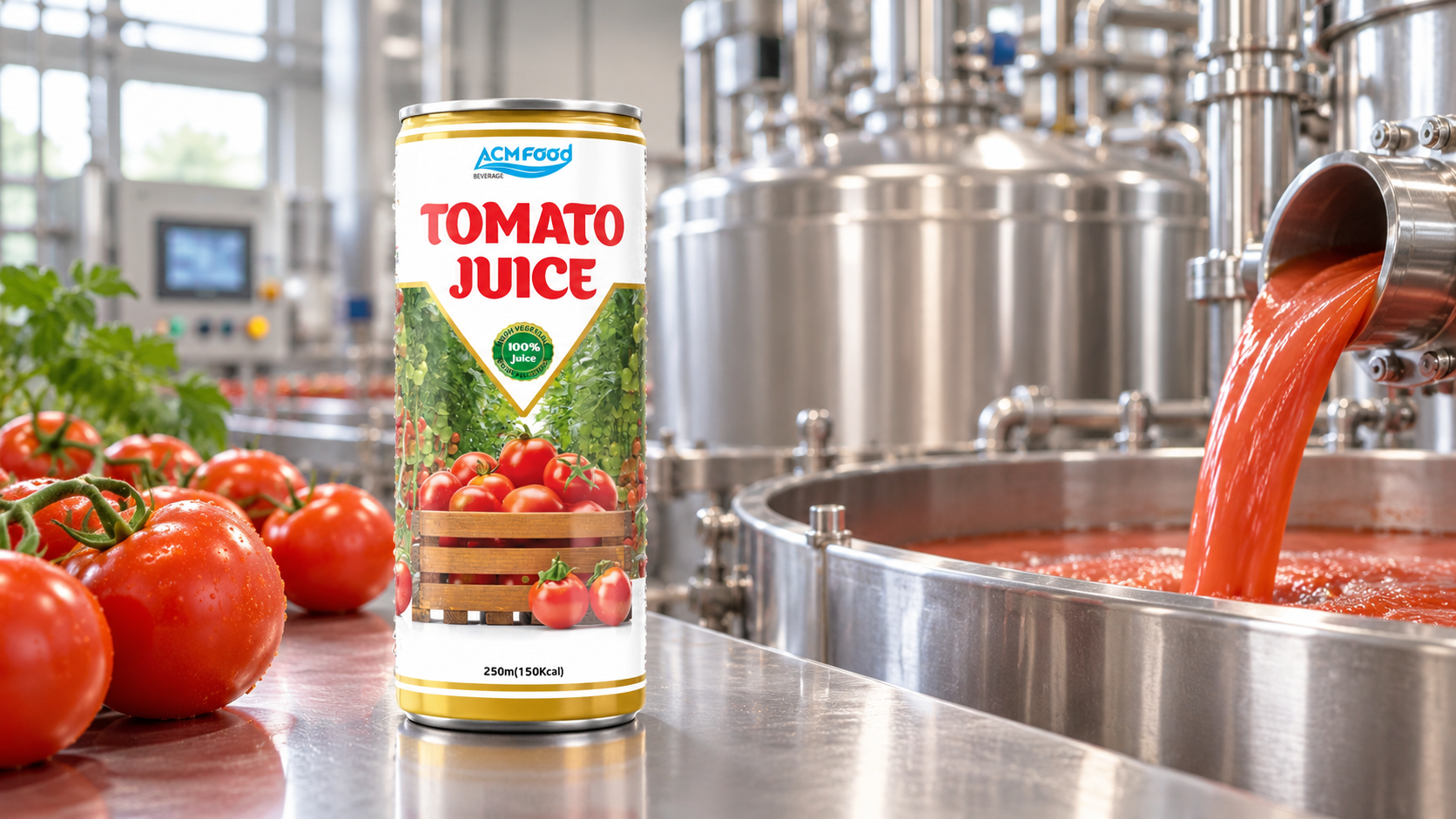
Concentrate and paste usually cost less to ship per litre of finished drink, because less water travels. This advantage is meaningful when the final filling happens near the destination market. When the finished drink is filled at origin, freight is on cans or bottles in both cases, and the saving disappears.
For an importer buying finished cans from Vietnam, the freight comparison is therefore about the carton, not the ingredient. Cans stack efficiently and are relatively light compared with glass, which helps in either case. If you plan to buy concentrate and fill locally, you also take on filling, quality control and regulatory responsibility locally. The export packaging guide compares formats for shipping.
How do labelling rules treat each form?
Rules differ by market, but in many of them a juice made from concentrate must be described as such, and a not-from-concentrate claim must be supportable. Wording on the label, front and back, can be regulated, and mistakes can delay clearance or force relabelling.
Before you finalise a form, confirm four points with your regulator, broker or compliance adviser:
- Name of the food. Whether the product is called tomato juice, tomato juice from concentrate or something else.
- Reconstitution statement. Whether a from-concentrate declaration is required and how it must appear.
- Salt and additives. How added salt, acidity regulators or flavourings must be declared.
- Nutrition panel. Required format, serving size and rounding rules in your market.
Label wording depends on the final formula, tested content, serving size and local rules, so it should not be copied from another country’s product.
What does each form mean for flavour and consistency?
NFC juice reflects the raw fruit, so seasonal variation in the tomatoes can show up in taste and Brix unless the producer blends or adjusts to hold a standard. Reconstituted juice starts from a more uniform base and can be standardised more easily, though the concentration step can affect aroma.
Ask the supplier how they hold consistency, because buyers care about the tenth shipment as much as the first. Useful questions include which Brix and acidity targets are set, how batches are checked, how often a certificate of analysis is issued and what the tolerance is. Our guide to fruit juice Brix explains how Brix is read, which helps you interpret the answers.
Which form suits which type of buyer?
A brand with a premium, natural or minimally processed story often prefers NFC, provided the label rules support it and the cost fits. A distributor focused on price per carton in a competitive channel may find reconstituted juice more economical. A manufacturer who fills locally may prefer paste or concentrate for freight efficiency.
- Premium or clean-label positioning. NFC is usually the better fit, subject to market rules.
- Large-volume, cost-sensitive lines. Reconstituted juice can be easier to standardise and price.
- Local filling operations. Paste or concentrate reduces raw material freight, though it shifts compliance work to the buyer.
- Mixed portfolios. Some brands run both, with one NFC hero SKU and a reconstituted value SKU.
What should you write into the purchasing specification?
A clear specification prevents most disputes. Define the term, the starting material and the measurable targets, and reference the test method for each.
- Definition. State whether the juice is NFC or reconstituted, and name the starting material.
- Brix and acidity targets. Give a target and a tolerance for each, with the test method.
- Ingredients. List every ingredient, including salt, acidity regulators or flavour.
- Packaging. Format, fill volume, closure and decoration.
- Shelf life and storage. The stated shelf life and the storage conditions it assumes.
- Documents. Certificate of analysis and food safety certificates for each batch.
ACMFOOD’s beverages are produced at facilities holding HACCP, ISO 22000 and FSSC 22000, and certificates and specification sheets are available on request.
What do “clarified”, “strained” and “thick” mean on a tomato juice offer?
These words describe texture and solids, not the concentration route. Clarified juice has had suspended solids removed, strained juice has been passed through a sieve to remove skins and seeds, and thick juice retains more tomato solids and has a heavier body. Any of them can be made from either route.
| Term | What it describes | Questions to ask |
|---|---|---|
| Clarified | Suspended solids removed for a thin, clear appearance | How is clarity measured and does it hold over shelf life? |
| Strained | Skins and seeds removed, pulp may remain | What sieve size is used? |
| Thick | More solids and higher viscosity | How is viscosity specified and tested? |
| Tomato extract | A concentrated tomato product used mainly in cooking and food manufacturing | Is it a drink ingredient or a culinary ingredient in your market? |
Tomato extract and similar terms are used inconsistently in the trade, so ask for a definition and a specification sheet whenever you see one. Do not assume it is interchangeable with drinking juice.
How should you check a delivery against the form you ordered?
Verification starts with documents and continues with measurement. A supplier’s paperwork should state the form and starting material, and your quality team should confirm the physical parameters match.
- Label and paperwork match. The name on the carton, the invoice and the certificate of analysis should use the same term.
- Brix and pH on receipt. Compare measured values with the specification and its tolerance.
- Appearance and consistency. Compare colour, separation and texture with the approved sample.
- Can or bottle condition. Check for dents, swelling, leaks and coding legibility.
Note that no routine test can fully prove that a juice was never concentrated. That claim rests on supplier documentation, audits and traceability, which is another reason to buy from a site with recognised food safety certification and to keep records of what you were told.
How would three typical buyers decide?
The same market can lead to different choices depending on the business model. These scenarios show how the factors combine.
- A premium retail brand wants a natural story and accepts a higher unit cost. It chooses NFC, confirms that the label may use not-from-concentrate wording, and requests a sample to check taste consistency.
- A distributor in a price-sensitive channel needs stable cost and wide availability. It compares NFC and reconstituted offers on landed cost and may accept reconstituted juice with a clearly worded label.
- A beverage manufacturer with its own filling line wants lower inbound freight. It buys paste or concentrate and fills locally, taking on the quality control and labelling work itself.
In each case the decision follows from positioning, cost and responsibility, not from a general ranking of the forms.
What should you keep on file after choosing a form?
Keep a short record that shows what you ordered, what you were told and what you received. If a regulator, retailer or customer later questions the wording on your label, this file is your evidence.
- Specification sheet. The version that applied to each shipment, with the stated starting material.
- Supplier statement. A written confirmation of whether the juice is NFC or reconstituted.
- Certificate of analysis. Batch results against the agreed limits.
- Label approval. The approved artwork and any compliance review notes.
What is the next step for a tomato juice sourcing project?
Decide the form first, then the format and the quantity. With those fixed, a supplier can quote accurately and confirm the minimum, which for ACMFOOD is 500 cartons per SKU with a 15 to 30 day production lead time. Details of the current items are in the tomato juice category.
When you are ready to ask for a quotation or a specification sheet, use the request a quote page and include the form you prefer, the pack and your destination market.