Français
 Español
 العربية
 한국어
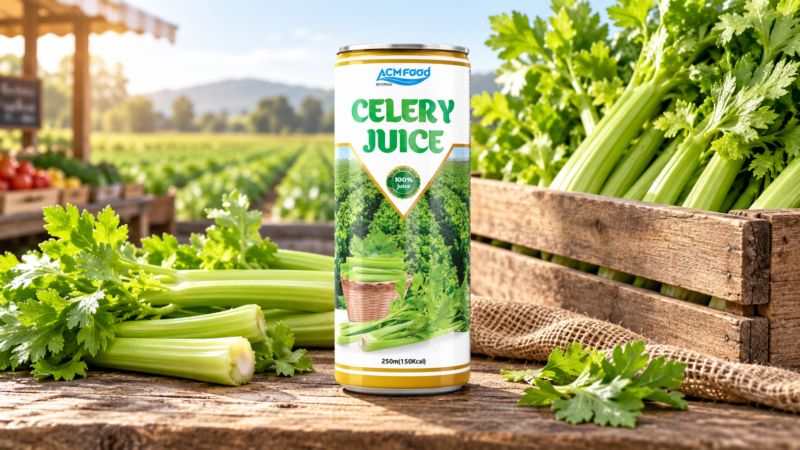
한국어100% pure celery juice is juice pressed from celery stalks with nothing added to the juice itself, and NFC means it is packed without a concentration step. The result is a thin, green, savoury drink whose quality depends on how fast the celery is processed and how carefully the juice is protected from air, heat and microbes.
This article explains how NFC celery juice is produced, what influences yield, how colour and flavour are kept and which quality specifications a buyer should write into a contract. It focuses on finished drinks in cans and bottles. ACMFOOD, a Vietnam beverage manufacturer, supplies finished drinks under OEM, ODM and private label arrangements, and publishes HACCP, ISO 22000 and FSSC 22000 certificates.
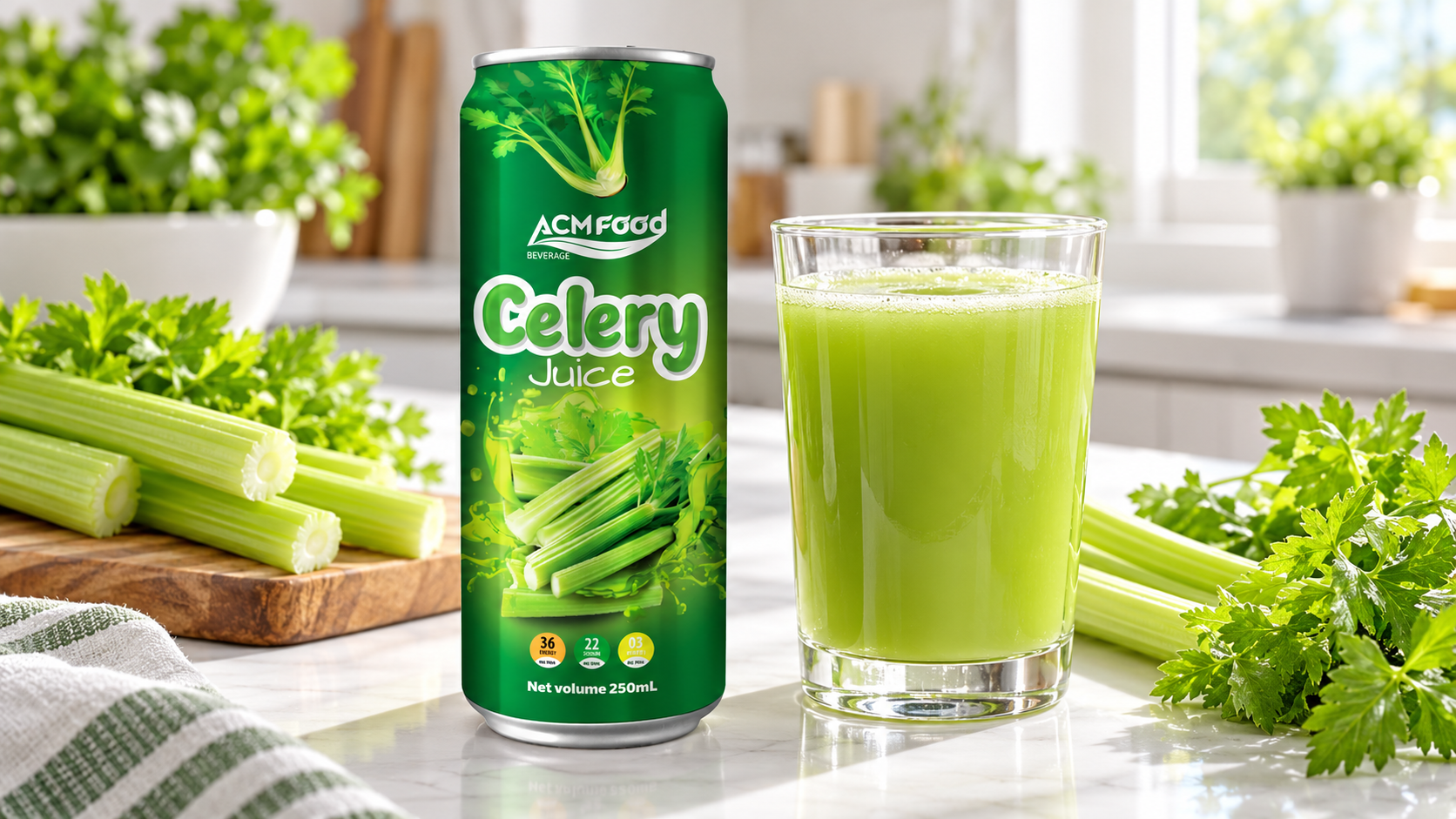
What does 100% pure NFC celery juice mean?
It means the drink contains only celery juice, extracted by pressing and preserved by heat or another process, without being concentrated and later restored with water. Where the market allows, small amounts of acidity regulators or vitamin C may be used to protect the juice, and they must be declared.
Several points help define the term for a specification:
- Single ingredient. Celery juice only, apart from permitted technical aids.
- No added sugar or water. Dilution turns the product into a drink and changes its name.
- No concentration step. The juice keeps its original water content from pressing to filling.
- Documented route. The process description and batch records show that the juice was not evaporated and reconstituted.
Because celery juice is naturally thin and low in solids, there is little commercial reason to concentrate it, and most pure celery juice is NFC by default. The label wording should still match the process described in the specification.
How is NFC celery juice produced?
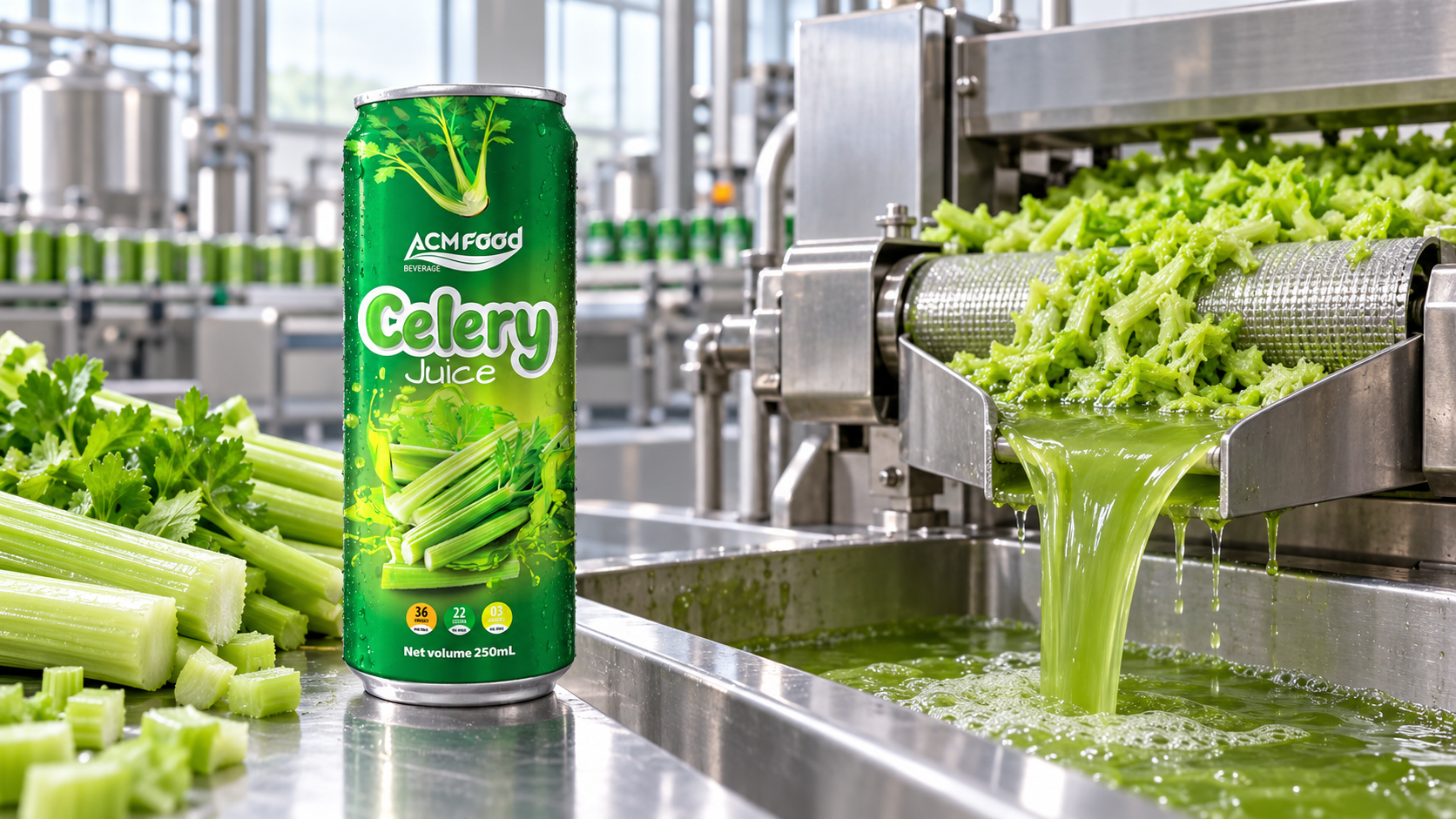
NFC celery juice is produced in seven steps: receiving, washing, size reduction, pressing, filtration, heat treatment and filling. The sequence is short on purpose, because celery juice loses colour and aroma quickly when it waits.
- Receiving and inspection. Celery is checked for freshness, damage and temperature. Poor lots are rejected.
- Washing. Soil and grit are removed with water sprays and flumes, and an inspection belt removes damaged pieces.
- Size reduction. Stalks are chopped or crushed so the press can extract juice efficiently.
- Pressing. Belt or screw presses squeeze out the juice. A decanter or centrifuge can remove coarse solids.
- Filtration. Fibre and fine solids are removed to obtain a smooth drink.
- Deaeration and heat treatment. Air is removed, and the juice is heated by a validated step that suits its low acidity.
- Filling and sealing. Cans or bottles are filled with low headspace and closed.
Each step has a limit for time and temperature. For example, juice that waits too long between pressing and heating can brown, and a press that is set too hard can pull bitterness and fibre into the juice.
What determines the yield of celery juice?
Yield is the amount of juice obtained from a given weight of celery, and it depends on variety, maturity, freshness, particle size and press settings. Celery is very watery, so the yield is relatively high compared with dense vegetables, but high pressure can lower quality.
- Variety and growing conditions. Crisp, juicy stalks give more juice than woody or old ones.
- Freshness. Wilted celery loses water and gives a lower yield and a duller taste.
- Trimming. Removing leaves and tough ends improves flavour but lowers the usable fraction.
- Particle size. Finer pieces release more juice, up to a point beyond which pressing becomes difficult.
- Pressing method and pressure. Gentle pressing keeps a cleaner taste, while heavy pressing raises yield but also bitterness.
- Enzymes. Some producers use enzymes to break down cell walls and increase yield, within the rules of the target market.
A supplier should be able to describe its typical yield range and how it balances yield against taste, though the exact figure depends on season and variety and should be treated as a process parameter, not a promise.
How are colour and flavour protected?
Colour and flavour are protected by working quickly, removing oxygen, controlling heat and choosing a pack that blocks light. Chlorophyll turns olive under heat and acid, and the volatile aroma compounds of celery are lost when the juice is heated or exposed to air.
Common protective steps include:
- Short time between pressing and heating. Minutes rather than hours.
- Deaeration. Removing dissolved oxygen slows browning and flavour loss.
- Short-time heating. A plate heat exchanger heats and cools the juice quickly.
- Acidity balance. A mildly acidic pH supports microbial safety but accelerates chlorophyll change, so the level is chosen carefully.
- Light barrier. Cans, tinted bottles or full-coverage labels protect colour.
- Cold storage. Cool warehouses slow the long-term change.
A heat-treated celery juice will look and taste different from a fresh-pressed sample. Specifications should reference a heat-treated, finished sample rather than a bench-pressed juice.
Which heat treatment suits celery juice?
The heat treatment must match celery’s low acidity, so ambient shelf-stable products need acidified hot-fill, tunnel pasteurisation or a sterilising step such as retort or aseptic filling. A plain mild pasteurisation is only suitable for refrigerated products.
| Route | Pack | Effect on celery juice |
|---|---|---|
| Retort sterilisation | Aluminium cans | Strong safety margin, more colour and aroma loss |
| Acidified hot-fill | Glass or heat-set PET | Short heat, brighter taste, slightly acidic profile |
| Aseptic filling | PET or glass | Short high heat, best flavour, needs aseptic line |
| Chilled pasteurisation | PET bottles | Fresher taste, short refrigerated shelf life |
The process must be validated by the factory or a process authority, and any recipe change should trigger a review. A wider explanation of vegetable juice production routes is given in the vegetable juice manufacturing guide.
Which quality specifications should a buyer require?
A buyer should require a written specification covering composition, physical and chemical parameters, microbiology, contaminants, packaging and shelf life. Each line needs a limit and a test method so that certificates of analysis can be checked against it.
- Composition. 100% celery juice, with any permitted technical aids listed.
- Brix. Target range, noting that celery has a low value.
- pH and acidity. Target pH with tolerance, linked to the validated process.
- Sodium. Maximum or typical natural level measured on the finished drink.
- Colour. Reference sample or measured values, with an acceptable range after storage.
- Appearance. Clarity or cloud, fibre and sediment limits.
- Microbiology. Limits suited to the heat treatment and storage.
- Contaminants and residues. Limits at or below the destination market’s legal levels.
- Packaging. Can or bottle, size, closure and coding.
- Shelf life. Duration and storage conditions on which the claim relies.
Many buyers also require a retained sample for each batch. It allows later comparison if a complaint arises.
How is microbial safety verified for celery juice?
Microbial safety is verified through a validated heat step, hygiene controls and tests on finished batches. Celery grows close to the soil, so the incoming load of soil organisms and spores can be high, and the process has to be designed to handle that load.
- Incoming controls. Washing with potable water, inspection of the celery and rejection of rotten or damaged stalks lower the starting load.
- Heat validation. A study proves that the heat step reduces target organisms by the required amount at the specified pH.
- Environmental hygiene. Cleaning and sanitation of presses, tanks and pipes, with swab tests, prevent recontamination after the heat step.
- Finished product testing. Samples from each batch are held and tested for microbial growth before release.
- Seal control. A weak seam or cap lets microbes in, so seal checks continue throughout the run.
A supplier working under HACCP and recognised food safety standards can describe these controls in a hazard analysis. Buyers should ask to see the critical control points for the heat step and the closing step.
What changes between seasons?
Celery changes with the season: summer crops tend to be more fibrous and more bitter, while cooler-season crops tend to be crisper and milder. Sodium and aroma intensity also vary, so a specification with narrow limits needs a plan for seasonal adjustment.
A good supplier manages the swing with variety selection, supplier rotation, trimming of leaves and bitter parts, and, where permitted, blending lots before pressing. The tasting panel compares each batch with the approved reference and records its decision. Buyers who need consistent taste across the year should discuss the tolerance range at the start, so that the approved reference describes a realistic window rather than a single point.
What should a trial order include?
A trial order should be a small production run on the final pack with a full set of documents. It lets the buyer test taste, colour, sodium, shelf-life behaviour and paperwork before committing to a larger volume.
- Final recipe and pack. The trial uses the real cans or bottles, not temporary samples.
- Documents. Specification, certificate of analysis and food safety certificates are supplied as for a commercial order.
- Stability samples. Part of the run is stored at ambient and warm conditions and checked at intervals.
- Feedback loop. Taste and colour results are shared with the factory, and any needed change is validated before scale-up.
How is pure celery juice packed?
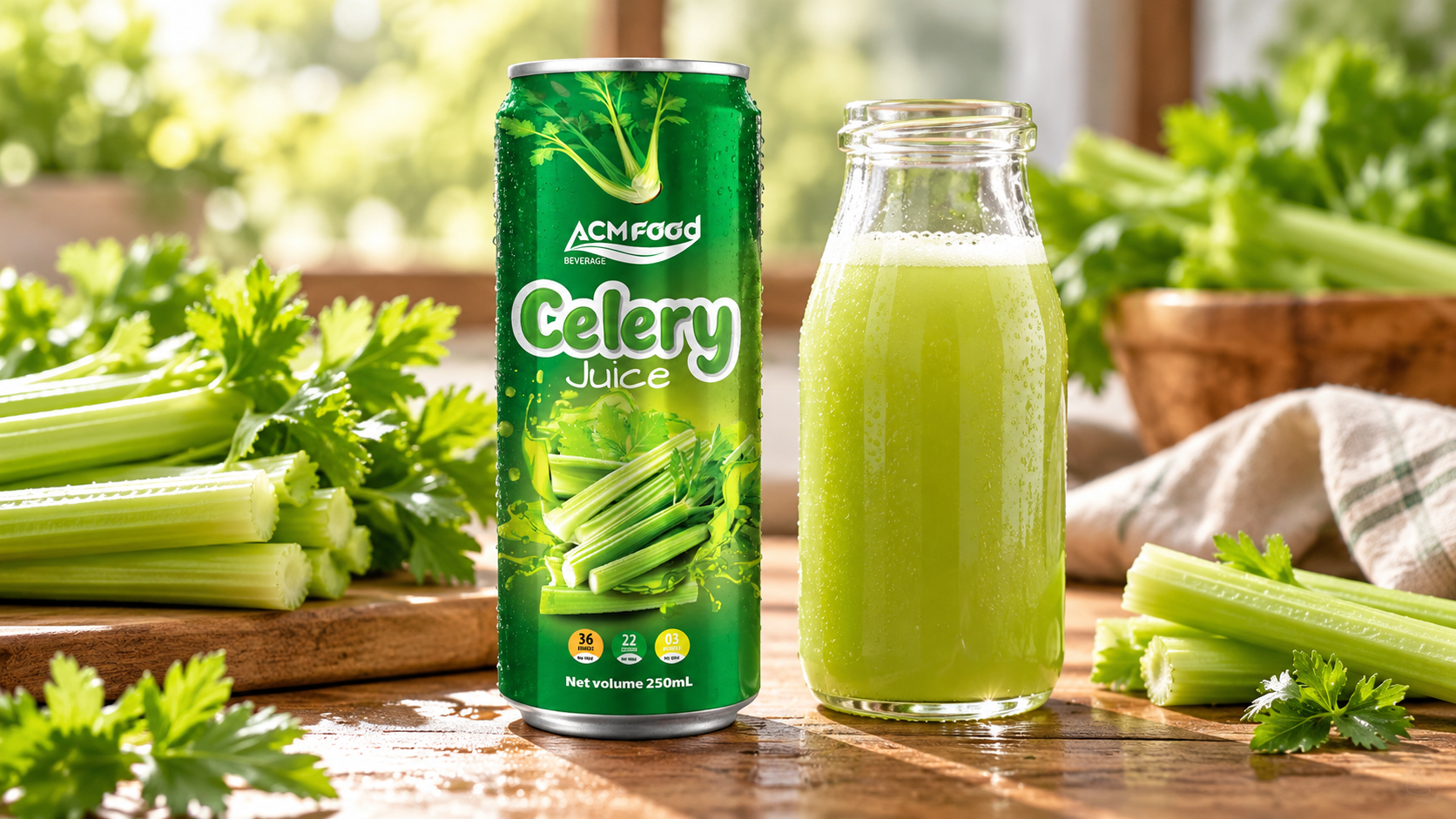
Pure celery juice is packed in aluminium cans or in PET or glass bottles. Cans protect colour best, and bottles show the pale green juice and allow resealing, so the choice depends on channel and positioning.
- Cans. Block light, give a strong oxygen barrier and suit retort sterilisation. The lining must withstand a salty, vegetable-based juice.
- PET. Light, practical and clear. Needs a heat-set design for hot-fill and, for long life, an oxygen barrier.
- Glass. Premium image, strong barrier, higher weight and breakage risk.
Information on current vegetable drink formats from ACMFOOD is available in the celery juice category.
FAQ about pure celery juice
Is 100% celery juice always NFC?
Mostly yes, because celery juice is thin and there is little reason to concentrate it. The label wording should still follow the actual process, and records should confirm it.
Why does celery juice taste salty?
Celery naturally contains more sodium than many vegetables, and the aroma compounds create a savoury impression. The level varies by variety and season.
Why does celery juice turn brown?
Enzymes and oxygen cause browning in fresh juice, and heat and acid change chlorophyll from bright green to olive during processing. Fast handling and deaeration reduce the effect.
Can pure celery juice be stored at room temperature?
Yes, if it is acidified and hot-filled, or sterilised in a validated process, and sealed in an intact can or bottle. Mild pasteurisation alone requires refrigeration.
What is the best pack for celery juice?
Cans protect colour and flavour best, while bottles give visibility and resealing. The better choice depends on the market and the shelf-life target.
Is celery a labelled allergen?
In several markets, including the European Union, celery is on the list of allergens that must be declared, and a celery juice product may need a clear allergen statement. Brands should confirm the rule for each destination before the label is finalised.
Specifying a pure celery juice product
Pure NFC celery juice depends on fast processing, deaeration and a heat route matched to its low acidity. Colour, sodium and sediment are the three points that buyers should specify most carefully, and the shelf life should come from storage tests on the real pack.
Brands that want to develop a celery juice in cans or bottles can send ACMFOOD a brief with the pack format, target markets and quality documents needed. The team can propose a route and plan samples.