


 Français
 Español
 العربية
 한국어
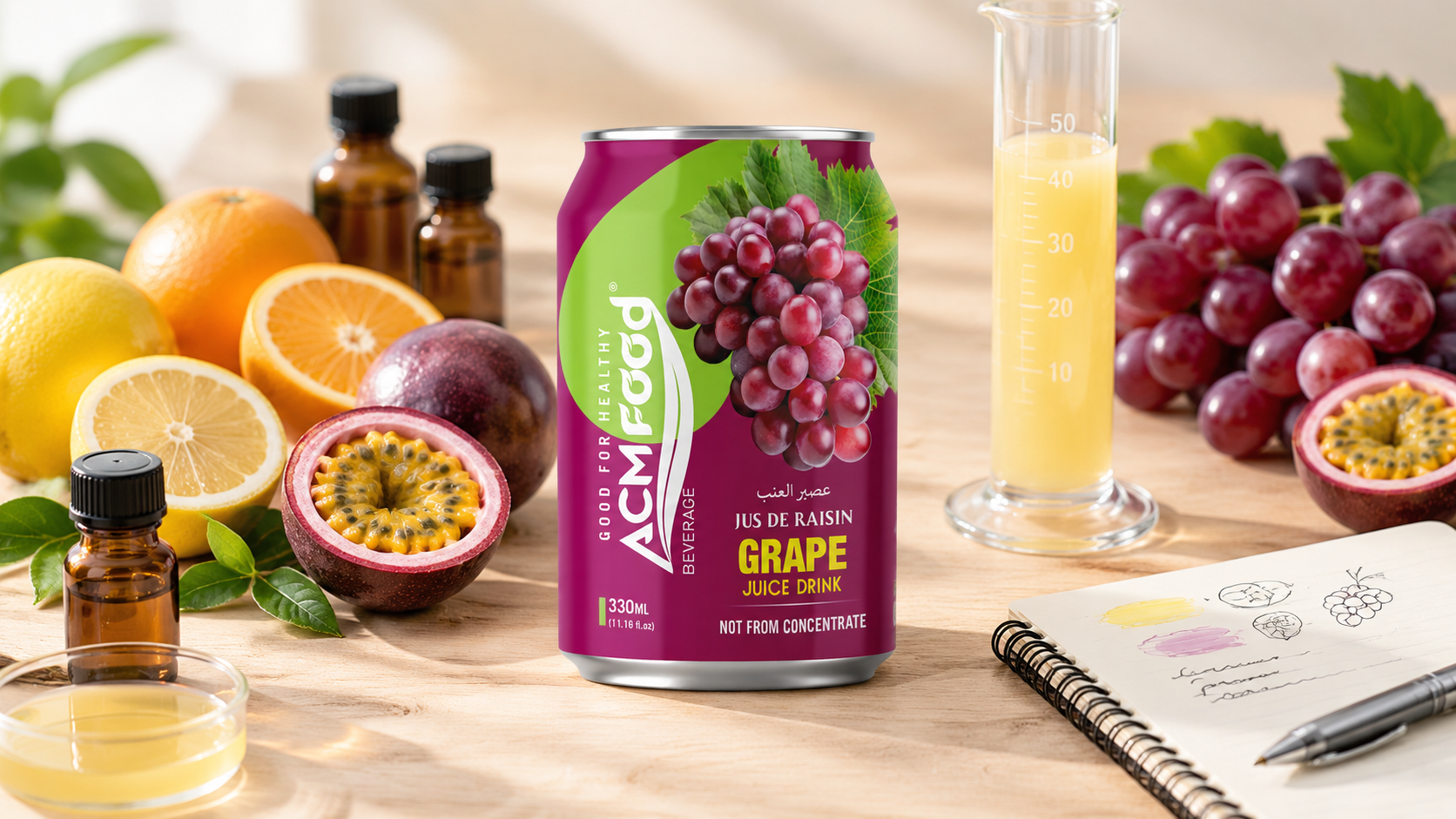
한국어Beverage flavour development is the process of turning a written flavour brief into a single approved profile that a factory can reproduce at full scale, batch after batch. It covers the choice between a house-made flavour and a supplied flavour system, the dosage trials that narrow a shortlist, the sensory work that decides which sample wins, and the documentation that locks the winning profile before production begins.
Most delays in a first production run are not caused by the factory. They are caused by a profile that was approved informally, described loosely, or approved on a sample that was never processed the way the finished product will be. This guide sets out the stages in order and the decisions a brand owner keeps at each one.
What is beverage flavour development?
Beverage flavour development is the structured process of defining a target taste, trialling formulations against it, and approving one profile for manufacture. It ends with a specification detailed enough that a different operator, on a different day, can reproduce the same drink. It is a formulation activity, not a marketing one, although the brief usually starts with a commercial idea.
The work sits between two neighbouring activities that are often confused with it. It begins after the product concept exists and ends before scale-up. Once a profile is approved, the questions change from what should this taste like to how do we hold this taste steady, which is the domain of scaling a benchtop sample to production.
What goes into a usable flavour brief?
A usable brief gives the development team a target they can measure against, not an adjective. Briefs that say fresh and tropical produce rounds of guesswork; briefs that name a reference product, a sweetness level and a market produce a shortlist in the first round.
The elements worth fixing before any bench work starts:
- A reference product. A commercially available drink the team can buy and taste, even if the target is only close to it. This removes more ambiguity than any written description.
- Target market and channel. Sweetness expectations differ sharply between regions, and a profile tuned for one market often reads as flat or cloying in another.
- Juice content or category. Whether the product is a 100% juice, a nectar, a juice drink or a flavoured water changes which flavour systems are even usable.
- Sweetness and acidity direction. A stated intent, such as lower sugar than the reference, shapes the sweetener choice from the first trial rather than the fifth.
- Label constraints. Natural flavour only, no artificial colours, or a clean-label position all narrow the palette before work begins.
- Packaging and process. The fill temperature and pack format decide how much top note survives, so they belong in the brief, not in a later conversation.
House flavour or supplied flavour house?
Both routes are legitimate and the choice is usually commercial rather than technical. A supplied flavour from a flavour house arrives with regulatory documentation and consistent lot-to-lot performance. A house-developed profile, built from juice bases, acids and botanical extracts, gives the brand more control over the story on the label but carries more of the reproducibility burden.
| Consideration | Supplied flavour system | House-developed profile |
|---|---|---|
| Development speed | Faster; a shortlist can be dosed in one session | Slower; each component is trialled separately |
| Lot-to-lot consistency | Managed by the flavour house against its own specification | Managed by the manufacturer through raw material control |
| Label wording | Depends on the flavour declaration supplied | Often easier to position as a simple ingredient list |
| Documentation | Comes with the flavour, including allergen and origin statements | Assembled from each individual ingredient specification |
| Exclusivity | Usually non-exclusive unless negotiated | Easier to keep specific to one brand |
| Reformulation | Dependent on the flavour house schedule | Controlled in-house, but slower to validate |
Many projects end up mixed: a supplied flavour carries the top notes while juice content, acid balance and sweetener system are developed in house. That hybrid is common and does not need to be resolved at brief stage.
How are dosage trials run?
Dosage trials narrow a shortlist by holding everything constant except one variable. A typical first round doses two or three candidate flavours at three levels each into the same base, giving a small matrix that can be tasted in one sitting. The aim of round one is elimination, not perfection.
Three points decide whether the trial produces a usable answer:
- The base must be the real base. Trialling a flavour in water when the product is a juice blend gives a result that will not hold once the juice is added.
- Acidity is set before flavour, not after. Perceived sweetness and fruit character move with pH, so trialling flavours over a drifting acid level produces noise. Fixing pH and acidity targets first makes the comparison meaningful.
- Sweetener choice belongs in the same round. High-intensity sweeteners carry their own time-intensity curve, and a flavour judged over sugar may read differently over a blend, as the work on sweetener systems for export beverages sets out.
How does processing change a flavour profile?
Heat changes flavour, and the size of the change depends on the process. A profile approved on an unpasteurised bench sample can lose much of its top note after a thermal step, and the loss is not uniform across a flavour: bright, volatile citrus and green notes tend to go first, while heavier caramel, vanilla and cooked-fruit notes can strengthen.
This is why the approval sample should be processed, wherever practical, the way the finished product will be. The practical consequences worth planning for:
- Overdosing to compensate is a blunt tool. Adding more flavour restores intensity but often shifts the balance, because the components do not degrade at the same rate.
- Pack material matters. Some flavour components are absorbed into plastic over time, so a profile approved in glass may read differently in PET months later.
- Colour and flavour move together. Both are affected by light, oxygen and temperature during storage, a subject covered in detail in the article on colour and flavour drift over shelf life.
- Headspace oxygen is a variable. Filling conditions influence how quickly a fresh profile begins to flatten, independent of the flavour system chosen.
What does a sensory panel actually do?
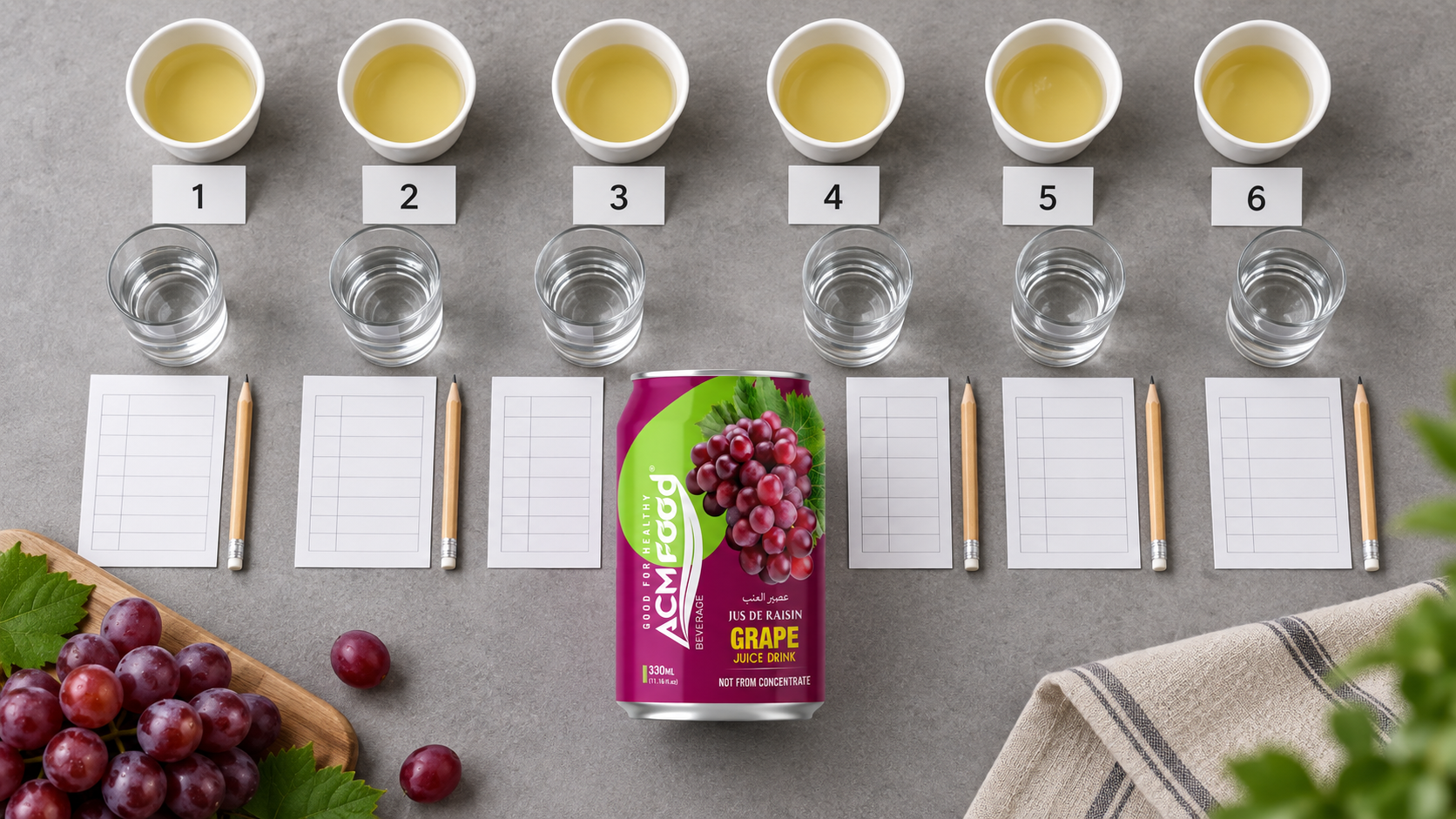
A sensory panel replaces individual preference with a repeatable comparison. Rather than asking whether people like a sample, a well-run panel asks whether tasters can tell two samples apart, and if so, how they differ. That distinction is what makes the result usable as a development decision rather than an opinion.
Panels used in beverage development fall into a few practical types. A discrimination test establishes whether a change is even detectable, which is the right question when comparing a reformulation against an existing product. A descriptive panel, trained on an agreed vocabulary, scores specific attributes such as sweetness, acidity, body and aftertaste, producing a profile that can be plotted and compared between rounds. A consumer preference test asks untrained tasters which sample they prefer, and is the right tool only once the shortlist is already short.
Panel results are only as good as the sample handling. Samples served at different temperatures, in different vessels, or in a fixed order will produce differences that have nothing to do with the formulation. Blind coding, randomised serving order and a consistent serving temperature are the minimum controls.
Locking the profile for production
Approval is not a verbal agreement on a sample. It is a document set that allows a different operator to reproduce the drink, and it is the point at which flavour development formally ends. Without it, the approved taste exists only in the memory of whoever was in the room.
A profile is properly locked when the following are written down and agreed:
- The formulation, with each ingredient named by its full specification rather than a generic description.
- Analytical targets with tolerances, typically brix, pH and titratable acidity, expressed as a range rather than a single figure.
- A retained reference sample, stored under agreed conditions, that later batches are compared against.
- The sensory specification, describing the attributes that define the product and the deviations that would constitute a failed batch.
- The process conditions the approval was granted under, since a profile approved after one thermal treatment is not approved for another.
- A named approver and a date, so that later changes are traceable to a decision rather than a drift.
Once these exist, batch-to-batch comparison becomes a measurement instead of a debate, and a supplier can be held to a standard that both sides recognise.
What beverage brands should confirm before approval
Before signing off a profile, a brand owner is usually best served by confirming a short list of items that are expensive to change afterwards. Whether the flavour supply is exclusive, and on what terms, is worth settling early rather than after launch. The regulatory status of every flavour component in each target market should be confirmed in writing, since a component permitted in one region may be restricted in another.
Any claim the brand intends to make on the pack depends on the final formulation, the tested content and the rules of the destination market, so claims should be treated as provisional until the locked specification exists. It is also worth agreeing in advance what happens when a flavour component becomes unavailable, because substitution without a revalidation step is one of the common routes to an unexplained change in a shipped product.
ACMFOOD works with brand owners through these stages as part of its formulation and R&D support, taking a written brief through trial rounds to an approved, documented profile.
Frequently asked questions
How long does beverage flavour development take?
It depends on how specific the brief is and how many trial rounds are needed. A project with a clear reference product and fixed constraints moves faster than one where the target is still being discussed. Each round involves sample preparation, tasting and feedback, and shipping samples internationally adds time to every round.
Can a competitor product be matched exactly?
Close approximation is realistic; an exact match usually is not. A commercial product reflects specific raw materials, a particular process and often a proprietary flavour system. A practical target is a profile that satisfies the same consumer expectation rather than an identical analytical fingerprint.
Does a lower sugar target change the flavour work?
Yes, substantially. Sugar contributes body and mouthfeel as well as sweetness, so removing it changes more than the sweetness level. The flavour system often has to be adjusted alongside the sweetener to compensate for the lost body and to manage any aftertaste the sweetener introduces.
Who owns the approved flavour profile?
Ownership depends on the agreement in place and on the route taken. A supplied flavour usually remains the property of the flavour house, while a house-developed profile is normally addressed in the manufacturing or confidentiality agreement. It is a point to settle in writing before development starts rather than after approval.
Bringing the brief and the profile together
Flavour development is most efficient when the brief is specific, the trials are run against the real base and the real process, and the approved profile is written down in a form that a factory can reproduce. The technical work is rarely the constraint; the constraint is usually how precisely the target was defined and how formally the result was recorded.
Brands preparing a product brief can shorten the process considerably by arriving with a reference product, a target market, a stated sweetness direction and the pack format in mind. With those fixed, the first trial round becomes a genuine narrowing exercise rather than an exploration, and the path to a locked, reproducible profile is materially shorter.