


 Français
 Español
 العربية
 한국어
한국어Scaling up beverage production is the process of turning a benchtop sample into a stable, repeatable product that runs on factory equipment without compromising taste, texture or shelf life. A formula that works in a blender and saucepan may behave very differently in a stainless tank, through heat exchangers, filters and fillers.
This guide focuses on the technical pitfalls and decisions that matter most between pilot batch and the first production run. It is written for R&D, QA and operations teams who need to de-risk scale-up, align stakeholders, and protect brand intent from lab to line. If you plan to work with a contract manufacturer, see how OEM beverage manufacturing projects are typically structured.
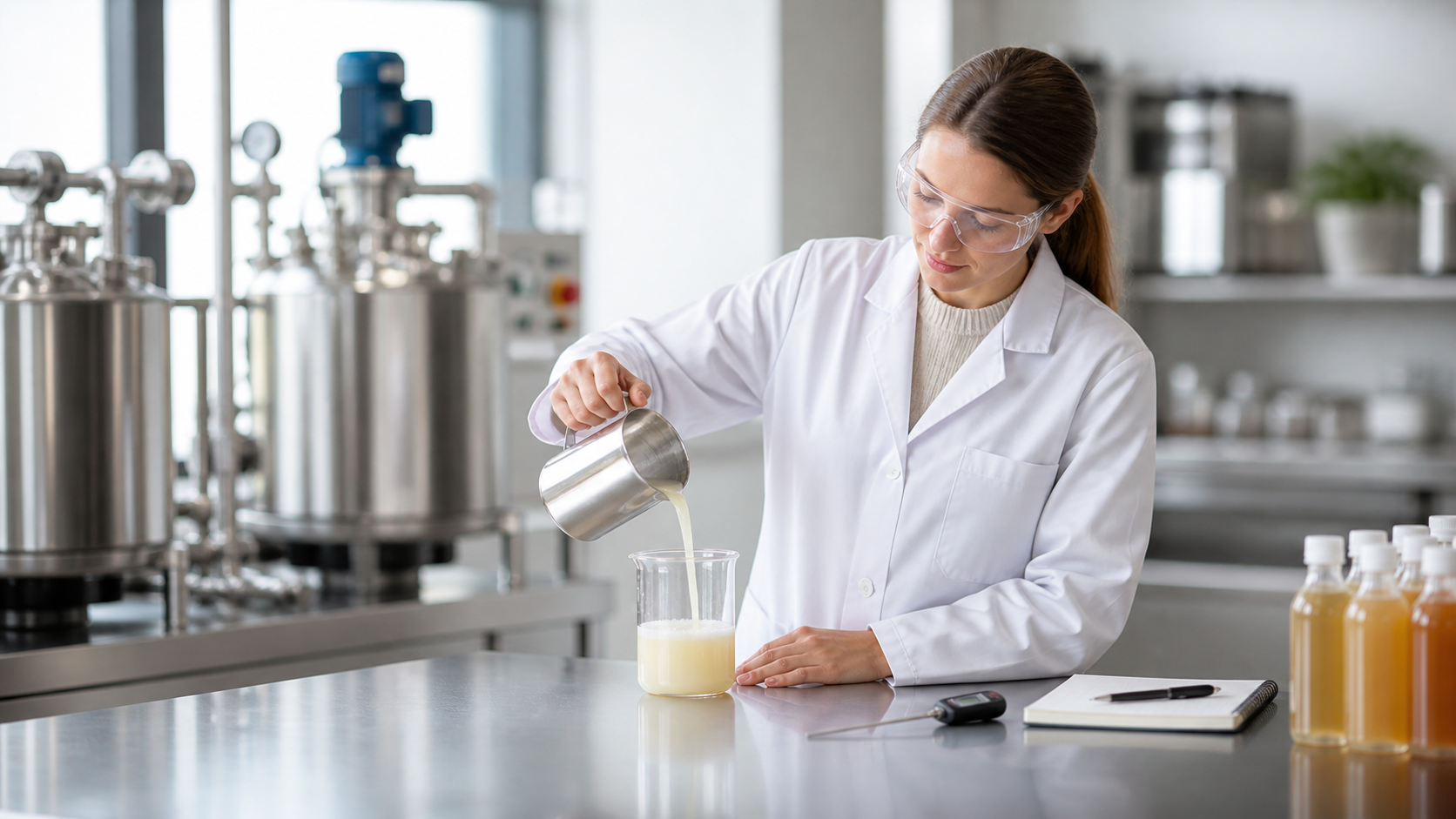
Why do benchtop recipes fail at plant scale?
Most failures arise because the physical and thermal environment in a factory is not a scaled-up kitchen. Mixing energy, heat transfer, hold times, aeration, filtration and filling conditions all change, shifting taste, texture, stability and even color unless the process is adapted.
Key differences that often break a lab-perfect formula when scaled:
- Mixing & shear: Tank geometry, impeller design and RPM create different shear profiles than a benchtop blender, altering emulsions, suspensions and hydrocolloid hydration.
- Heat transfer & residence time: Large volumes heat and cool more slowly; thermal exposure and hold times can drive flavor loss, color changes or viscosity drift.
- Order of addition: Inline dosing, powder induction and limited access to top openings force sequence changes that affect hydration and dispersion.
- Aeration & deaeration: Bench blending traps air; plants may add vacuum or nitrogen sparging. Oxygen differences shift flavor, browning and shelf life.
- Filtration & strainers: Inline filters and screens can remove particulates you expected to remain, or plug if viscosity/particle size are mis-specified.
- Flavor volatility: Larger surface areas, longer warm holds and higher shear strip top notes unless aroma is adjusted or protected.
- Packaging dynamics: Headspace, seams/closures, light and oxygen ingress vary by package, changing carbonation, aroma delivery and color stability.
- Quality sampling: In-line vs. grab samples and instrument calibration can shift apparent Brix, pH and viscosity compared with the lab.
What changes between benchtop, pilot batch and production?
Pilot batching bridges lab intent and factory reality. It tests equipment-like shear, heating and holding, validates order of addition, and tightens specs before committing to a full run. Production then validates repeatability under real speeds, utilities and packaging.
| Aspect | Benchtop | Pilot batch | First production run |
|---|---|---|---|
| Mixing energy | High blender shear, small vessel | Tank agitator or small homogenizer | Full-size impeller/homogenizer, line shear |
| Heating & cooling | Direct stove or small hotplate | Jacketed kettle or small heat exchanger | Plate/tubular exchanger, controlled holds |
| Hold times | Short, minimal exposure | Representative but shorter than plant | Real line residence and wait times |
| Aeration control | Often aerated | Optional vacuum or nitrogen | Inline deaeration where available |
| Filtration/straining | Coarse sieve if any | Selectable mesh and flow | Defined screen/mesh per line standards |
| Filling & headspace | Hand fill | Tabletop filler | Production filler and closures |
| QC sampling | Single bench measurement | Start/mid/end checks | In-line & periodic grab samples |
| Risk & cost | Low cost, quick | Moderate risk, faster feedback | Highest commitment, commercial impact |
Which variables matter most when you scale up beverage production?
Prioritize variables that control safety, stability and sensory: thermal profile, mixing/shear, order of addition, pH and Brix targets, viscosity/rheology, oxygen level, filtration, and packaging interactions. Lock these in pilot trials and document acceptance ranges before committing to a first run.
- Order of addition: Decide where powders, acids, gums and flavors enter. Pre-dispersions and slurry concentrates can prevent fisheyes and flavor loss.
- Shear & homogenization: Match shear history to the plant (impeller type, homogenizer presence). Emulsions and hydrocolloids are highly shear-dependent.
- Thermal profile: Define temperature ramps, hold times and cool-down. Flavor, color and viscosity respond to the total thermal load, not just peak temperature.
- pH & titratable acidity: Set a pH target with a realistic acceptance band. Buffering capacity may differ at scale, shifting perceived sourness and preservative efficacy.
- Brix & solids: Calibrate instruments and account for temperature correction. Perceived sweetness changes with acidity and serving temperature.
- Rheology: Specify viscosity at stated shear rate and temperature. Some systems thicken after aging; include an aging check in pilot trials.
- Oxygen management: Decide on deaeration, nitrogen dosing or vacuum; oxygen changes flavor, browning and vitamin/aroma retention.
- Filtration & particulates: Define target particle size and mesh to protect equipment without stripping intended texture or cloud.
- Filling conditions: Filling temperature, headspace control and closure torque affect stability, carbonation and sensory release.
Thermal processing and stability choices
Your product’s acidity, ingredients and intended shelf life guide the process choice. Each option imposes different heat and shear histories, which change flavor, color and body unless the formula is tuned accordingly.
- Hot-fill: Product is filled while hot, then sealed. Works well with compatible bottles and closures designed for elevated temperatures. Watch for aroma loss during warm holds and paneling risks.
- Tunnel pasteurization: Filled containers pass through a heated water tunnel. Suits many cans and glass formats; check label/ink adhesives for heat resilience.
- Aseptic processing: Product and packaging are sterilized separately; filling occurs in a sterile environment. Demands stringent controls but offers a clean flavor profile with shorter heat exposure.
- Retort: Package and product are heated together in a pressurized vessel. Suitable for certain formats and recipes; expect a heavier thermal impact on flavor and texture.
- High-pressure processing (HPP): Cold-pressure treatment applied to sealed packages; check packaging compatibility and expect chilled distribution.
Confirm that stabilizers, flavors and colors tolerate your chosen process. Create pilot-scale thermal curves that mimic production as closely as possible.
Flavor, aroma and perceived sweetness at scale
Expect top-note fade and sweetness shifts as shear, heat and oxygen exposure change. Build headroom in the brief for flavor adjustments and validate in the intended package at serving temperature.
- Volatiles: Longer warm holds strip citrus, herbal and floral top notes. Consider timing of flavor addition and, where appropriate, top-dressing post-thermal process.
- Sweetness balance: Acids sharpen or mute perceived sweetness; non-nutritive sweeteners can shift intensity after heat or over time. Tune with controlled sensory.
- Temperature effects: Cold service reduces sweetness aroma perception; test at real serving conditions.
- Oxygen pickup: Manage DO to reduce oxidative notes and color browning; validate in the actual line and package.
Hydrocolloids, body and particulates
Gums, pectins, starches and proteins respond to shear, temperature and time. Without adjustment, the same formula may pour thin on day one and over-thicken after aging, or particulates may settle or clog strainers.
- Hydration: Pre-mixes or slurry concentrates can ensure full hydration before heat, reducing fisheyes and graininess.
- Shear sensitivity: Over-shearing can reduce viscosity or break emulsions; under-shearing leaves undispersed lumps.
- Aging & set: Some systems continue to thicken over 12–24 hours; include an aging hold in pilot protocols.
- Particles: Specify size, sink/float behavior and acceptable loss across filters. Match tank and line velocities to keep particles suspended.
Packaging decisions that influence scale-up
Package format affects oxygen ingress, light exposure, carbonation retention, filling temperature and label resilience. Decide early, because formula and process windows can shift with the package.
- Compatibility with process: Not all bottles, cans or labels tolerate hot-fill or tunnel pasteurization equally; confirm with your suppliers.
- Closures & seams: Headspace, seam integrity and torque drive oxygen pick-up, carbonation and leak resistance.
- Light & color: Clear packages showcase color but may need light-stable formulations or opacifiers for sensitive ingredients.
- Graphics & labels: Heat, moisture and time in tunnels can challenge inks and adhesives; align with your beverage label printing workflow.
For a deeper comparison of cans, PET bottles, glass and cartons, review beverage packaging options before you lock tooling or artwork.
Process water and plant utilities
Water chemistry and utilities are silent drivers of consistency. Mineral content, disinfectants and microbiological profile influence flavor, stability and scale fouling; steam, air and nitrogen quality affect product contact points.
- Process water: Align your specification with the plant’s treatment capability; see process water in a beverage plant for why it often decides product consistency.
- Compressed air & gases: Oil, moisture and particulates can reach product contact; define filtration and quality classes for injection or sparging.
- Steam quality: Culinary steam standards and condensate management protect taste and equipment.
QC specifications, sampling and acceptance bands
Write QC specs that are measurable on the plant’s instruments, with realistic acceptance ranges that reflect line variation. Use a golden sample and sensory references to align decisions during the run.
- Targets with methods: Specify method, instrument model (or equivalent) and temperature for Brix, pH and viscosity.
- Sampling plan: Define start, middle and end checks, in-line vs. grab, and retain samples per lot.
- Sensory standards: Provide a reference set for sweetness, acidity, aroma and body; train evaluators on pass/fail cues.
- Non-conformance response: Pre-agree stop-run criteria, rework options and documentation.
Documentation and the product brief for the first run
A precise brief reduces surprises and protects intent when decisions happen fast. Keep commercial claims separate from technical requirements, and state what must not change.
- Formula & process: Master formula with order of addition, target temperatures, holds and cool-down notes.
- Ingredient specs: COAs, allergens, storage and handling instructions for each input; thermal and shear limits where relevant.
- Packaging & artwork: Finished package bill of materials, torque/seam targets, and artwork approved per your label printing workflow.
- Utilities & sanitation: Water spec, gas quality, sanitation compatibility and any no-go chemicals.
- QC & release: Measurable targets, methods, acceptance bands, retain policy and shelf-life plan.
- Change control: What can be adjusted on-line (and by how much) vs. what requires approval.
If you are transferring a live product to a new facility, align on data, samples and tolerances early. See guidance on moving an existing recipe to another manufacturer.
How to run the first production run with fewer surprises
Treat the first run as a structured experiment with commercial stakes. Plan narrowly, instrument well and agree on how to pause or pivot.
- Pre-run alignment: Walk the line with the team. Confirm the bill of materials, lot traceability, process setpoints, sampling plan and stop criteria.
- Staged ramp-up: Start slowly to verify dispersion, heat-up, filters and deaeration. Check early pH/Brix/viscosity against targets before full speed.
- Hold-back strategy: Retain a portion of blend for quick adjustment if early results drift within allowable limits.
- Package checks: Validate closure torque or seam integrity, headspace and fill weights at agreed intervals.
- Sensory checkpoints: Evaluate warm and after cool-down, then again from finished packs at intended serving temperature.
- Document everything: Record actual temperatures, times, shear, adjustments and QC reads; capture samples from start/middle/end.
- Post-run review: Consolidate data, compare to pilot, set corrective actions and update the brief for the next lot.
If you are partnering with a contract manufacturer, ensure your scope covers development support and handover expectations; see typical scopes in OEM beverage manufacturing.
FAQ
Do I need a pilot batch before the first production run?
Yes, in most cases. Pilot batching reveals shear, heating and holding effects that benchtop work cannot replicate. It allows you to set acceptance ranges and de-risk the commercial run at manageable cost.
Which specs should I lock before scaling?
Lock your thermal profile, order of addition, pH and Brix targets (with methods), viscosity at stated conditions, filtration mesh, oxygen strategy, filling temperature, headspace and packaging parameters such as seam/torque checks.
Can I change flavors or sweeteners on the fly?
Small, pre-agreed adjustments may be possible, but most flavor and sweetener changes ripple through balance, labeling and claims. Define allowable adjustment ranges in the brief and retest sensory from finished packs.
Why does my emulsion look different on the line?
Homogenization pressure, impeller shear, temperature and hold times differ from the lab. Validate droplet size and stability under plant conditions, and tune emulsifier/stabilizer systems accordingly.
How many people should approve first-run decisions?
Keep the approval cell small and pre-defined (typically R&D, QA and operations). Provide a golden sample and written acceptance bands so decisions on taste and texture are fast and consistent.
Key takeaways and next steps
To scale up beverage production with fewer surprises, bridge benchtop intent through pilot trials that mimic plant shear and thermal history; lock measurable specs with realistic acceptance bands; and choose packaging early, as it changes stability and sensory. Tight documentation, aligned sampling and a staged first run protect quality and help you move from sample to shelf with confidence.
Preparing a clear brief, aligning utilities and packaging, and agreeing on on-line adjustments are the fastest ways to de-risk your first run. For adjacent planning topics, review package format trade-offs, the role of process water in a beverage plant, and how OEM beverage manufacturing engagements structure development support.