


 Français
 Español
 العربية
 한국어
A beverage manufacturing glossary is a short reference that defines the technical, quality and commercial terms used between a brand owner and the factory that produces its drinks. Knowing these terms helps buyers read quotations, specifications and test reports without guesswork, and ask sharper questions during an OEM project.
The 75 terms below are grouped by stage: business models, ingredients and formulation, processing, packaging, quality and certification, and trade. Each definition is kept to one or two sentences. Where ACMFOOD has a page that covers the topic in depth, the term links to it, so this glossary also works as a map of where each concept is explained on this site.

Business models and project terms
These terms describe who owns the formula, the brand and the responsibilities in a manufacturing agreement.
- OEM (original equipment manufacturer): the factory produces a drink to the buyer’s own formula and specification, under the buyer’s brand. See OEM beverage manufacturing.
- ODM (original design manufacturer): the factory develops or supplies the formula, and the buyer sells the finished product under its own brand. See ODM beverage manufacturing.
- Private label: a product made by a manufacturer and sold under a retailer’s or brand owner’s label, often with some customisation of recipe or pack. See private label beverages.
- White label: a standard product sold to several buyers who each apply their own label, with little or no change to the recipe. The distinction is covered in private label vs white label.
- Co-packer: a company that fills and packs drinks for brand owners, usually using the brand’s formula and sometimes the brand’s ingredients. Compare the roles in co-packer vs contract manufacturer.
- Contract manufacturer: a producer that manufactures under contract and may also source ingredients, develop formulas and manage packaging for the buyer.
- MOQ (minimum order quantity): the smallest quantity a manufacturer will produce per SKU or per order. See private label fruit juice MOQ.
- SKU (stock keeping unit): one distinct product, such as one flavour in one pack size; two flavours in the same can are two SKUs.
- Product brief: the buyer’s written description of the target product, covering market, format, flavour, sweetness, claims and budget.
- NDA (non-disclosure agreement): a contract that protects confidential information such as formulas and plans. See the co-packer NDA checklist.
- Lead time: the time between order confirmation, or approval of samples and artwork, and goods being ready for shipment.
Ingredient and formulation terms
These terms appear in specifications, recipes and ingredient declarations.
- NFC (not from concentrate): juice that is pressed and heat treated without being concentrated and later diluted. See NFC vs from concentrate.
- From concentrate: juice made by restoring concentrated juice with water to a defined strength.
- Juice concentrate: juice with much of its water removed, which lowers volume for storage and transport.
- Fruit puree: fruit flesh broken down into a smooth, thick mass that keeps fibre and body. See fruit puree in beverages.
- Nectar: a drink made from juice or puree with added water and usually sugar, with a lower juice content than 100% juice.
- Juice drink: a beverage that contains some juice but less than a nectar; minimum juice levels depend on the market.
- Brix (°Bx): a measure of dissolved solids, mostly sugars, in a liquid, read with a refractometer. See the fruit juice Brix guide.
- pH: a scale of acidity; lower values are more acidic, and pH guides the choice of heat treatment. See pH and acidity in beverage formulation.
- Titratable acidity: the total amount of acid in a drink, measured by titration and often expressed as citric acid.
- Brix/acid ratio: the balance of sweetness to sourness, a common way to describe taste in juice specifications.
- Acidulant: an acid added to adjust taste and pH, such as citric, malic or tartaric acid.
- Sweetener system: the combination of sugars and non-sugar sweeteners used to reach a target taste and sugar level. See sweetener systems for export beverages.
- Hydrocolloid: a thickener or stabiliser, such as pectin, gellan or carrageenan, used to suspend particles or build texture.
- Fortification: adding vitamins or minerals to a drink in measured amounts. See beverage fortification.
- Clean label: an informal term for short, recognisable ingredient lists; it has no single legal definition.
- Formulation: the recipe and the work of developing it to meet taste, cost and stability targets. See formulation and R&D.
Processing and heat treatment terms
These terms describe how a drink is made safe and stable for its shelf life.
- Pasteurisation: heating a product to a set temperature for a set time to reduce microorganisms to a safe level.
- Flash pasteurisation: rapid heating and cooling of the liquid before filling. Compare it in flash vs tunnel pasteurisation.
- Tunnel pasteurisation: heating filled, sealed containers as they pass through a tunnel of hot water sprays. See tunnel pasteurisation.
- Hot fill: filling a heated, acidic product into containers so the heat also treats the inside of the pack. See the hot fill process.
- Cold aseptic filling: filling a sterilised, cooled product into sterilised containers in a sterile zone. See cold aseptic filling.
- Aseptic bottle sterilisation: treating bottles and caps with a sterilant before aseptic filling. See aseptic bottle sterilisation.
- UHT (ultra-high temperature): very high heat for a few seconds, followed by aseptic packing, used for milk and low-acid drinks. See UHT processing.
- ESL (extended shelf life): a process that extends chilled shelf life beyond standard pasteurisation without reaching UHT stability. See ESL vs UHT.
- Retort: sterilising sealed cans or bottles under pressure at high temperature, used for low-acid drinks. See retort processing.
- HPP (high pressure processing): treating sealed, chilled packs with very high water pressure instead of heat. See HPP beverages.
- 5-log reduction: a 100,000-fold reduction of a target pathogen, a performance standard in juice HACCP. See juice HACCP and the 5-log reduction.
- Homogenisation: forcing a liquid through a narrow gap at high pressure to reduce particle or fat droplet size.
- Deaeration: removing dissolved air, mainly oxygen, from a liquid before heat treatment and filling.
- Clarification: removing haze and suspended solids, for example with enzymes or filtration, to produce clear juice.
- Carbonation: dissolving carbon dioxide into a drink, usually stated in volumes of CO2.
- Commercial sterility: the condition in which no microorganisms capable of growing in the product under normal storage remain. See commercial sterility testing.

Packaging terms
These terms come up when choosing and specifying the container, closure and outer packaging.
- PET: polyethylene terephthalate, the clear plastic used for most beverage bottles.
- rPET: PET made partly or wholly from recycled material. See what is rPET.
- Preform: the small test-tube-shaped PET part that is blown into a bottle.
- Heat-set PET: PET bottles designed to resist deformation at hot-fill temperatures.
- Slim, sleek and standard can: common aluminium can shapes that differ in diameter and height. See can formats.
- Can liner: the internal coating that separates the drink from the metal of the can.
- Nitrogen dosing: adding a drop of liquid nitrogen before seaming so a still drink can stays pressurised and rigid.
- Headspace: the gap between the liquid and the closure in a filled container.
- Shrink sleeve: a printed plastic film shrunk around a can or bottle as a label. Compare in shrink sleeve vs printed can.
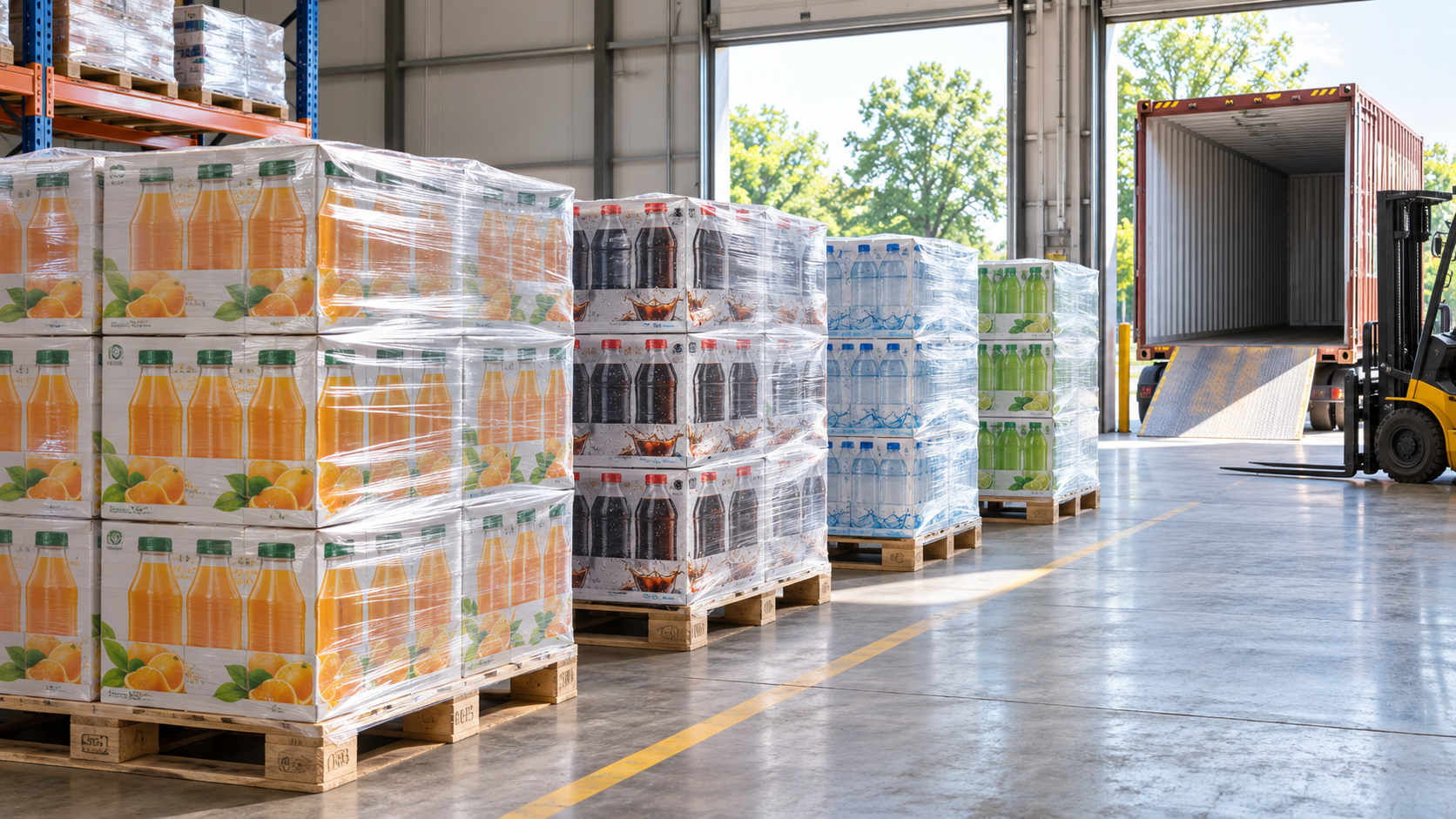
- Case and pallet configuration: how many units go into a carton and how cartons are stacked on a pallet. See case configuration and pallets.
- Shelf life: the period during which a product, stored as instructed, keeps its safety and agreed quality.
Quality and certification terms
These terms describe food safety systems and the documents that prove product quality.
- HACCP: hazard analysis and critical control points, a system for identifying and controlling food safety hazards.
- CCP (critical control point): a step where control is essential to prevent or remove a food safety hazard, such as a pasteurisation temperature.
- ISO 22000: an international standard for food safety management systems.
- FSSC 22000: a certification scheme built on ISO 22000 plus additional requirements, recognised by GFSI. See ISO 22000 vs FSSC 22000.
- BRCGS: a GFSI-recognised food safety standard widely requested by UK retailers. Compare in BRCGS vs FSSC 22000.
- GFSI: the Global Food Safety Initiative, which benchmarks food safety certification schemes.
- Halal: certification that a product meets Islamic dietary requirements, issued by an accredited body. See halal certification for beverage export.
- Kosher: certification that a product meets Jewish dietary law. See kosher certification.
- CoA (certificate of analysis): a document reporting test results for a production batch against the agreed specification. See certificate of analysis.
- Specification: the agreed list of product parameters, tolerances and test methods for a SKU.
- Retained sample: units kept from each batch so the product can be re-tested if a question arises.
- LACF (low-acid canned food): in the US, a shelf-stable food with a pH above 4.6 that is subject to specific FDA process rules. See LACF process filing.
- Acidified food: in the US, a low-acid food to which acid is added to reach a pH of 4.6 or below.
Trade and export terms
These terms appear in quotations, contracts and shipping documents.
- Incoterms: standard trade terms that set where cost and risk pass from seller to buyer. See Incoterms for beverage import.
- FOB (free on board): the seller delivers goods onto the vessel at the named port, after which risk passes to the buyer.
- CIF (cost, insurance and freight): the seller pays freight and insurance to the destination port, but risk passes when goods are loaded.
- HS code: the customs classification number that determines duty rates. See beverage HS code classification.
- Certificate of origin: a document that states where goods were made and supports preferential duty claims. See the certificate of origin guide.
- Bill of lading: the carrier’s document acknowledging receipt of goods and serving as a transport contract.
- Sugar tax: a levy on sweetened drinks, usually based on sugar content per volume. See beverage sugar tax by market.
- Importer of record: the party legally responsible for the goods at customs in the destination country.
How should buyers use this glossary?
Use this glossary as a shared vocabulary with your manufacturer: check that both sides mean the same thing by MOQ, lead time, shelf life or juice content before signing a specification. Many disputes in OEM projects start with a term both parties understood differently, not with a production fault.
Three habits help:
- Define key terms in writing in the product specification, with numbers and units where they apply.
- Ask the manufacturer which heat treatment and filling method a product will use, and why.
- Confirm which certificates cover the specific factory and product, not only the company name.
Next step
A beverage manufacturing glossary is most useful when it turns into a clear brief. ACMFOOD works with a minimum order of 500 cartons per SKU, a production lead time of 15–30 days after approval, HACCP, ISO 22000 and FSSC 22000 systems, and cans, PET and glass bottles. Send us your product idea, and we will reply in the same terms used above.