


 Français
 Español
 العربية
 한국어
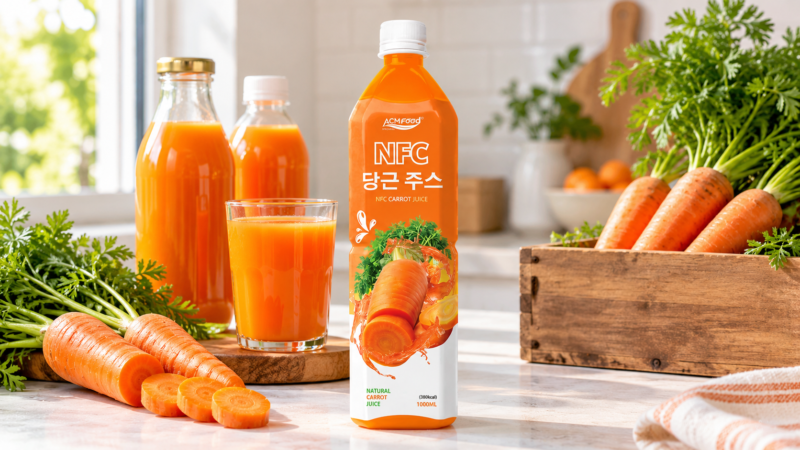
100% carrot juice, carrot nectar and carrot juice drinks look similar on a shelf, yet they are different products. They differ in how much carrot juice they contain, what else is added, how sweet they taste and how they must be named on the label, which in turn changes cost and brand positioning.
This spec guide explains the three categories in practical terms, shows how Brix and added ingredients separate them and lists the fields a brand should write into a specification. Naming rules vary by market, so treat the descriptions as a framework and check the destination rules before printing a label. ACMFOOD, a Vietnam beverage manufacturer, supplies finished drinks in cans and bottles under OEM, ODM and private label arrangements.
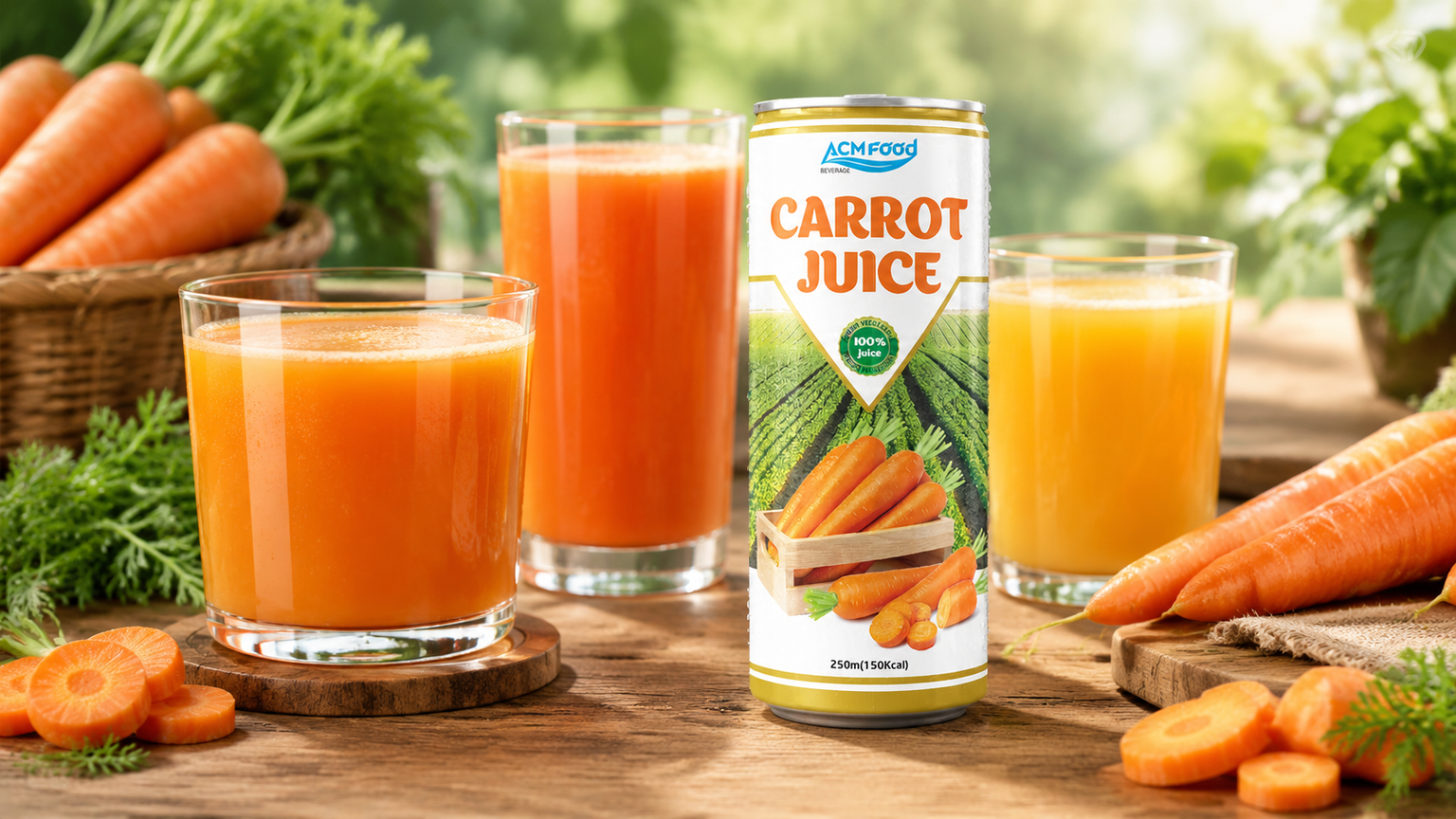
What is the difference between carrot juice, nectar and drink?
Carrot juice contains only carrot juice, carrot nectar is juice diluted with water and often sweetened, and a carrot drink contains a lower share of juice together with water, sweeteners and flavour. The more a product is diluted, the lower its juice content and the lower the cost per bottle.
| Category | Typical composition | Taste and body | Positioning |
|---|---|---|---|
| 100% carrot juice | Carrot juice only, with permitted adjustments such as acidity regulators | Thick, naturally sweet, strong carrot flavour | Premium, minimal ingredient list |
| Carrot nectar | Carrot juice plus water and, in many cases, sugar or sweetener | Lighter, sweeter and smoother | Mainstream, broader appeal |
| Carrot juice drink | Lower juice share with water, sugar and flavour | Light, sweet, less carrot character | Value and mass market |
| Blend | Carrot juice with other juices such as apple or orange | Brighter, fruitier, easier to drink | Family and everyday use |
The names “juice”, “nectar” and “drink” are regulated in many markets, usually with minimum juice contents written for fruit. Rules for vegetable juices are less uniform, so a brand should confirm which terms are allowed and what each requires before it chooses a name.
How does Brix separate the categories?
Brix measures the dissolved solids in a juice, mostly sugars, and it is a quick way to check strength. Pure carrot juice has a characteristic Brix level that depends on variety and season, while nectars and drinks show lower values unless sugar has been added.
Brix is useful in three ways. It confirms that a batch of juice has the expected strength before it is diluted or filled. It helps compare lots across harvests, since carrot sweetness changes through the year. And it supports the quality claim on a finished product, because a drink that claims to be 100% juice should show a Brix consistent with undiluted carrot juice.
Brix alone cannot prove composition. Added sugar can raise Brix in a diluted product to look similar to juice, so other tests and production records are required to verify what was added. Specifications should therefore state Brix with a range and with the test method.
What can be added to each category?
A 100% juice allows very little beyond the juice itself, while nectars and drinks allow water, sweeteners, acids, vitamins and flavours within local rules. The ingredient list is the clearest guide for consumers and regulators.
- 100% juice. Only juice, and in some markets small amounts of acidity regulators or vitamin C. No added sugar or water.
- Nectar. Water and often sugar, honey or a sweetener, together with acidity regulators to balance taste and stabilise pH.
- Drink. Water, sweetener, flavour, colour or vitamin additions as the recipe requires.
- Blend. Other juices, with or without water and sugar depending on the category claimed.
Any additive must appear on the label in the required form. A brand that wants a short, simple ingredient list should lean toward the juice or blend categories, which also support a clean label story. More on clean formulation can be found in the clean label juice formulation guide.
How does the category affect cost?
Cost falls as the juice share falls. Carrot juice is the main cost driver of the recipe, so a nectar or drink uses less of it and more water, and it therefore costs less per bottle. Packaging, heat treatment and freight remain similar across categories.
Cost differences also come from other sources:
- Yield. The amount of juice obtained from a tonne of carrots varies with variety, season and pressing method.
- Sweetener. Sugar or sweetener adds cost, though less than juice itself.
- Process complexity. Blends need more raw materials and quality checks.
- Shelf-life route. Acidified recipes are cheaper to stabilise than unacidified ones that need sterilisation.
Brands should compare options on the cost of the whole finished pack, not on the juice recipe alone, since packaging and logistics often decide the final price tier.
How should each category be positioned?
Each category has a natural audience. 100% juice fits premium and wellness positioning, nectar fits mainstream grocery and families, and drinks fit value channels, foodservice and children’s ranges. The decision should start from the consumer and the price shelf rather than from the cheapest recipe.
- 100% carrot juice. A short ingredient list, a bold colour and a clear message of simplicity. Smaller sizes suit single servings.
- Carrot nectar. A softer taste for people who find pure juice too intense, with larger pack sizes for households.
- Carrot drink. Sweeter, lighter, often flavoured, aimed at price-sensitive channels.
- Carrot and fruit blends. A familiar fruit note makes the product approachable and lowers the barrier to trial.
An established example of how a carrot beverage is developed for a brand can be read in the carrot juice OEM guide, and wider vegetable drink development is covered in the vegetable juice manufacturing guide.
What should a carrot juice specification contain?
A specification should define composition, analytical limits, sensory targets, packaging and shelf life. It becomes the benchmark for every batch, so each field should have a value, a tolerance and a test method.
- Product name and category. Juice, nectar, drink or blend, using the wording intended for the label.
- Juice content. Minimum percentage of carrot juice and any other juices.
- Ingredients. Every ingredient, with grade or origin where relevant, including acidulants and sweeteners.
- Brix and pH. Target range and method of analysis.
- Sensory description. Colour, cloud, taste, aroma and mouthfeel, with an approved reference sample.
- Microbiology. Limits suited to the heat treatment.
- Contaminants. Limits at or below the destination market’s legal levels.
- Packaging. Can or bottle, size, closure, coding and carton configuration.
- Shelf life. Duration and storage conditions on which the claim relies.
How is carrot juice kept consistent across harvests?
Consistency is managed by sourcing from several fields, blending lots and adjusting the recipe within a validated range. Carrot sweetness, colour and cloud change with variety, soil, rainfall and storage time, so a factory that sells all year cannot rely on one uniform raw material.
- Lot blending. Juice from sweeter and less sweet lots is mixed to reach the target Brix and flavour.
- Brix and acid ratio. The balance between sugar and acid is measured and corrected, usually by adjusting the blend or the acidulant dose.
- Colour reference. Colour is compared with a reference sample so the product looks the same from batch to batch.
- Storage management. Older carrots lose sugar and develop bitterness, so storage time and conditions are limited and recorded.
- Sensory tasting. A tasting panel confirms that each batch matches the approved reference before filling.
For a 100% juice, these adjustments must stay within the permitted wording of the category. For a nectar or drink, they can also involve water and sweetener, which offers more control but changes the label.
Which tests support a 100% juice claim?
A 100% juice claim is supported mainly by the formulation record, the raw material receipts and the production log, with analytical tests as a cross-check. Laboratory tests can detect large deviations, but the most reliable proof is a complete record that shows only carrot juice entered the batch.
- Batch formulation sheet. Lists every ingredient and quantity used, signed at the time of production.
- Raw material records. Carrot lots, acidity regulators and any other ingredients, matched to supplier documents.
- Brix and acid profile. Compared with the range for undiluted carrot juice from the same season.
- Sugar profile. A sugar analysis can reveal added sugar when the ratio of sugars differs from carrot’s natural pattern.
- Retained sample. Stored for later reference in case a customer or authority raises a question.
The set of tools used by authorities differs by country, so the buyer should ask the supplier which records and tests are available and in what form they can be shared during an audit.
How do sugar statements work on carrot beverages?
Sugar statements must reflect the total sugars on the nutrition panel and the presence or absence of added sugar. A 100% carrot juice contains only the sugars naturally present, so it can often carry a no-added-sugar statement where the market allows, but it still shows total sugars on the panel.
A nectar or drink with added sugar cannot use that statement, and a reduced-sugar claim requires a defined reduction compared with a reference product. The nutrition values should come from analysis of the finished product, since sugar content varies with the carrot lot. Brands should also keep in mind that some markets add front-of-pack labelling or sugar-based levies that treat juice, nectar and drinks differently, which can influence the choice of category as much as taste does.
How do label claims connect to the specification?
Every claim on the pack should be traceable to a line in the specification and to a batch record. A statement such as 100% juice, no added sugar or source of fibre must be supported by the recipe and by test results, and it must be allowed in the destination market.
Brands should avoid wording that implies more than the product delivers. Health-related statements require approval in many markets and should not be used without it. For nutrition panels, values must be based on analysis of the finished product, not on estimates from raw carrots. A supplier can provide analytical reports and process descriptions, while the brand owner checks the final text against local regulation.
FAQ about carrot juice categories
Can carrot nectar contain added sugar?
In many markets yes, within limits, and the sugar must be declared. Check the destination rules, because some retailers prefer reduced-sugar or no-added-sugar positioning.
Is a carrot and apple blend still 100% juice?
It can be, if both ingredients are juices and nothing else is added. It is not 100% carrot juice, and the pack must not imply it is.
Does 100% juice taste sweeter than a drink?
Not always. A drink usually contains added sweetener and is therefore sweeter, while pure carrot juice has a natural sweetness with an earthy base.
Which category is easiest to export?
Categories with clear, simple ingredient lists and well-defined names usually meet fewer regulatory questions, but each market has its own rules.
Can the same factory make all three categories?
Yes. A factory with juice processing, dosing and filling can make juice, nectar, drink and blends, using separate recipes and records for each.
Choosing between juice, nectar and blend
The choice between 100% carrot juice, nectar and a blend sets the taste, the price and the label wording. Brix, composition and added ingredients define the category, and a clear specification keeps every batch consistent with the claim on the pack.
Brands that want to develop a carrot beverage can share a brief with ACMFOOD covering category, juice content, pack and target market. The team can propose recipes from its production range and prepare samples for comparison.