


 Français
 Español
 العربية
 한국어
Allulose in beverages is a newer way to cut sugar: allulose is a rare sugar that tastes like sugar but contributes far fewer calories, and in the United States it can be left out of the “Total Sugars” and “Added Sugars” lines on the label. Monk fruit extract, whose sweetness comes from compounds called mogrosides, is often used alongside it. Both behave differently from sucrose in a drink, and their regulatory status is not the same in every market.
This note explains how allulose and monk fruit taste, how they hold up to heat and acid, why allulose can brown, what the US and EU positions are, and what a brand should request from its manufacturer before choosing these sweeteners. Erythritol is covered briefly because it is often part of the same sweetener blend. Regulatory points are drawn from primary sources listed at the end.
What is allulose, and why is it used in drinks?
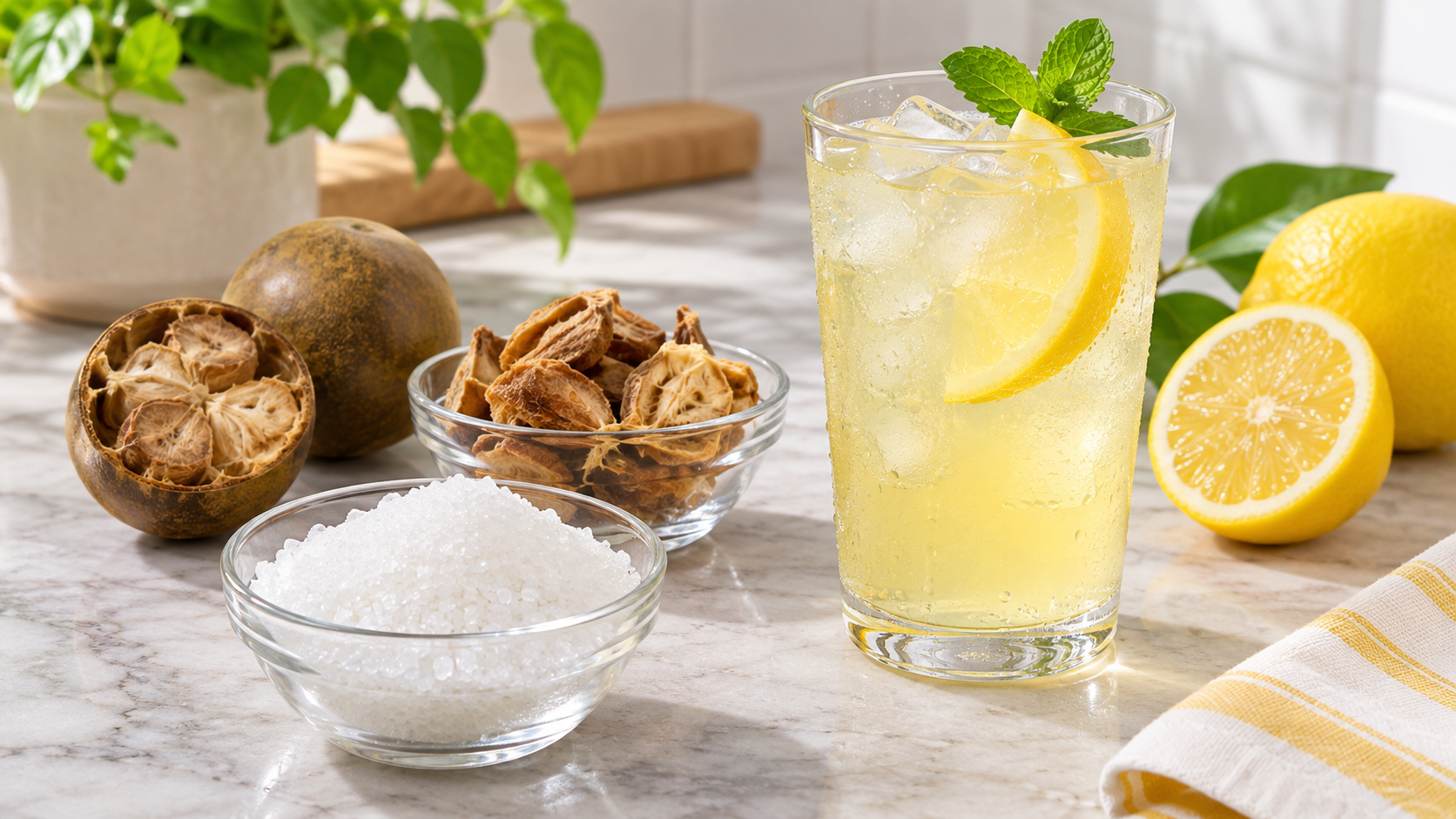
Allulose, also called D-psicose, is a rare sugar with a structure close to fructose. It tastes clean and sugar-like, though less sweet than sucrose, and it is used in drinks to reduce sugar and calories while keeping a more natural sweetness and body than many high-intensity sweeteners provide.
For a beverage developer, allulose has three attractions:
- Sugar-like taste. It has little of the lingering aftertaste associated with some high-intensity sweeteners.
- Body. As a bulk sweetener, it adds some mouthfeel, which helps reduced-sugar drinks taste less thin.
- Label position in the US. Under FDA guidance, allulose can be excluded from total and added sugars on Nutrition Facts labels.
Because allulose is less sweet than sugar, it is often combined with a high-intensity sweetener such as monk fruit extract or stevia to reach the target sweetness. A broader overview of how such blends are designed is in our guide to sweetener systems for export beverages.
What does monk fruit add to a sweetener blend?
Monk fruit extract, from the fruit of Siraitia grosvenorii, provides intense sweetness from mogrosides, mainly mogroside V. It is used in very small amounts and contributes negligible calories. In a blend, it lifts sweetness so that bulk sweeteners such as allulose or erythritol can be used at lower levels.
Monk fruit has its own flavour notes. At higher levels some tasters detect a lingering sweetness or a slightly fruity, liquorice-like note. Blending with allulose, erythritol or a little sugar usually gives a rounder profile than monk fruit alone. It is often compared with stevia, which plays a similar role; our article on stevia as a natural sweetener covers that alternative.
How stable are allulose and monk fruit to heat and acid?
Allulose and monk fruit are generally used successfully in acidic, heat-treated drinks, but their behaviour should be confirmed in the actual recipe and process. Stability depends on pH, heat treatment, storage temperature and time, and on interactions with other ingredients. Shelf-life testing, not assumption, settles the question for each product.
Points to check during development:
- Sweetness over shelf life. Measure perceived sweetness at the start and end of storage to see whether it changes.
- Heat process. Pasteurisation, hot fill and retort expose sweeteners to different heat loads; test under the real process.
- Acidity. Very acidic drinks can behave differently from mildly acidic ones, so test at the recipe’s actual pH.
- Flavour interactions. Sweeteners change how fruit and acid are perceived; balance is set on the full recipe.
Monk fruit extracts are also checked for flavour stability, because some aromatic notes can shift during heating. Suppliers usually provide stability data for their specific grades, which is a good starting point.
Why can allulose cause browning?
Allulose is a reducing sugar, so it can take part in the Maillard reaction, the browning reaction between sugars and amino acids that also creates cooked or caramel flavours. In drinks with protein or amino acids, such as milk drinks, plant-based drinks or some functional drinks, heat and storage can cause colour and flavour change.
The risk is lower in clear, acidic fruit drinks with little protein, and higher in:
- Milk-based or plant-protein beverages.
- Drinks processed with strong heat, such as retort or UHT.
- Drinks stored warm for long periods.
- Recipes that combine allulose with amino acids, for example in energy or sports drinks.
Where browning is a concern, developers can lower the allulose share, adjust the heat process, or choose a different bulk sweetener. Storage trials at elevated temperature reveal colour change early.
How is allulose labelled in the United States?
In the United States, the FDA’s guidance on the declaration of allulose, issued in October 2020, states that the agency intends to exercise enforcement discretion so that allulose may be excluded from the amounts of “Total Sugars” and “Added Sugars” on Nutrition and Supplement Facts labels. It also allows a calorie factor of 0.4 kcal per gram for allulose.
In practice, this means a drink sweetened partly with allulose can show lower sugar and calorie figures than a sugar-sweetened version. Several points follow:
- Allulose still appears in the ingredient list by name.
- The FDA describes these positions as pending review in a rulemaking, so brands should check for updates.
- Claims such as “zero sugar” must still meet the conditions for those claims.
- Total carbohydrate on the label includes allulose.
Our guides to the Nutrition Facts label for beverages and the US label checklist for imported beverages cover the wider label requirements.
What is the status of allulose in the European Union?
In the European Union, allulose is treated as a novel food that requires authorisation before it can be sold. In a 2025 opinion, the EFSA Panel on Nutrition, Novel Foods and Food Allergens concluded that the safety of D-allulose as a novel food could not be established, because the applicant did not provide requested data. Allulose should not be used in drinks for the EU unless its status changes.
This has direct consequences for multi-market brands:
- A formula using allulose for the US cannot simply be shipped to the EU.
- EU versions need a different sweetener system, for example sugar reduction with authorised sweeteners.
- Status in other markets, including the UK, should be checked separately, since they run their own approval processes.
- Brands should check the current position at the time of formulation, because applications and opinions can change.
Monk fruit extract’s status should likewise be checked market by market. In the EU, any sweetener or novel ingredient must appear on the relevant authorised list for the intended use before it can be used.
Where does erythritol fit?
Erythritol is a sugar alcohol often blended with monk fruit or stevia. It provides bulk and a clean sweetness with very few calories, and it is widely used in reduced-sugar drinks. Like allulose, it is less sweet than sugar, so it is usually paired with a high-intensity sweetener.
In beverages, erythritol can give a cooling sensation at higher levels and has limited solubility in cold conditions, so dosage is set with care. Its regulatory status, permitted uses and label statements vary by market and should be checked for each destination.
Blends that combine erythritol with allulose and monk fruit are common in the US market, where all three can be used. For brands that ship the same drink to several regions, a blend built only from sweeteners permitted in every destination is often simpler to manage than separate formulas, even if it is not the best-tasting option for any single market. That trade-off between taste and simplicity is a commercial decision for the brand.
Comparison of newer sweeteners in drinks
| Sweetener | Type | Taste notes | Technical point | Regulatory point |
|---|---|---|---|---|
| Allulose | Rare sugar, bulk sweetener | Clean, sugar-like, less sweet than sucrose | Can brown with amino acids under heat | US: may be excluded from total and added sugars; EU: not authorised |
| Monk fruit extract | High-intensity sweetener (mogrosides) | Intense, can linger or taste fruity | Used at very low levels; blended for roundness | Check status and permitted uses per market |
| Erythritol | Sugar alcohol, bulk sweetener | Clean, slight cooling effect | Solubility and cooling limit high doses | Check permitted uses and label statements per market |
What should a brand request from its manufacturer?
Before choosing allulose, monk fruit or erythritol, a brand should ask its manufacturer for a regulatory check by destination market, stability data in the real recipe and process, side-by-side tasting against a sugar version, and a draft nutrition panel. These four items show whether the sweetener works technically, tastes right and can legally be sold.
- Market check. Confirmation, ideally supported by the brand’s regulatory advisor, that each sweetener is permitted for the intended use in every destination market.
- Supplier documents. Specifications, certificates of analysis and regulatory statements for each sweetener grade.
- Stability results. Taste and colour after storage, including accelerated storage, in the intended pack.
- Taste comparison. Samples of the reduced-sugar recipe tasted alongside a sugar-sweetened reference.
- Draft label data. Nutrition figures and ingredient list based on the approved recipe and the rules of each market.
ACMFOOD develops reduced-sugar and sugar-free drinks for export and can prepare market-specific versions where sweetener rules differ. Standard terms are a minimum order of 500 cartons per SKU and a production lead time of 15–30 days after samples and artwork are approved.
Frequently asked questions
Does allulose count as sugar on a US label?
Under FDA guidance issued in 2020, allulose may be excluded from “Total Sugars” and “Added Sugars” on US Nutrition Facts labels, and a calorie factor of 0.4 kcal per gram may be used.
Can allulose be used in drinks sold in the EU?
Not at present. Allulose requires novel food authorisation in the EU, and EFSA concluded in 2025 that its safety could not be established on the data provided.
Why combine allulose with monk fruit?
Allulose provides body and sugar-like taste but is less sweet than sugar. A small amount of monk fruit extract lifts sweetness so the blend can match a sugar reference.
Will allulose make my milk drink turn brown?
It can. Allulose is a reducing sugar and can take part in Maillard browning with proteins during heating and storage. Testing in the real recipe shows the extent.
Choosing a sweetener route
Allulose in beverages offers a sugar-like taste and a favourable US label position, but it can brown in protein-containing drinks and it is not authorised in the EU. Monk fruit adds intense sweetness at low dose, and erythritol adds clean bulk. The right choice depends on recipe, process and, above all, the markets where the drink will be sold.
Send ACMFOOD your target markets, sugar goals and product type, and we will propose a sweetener route and prepare samples for comparison.
Sources
- U.S. FDA — Guidance for Industry: The Declaration of Allulose and Calories from Allulose on Nutrition and Supplement Facts Labels (2020)
- EFSA NDA Panel — Safety of D-allulose as a novel food pursuant to Regulation (EU) 2015/2283, EFSA Journal 2025