




 Français
 Español
 العربية
 한국어
한국어Choosing beverage packaging for export is a different exercise from choosing packaging for a domestic launch. The same can, bottle or carton has to survive weeks in a container, arrive without damage, fit the freight economics of a long route, and satisfy packaging obligations that belong to the destination market rather than the country of production.
This guide covers the export-specific side of that decision: how format affects freight cost and breakage, what happens to packaging in transit, which market obligations attach to the pack itself, and how decoration lead time interacts with minimum order quantity. The material-by-material comparison is a separate question, covered in this overview of cans, PET, glass and Tetra Pak compared.
Why does export change the packaging decision?
Export changes the decision because it adds three costs that a domestic launch barely notices: the volume the pack occupies in a container, the proportion of units that arrive unsaleable, and the compliance obligations that attach to packaging in the destination market. A format that is cheapest at the factory gate is not necessarily cheapest delivered.
The practical consequence is that packaging should be evaluated on landed cost per saleable unit rather than on unit price. A lighter pack that ships more efficiently can absorb a higher unit cost. A heavier pack with a breakage rate of a few percent can quietly consume the margin that made it look premium, and the loss is rarely visible until the first container is unloaded and counted.
How does format affect freight economics?
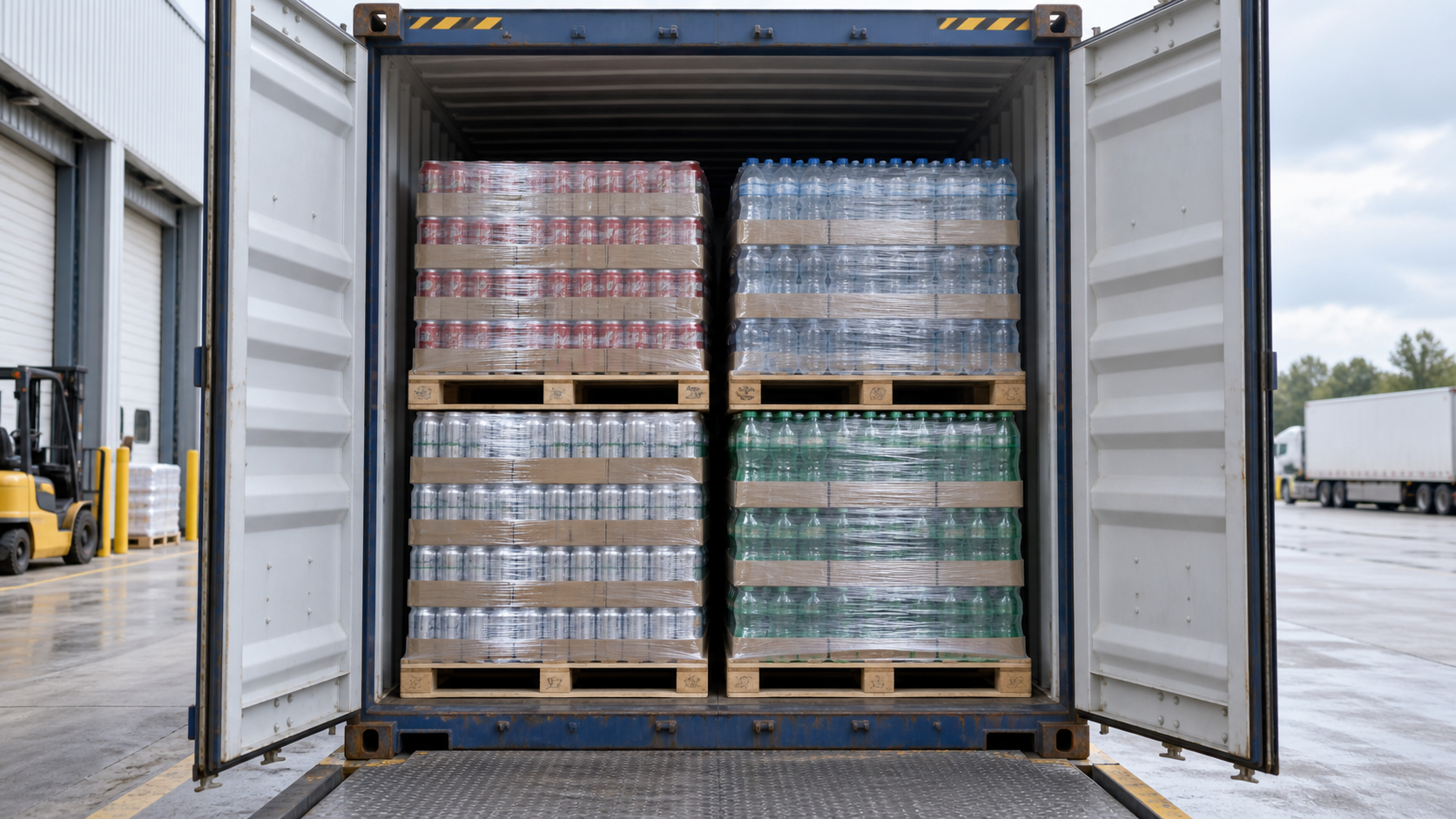
Ocean freight is charged by container, so the question that matters is how many saleable units fit into one. Two variables decide it: how much of the container volume the packaging itself occupies, and whether the shipment reaches the weight limit before it fills the space.
Beverages are dense, and full containers of liquid frequently hit the weight limit with space to spare. When that happens, reducing packaging weight increases the number of units per container directly. When a shipment instead cubes out — filling the space before reaching the weight limit — the shape of the pack and how efficiently it stacks matters more than its weight.
- Pack weight — the empty container weight travels with every unit and is paid for on every shipment.
- Stacking efficiency — cylindrical packs waste space between units; the case and pallet configuration recovers some of it.
- Pallet pattern — how cases fit the pallet footprint, and the pallet the destination market expects.
- Stack height — how many layers the pack supports without deforming, which decides whether the container’s height is usable.
- Secondary packaging — trays, shrink film and dividers protect the product but add both weight and volume.
What happens to packaging during a long shipment?
Containers on long routes go through repeated temperature cycles, and the interior can become considerably warmer and more humid than the outside air. Packaging that performs well in a warehouse can behave differently after several weeks of that treatment.
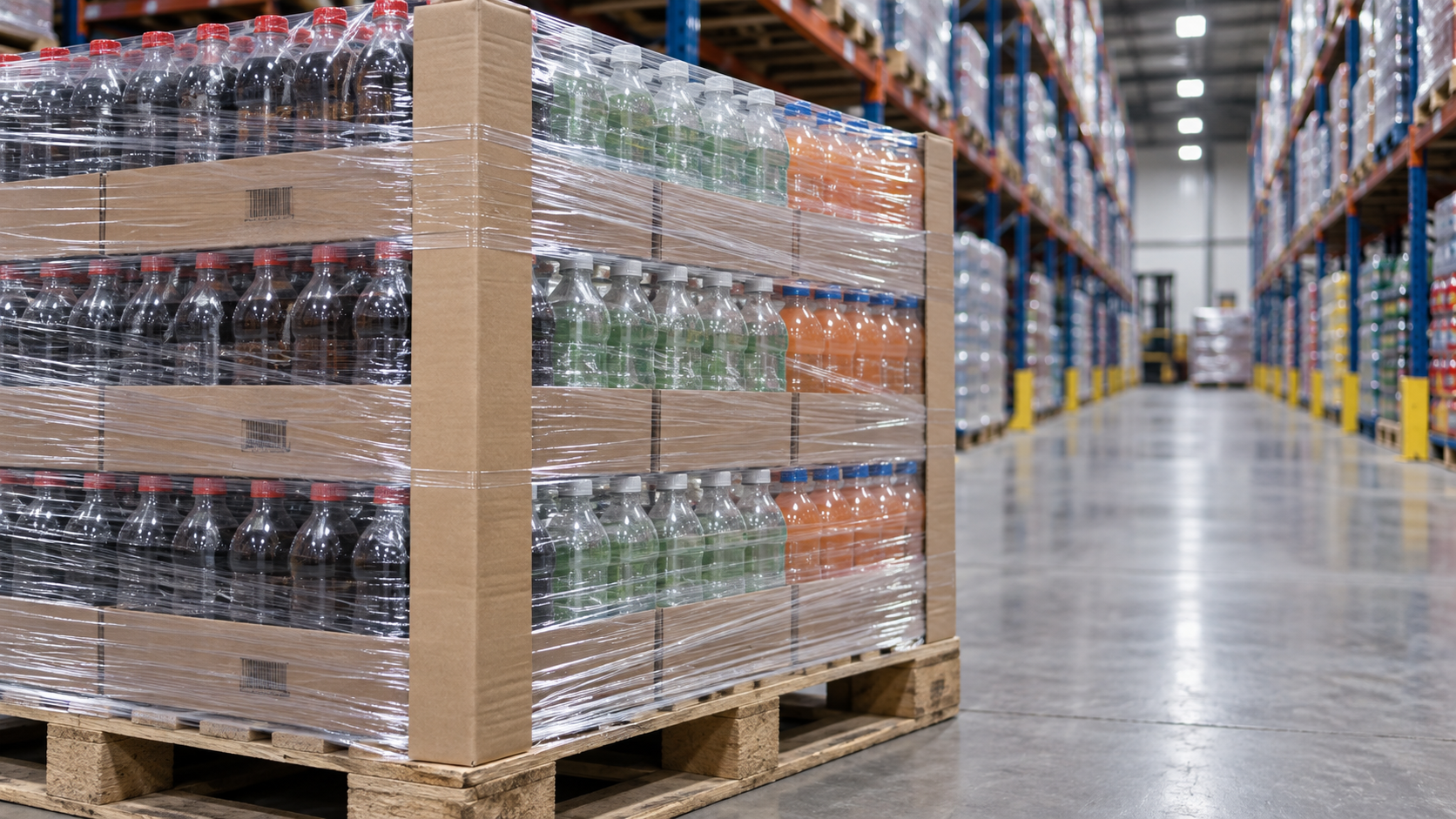
The failures worth anticipating are mostly mechanical rather than dramatic. Cardboard loses stiffness as it absorbs moisture, which reduces how much load the lower layers of a pallet can carry. Labels and sleeves can lift at the edges when adhesive is stressed by heat and humidity. Thin-walled plastic containers can deform under sustained top load, and glass that shifts inside a case chips at the neck and shoulder. None of these makes a product unsafe; all of them make it unsaleable.
| Export risk | Where it usually appears | What reduces it |
|---|---|---|
| Breakage and chipping | Rigid, brittle formats in long-haul transit | Case dividers, tighter unit fit, lower stack height |
| Pallet collapse | Lower layers after humidity exposure | Higher grade board, corner protection, stretch wrapping |
| Label or sleeve lifting | Heat and humidity cycling in transit | Adhesive selection tested against transit conditions |
| Container deformation | Lightweight packs under sustained top load | Wall specification matched to stack height |
| Cubing out before weight limit | Bulky formats and inefficient case patterns | Case and pallet pattern reviewed before artwork |
How does the filling process narrow the format choice?
Packaging and process are chosen together, not in sequence. The filling route a product requires eliminates some containers before commercial preferences are considered, and a format selected on shelf appeal alone can turn out to be incompatible with the way the drink has to be made.
Three constraints do most of the narrowing. Products needing a severe heat treatment require containers that survive it, which rules out standard cold-fill plastics. Carbonated products need containers and closures rated for internal pressure, and the specification differs from a still equivalent. Products sensitive to oxygen need formats and closures that limit ingress, since a pack that performs adequately over a short domestic shelf life may not over an export one.
Shelf life is where these constraints become commercially visible. An export programme usually needs enough remaining shelf life on arrival for the importer to distribute and sell the product, and retailers often specify a minimum proportion of life remaining at delivery. Transit time consumes part of that allowance before the product reaches a shelf, so the pack has to protect the product for meaningfully longer than a domestic equivalent.
The practical rule is to confirm the process route before committing to a format. Changing container after a process has been validated is not a purchasing decision; it usually means repeating validation and shelf-life work, and it can invalidate the sample a buyer has already approved.
Which packaging obligations belong to the destination market?
Several markets place legal obligations on the packaging itself, separately from the food labelling rules that apply to the product. These obligations usually fall on whoever places the packaging on the market, which in an import arrangement is the importer rather than the manufacturer — but the pack has to be designed to satisfy them.
Two families come up most often. Extended producer responsibility schemes require packaging to be registered and reported, sometimes before the first shipment arrives, with fees based on material and weight. Deposit return schemes add a deposit to specific container types and often require a mark on the pack itself, which changes artwork rather than just paperwork.
Because these obligations are national, they have to be checked market by market. The German requirements, including packaging registration, are covered in this guide to beverage import rules for Germany, and the United Kingdom equivalents in this guide to beverage import rules for the United Kingdom. Confirming them before artwork is finalised avoids reprinting decorated packaging.
How do decoration and MOQ interact in an export project?
Decorated packaging is usually the constraint that sets the minimum order quantity, and it is also the longest item to procure. Printed containers are made in the packaging supplier’s own minimum runs, which for many formats exceeds what a first export order needs, so the decoration decision effectively sets the floor for the whole project.
That is why decoration method deserves attention early. Applying decoration after the container is made — through sleeves or labels rather than direct printing — usually lowers the minimum quantity and shortens lead time, at a higher cost per unit. For a first export order into an unproven market, that trade is often worth making, and it also allows market-specific artwork variants without committing to a full print run for each.
- Confirm the destination markets first, because deposit marks and language requirements change the artwork.
- Choose the decoration method against order size rather than against the eventual target volume.
- Check the case and pallet pattern before artwork, since case dimensions affect both freight and shelf presentation.
- Complete label review before committing to printed packaging, not after.
- Order a transit trial where the route is long or the format fragile, so the first commercial container is not the test.
The available formats and fill volumes are set out under beverage packaging formats and fill volumes, which is the right place to start when narrowing options before a brief.
Information for brands specifying export packaging
Packaging decisions become expensive to reverse once artwork is approved and decorated stock is produced. Settling the following before that point keeps the options open:
- The destination markets for the first twelve months, including any where a deposit scheme applies.
- Whether the route is long-haul ocean freight and roughly how long the product will sit in transit.
- Whether the priority is landed cost, shelf presence or recyclability, since these pull in different directions.
- The retail channel, because chilled impulse, grocery multipack and food service have different format expectations.
- Case count, pallet pattern and expected stack height for the destination warehouse.
- Whether market-specific artwork variants will be needed, which favours late-stage decoration.
Environmental claims deserve their own check, because a claim printed on an export pack has to be defensible in the market where it is read. What can and cannot be documented is set out in this guide to packaging sustainability claims you can support.

For a market where recyclability grading drives pack choice, see beverage packaging options for the Korean market.
FAQ: beverage packaging for export
Which packaging format is cheapest to export?
There is no single answer, because the cost depends on whether the container reaches its weight limit or fills its space first. Dense beverages often hit the weight limit, which favours lighter packaging. Bulkier or lower-density products cube out instead, which favours formats that stack efficiently.
Does glass make sense for long-haul export at all?
Yes, where the positioning justifies it and the packing is designed for the route. Glass carries higher freight cost and a real breakage rate, so the case design, dividers and stack height matter more than for other formats. It works best where the retail price supports the additional handling.
Who is responsible for packaging registration in the destination market?
Usually the party placing the packaging on that market, which in an import arrangement is generally the importer. The manufacturer supplies the material and weight data needed to register and report, but the legal obligation typically sits with the importer.
Should packaging be tested before the first container ships?
Where the route is long or the format fragile, a transit trial is worth the delay. Sending a small quantity through the actual route reveals pallet, adhesive and case problems while they can still be corrected cheaply.
Conclusion
Beverage packaging for export is decided by three things a domestic brief rarely covers: how many saleable units fit in a container, how many survive the journey, and what the destination market requires of the pack itself. Unit price is a poor guide to any of them.
Settle the destination markets, the freight route and the decoration method before artwork is finalised, and treat the case and pallet pattern as part of the packaging specification rather than an afterthought. ACMFOOD fills a range of export formats and can review a packaging brief against the route, the destination requirements and the order size a brand is planning for.