


 Français
 Español
 العربية
 한국어
한국어Organic celery juice is the juice of celery grown and processed under an organic standard, and it can only be sold as organic when the farm, the factory and the label all comply with the rules of the destination market. Celery adds its own challenges: it is a watery, fibrous, quickly oxidising crop, and its green colour fades easily.
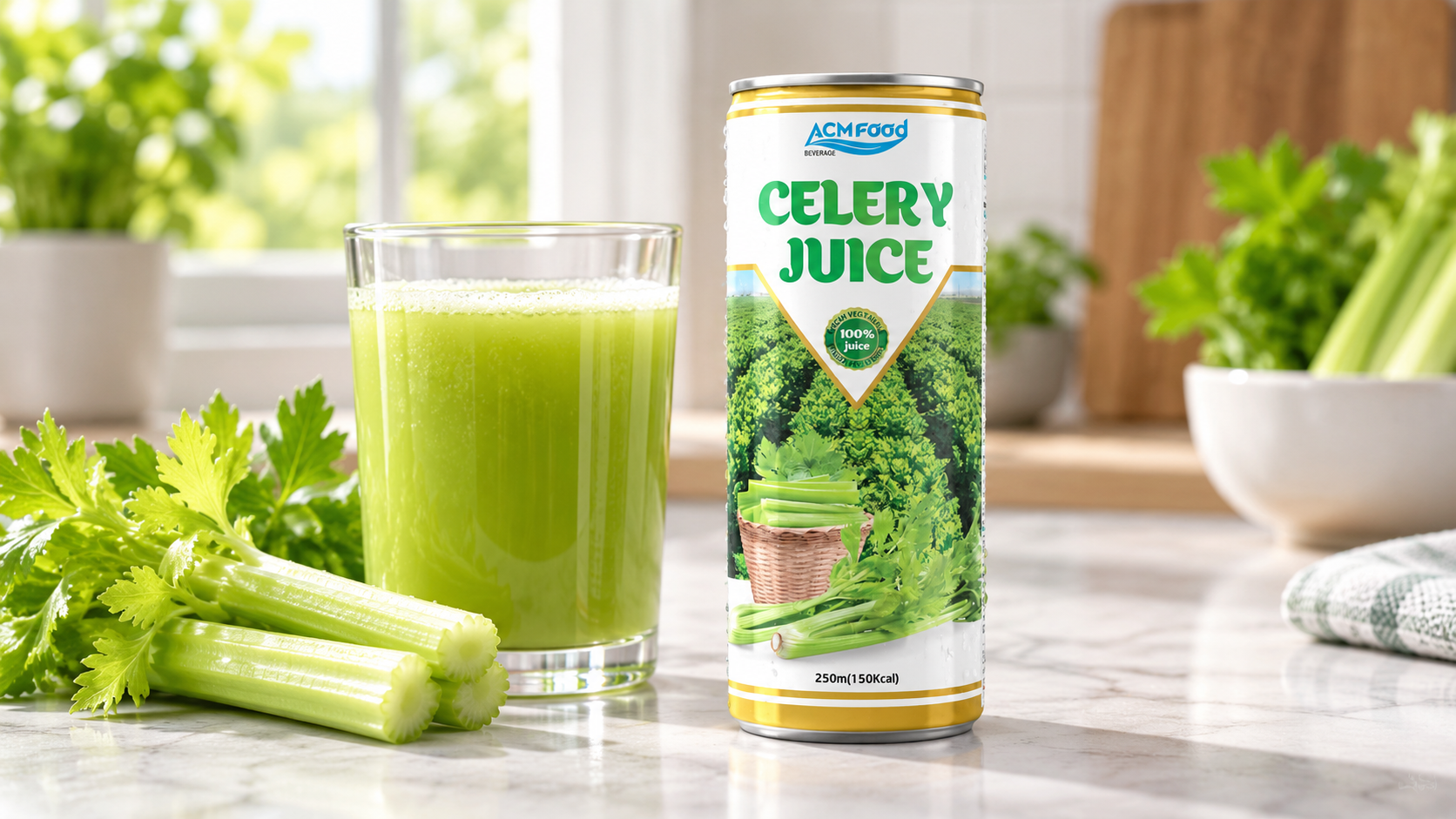
This guide explains how to source and specify organic celery juice in cans and bottles, which certificates to request and which technical points are specific to celery. ACMFOOD, a Vietnam beverage manufacturer, publishes HACCP, ISO 22000 and FSSC 22000 certificates. Organic status is not among them, so any organic lot must be confirmed with the factory before an order.
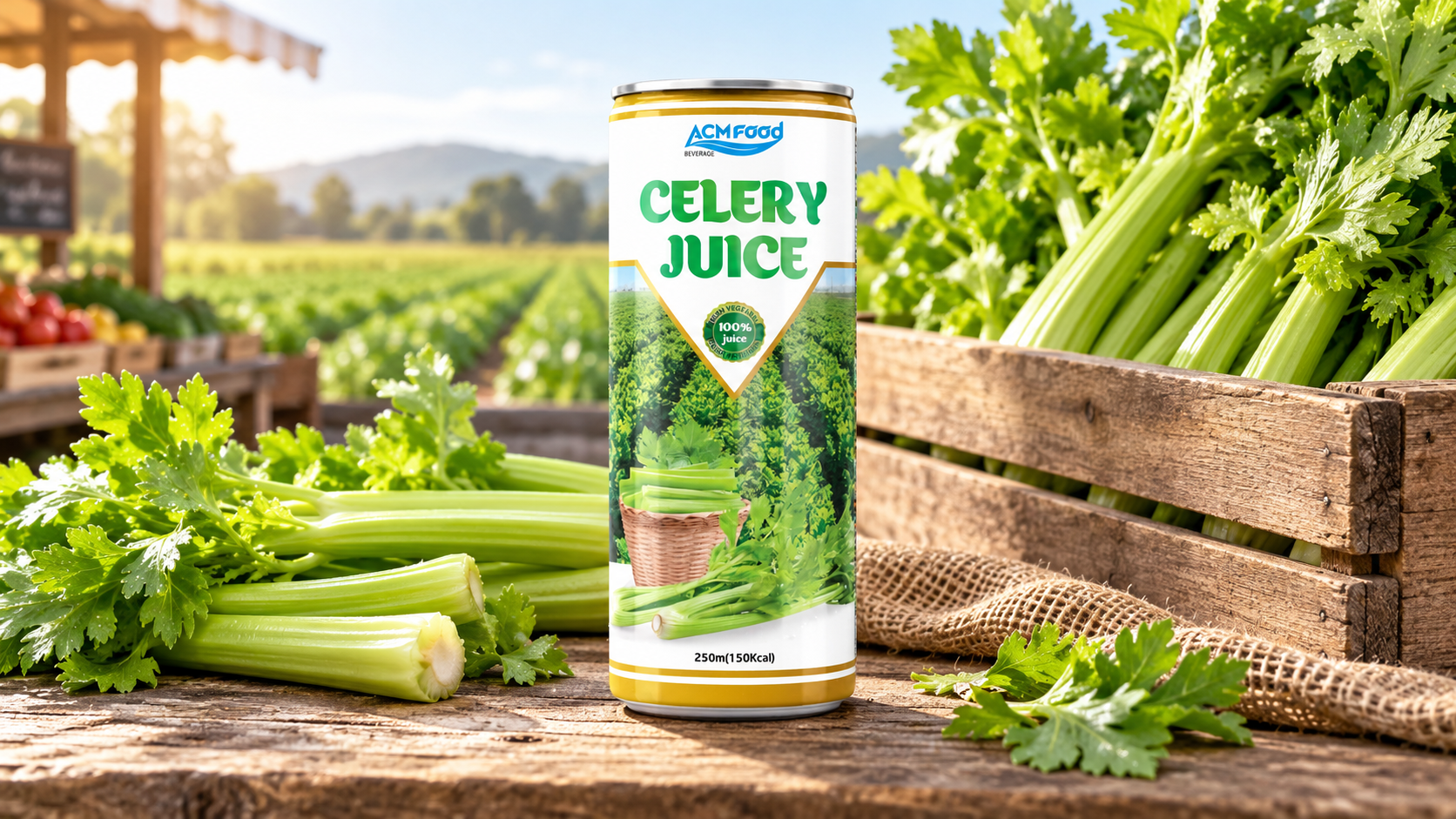
What is special about celery as a juice raw material?
Celery is mostly water, with a distinct aroma, a fibrous structure and a green colour that is sensitive to heat, acid and oxygen. These features change how the plant is grown, washed, pressed and preserved, and they explain why celery juice needs more care than a sweeter juice such as carrot.
- High water content. Celery is very watery, so it yields a lot of juice with low solids and a mild flavour that reveals defects easily.
- Aroma compounds. A group of aroma compounds called phthalides gives celery its recognisable smell. They are partly lost when juice is heated.
- Natural sodium and nitrate. Celery naturally contains more sodium than many vegetables and is a naturally nitrate-containing vegetable. Some specifications track both.
- Fibre and strings. Stalk fibres must be filtered, otherwise the drink feels stringy.
- Chlorophyll. The green pigment turns olive or brown under heat and acid, which affects product appearance.
Because of these traits, an organic celery project involves choices that go beyond certification, and they should be discussed at the briefing stage.
What should an organic celery juice supplier show?
A suitable supplier can show a valid organic certificate for the processing site, certificates for the celery growers, traceable batch records and a recognised food safety system. The certificate scope must cover vegetable juice and the production site named in the contract.
| Document | What to check |
|---|---|
| Factory organic certificate | Scope includes vegetable juices, site address, validity date, certification body recognised in the destination market |
| Grower certificates | Crop is celery, area is listed, certificate is valid at harvest |
| Traceability record | Link from finished carton to celery lot and grower |
| Cleaning and segregation records | Evidence that organic runs follow a validated clean and use separate storage |
| Food safety certificates | HACCP, ISO 22000 or FSSC 22000 status, which prove food safety management but not organic status |
| Certificate of analysis | Brix, pH, microbiology and contaminant results for the lot |
A general explanation of organic juices for readers is available in the article on organic juice types. For supplier selection, the points above matter more than consumer-facing copy.
How is organic celery sourced?
Organic celery is sourced from certified farms in climates where celery grows well, and it is harvested close to processing because the stalks wilt and lose quality quickly. Sourcing plans cover variety, harvest timing, cold transport and cleaning.
- Variety selection. Green, crisp, low-bitterness varieties are preferred for juice, and yellow or blanched varieties are less common.
- Harvest timing. Celery harvested at the right maturity gives a smoother flavour, while over-mature stalks are fibrous and bitter.
- Cold chain. Cooling soon after harvest slows wilting, and short transport to the factory protects flavour.
- Cleaning. Celery grows close to the soil, and grit can lodge between the stalks. Washing and inspection remove soil and damaged parts.
- Residue and contaminant testing. Organic status does not guarantee zero residues, so testing against market limits is a standard control.
Because celery is perishable, processing starts soon after delivery, and the factory’s capacity at harvest peak is part of the supplier assessment.
How do organic rules affect the celery juice recipe?
Organic rules limit which ingredients and processing aids can be used. A recipe built for conventional celery juice may need to change, especially in acidity regulators, antioxidants and enzymes, each of which must be allowed in organic products in the target market.
- Acidity regulators. Needed to lower the pH of low-acid celery juice for hot-fill or tunnel pasteurisation. The list of permitted acids is narrower for organic juice.
- Antioxidants. Ascorbic acid is common in conventional juice, and its status in organic products should be checked.
- Enzymes. Pectinase or cellulase can improve yield and clarity, and organic schemes control which enzymes are allowed.
- Blending juices. Apple, cucumber or lemon juice may be added for flavour, and each must also be organic or permitted.
- Packaging. Can linings, inks and closures must be suitable for food contact and for organic production.
The result is a shorter list of tools. Developers therefore test more recipes at bench scale before choosing one for the pilot batch.
Why does celery juice change colour and how can it be managed?
Celery juice changes colour because chlorophyll loses its magnesium under heat and acid, turning bright green into olive-brown. Oxygen and enzymes accelerate the browning, which is why raw celery juice darkens within minutes.
Management combines process and recipe: rapid processing after pressing, deaeration to remove oxygen, short heat treatment and a recipe pH that balances safety with colour. Some producers accept an olive-green tone as natural, and others blend celery with cucumber or green apple to lift the colour. Cans protect colour better than clear bottles because they block light, and tinted bottles help in the same way.
Brands should write a colour reference into the specification, taking into account that a heat-treated organic celery juice will not look like a freshly pressed sample. A consumer-facing label with a natural colour variation statement can help prevent complaints.
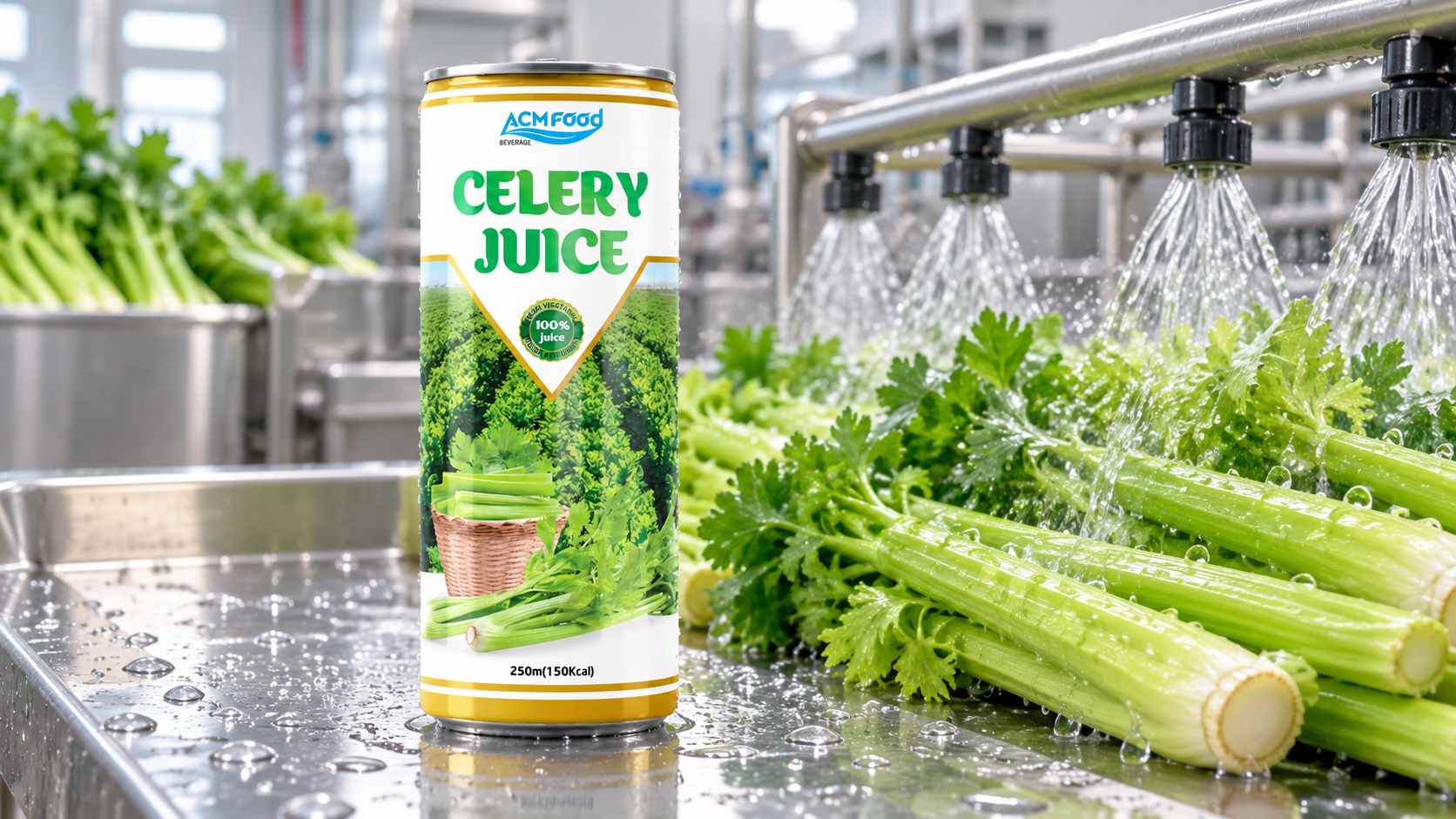
How is celery pressed and filtered into juice?
Celery is chopped or crushed and pressed with a belt press, screw press or decanter, and the juice is then filtered to remove fibre. The speed from washing to pressing to heating matters most, because celery juice oxidises and loses aroma within minutes if it waits.
- Washing and trimming. Roots, leaves with damage and discoloured stalk ends are removed before crushing.
- Size reduction. Stalks are cut or crushed into small pieces so that more juice is released.
- Pressing. The pulp is pressed at a controlled pressure. Higher pressure raises yield but pulls in more fibre and bitter notes.
- Filtration. Screens and fine filters remove strings and coarse particles. A centrifuge can further clarify the juice.
- Deaeration and cooling. Removing dissolved air and cooling the juice slows browning before the heat step.
The press settings, filter size and holding time are part of the specification, since they change the taste and the stringiness of the finished drink. A good supplier can explain how each setting was chosen and how it is monitored.
What quality checks apply to each organic celery juice lot?
Each lot is checked at receiving, in process and on the finished pack. Records for each check are kept per batch so that a certificate of analysis and a traceability report can be provided for the shipment.
- Receiving. Certificate and lot number of celery, temperature at arrival, freshness and visible damage.
- In process. Pressing yield, juice temperature, pH after acidification, Brix and colour against the reference.
- Heat step. Time and temperature records for the heat exchanger, tunnel or retort.
- Finished pack. Fill level, seal or cap integrity, coding, microbiological tests and retained samples.
- Organic controls. Cleaning verification before the organic run and a mass balance after it.
Buyers can ask to see an anonymised example of such records during supplier approval. A supplier that works under HACCP or ISO 22000 will normally have a standard format for them.
How should a buyer handle sodium and nitrate questions?
A buyer should ask for measured values on the finished drink and avoid making claims that rely on assumptions. Celery naturally contains sodium and nitrate, and the levels vary with variety, soil and season, so values from one batch do not represent every lot.
For a low-sodium or no-added-salt positioning, the specification should state a maximum natural sodium level, and the supplier should test each production campaign. For nitrate, some markets monitor levels in vegetable products, so the supplier should explain which tests are available and how results are reported. Honest labelling and measured data protect the brand more than a strong claim that cannot be proven.
How is shelf life set for organic celery juice?
Shelf life is set from process validation and storage tests on the exact recipe and pack. Celery is a low-acid vegetable, so ambient storage requires acidification with hot-fill or tunnel pasteurisation, or a sterilising step, and the validated process defines the minimum values.
- pH. A lower pH supports stability but changes taste and colour.
- Heat route. Retort for cans, acidified hot-fill or aseptic for bottles.
- Oxygen. Deaeration and low headspace slow flavour change.
- Light. Cans or tinted bottles protect colour and flavour.
- Storage temperature. Warm storage shortens quality life.
The label should only carry a shelf life that is backed by a study. When a buyer receives a figure from a supplier, it should be tied to a recipe, a pack and a storage condition in writing.
Which specification points should be set?
- Product definition. Pure celery juice, blend or drink, and juice percentage.
- Organic status. Scheme, certification body and the documents to be supplied per shipment.
- Brix and pH. Target ranges with tolerance, noting that celery has low Brix.
- Sodium. If a low-sodium statement is intended, the natural sodium of celery must be measured and considered.
- Colour and clarity. A reference sample and an acceptable range after storage.
- Microbiology and contaminants. Limits suited to the heat treatment and the market.
- Pack and closure. Can or bottle, size, lining, closure and coding.
- Shelf life and storage. Duration and temperature range for the claim.
ACMFOOD’s current celery and other vegetable drinks are described in the celery juice category, and the company produces finished drinks under OEM, ODM and private label arrangements.
FAQ about organic celery juice
Is organic celery juice stronger in flavour?
Not necessarily. Flavour depends on variety, maturity, harvest time and processing. Organic farming alone does not guarantee a different taste.
Can organic celery juice be packed in cans?
Yes, provided the can lining, inks and closures are suitable and the heat treatment fits a low-acid vegetable. Cans protect colour well.
Why does celery juice need acid for shelf stability?
Because celery is low in acid, so the juice could support the growth of spore-forming bacteria at room temperature. Lowering pH or sterilising the pack addresses that risk.
Does celery naturally contain sodium?
Yes, celery contains more natural sodium than many vegetables. Anyone planning a low-sodium claim should measure the finished drink rather than assume.
Does an organic certificate replace HACCP?
No. Organic certification covers the production standard, while HACCP and related certificates cover food safety management. A supplier should hold both for an organic export project.
Is celery a labelled allergen?
In several markets, including the European Union, celery is on the list of allergens that must be declared, and a celery juice product may need a clear allergen statement. Brands should confirm the rule for each destination before the label is finalised.
Selecting an organic celery juice supplier
Organic celery juice depends on certified farms, a certified factory and fast processing, plus technical control of colour, acidity and shelf life. Buyers should read certificate scopes carefully, ask for sample batch records and agree a specification that reflects celery’s natural sodium and colour behaviour.
Brands that want to discuss a celery juice project can send ACMFOOD a brief with the pack, markets and documentation needs. The team can confirm what is possible for organic lots and share a plan for samples.