


 Français
 Español
 العربية
 한국어
한국어An ingredient specification sheet is a controlled document that defines exactly what a raw material must be — identity, composition, quality limits, packaging, shelf life, and compliance — so buyers, suppliers and QC teams can judge every lot the same way. In beverages, a tight spec avoids disputes, protects consistency, and speeds up release.
This guide explains what belongs in an ingredient specification sheet, why each field matters, and provides a copy-and-use template you can adapt to your category (juices, concentrates, sweeteners, flavors, botanicals, acids, stabilizers, minerals, sweeteners, or functional premixes). It focuses on raw material specs — not supplier approval forms or audits.

What is an ingredient specification sheet?
An ingredient specification sheet is a mutually agreed document between buyer and supplier that lists required characteristics, acceptance criteria, test methods, packaging, labeling, storage, and documentation for a raw material. QC uses it to accept or reject each lot; the supplier uses it to manufacture and certify compliance.
Think of the spec as the single source of truth for the material itself. It is different from a supplier-approval questionnaire (which assesses the company) and different from a Certificate of Analysis (CoA), which reports test results for one specific lot against the spec.
Why do beverage brands need a clear spec?
A clear spec turns expectations into measurable requirements and reduces ambiguity in contracts and day-to-day operations.
- Consistency: Locks taste, color and functionality so product quality is repeatable across lots.
- Speed: Incoming QC can release material faster when acceptance criteria and sampling are explicit.
- Dispute prevention: Objective, pre-agreed limits minimize arguments if a lot trends off-target.
- Regulatory readiness: The right fields support labeling, allergen control and market submissions.
- Change control: Versioning ensures R&D, procurement and QC are aligned when anything changes.
What belongs in an ingredient specification sheet?
At minimum, include identity, composition, acceptance criteria with test methods, microbiological and contaminant limits, packaging and labeling, storage and shelf life, documentation (CoA, declarations), and change-control rules. The sections below outline a practical structure and a field-by-field template.
| Spec section | What to capture | Positioning & notes |
|---|---|---|
| Identity & description | Material name, synonyms, grade, form, botanical or chemical identity | Use the same naming as in your BOM and label |
| Composition | Active(s), carriers, processing aids, declared ranges | Clarify if values are typical or guaranteed |
| Analytical criteria | Targets & tolerances for key parameters; test methods | Match CoA fields exactly |
| Microbiology & contaminants | Which organisms/contaminants are tested and acceptance | Align with markets you sell into |
| Sensory/appearance | Color range, aroma, clarity/turbidity, particle size | Define objective descriptors where possible |
| Packaging | Pack type, closure, net weight/volume, liner, tamper features | Include pallet pattern and overpack |
| Labeling & traceability | Lot code format, dates, required statements | List documents provided per lot |
| Storage & shelf life | Temperature, humidity, light, retest/expiry date | State post-open shelf life if applicable |
| Declarations | Allergens, GMO, irradiation, dietary and origin statements | Keep current with certification renewals |
| Change control | What changes require pre-approval; notification timing | Reference contract terms |
Field-by-field template you can copy
Use this template as a starting point and adapt terminology to your QA system. Keep each numbered section in your controlled spec document and assign a spec number and version.
- 0. Document control
Spec No.: ______ | Version: ______ | Effective date: ______ | Supersedes: ______ | Owner: QA | Next review: ______ - 1. Identity
Material name (exact): ______
Internal code/SKU: ______
Synonyms/Grade: ______ (e.g., citric acid anhydrous, FCC)
Form: ______ (liquid, powder, concentrate, puree, syrup, extract)
Botanical/Chemical identity (if applicable): ______ (e.g., Citrus limon extract)
- 2. Intended use
Function in product: ______ (acidulant, sweetener, color, flavor, stabilizer, vitamin, mineral)
Application notes/solubility: ______
- 3. Composition
Declared or typical composition: ______
Actives & carriers (if any): ______
Additives/processing aids potentially present: ______
- 4. Acceptance criteria & test methods
List each parameter as a row in your internal QC form with a target and acceptable range, plus method reference. Example fields:
– Brix (target/range): ______ | Method: ______
– pH (target/range): ______ | Method: ______
– Titratable acidity (as citric, %): ______ | Method: ______
– Moisture (%): ______ | Method: ______
– Color (e.g., L*a*b*): ______ | Method: ______
– Density or specific gravity: ______ | Method: ______
– Particle size (if powder): ______ | Method: ______
– Identification (e.g., IR, HPLC, organoleptic): ______
- 5. Microbiology
Parameters tested: ______ (e.g., total plate count, yeast & mold, coliforms)
Acceptance: ______ (e.g., absence in X g/mL, or NMT criteria as agreed)
Method references: ______
- 6. Chemical contaminants (if applicable)
Heavy metals: ______
Pesticide residues (if applicable to agricultural ingredients): ______
Mycotoxins (if applicable): ______
Other contaminants (e.g., 3-MCPD in oils): ______
- 7. Sensory & appearance
Color: ______ (define range or reference standard)
Aroma/flavor: ______ (neutral, citrusy, caramel notes, etc.)
Clarity/turbidity/precipitation: ______
Off-notes not permitted: ______
- 8. Packaging
Primary pack: ______ (drum, Jerry can, bag-in-box, multilayer bag)
Closure & liner: ______
Net weight/volume per pack: ______
Tamper-evidence: ______
Secondary pack/overpack: ______
Pallet pattern & height: ______
UN/DOT or other transport notes (if hazardous): ______
- 9. Labeling & traceability
Lot/batch code format: ______
Manufacturing date format: ______
Expiry or retest date format: ______
Mandatory label statements (e.g., allergens, storage, country of origin): ______
Documents provided per lot: CoA (mandatory), SDS (if applicable), allergen/GMO/declaration packs, origin or dietary statements.
- 10. Storage & shelf life
Storage temperature: ______ | Light protection: ______ | Humidity: ______
Shelf life from manufacturing: ______ months
Retest date (if used): ______
Handling after opening: ______ (e.g., reseal under nitrogen, refrigerate, use within X days)
- 11. Declarations & certifications
Allergen status: ______
GMO statement: ______
Irradiation: ______
Country of origin: ______
Dietary/faith status (e.g., vegan, Halal, Kosher): ______ (attach certificates if available)
See also ingredient certifications and declarations: ingredient certifications and declarations
- 12. Change control
Supplier must notify buyer at least ______ days in advance before changes to: raw sources, grade, processing aids, packaging materials, manufacturing site, test method, or specification limits.
Temporary deviations require written approval per lot.
- 13. Contacts & signatures
Supplier QA contact: ______ | Buyer QA contact: ______
Authorized signatures and dates: ______
Analytical parameters and test methods
Set analytical criteria that directly protect product quality and regulatory needs, and define how they are measured. Use validated or recognized methods and keep them stable over time to trend results reliably.
- Identity tests: Suitable for the material type (e.g., organoleptic profile, chromatography, spectroscopy, or simple wet-chemistry verification).
- Key performance parameters: For beverage ingredients these commonly include Brix, pH, titratable acidity, moisture, density/specific gravity, color (e.g., L*a*b*), turbidity/clarity, or particle size (for powders).
- Acceptance format: Write as a target plus allowable range or a min/max (e.g., Target 65.0, Range 64.0–66.0; or pH 2.2–2.6). Keep formatting consistent with your CoA.
- Method references: Reference an internal SOP or an external standard method where applicable. Keep the exact reference consistent on the spec and on the CoA.
- Retains & trending: Retain samples and CoAs per your record policy so you can track drift and initiate corrective actions before out-of-spec events occur.
Microbiology, contaminants and allergens
Specify relevant microbiology and contaminant checks for your ingredient type and markets. Avoid unrealistic zero-tolerance language unless genuinely required; define what you will actually test and how compliance is determined.
- Microbiology: Define parameters such as total plate count, yeast & mold, coliforms, and pathogen screens as appropriate for the ingredient category and intended kill-steps in your process.
- Chemical contaminants: For agricultural inputs, consider pesticide residues and mycotoxins where relevant. Inorganics like heavy metals may be applicable depending on the material and origin.
- Allergens & cross-contact: State allergen presence/absence and controls. Request the supplier’s allergen matrix and manufacturing line information if needed.
- Market differences: Acceptance criteria and required statements may vary by country. Ensure your spec aligns with labeling and safety requirements for your target markets and product claims. For U.S. compliance topics at the finished product level, see the U.S. food label checklist for imported beverages.
Packaging, storage, and shelf life
Packaging and storage details on the spec protect ingredient integrity in transit and in your warehouse. Define exactly what you expect so QC and logistics can verify on arrival.
- Primary packaging: Pack type, material, liner/barrier, closure style, and tamper-evidence.
- Secondary packaging: Cartons, shrink, separators; pallet pattern, maximum stack height, and stretch-wrap.
- Label fields: Material name, supplier name, lot/batch, net content, manufacturing date, expiry/retest date, storage instructions, and hazard symbols if applicable.
- Storage conditions: Temperature range, humidity, light exposure, and orientation (e.g., keep upright). Note if cold-chain is required.
- Shelf life & retest: Define the time from manufacture and how retest releases are handled if allowed.
Labeling & traceability requirements for each lot
Traceability begins with unambiguous codes and complete documents. Spell out your minimum paperwork and coding format so suppliers deliver what QC needs to file.
- Lot code format: Describe structure and an example (e.g., YYDDD-SITE-SEQ). Ensure scannability if you use barcodes.
- Dates: State which date formats are used (manufacture, expiry or retest) and how they appear on pack and CoA.
- Documents required per lot: CoA matching the agreed spec fields, SDS if applicable, and current declarations (allergen, GMO, dietary/faith, origin). Maintain version control so documents align with the active spec.
Change control, deviations and nonconformance
Suppliers should not change what you buy without notice. Your spec should define which changes need written approval and how deviations are handled.
- Pre-approval: Source changes, manufacturing site, processing aids, packaging, test methods, and any spec limits require prior written approval.
- Notification lead time: State a minimum notice period so you can qualify the change.
- Deviations: Temporary out-of-spec or alternative-pack proposals must be documented and approved per lot before shipment.
- Nonconformance: Define rejection, segregation, and corrective action steps, including supplier investigation and disposition timelines.
- Technology transfer: If moving production, align specs early to avoid reformulation drift; see guidance on moving a beverage recipe.
Acceptance sampling & incoming QC
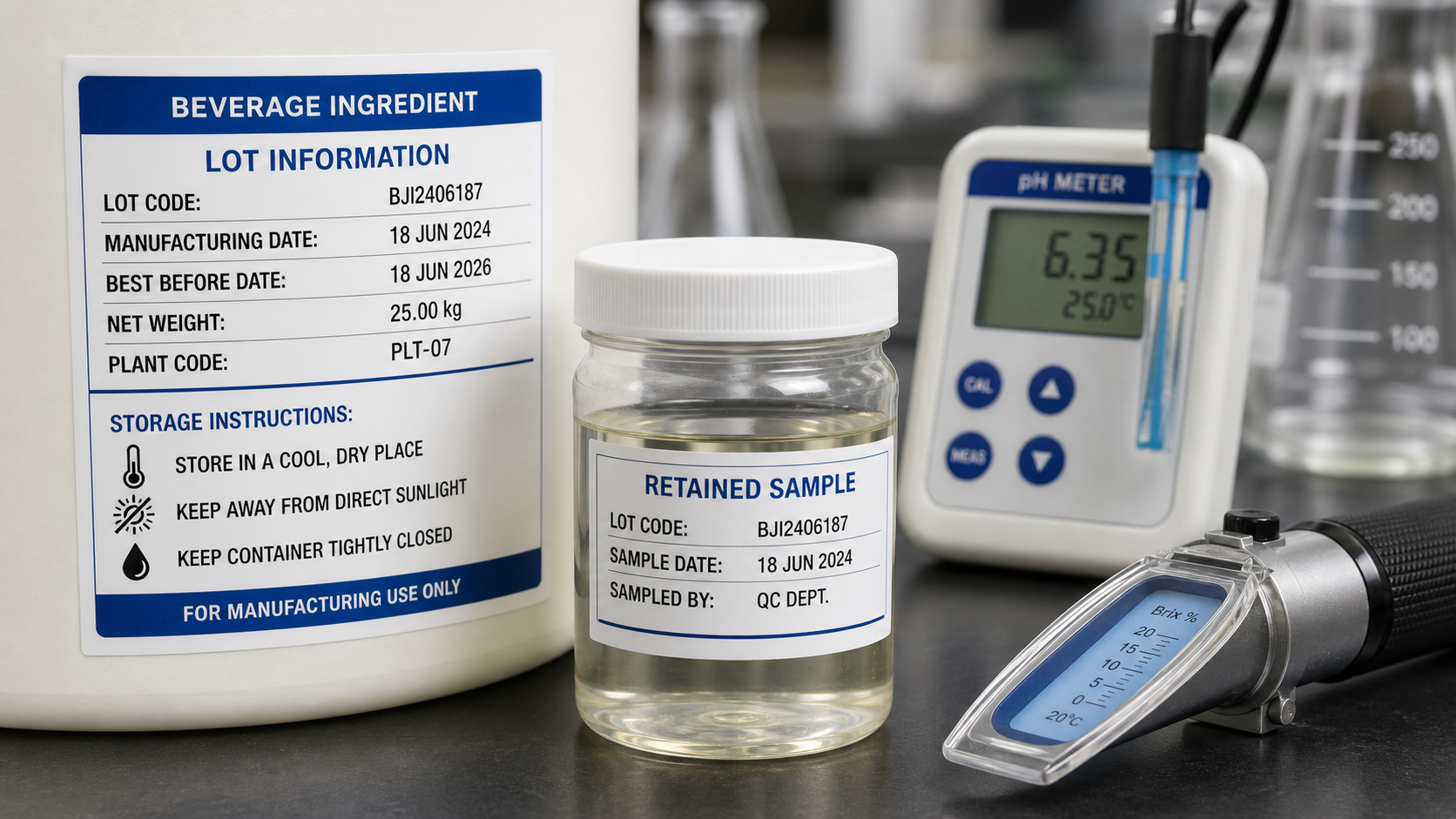
Incoming QC should verify identity, documentation, visible condition, and critical parameters against the spec before releasing the lot to production. Define who samples, how much, and the decision rules.
| Incoming check | What to verify | Record or file |
|---|---|---|
| Paperwork | CoA matches spec fields; lot codes & dates consistent; declarations current | CoA copy, declarations, receiving log |
| Packaging condition | Correct pack type; tamper-evidence intact; no leaks, tears, pest/insect damage | Inspection checklist; photos if damaged |
| Label & coding | Material name, lot code, net content, storage instructions visible and legible | Label verification record |
| Sampling | Representative sample per SOP; tools sanitized; retained sample sealed and labeled | Sample ID, retain log, chain of custody |
| Quick tests | Identity check and critical parameters (e.g., Brix, pH) if applicable | Incoming QC test sheet |
| Disposition | Release, conditional release, hold, or reject per acceptance criteria | Approval status in ERP/QMS |
- Sampling plan: Define sample size, number of containers to open, and aseptic technique to avoid contamination.
- Retains: Keep a sealed retain per lot with date, lot code, and storage noted for trace-back.
- Trending: Enter key results into a control chart. Early drift often predicts out-of-spec events.
- Escalation: If any critical-to-quality parameter fails, place the lot on hold and initiate supplier communication.
Common mistakes to avoid
- Vague terms: Words like “good color” or “clean flavor” are subjective. Add objective ranges, references, or examples.
- Unlisted test methods: CoAs become hard to compare when methods change without notice. Fix the reference on the spec.
- Missing packaging detail: Many quality issues start with incorrect liners, closures, or pallet patterns.
- Ignoring storage reality: Write conditions your warehouse can actually maintain.
- No change control: Even small adjustments (e.g., new carrier) can affect stability or allergen status.
- Spec sprawl: Keep one master spec per ingredient and version it. Don’t scatter updates across emails.
Keeping specs aligned across markets
If you sell in multiple countries, keep a core spec then add market-specific annexes for contaminants, allergens, and declarations. This limits rework while staying compliant locally.
- Label & document alignment: Finished product labeling rules interact with ingredient declarations. For U.S. labelling process topics, see the U.S. food label checklist for imported beverages.
- Market research: Plan extra lead time for documents and any additional tests required in markets such as the South Korea market.
- Supplier readiness: Confirm your supplier can support added testing or documentation without delaying shipments.
Turning specs into manufacturable products
During development, align your ingredient specifications with process capability and product requirements. Standardized specs simplify trials, scale-up, and change control in commercial runs.
- Build your brief and select ingredients with spec feasibility in mind during the ODM beverage manufacturing workflow.
- Ensure your ERP/QMS mirrors spec fields so CoA checks and trending are seamless.
- Train receiving and production teams on what each acceptance criterion means for release decisions.

FAQ
Is a supplier spec the same as a CoA?
No. The ingredient specification is the pre-agreed standard; the CoA reports test results for one lot measured against that standard. Your CoA fields should mirror the spec fields and methods.
Who owns the specification and how often should it be reviewed?
QA typically owns the spec with input from R&D and procurement. Review on a set cadence (e.g., annually) or whenever there’s a material change, a nonconformance trend, or a market expansion.
What happens when a CoA is out of spec?
Place the lot on hold, verify results with your method, and follow your deviation process. You may reject, request rework, or approve with documented concession if risk is acceptable.
How detailed should sensory descriptions be?
Use practical, objective descriptors and, where possible, link to references (e.g., colorimetric values, reference standards). Avoid purely subjective language that’s hard to enforce.
Do specs need different versions for different plants?
Prefer one master spec. If a plant needs unique limits or packaging, use controlled annexes rather than separate uncontrolled documents.
Conclusion
A robust ingredient specification sheet translates expectations into measurable, auditable requirements — reducing risk at receiving, protecting product quality, and accelerating release. Use the template above to define identity, acceptance criteria, microbiology, contaminants, packaging, storage, labeling, documentation, and change control. Keep the spec synchronized with your CoA and QMS, review it on a fixed cadence, and train teams on incoming QC so every lot is judged the same way.