


 Français
 Español
 العربية
 한국어
한국어Bulk tomato juice is bought by importers and distributors as cartons of finished cans or bottles, or as a liquid ingredient in larger packs. The price depends on the raw material, the production route, the pack, the fill volume, the quantity and the delivery terms, which is why a single “tomato juice price” is rarely meaningful. This guide explains the factors that build the price, the formats available, and the steps importers follow from enquiry to first shipment.
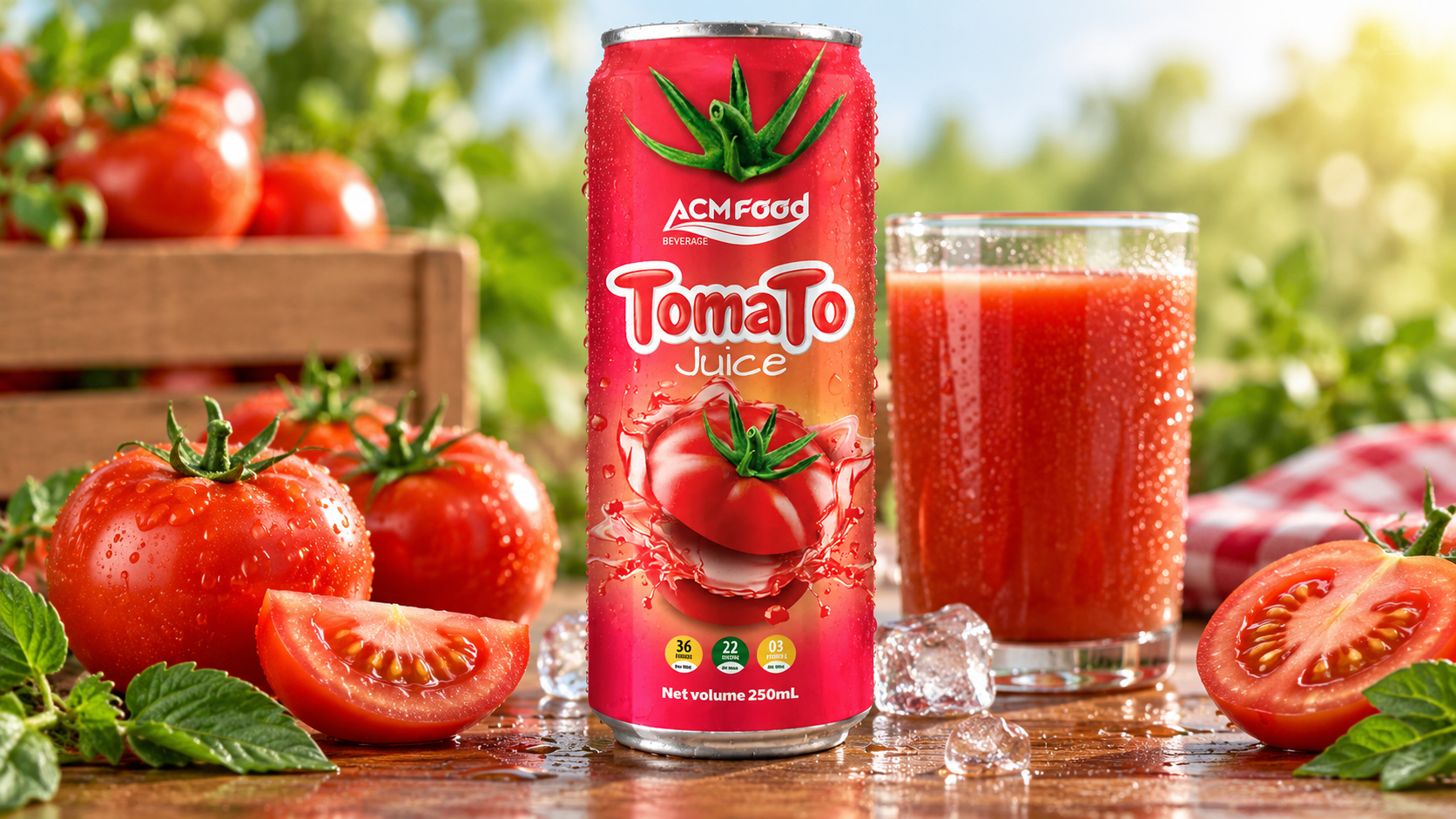
ACMFOOD supplies a 250ml aluminium slim can tomato juice from Vietnam, with a 24-month shelf life and a standard minimum of 500 cartons per SKU. This page does not publish prices and does not state a minimum other than the published one, because quotations depend on your specification.
Key takeaways
- Price is built from tomato raw material, production route (NFC or reconstituted), pack, fill volume, quantity and delivery terms; no prices are published here.
- ACMFOOD supplies a 250ml aluminium slim can tomato juice with a 24-month shelf life.
- The standard minimum is 500 cartons per SKU with a 15 to 30 day lead time.
- Fix the route, format and decoration before requesting a quote.
What factors set the price of bulk tomato juice?
Five groups of factors build the price: the tomato raw material, whether the juice is not from concentrate or reconstituted, the pack, the fill volume and the delivery terms. A supplier who quotes without asking about these is guessing.
- Tomato raw material. Variety, ripeness, seasonal supply and sourcing arrangements affect the cost of the fruit that becomes juice.
- Production route. Juice pressed and packed as not from concentrate (NFC) has different cost drivers from juice reconstituted from paste or concentrate.
- Packaging. Aluminium can, PET bottle or glass, plus the decoration method, such as a printed can, shrink sleeve or applied label.
- Fill volume. Smaller cans use more packaging per litre; larger formats shift the balance between pack cost and freight.
- Quantity and delivery terms. Order size, Incoterm, freight, insurance and import duties.
The guide to private label fruit juice cost shows how the same logic applies to other juices.
NFC or reconstituted: how does the choice change cost and positioning?
NFC tomato juice is pressed, treated and packed without first being concentrated, while reconstituted juice is made by diluting concentrate or paste back to drinking strength. The choice affects flavour, freight, labelling wording and cost, and it should be fixed before you request a quote.
| Factor | NFC | Reconstituted from concentrate or paste |
|---|---|---|
| Process | Pressed and packed without a concentration step | Concentrate or paste is diluted to a target Brix |
| Label wording | May be described as not from concentrate where rules allow | Usually requires a from-concentrate or reconstituted statement |
| Freight of raw material | Carries water | Carries less water before dilution |
| Flavour | Closer to the fresh product | Depends on the concentration method |
| Best for | Premium positioning | Cost-sensitive lines and large volumes |
If you need a deeper comparison, the article on NFC versus from-concentrate juice explains how the two are defined. Which route a given ACMFOOD product follows should be confirmed on its specification sheet.
Which tomato juice formats can an importer choose?
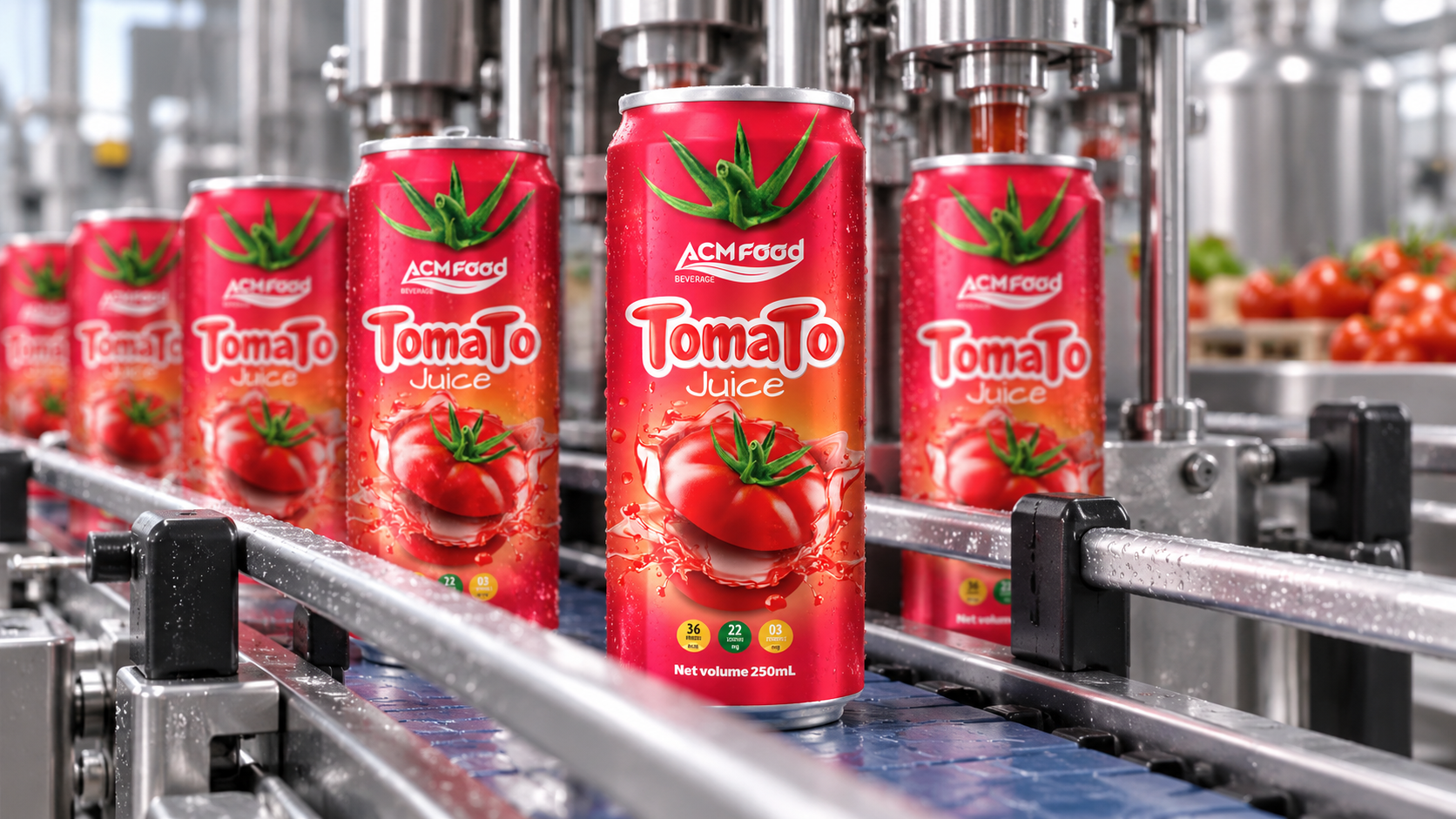
ACMFOOD fills aluminium cans in standard, slim and sleek profiles, PET bottles and glass bottles, with fill volumes from 200ml to 1.5L. The tomato juice currently listed is a 250ml aluminium slim can, so other formats must be confirmed per project.
The slim can has practical advantages for tomato juice. Aluminium gives a strong barrier against light and oxygen, which helps protect colour and taste across long distribution times. A tall, narrow can also loads efficiently. The packaging options page explains each format, and the guide on choosing beverage packaging for export compares cans, PET and glass for shipping.
What does the published tomato juice specification include?
The table lists the data currently published for the 250ml slim can tomato juice. Items not shown, such as Brix, pH, sodium and carton configuration, should be requested on the specification sheet before ordering.
| Item | 250ml slim can tomato juice |
|---|---|
| Packaging | Aluminium can, slim |
| Volume | 250ml |
| Flavour | Original |
| Shelf life | 24 months |
| Certifications | HACCP, ISO 22000, FSSC 22000 |
| Place of origin | Vietnam |
| Port of loading | Ho Chi Minh City Port |
| Payment terms | T/T |
| Lead time | 15 to 30 days |
You can browse the full range in the tomato juice category, which lists the current products and their formats.
How does the quotation process work?
A quotation starts with five inputs: the beverage category, the packaging format, the fill volume, the target quantity and the destination market. From these, a supplier can propose matching products, indicative pricing at more than one quantity tier and the exact minimum for your project.
Include any reference product you want to match, your target shelf price and whether you already have artwork or a formula. These shorten the process. ACMFOOD’s request a quote page lists what to send and what you receive in return, including realistic lead time that separates development from the 15 to 30 day production window.
How do samples and approval work?
Request a sample of the exact product, then check taste, colour, texture, can condition and label fit. Approval should be written, and the approved sample becomes the reference for the first production batch.
For tomato juice, pay attention to colour and separation. Tomato juice can show settling, so agree on what is acceptable in appearance and whether shaking before use is stated on the label. Batches should ship with a certificate of analysis against the agreed specification, and our article on how to read a beverage certificate of analysis shows what to check.
What should you plan for in minimum order and lead time?
The standard minimum is 500 cartons per SKU, and production lead time is 15 to 30 days after order confirmation. The minimum applies per SKU, so two tomato juice formats require two minimums.
Printing method, packaging format, ingredients, number of SKUs and destination market all influence the final minimum. Directly printed cans carry a higher minimum than shrink sleeves or applied labels. Details are on the minimum order quantity page. The enquiry stage is the right moment to ask, because a firm figure can only be given once the format and decoration are fixed.
What are the delivery terms and shipping documents?
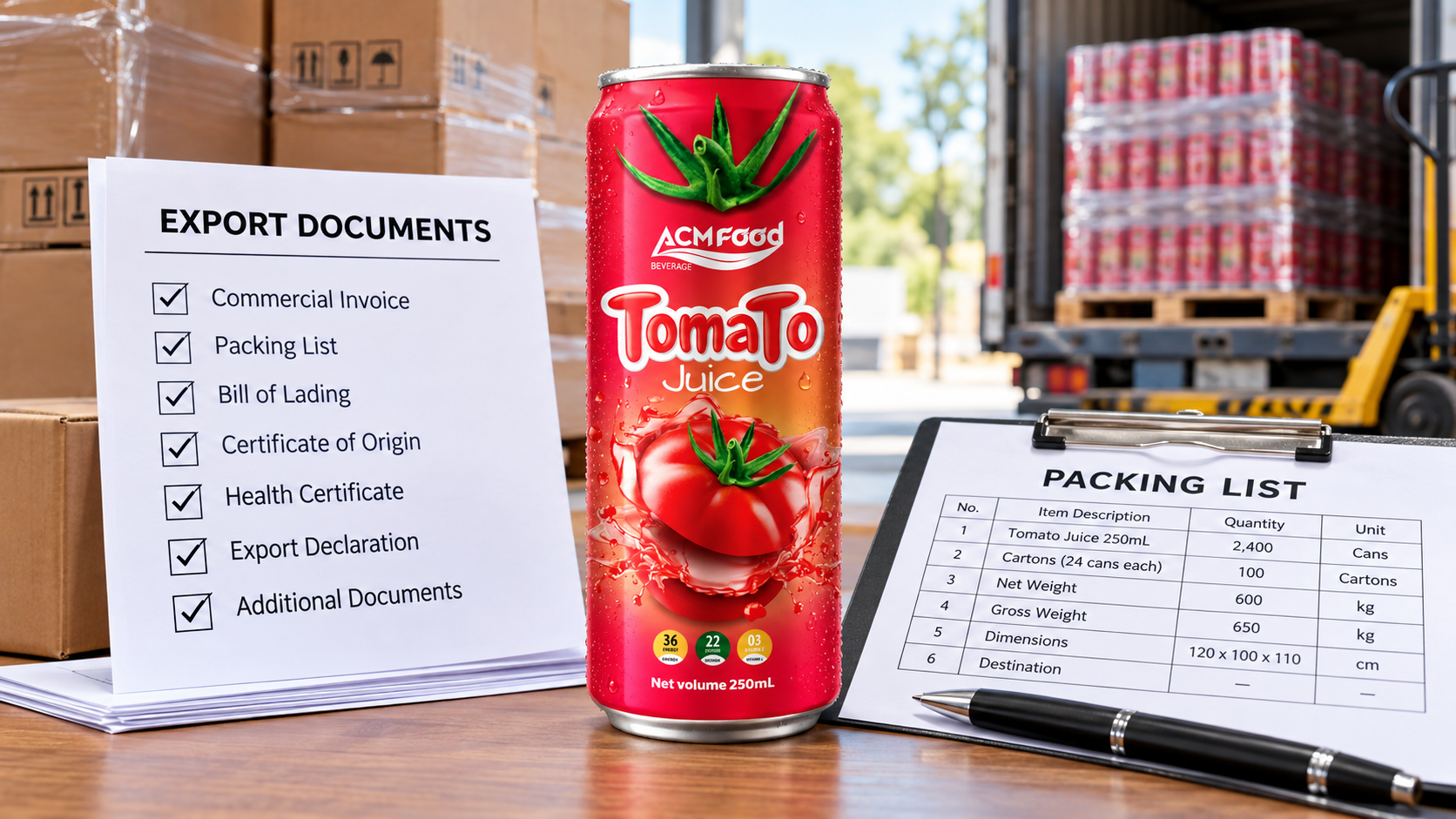
All ACMFOOD shipments depart from Ho Chi Minh City Port under T/T payment terms. Export documents are prepared in-house and typically include a commercial invoice, packing list, bill of lading, certificate of origin and certificate of analysis, with health and free sale certificates where required.
The Incoterm you choose changes who pays for freight, insurance and import clearance, so the delivered cost can differ even when the ex-works price is identical. The guide on FOB or CIF for a beverage import explains the trade-offs, and the overview of how to import beverages from Vietnam covers documents and logistics from supplier selection to clearance.
Which food safety and market checks should importers make?
Importers should check the manufacturing site’s food safety certification, the product’s classification in the destination market and the labelling rules. ACMFOOD’s beverages are produced at facilities holding HACCP, ISO 22000 and FSSC 22000, with certificates, specification sheets and test reports available on request.
Labelling matters for tomato juice because salt content, added ingredients and from-concentrate wording differ across markets. Do not use nutrition or health wording from another country. Wording depends on the final formula, tested content, serving size and local rules.
How can importers keep cost under control?
Four decisions have the largest effect on landed cost: format, quantity, decoration and delivery terms. Reducing the number of SKUs, using an existing formula and choosing sleeve or label decoration instead of direct can printing can all lower the minimum and the unit cost.
- Start with one or two SKUs. Each SKU carries its own minimum, so a narrow range reduces the first investment.
- Use an existing product. A proven formula avoids development time and sampling rounds.
- Choose decoration carefully. Direct printing needs a larger run than sleeves or labels.
- Load containers efficiently. Mixed-SKU loading can be the most efficient route for a first order.
- Compare quotes on equal terms. Same spec, same pack, same Incoterm.
Our article on comparing fruit juice supplier quotations offers a method for comparing offers fairly, and it applies to vegetable juice as well.
How do you build a landed cost model for tomato juice?
A landed cost model adds every cost between the factory and your warehouse, so you can compare offers on the price you will actually pay per carton. The factory price is only one line of the model.
| Cost line | What it covers | Who normally controls it |
|---|---|---|
| Product price | Cartons at the agreed specification | Supplier |
| Decoration and artwork | Printing, sleeves or labels and any set-up | Supplier and buyer |
| Origin charges | Export clearance, port handling and documents | Depends on Incoterm |
| Sea freight and insurance | Container transport to the destination port | Depends on Incoterm |
| Import duty and taxes | Duty, VAT or sales tax, and any excise | Buyer, unless DDP |
| Destination charges | Port fees, customs broker and inland delivery | Buyer, unless DDP |
| Finance and stock cost | Payment timing, warehousing and shelf life consumed | Buyer |
Fill the table with real quotations rather than estimates, and rebuild it whenever you change the format, the Incoterm or the destination.
What should an RFQ for bulk tomato juice include?
A request for quotation should give every supplier the same information so the answers can be compared. Vague requests produce vague quotations.
- Product definition. NFC or reconstituted, flavour variant and whether salt or other ingredients are added.
- Pack and volume. Can, bottle or glass, fill volume and decoration method.
- Quantity. Cartons per SKU, number of SKUs and whether you will repeat the order.
- Destination. Country, port and preferred Incoterm.
- Documents. Certificates, test reports and specification sheet you require.
- Timeline. Target delivery window and any shelf-life requirement on arrival.
How do seasonality and sourcing risk affect tomato juice supply?
Tomatoes are an agricultural raw material, so harvest timing, weather and regional supply can change availability and cost. For buyers, this matters most for NFC production, where fruit is pressed close to harvest, and less for lines built on stored paste.
Ask a supplier how raw material is secured through the year, how it is traced and what happens when supply tightens. A written answer about sourcing arrangements and traceability tells you more than a general statement about quality. ACMFOOD’s tomato juice carries a 24-month shelf life in the published specification, but planning your own stock around harvest cycles and reorder points is still sensible.
How should you read a tomato juice quotation?
Read a quotation as a bundle of assumptions. The unit price only makes sense together with the specification, pack, quantity tier, Incoterm and validity period. Two quotes that look a few percent apart may differ more in what they include than in what they charge.
Check what the quote states about the minimum order, the lead time, the payment structure and the documents included. Note how long it stays valid, because raw material and freight conditions change. If an item is missing, ask for it in writing before you compare. A supplier who answers quickly and precisely at this stage is usually easier to work with once production starts.
What are the steps from enquiry to first shipment?
- Define the product. Choose NFC or reconstituted, then the format, fill volume and decoration.
- Send the enquiry. Include category, packaging format, fill volume, target quantity and destination market.
- Review the quotation and specification sheet. Check the minimum, price basis and Incoterm.
- Approve a sample. Record approval in writing and keep the sample as the reference.
- Confirm the order. Agree T/T payment terms; production takes 15 to 30 days after confirmation.
- Ship and document. Goods depart from Ho Chi Minh City Port with the export documents and a certificate of analysis.
FAQ about bulk tomato juice
Does this page publish a tomato juice price?
No. Quotations depend on your specification, so the price is built from the factors listed above.
Is the minimum order per SKU?
Yes. The standard minimum is 500 cartons per SKU, so two tomato juice formats require two minimums.
What tomato juice format is listed today?
A 250ml aluminium slim can with original flavour and a 24-month shelf life. Other formats must be confirmed per project.
Summary and next step
Bulk tomato juice pricing is the sum of raw material, production route, pack, fill volume, quantity and delivery terms. Decide whether you want NFC or reconstituted juice, choose a format and decoration, and request a specification sheet and sample before committing to a quantity.
To start a sourcing request, send your beverage category, packaging format, fill volume, target quantity and destination through the request a quote page, and ACMFOOD will confirm product options and the minimum for your project.
Sources
- Codex Alimentarius, General Standard for Fruit Juices and Nectars (CXS 247-2005) — definitions of juice, concentrate and nectar, and minimum Brix values.
- US FDA, Acidified and Low-Acid Canned Foods guidance and regulatory information — the pH 4.6 boundary between acid and low-acid foods.
- European Commission, EU register of nutrition and health claims — authorised claims and their conditions of use.
External standards and regulations are cited for orientation. Always check the current text that applies in your destination market.