Français
 Español
 العربية
 한국어
한국어An organic carrot juice supplier is a producer that can show certified organic carrots, a certified processing site and a documented chain from field to sealed pack. For an importer or private label brand, the supplier matters more than the recipe, because the organic claim stands or falls on paperwork and segregation.
This guide explains how to evaluate such a supplier for carrot juice in cans and bottles. It covers the sourcing of organic carrots, certificate scope, batch control, labelling and the questions a buyer should ask before a project. ACMFOOD, a Vietnam beverage manufacturer, publishes HACCP, ISO 22000 and FSSC 22000 certificates, but organic status is not among them, so organic lots must be confirmed individually with the factory.
What should an organic carrot juice supplier be able to show?
A credible supplier can show a valid organic certificate that covers the production site and the product category, grower certificates for the carrots, batch records and a food safety system. If any of these is missing, the organic claim cannot be supported in export markets.
A short evaluation checklist:
- Organic certificate of the factory. The scope must include fruit and vegetable juice or the equivalent category, and the certificate must be valid on the date of production.
- Grower certificates. Each carrot supplier holds its own certificate, and each delivery is linked to it.
- Segregation system. Separate storage, labelled containers and cleaning records for organic runs.
- Traceability. A way to follow a finished can or bottle back to the carrot lot and the production date.
- Food safety management. HACCP and a recognised standard such as ISO 22000 or FSSC 22000 prove that hazards are controlled.
- Analytical capability. In-house or contracted laboratory testing for Brix, pH, microbiology and residues.
Food safety certificates and organic certificates answer different questions. The first set shows that hazards are managed. The second shows that the product was grown and processed under an organic standard. Buyers should ask for both and read the scope of each.
How are organic carrots sourced for juice?
Organic carrots are sourced from certified farms, graded for juice rather than for fresh sale, and delivered with lot documents. The raw material for juice is often the grade that is too small or irregular for the fresh market but still sound in flavour and sugar.
Points that matter specifically for carrots:
- Variety and sweetness. Sweeter varieties with good colour give a juice that needs less blending. Soil and season change sugar level and flavour.
- Soil and water quality. Carrots are root crops, so they carry soil contact. Soil history and irrigation water are part of the risk assessment for residues and contaminants.
- Harvest and storage. Carrots store well in cool, humid conditions, which spreads supply across the year more than for many other vegetables. Poor storage causes bitterness and sprouting.
- Washing and sorting. Soil is removed, damaged roots are discarded and the washed carrots are inspected before pressing.
- Residue and contaminant testing. Organic does not mean zero residues, and testing confirms the lot is within the limits of the destination market.
Because carrots store comparatively well, a supplier may offer several production campaigns through the year, but each batch of juice must still be tied to a certified carrot lot.
How does the factory keep organic and conventional carrot juice apart?
The factory keeps them apart by scheduling, cleaning, storage control and documents. A line that makes both types follows a cleaning procedure between runs, and organic production is recorded in separate batch sheets with its own raw material lots.
| Control point | What the factory does | What the buyer can ask to see |
|---|---|---|
| Receiving | Checks certificate and lot of carrots at the gate | Receiving record with lot and certificate number |
| Storage | Marks and separates organic carrots and packaging | Storage map or photos of marked areas |
| Processing | Cleans the line before an organic run and verifies the cleaning | Cleaning log and verification result |
| Ingredients | Uses only permitted acidulants and aids | Approved ingredient list for the recipe |
| Filling and packing | Uses certified or approved cans, bottles, inks and labels | Packaging specification sheets |
| Release | Matches output to input through a mass balance | Batch record and balance calculation |
What recipe and process choices apply to organic carrot juice?
Recipe and process choices follow the same technical logic as conventional carrot juice, with a narrower list of permitted aids. Carrot is a low-acid vegetable, so ambient shelf-stable cans or bottles need either acidification or a sterilisation step, and the acidulant must be permitted for organic products in the target market.
- Pure carrot juice. The simplest recipe, naturally sweet, with a thick body and a warm orange colour from carotenoids.
- Blends. Carrot with apple or orange juice, which lowers pH and adds brightness. Each blending juice must also qualify as organic.
- Enzymes and processing aids. Some are used to improve yield. Each must be checked against the organic scheme.
- Heat treatment. Retort sterilisation for cans or aseptic filling for bottles for unacidified juice, or acidified hot-fill for acid recipes.
- Cloud and sediment. Carrot juice is naturally cloudy and can separate over time, so shaking instructions or homogenisation are considered.
Carotenoid colour is relatively stable to pH, but long heat and light exposure still reduce it. A can protects colour better than a clear bottle, though bottles are valued for visibility. A detailed look at carrot formulation and packaging is available in the carrot juice OEM guide.
How is organic carrot juice labelled?
Labelling follows the organic regulation of the importing country. It normally requires the organic term, the certification body code or logo, the origin of the ingredients and, in some markets, the percentage of organic content. Using the wrong wording can lead to rejection at customs.
The brand owner is responsible for correct label use, while the supplier provides the facts: certificate numbers, certification body, ingredient origin and batch information. Information on organic juice types for readers can be found in this article about organic juice types, which may help when planning consumer-facing copy without making claims the product cannot support.
Which specification points should be set for organic carrot juice?
The specification should cover composition, analytical limits, sensory targets and packaging. It becomes the reference for each shipment, so buyers should write it before sampling and attach it to the purchase order.
- Juice content and ingredients. Percentage of carrot juice, blending juices, acidulants and any permitted aids.
- Brix and pH. Target values with tolerances to cover seasonal variation.
- Colour and appearance. Orange shade, cloud and sediment limits.
- Microbiology. Limits matched to the heat treatment and pack.
- Contaminants and residues. Limits at or below the destination market’s legal levels.
- Pack and shelf life. Can or bottle format, closure, shelf life and storage conditions.
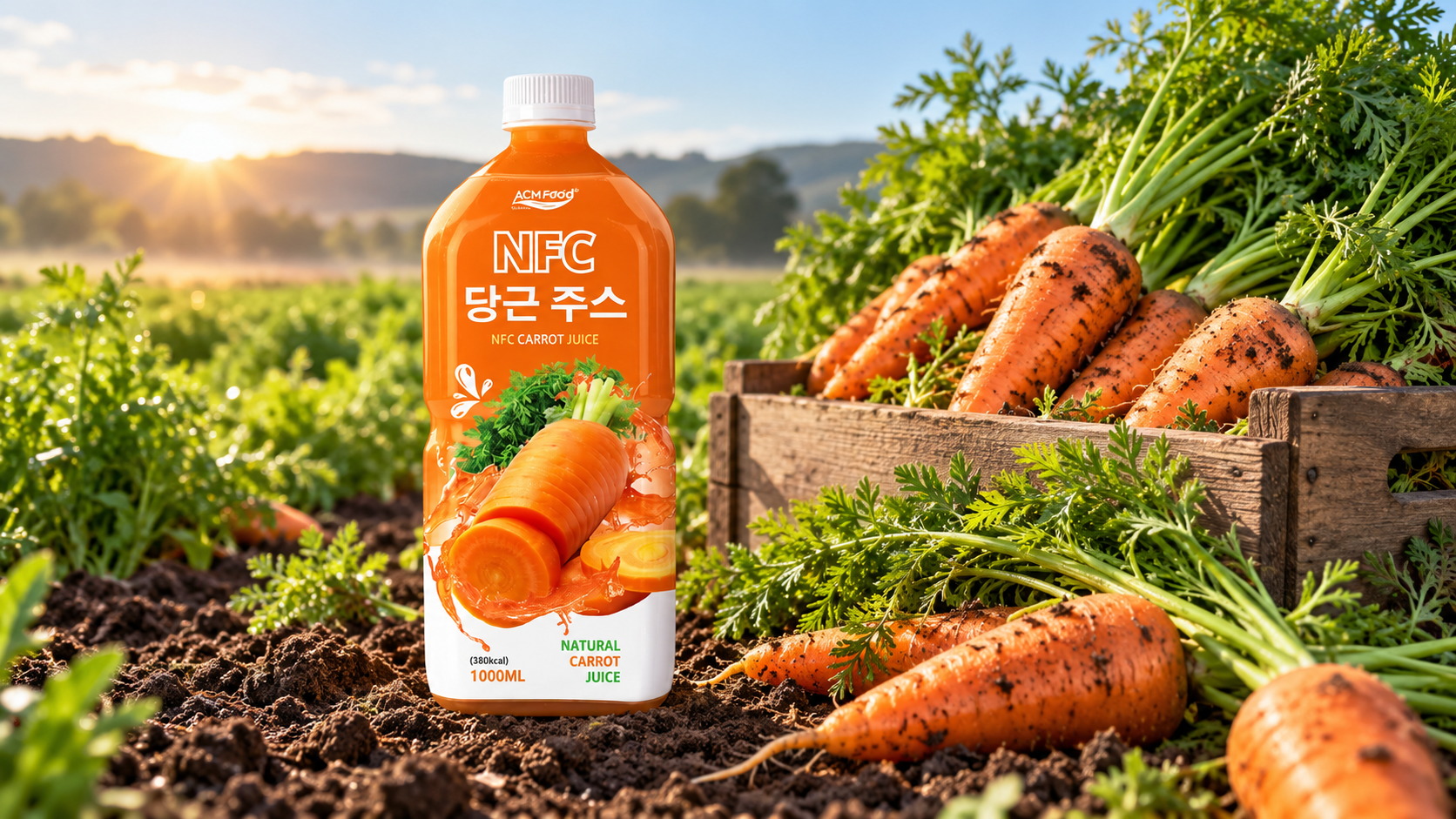
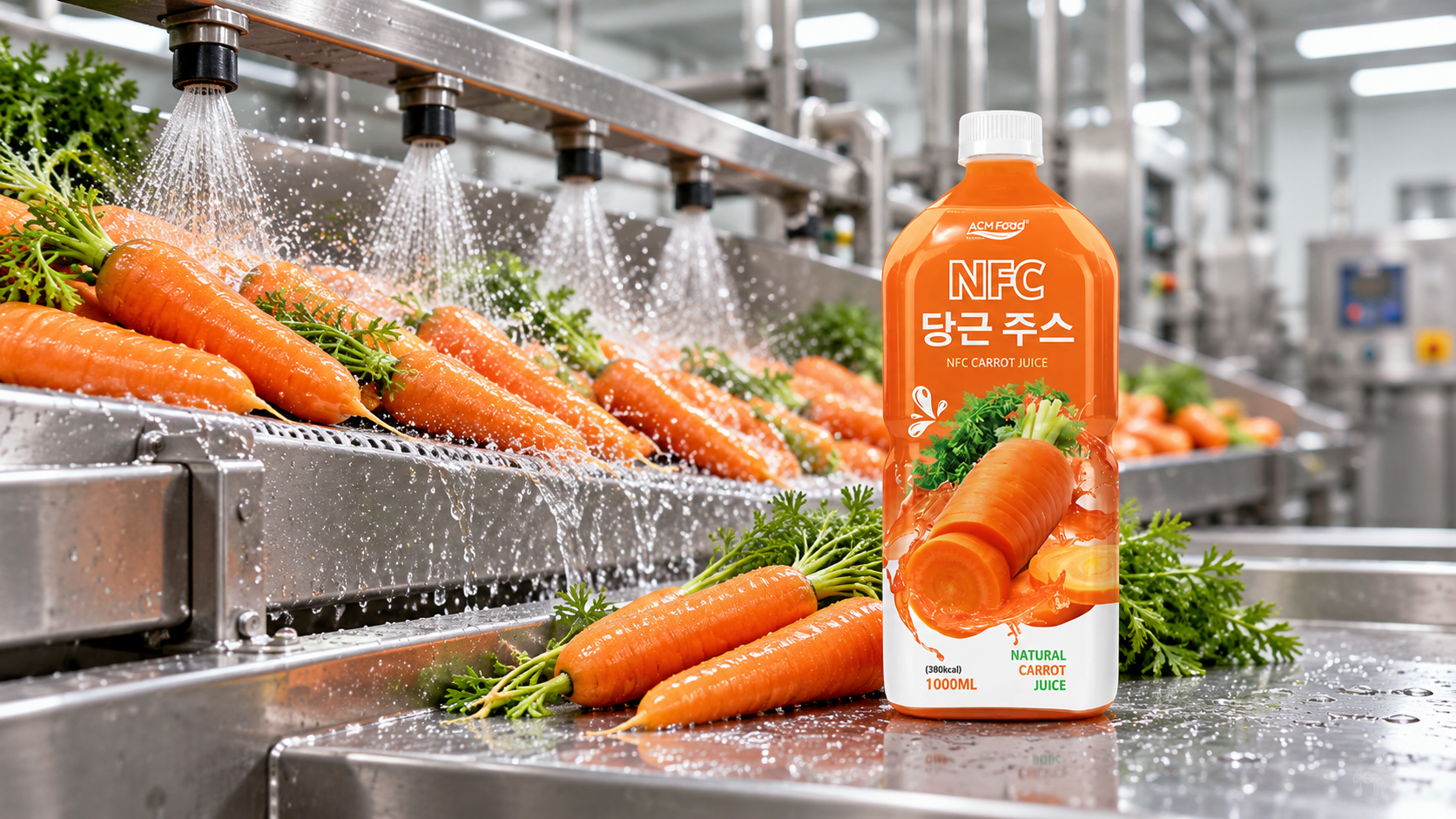
For reference on non-organic formats, ACMFOOD’s carrot range is shown in the carrot juice category, where the current pack format is a 250 ml slim aluminium can with a published shelf life stated on the category page.
How should a buyer audit an organic carrot juice supplier?
A buyer should audit the documents first, the site second and a sample shipment third. The document review removes unsuitable suppliers early, the site visit or a remote audit verifies the controls on the ground, and a small first order proves the whole chain under real conditions.
- Document review. Collect the factory and grower certificates, the food safety certificates, a sample batch record, a sample specification and the cleaning procedure for organic runs.
- Site or remote audit. Walk through receiving, storage, the line, filling and warehouse. Ask to see how organic material is marked and where cleaning records are kept.
- Traceability test. Pick a finished carton and ask the supplier to trace it back to the carrot lot and the grower within a short time. A fast, complete answer is a good sign.
- Sample shipment. Run a small order with full documentation, and check that the paperwork is accepted at the border.
- Periodic review. Repeat the review each year and whenever the supplier changes carrot sources or certification bodies.
Third-party audit reports and certification body findings add value, but they do not replace the buyer’s own check on the specific product category and lot that will be purchased.
What does a typical project timeline look like?
A project usually follows the carrot calendar and the certification calendar as much as the factory calendar. Planning backwards from the launch date helps avoid a situation where the carrots, the paperwork or the cans are not ready on time.
- Brief and feasibility. The buyer shares the specification, and the factory confirms whether organic carrots and a certified production slot are available.
- Sampling. Bench samples and a pilot run are prepared for taste, colour and stability review.
- Documents and label. Certificates, specifications and label drafts are checked against the destination market.
- Production slot. The factory schedules a cleaned line and secures certified carrots and packaging.
- Release and shipment. Batch testing, certificate issue and loading follow, with the shipping documents prepared in advance.
Each step can run in parallel to some extent, but the label and the certificates should be agreed before cans or bottles are printed. Changing artwork after printing is one of the most expensive mistakes in any private label project.
How do organic and conventional carrot juice compare for a buyer?
The two products are produced with similar equipment and similar quality tests, but they differ in raw material availability, documentation and the permitted ingredient list. The buyer pays for the added control through a longer lead time, stricter paperwork and less flexibility in recipe changes.
Organic projects benefit from early planning and a stable specification. Conventional carrot juice, by contrast, is easier to adjust and easier to scale across seasons. Many brands start with a conventional range and add an organic variant once distribution and demand are proven, because it limits the risk of holding specialised packaging and certified stock that sells slowly.
How does ACMFOOD approach organic requests?
ACMFOOD produces finished carrot drinks in cans and bottles under OEM, ODM and private label arrangements. Organic production is not part of its published certificates, so the company treats organic carrot juice as a request to be assessed for each lot, and it does not offer concentrate or bulk juice.
A buyer who needs organic carrot juice should ask whether a certified lot of carrots and a certified production slot can be arranged, request the supporting certificates in advance and confirm which acidulants and packaging components the scheme allows. This sequence avoids delays near shipment.
FAQ about organic carrot juice
Does organic carrot juice taste sweeter?
Not necessarily. Sweetness depends on variety, soil, harvest time and the recipe. Organic status alone does not guarantee a different taste.
Can organic carrot juice be sold in cans?
Yes. Cans are widely used for carrot juice, provided the lining, inks and closures meet food-contact and organic requirements and the heat treatment suits a low-acid vegetable.
Is organic carrot juice free of pesticide residues?
Not always. Organic farming restricts synthetic pesticides, but traces can reach crops through drift or soil. Testing against market limits is still part of quality control.
What happens if the organic certificate expires?
Production after the expiry date cannot be sold as organic. Buyers should check validity dates when approving a supplier and before every campaign.
Do HACCP or FSSC 22000 certificates prove organic status?
No. They show that a food safety system is in place. Organic status requires a separate organic certificate that covers the product and the site.
Selecting an organic carrot juice supplier
A good supplier of organic carrot juice shows certified carrots, a certified site, strict segregation and traceable batches. Buyers should read certificate scopes carefully, ask for sample documents, confirm permitted ingredients and agree the specification before the first order.
Brands that want to discuss a carrot juice project in cans or bottles can contact ACMFOOD with their market, pack and documentation requirements. The team can confirm what is possible for organic lots and share a sample plan.