


 Français
 Español
 العربية
 한국어
한국어Apple juice is the most widely traded fruit juice in the world, and that scale is exactly what makes it a practical category for a new brand. Raw material supply is deep and year-round, consumer acceptance needs no explanation, and the technical questions are well understood. What separates a good apple juice product from an ordinary one comes down to a handful of decisions made before production starts.
This guide covers what apple juice OEM involves, the choices that shape the finished product, and how to assess a manufacturing partner for an apple juice project.
What is apple juice OEM?
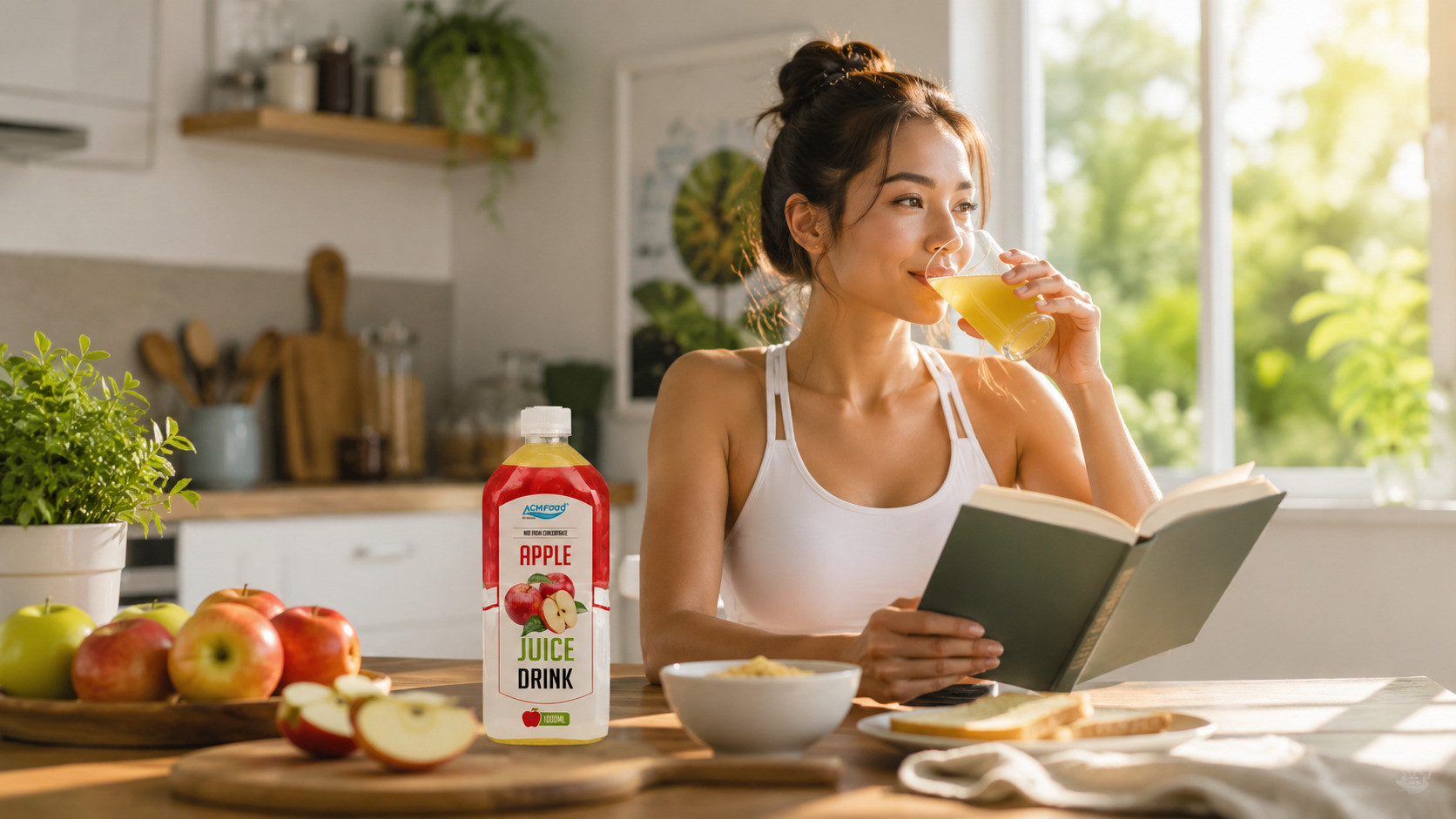
OEM means a manufacturer produces apple juice to your specification and delivers it packaged under your brand. You bring the positioning, the target price and the market; the factory handles formulation, raw material sourcing, production, quality control and packaging, and ships finished goods ready to sell.
For a brand owner, importer or distributor, this removes the need to build or operate a facility. It also means the technical decisions below are made jointly with the manufacturer rather than in isolation, which is where most of the value of a good partner lies. See OEM beverage manufacturing for how the process works end to end.
Why apple juice remains a strong category
- Universal familiarity. Apple needs no consumer education in any market, which lowers the cost of launching.
- Deep raw material supply. Apple concentrate is one of the most traded juice commodities globally, so supply is available year-round and priced transparently.
- Broad demographic reach. The flavour sells across age groups, which is why it dominates the children’s and family segments as well as standard single-serve.
- A reliable blending base. Apple adds sweetness and body without a competing flavour, so it appears as the carrier in a large share of multi-fruit blends.
- Format flexibility. It works in carton, PET, glass and can without reformulation.
Clear or cloudy: the first product decision
Apple juice is sold in two visually distinct forms, and the choice sets the positioning more than any other single decision.
Clear apple juice is clarified and filtered to remove suspended solids. It is bright, visually stable, and shows no sediment over shelf life. It is the standard for mainstream and children’s products.
Cloudy apple juice retains fine fruit particles. It reads as less processed and more premium, and carries more of the fruit’s character, but it will settle over time — which means the label needs to set that expectation with a shake-before-opening instruction, or the sediment reads as a fault.
NFC or from concentrate?
| Not from concentrate (NFC) | From concentrate | |
|---|---|---|
| Process | Pressed, treated and packed without removing water | Water removed at origin, added back at the plant |
| Flavour | Closer to fresh fruit | Thinner aroma unless restored |
| Cost | Higher raw material and freight cost | Substantially lower to ship and store |
| Availability | Tied more closely to the harvest | Year-round |
| Label | Can state not from concentrate | Must declare made from concentrate |
Most commercial apple juice worldwide is made from concentrate, because the economics are compelling and the flavour gap is smaller for apple than for delicate fruits. NFC is chosen when the brand promise depends on it and the retail price supports it.
Browning: the technical issue specific to apple
Cut apple flesh turns brown quickly, and the same reaction can affect juice. It is driven by enzymes acting on the fruit’s natural compounds in the presence of oxygen, and it is controlled during processing rather than corrected afterwards — by deactivating the enzymes with heat, by limiting oxygen contact, and by managing pH.
For a brand this matters mainly as a question to ask. A manufacturer that handles apple regularly will have this designed into the process; one that does not may deliver a product that darkens noticeably over shelf life. Ask to see how colour holds at the end of a stability trial, not at the point of filling.
Sweetness, acidity and variety
Apple varieties differ substantially in sugar and acid, and commercial juice is normally blended from several to reach a consistent target rather than relying on a single variety. The ratio of soluble solids to acidity is what determines whether the finished juice tastes flat, balanced or sharp, and it is the parameter to specify rather than naming a variety.
This is also where a great deal of the batch-to-batch consistency comes from. Agricultural raw material varies; blending to a specification is how a manufacturer delivers the same taste twelve months apart.

Juice content and product category
Apple products are sold across all three juice categories, and the declared content determines which one applies, what the pack may be called, and what the cost structure looks like. A 100% juice, a nectar and a juice drink are three different products, and the minimum content for each is set by the destination market rather than the manufacturer.
Decide this before the recipe work starts, because it constrains everything downstream including whether sugar may be added at all. See 100% juice vs nectar vs juice drink for how the three compare.
Customisation available under an OEM programme
- Juice content and category — 100% juice, nectar or juice drink, according to the price point.
- Clear or cloudy — the main visual and positioning lever.
- Sweetness and acidity balance — tuned to the target market’s taste preference.
- Blends — apple with pear, grape, mango, carrot or berry, using apple as the base.
- Pack format and size — carton, PET, glass or can, from small single-serve to family sizes.
- Artwork and label — designed to the destination market’s mandatory requirements.
Quality assurance: what to verify in a partner
Certification is the starting point rather than the whole answer. A serious apple juice programme should give you visibility of:
- The facility’s food safety certification, and its current validity.
- Raw material specifications and supplier documentation for the juice or concentrate.
- Finished product testing, including the contaminant parameters relevant to apple.
- Traceability from raw material lot through to finished pack.
- Stability data supporting the declared shelf life in your chosen format.
Apple juice has a well-known contaminant parameter that regulators monitor and that responsible producers test for. Ask directly how it is controlled and what the testing regime is — a competent manufacturer will answer without hesitation.
Shelf life and export planning
Ambient-stable apple juice has a long shelf life, but for an importer the number that matters is how much of it remains when the goods reach the warehouse. Sea freight, customs clearance and inland handling all consume part of the window, and many retailers specify a minimum remaining shelf life on arrival.
Work that calculation before the first order rather than after, and align production dates with the sailing schedule. See shelf life on arrival for how the clause is usually written.
Choosing an apple juice OEM partner
Beyond price, three things separate partners in practice. The first is whether they have run apple specifically, since browning control and clarity are not generic skills. The second is whether they will commit to a written specification with tolerances rather than a verbal agreement. The third is whether they can support the destination market’s label requirements, which is where many first-time export projects lose time.
Frequently asked questions about apple juice OEM
Is from-concentrate apple juice lower quality than NFC?
Not inherently. It is a different product with different economics: NFC keeps more of the fresh character and costs more to source and ship, while concentrate offers year-round availability at a substantially lower cost. Both are legitimate as long as the label declares which it is.
Should I choose clear or cloudy apple juice?
Clear suits mainstream and children’s products and stays visually stable; cloudy suits premium and natural positioning but will settle over shelf life. The decision should follow the positioning and retail price rather than personal preference.
What is the minimum order quantity?
At ACMFOOD the minimum is 500 cartons per SKU. Custom pack formats or bespoke artwork can raise the practical minimum, since tooling and print plates carry their own lead times and setup costs.
Can apple juice be blended with other fruits?
Yes, and it is one of the most commonly used bases for exactly that reason. Apple contributes sweetness and body without overpowering the headline fruit, which is why it appears in a large share of multi-fruit blends.
How long does an apple juice OEM project take?
It depends on how much formulation work is required and whether packaging is standard or custom. A product built on an existing recipe in a standard pack moves considerably faster than a bespoke formulation with new artwork and a new format.
Information for beverage brands
Apple is a straightforward category to enter and a competitive one to win in, so the differentiation usually comes from format, positioning and price rather than from the fruit itself. Bring your target retail price, destination markets and preferred format to the first conversation. ACMFOOD produces apple juice and apple-based blends in carton, PET, glass and can formats under private label and OEM programmes, with a minimum of 500 cartons per SKU.
Conclusion
An apple juice OEM project turns on four decisions: the juice category, clear or cloudy, NFC or from concentrate, and the pack format. Settle those with your manufacturer before development starts, verify how browning and colour stability are controlled, and confirm the label against each destination market. The rest of the category’s maturity works in your favour.